REVIEW 4 major objections 4 minor 3 cited by
TrajAudit finds the earliest decisive failure step in long, noisy coding-agent trajectories more accurately than prior automated diagnosis methods.
Reviewed by Pith at T0; open to challenge. T0 means a machine referee read the full paper against a public rubric. the ladder, T0–T4 →
T0 review · grok-4.5
2026-07-12 15:55 UTC pith:SEHWXHFR
load-bearing objection Clear problem and a usable-looking diagnosis pipeline plus RootSE, but the body we received is unreadable so the 10.8/21.6% localization claims stay provisional. the 4 major comments →
TrajAudit: Automated Failure Diagnosis for Agentic Coding Systems
The pith
A machine-rendered reading of the paper's core claim, the machinery that carries it, and where it could break.
Core claim
The paper establishes that an investigator agent supported by semantic saliency folding of trajectory noise, diagnostic priors derived from test failure reports, and on-demand tools to re-inspect folded content can recover the earliest decisive error step in repository-level coding-agent trajectories substantially more accurately than existing trajectory-based diagnosis approaches, as measured on the new RootSE benchmark of 102 annotated real-world instances.
What carries the argument
TrajAudit: an investigator agent whose two supporting modules perform semantic saliency folding (to drop low-signal trajectory observations) and extract preliminary diagnostic guidance from test failure reports, with tools that re-expand folded content on demand so the full trajectory remains available without flooding the context.
Load-bearing premise
That folding away low-saliency trajectory content still preserves enough of the earliest decisive error for the investigator to recover the same step humans annotated as ground truth.
What would settle it
On RootSE, if TrajAudit’s exact-match localization accuracy dropped to or below the strongest baseline in both the with-reference and without-reference settings when semantic saliency folding is removed or replaced by naive truncation, the central claim that folding-plus-tools enables better diagnosis would be falsified.
If this is right
- Exact localization of the first decisive error becomes more practical for long agent trajectories on real multi-file repositories.
- Diagnosis remains useful when reference solutions or golden patches are unavailable, where the paper reports the larger accuracy gain.
- RootSE offers a shared yardstick that scores earliest-step recovery rather than only final failure symptoms.
- Agent refinement loops can target the true root step instead of late symptoms that only reflect downstream effects.
Where Pith is reading between the lines
- The same fold-then-reopen pattern may transfer to other long-horizon agent settings—web navigation, multi-tool workflows—where traces are similarly long and noisy.
- If saliency folding systematically drops rare but decisive observations, the method could still miss the true earliest error; measuring fold recall against human root steps would be a direct stress test.
- Continuous evaluation pipelines for coding agents could insert TrajAudit-style diagnosis without requiring human root-cause labels for every failed run.
Editorial analysis
A structured set of objections, weighed in public.
Referee Report
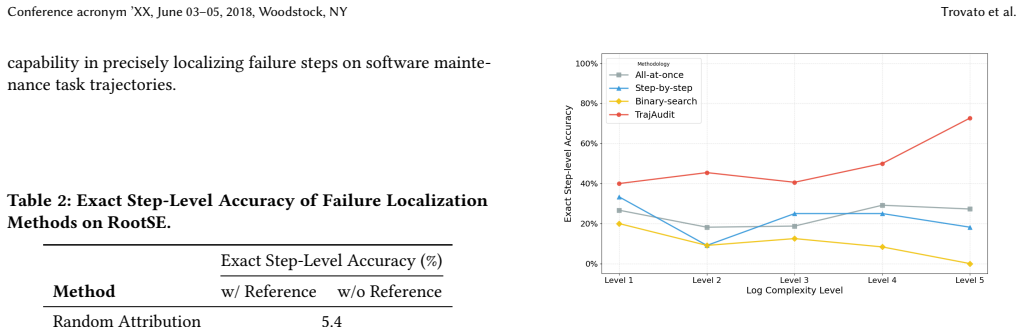
Summary. The paper proposes TrajAudit, an automated failure-diagnosis framework for long, noisy trajectories of repository-level coding agents. It combines an investigator agent with two modules: semantic saliency folding to compress failure-irrelevant context, and prior guidance derived from test-failure reports; the agent may re-expand folded content via tools. The authors introduce RootSE (102 real-world instances annotated with the earliest decisive error step and a justification) and report that TrajAudit improves exact failure-localization accuracy over the strongest baselines by 10.8% (with-reference) and 21.6% (without-reference).
Significance. If the gains hold under a stable annotation protocol and a folding procedure that preserves decisive evidence, the work would supply both a practical diagnosis pipeline for agentic coding systems and a reusable localization benchmark. The combination of saliency folding, test-report priors, and on-demand tool inspection is a concrete systems contribution aimed at a real operational pain point (long, noisy trajectories). The absolute exact-match lifts on n=102 are large enough to matter for iterative agent refinement, provided the evaluation design is shown to be non-circular and statistically reliable.
major comments (4)
- The central claim rests on exact match to RootSE “earliest decisive error” labels (abstract; evaluation). The readable material does not report inter-annotator agreement, multi-annotator protocol, or adjudication rules for that definition. Without IAA (or equivalent reliability evidence), the 10.8%/21.6% absolute gains cannot be interpreted as genuine diagnostic improvement rather than agreement with a single labeling style. This is load-bearing for every reported accuracy number.
- Semantic saliency folding is presented as noise reduction that preserves failure-relevant content, with tools recovering folded evidence on demand. No preservation/recovery analysis is given: how often the gold earliest step is folded away, how often tools re-expand it, and whether accuracy drops when re-expansion fails. If folding systematically discards or buries the decisive step, the reported lifts overstate the method’s contribution. An ablation or retention rate on RootSE is required.
- The with-reference vs. without-reference split is used for the headline deltas, but the manuscript (as readable) does not define what the reference supplies or rule out leakage of localization cues into the with-reference condition. That definition is necessary to interpret why the without-reference gap (21.6%) is much larger and whether the more modest 10.8% gap is the fairer operational setting.
- The provided full-text body is severely garbled (encoding/OCR corruption across sections), so baseline definitions, ablations, statistical tests, and annotation details cannot be verified from the manuscript itself. Until a clean, complete version is available, the experimental claims cannot be audited at the level expected for a systems paper in this venue.
minor comments (4)
- Abstract and intro should state the LLM backbone(s), decoding settings, and whether they are shared across TrajAudit and baselines, so absolute gains are not confounded by model choice.
- Clarify the formal definition of “earliest decisive error step” (decision rule, examples of borderline cases) so RootSE can be reused or re-annotated by others.
- Report confidence intervals or significance tests for the 10.8% and 21.6% absolute differences on n=102; raw point estimates alone are hard to weigh.
- The arXiv footer in the source dump appears to mis-tag the paper (astro-ph.SR); correct metadata and ensure the camera-ready PDF is free of the encoding corruption seen in the review copy.
Circularity Check
No significant circularity: empirical localization accuracy is scored against human RootSE annotations, not quantities defined by TrajAudit’s free parameters.
full rationale
TrajAudit is an empirical systems paper. Its load-bearing claim is absolute exact-match lifts (10.8% with-reference, 21.6% without-reference) on RootSE (n=102), where each instance is annotated with an earliest decisive error step and justification. That metric is an external match to human labels, not a quantity derived from, or statistically forced by, TrajAudit’s own saliency-folding parameters, test-failure priors, or investigator tool policy. Semantic saliency folding and on-demand re-expansion are method components whose success is measured against those fixed labels; they do not redefine the target. There is no self-definitional loop (X defined via Y then used to predict Y), no fitted parameter renamed as a prediction of a closely related quantity, no uniqueness theorem imported from overlapping authors to forbid alternatives, and no ansatz smuggled in via self-citation that then becomes the result. Self-citation, if any, is ordinary related-work framing and is not load-bearing for the accuracy numbers. Evaluation-validity concerns (inter-annotator agreement, whether folding ever discards the gold step) affect correctness risk, not circularity of the derivation chain. The paper is self-contained against an external benchmark; score 0 is the honest finding.
Axiom & Free-Parameter Ledger
free parameters (3)
- LLM backbone / temperature / decoding settings for investigator and folding modules
- Saliency folding thresholds / compression policy
- RootSE annotation criteria for “earliest decisive error step”
axioms (4)
- domain assumption Repository-level coding-agent trajectories are long enough and noisy enough that vanilla LLM diagnosis is systematically impaired.
- domain assumption Test failure reports contain useful prior signal about likely failure regions in the trajectory.
- domain assumption Human annotators can identify a unique earliest decisive error step with a justification that serves as exact-match ground truth.
- ad hoc to paper On-demand tool inspection of folded content can recover critical evidence without forcing full-context reasoning at every step.
invented entities (2)
-
TrajAudit (investigator agent + semantic saliency folding + test-report prior module)
no independent evidence
-
RootSE benchmark (102 annotated instances)
no independent evidence
read the original abstract
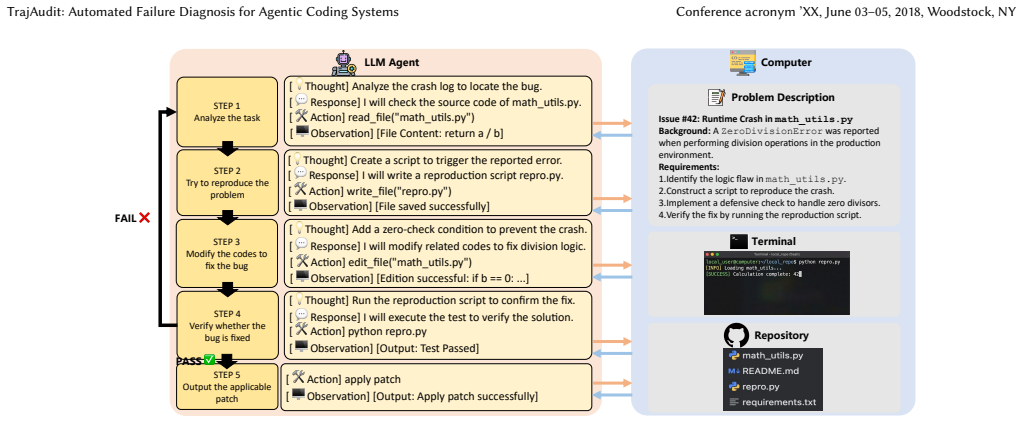
Agentic systems have been widely studied to automate coding tasks such as bug fixing and feature implementation. As these systems increasingly operate on complex codebases, understanding where and why they fail becomes essential for iterative refinement and operational reliability. Existing automated failure diagnosis approaches leverage \textit{task execution trajectories}, yet they struggle with trajectories produced by repository-level coding agents due to two key properties. First, these trajectories are often long, spanning many execution steps, making it difficult for LLMs to track the causal chain of failure over the execution history. Second, these trajectories are laden with noise, containing substantial low-signal observations such as redundant program structures and verbose code context, which can interfere with LLM reasoning. To address these challenges, we propose \textit{TrajAudit}, an automated failure diagnosis framework specifically for trajectories produced by repository-level coding agents. TrajAudit employs an investigator agent supported by two modules: one reduces failure-irrelevant noisy context through semantic saliency folding, and the other derives preliminary diagnostic guidance from test failure reports as prior knowledge to help LLMs focus on likely failure regions. The investigator agent can further invoke tools to inspect folded content on demand, enabling a focused investigation without losing access to the full trajectory context. We also introduce \textit{RootSE}, a benchmark of 102 real-world instances from repository-level coding tasks, each annotated with the earliest decisive error step and a justification. Experiments on RootSE show that TrajAudit outperforms the strongest baselines by 10.8\% and 21.6\% in exact failure localization accuracy in the with- and without-reference settings, respectively, demonstrating its effectiveness.
Figures




Forward citations
Cited by 3 Pith papers
-
AfterVibe: What Remains When the Conversation Ends
AfterVibe extracts natural-language specs from vibe-coding trajectories, validates them via blind regeneration scored by a three-tier verifier, and reaches mean scores of 5.06–5.74/6 on 72 industrial tasks.
-
Failure as a Process: An Anatomy of CLI Coding Agent Trajectories
Across 1,794 CLI agent trajectories, failures are mostly epistemic, start by median step 7, and often stay silent until after lock-in.
-
What Resolve Rate Hides: Trajectory Structure Diagnostics for Coding Agents
TraceProbe normalizes coding agent trajectories into canonical actions and applies rule-based detectors to localize failure patterns and behavioral divergences that resolve rate hides.
Reference graph
Works this paper leans on
-
[1]
����� ������� ��� ��� ���� ������� ����� � � ��� ��������� ����� �� ����������� � ������� ����������� �������� ������ ��� ��� ��������� �� � ������ ������ ���� ����� ������ ����� � ��� ���� ���������� � � ������� ����� ������������ �������� �������� ����������� ������ ���� ����� ������� �������� ���������� ����� �������� ������ ���� ����� ��� ����������� ...
Pith/arXiv arXiv 2026
discussion (0)
Sign in with ORCID, Apple, or X to comment. Anyone can read and Pith papers without signing in.