Revealing the D₀^*(2300) two-pole structure from lattice data and the SU(3) limit
Pith reviewed 2026-06-28 09:11 UTC · model grok-4.3
The pith
Lattice data analyzed with chiral theory reveals a two-pole structure for the D0*(2300) resonance tied to different SU(3) representations.
A machine-rendered reading of the paper's core claim, the machinery that carries it, and where it could break.
Core claim
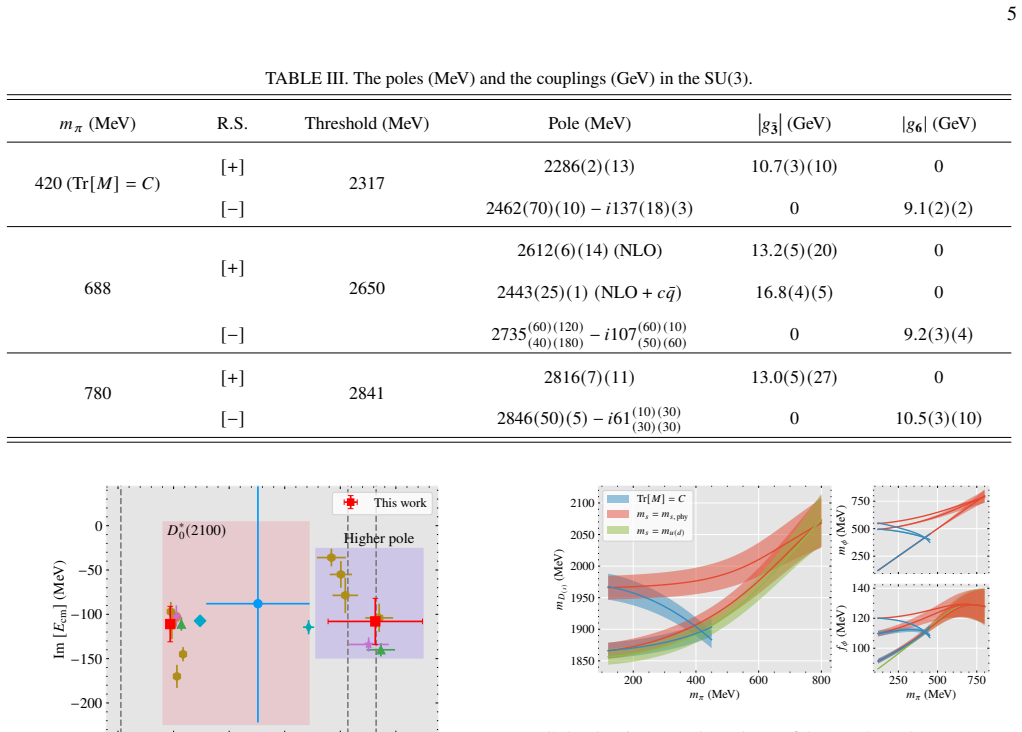
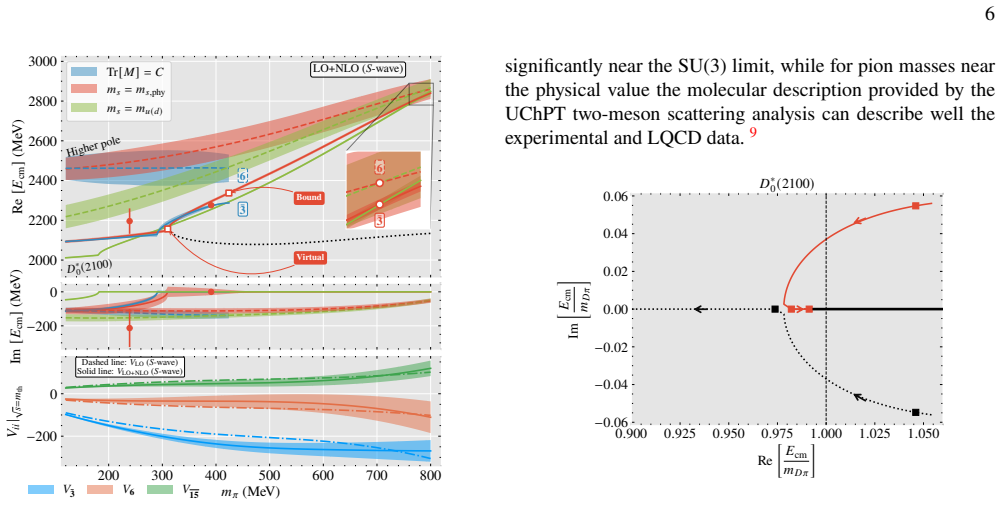
In the non-strange isospin I=1/2 sector two poles are found that relate to the experimental D0(2300). At physical pion mass they sit at √s0=2094(7)(1)−i111(7)(13) MeV and 2463(60)(30)−i108(14)(12) MeV. Along the ms=ms,phy trajectory the lower pole behaves like the σ in ππ scattering, splitting into two poles connected to the 3-bar representation; the higher pole is connected to the 6 representation and its mass stays fairly constant on the Tr[M]=C trajectory because it couples strongly to channels with hidden strangeness.
What carries the argument
Pole trajectories of unitary chiral perturbation theory amplitudes fitted to lattice data, continued along ms=ms,phy and Tr[M]=C chiral trajectories to the SU(3) limit and assigned to 3-bar and 6 representations.
If this is right
- The lower pole exhibits sigma-like splitting when the strange quark mass is held fixed.
- The higher pole's mass changes little when the trace of the quark-mass matrix is held constant.
- Strong coupling of the higher pole to Dη and DsK channels keeps its position stable.
- Compositeness of the lower state can be evaluated directly at the SU(3) symmetric point.
- The same framework applies to other isospin and strangeness sectors for additional poles.
Where Pith is reading between the lines
- Similar two-pole patterns may appear in other heavy-light meson systems once lattice data reach comparable precision.
- The representation assignments could guide model-building for resonances under full SU(3) flavor symmetry.
- Direct lattice simulations along the Tr[M]=C line would test whether the higher pole remains mass-stable.
- More data points between 400 and 600 MeV pion mass would constrain possible higher-order effects on the trajectories.
Load-bearing premise
The unitary chiral perturbation theory amplitudes, once their low-energy constants are fitted to the lattice points, correctly capture the analytic structure and pole trajectories all the way to the SU(3) limit without sizable higher-order corrections or missing channels.
What would settle it
Lattice results at the SU(3) limit that place only a single pole or show trajectories that do not split into separate 3-bar and 6 components would falsify the claimed two-pole structure.
Figures




read the original abstract
We perform an analysis of LQCD light - charmed (pseudoscalar) meson scattering data with UChPT for pion masses ranging from $m_\pi\simeq 230$~MeV till the SU(3) limit, $m_\pi\simeq 700$~MeV. We find two poles in the non-strange isospin $I=1/2$ sector that can be related to the experimental $D_0(2300)$ resonance. At the physical pion mass, the poles are located at $\sqrt{s_0}=2094(7)(1)-i111(7)(13)$ MeV, and $2463(60)(30)-i108(14)(12)$~MeV. While the first pole, named here $D_0^*(2100)$, is always a resonance in $D\pi$ within the $1\sigma$ region, the second pole can be a resonance or virtual state close to the $D\eta, D_s\bar{K}$ thresholds. For the first time, the pion mass dependence on different chiral trajectories including SU(3) LQCD data are investigated for these poles. We find that in the $m_s=m_{s,\mathrm{phy}}$ trajectory, the $D_0^*(2100)$ resonance pole behaves similarly as the $\sigma$ resonance in $\pi\pi$ scattering, splitting into two poles, connected to the $\bar{\mathbf{3}}$ representation. Moreover, we found that the higher pole related to the experimental $D_0^*(2300)$ can be related to the $\mathbf{6}$ representation. We highlight that since this pole couples strongly to channels with hidden strangeness, its mass is fairly constant in the $\mathrm{Tr}[M]=C$ trajectory, what can be tested in future LQCD simulations. The compositeness of the $D_0^*(2100)$ state at the SU(3) limit is evaluated. Finally, other sectors are also discussed.
Editorial analysis
A structured set of objections, weighed in public.
Referee Report
Summary. The manuscript analyzes LQCD data on light-charmed pseudoscalar meson scattering (Dπ, Dη, DsK channels) in the I=1/2 sector using unitary chiral perturbation theory (UChPT) for pion masses from ~230 MeV to the SU(3) limit (~700 MeV). It reports two poles related to the experimental D0*(2300), with positions at the physical point √s0=2094(7)(1)−i111(7)(13) MeV and 2463(60)(30)−i108(14)(12) MeV. The work tracks the poles along the ms=ms,phy and Tr[M]=C trajectories, assigns the lower pole (D0*(2100)) to the 3-bar representation (showing σ-like splitting) and the higher pole to the 6 representation, evaluates compositeness at the SU(3) limit, and discusses other sectors.
Significance. If the UChPT amplitudes after LEC fitting reliably capture the analytic structure across the full mass range, the results provide a concrete picture of the two-pole nature of the D0*(2300), its chiral evolution, and SU(3) multiplet assignments, with the inclusion of SU(3)-limit lattice data and explicit trajectory studies offering testable predictions for future simulations. The approach of fitting directly to lattice points at multiple masses is a positive feature.
major comments (3)
- [Abstract / chiral trajectories analysis] Abstract and results on pole trajectories: the reported splitting of the lower pole into two poles connected to the 3-bar representation along the ms=ms,phy trajectory, and the assignment of the higher pole to the 6 representation, are obtained after fitting UChPT LECs to discrete lattice points; the manuscript does not quantify how LEC variations within uncertainties propagate to pole positions and sheet structure at mπ≈700 MeV, which is load-bearing for the representation claims and the statement that the higher pole mass is 'fairly constant' on the Tr[M]=C trajectory.
- [Results on pole positions and nature] Section discussing the second pole near Dη and DsK thresholds: the conclusion that this pole 'can be a resonance or virtual state' rests on the fitted amplitude; given the large reported uncertainties (60 MeV on real part), the manuscript should demonstrate that the distinction remains stable when the fit is repeated with varied regularization scales or omitted channels, as this directly affects the two-pole interpretation at the physical point.
- [SU(3) limit and compositeness] Compositeness evaluation at the SU(3) limit: this quantity is computed from the residues of the fitted UChPT amplitude; without an explicit check that higher-order counterterms or additional channels (e.g., multi-meson) do not alter the residue by more than the quoted errors over the 230–700 MeV interval, the compositeness result cannot be considered robust.
minor comments (2)
- [Abstract] Notation: the abstract uses √s0 for the pole position; consistency with standard √s notation elsewhere in the manuscript would improve readability.
- [Lattice data section] The manuscript should add a table or figure explicitly listing the lattice data points (mπ values and channels) included in the fit versus those available in the literature, to address potential selection concerns.
Simulated Author's Rebuttal
We thank the referee for the careful reading of our manuscript and the constructive comments. We provide point-by-point responses below, indicating where we agree that revisions will strengthen the presentation and where we offer clarifications based on the existing analysis.
read point-by-point responses
-
Referee: [Abstract / chiral trajectories analysis] Abstract and results on pole trajectories: the reported splitting of the lower pole into two poles connected to the 3-bar representation along the ms=ms,phy trajectory, and the assignment of the higher pole to the 6 representation, are obtained after fitting UChPT LECs to discrete lattice points; the manuscript does not quantify how LEC variations within uncertainties propagate to pole positions and sheet structure at mπ≈700 MeV, which is load-bearing for the representation claims and the statement that the higher pole mass is 'fairly constant' on the Tr[M]=C trajectory.
Authors: We agree that an explicit propagation of LEC uncertainties to the pole trajectories at mπ≈700 MeV would make the representation assignments and stability statements more transparent. The quoted pole uncertainties at the physical point already incorporate the covariance from the global fit to all lattice points. In the revision we will add a dedicated paragraph (with a supplementary figure) showing the variation of both poles along the two trajectories when the LECs are sampled within their 1σ fit uncertainties. This will directly support the claims without altering the central results. revision: yes
-
Referee: [Results on pole positions and nature] Section discussing the second pole near Dη and DsK thresholds: the conclusion that this pole 'can be a resonance or virtual state' rests on the fitted amplitude; given the large reported uncertainties (60 MeV on real part), the manuscript should demonstrate that the distinction remains stable when the fit is repeated with varied regularization scales or omitted channels, as this directly affects the two-pole interpretation at the physical point.
Authors: The manuscript already stresses the large uncertainty and uses the cautious phrasing 'can be a resonance or virtual state'. The regularization scale is fixed by the standard UChPT convention employed throughout the literature for these channels, and all channels with lattice data are retained. Repeating the fit with omitted channels would change the model definition rather than test the same amplitude. We will nevertheless add a short paragraph discussing the expected sensitivity to the scale (based on the quality of the existing fit) and confirming that the two-pole structure persists inside the reported 1σ region. This addresses the concern without requiring new global fits. revision: partial
-
Referee: [SU(3) limit and compositeness] Compositeness evaluation at the SU(3) limit: this quantity is computed from the residues of the fitted UChPT amplitude; without an explicit check that higher-order counterterms or additional channels (e.g., multi-meson) do not alter the residue by more than the quoted errors over the 230–700 MeV interval, the compositeness result cannot be considered robust.
Authors: The compositeness is obtained directly from the residues of the UChPT amplitude that was fitted to the lattice data. We acknowledge that higher-order counterterms or additional multi-meson channels lie outside the present model and could in principle modify the residues. In the revised manuscript we will insert an explicit caveat stating that the quoted compositeness values and their uncertainties are those obtained within the employed UChPT framework, and that extensions beyond this framework are not explored here. revision: partial
Circularity Check
No significant circularity; poles and trajectories derived from external lattice fits
full rationale
The paper fits UChPT low-energy constants to independent LQCD scattering data at discrete pion masses (230–700 MeV, including SU(3) points) and extracts pole locations plus trajectories from the resulting amplitude. No quoted step reduces a claimed prediction or representation assignment to a tautology, self-fit, or load-bearing self-citation; the chiral framework supplies the analytic continuation while the numerical results remain tied to external data rather than being defined by construction.
Axiom & Free-Parameter Ledger
free parameters (1)
- UChPT low-energy constants
axioms (1)
- domain assumption Unitary chiral perturbation theory provides a reliable description of D-pi and related scattering amplitudes up to the SU(3) limit
Forward citations
Cited by 2 Pith papers
-
Machine learning unveils the quark mass dependence of the pseudoscalar meson decay constants in three-flavour N$^2$LO ChPT
LASSO regression on LQCD data determines quark-mass dependence of f_π, f_K, f_η in N²LO three-flavor ChPT and supplies LECs for SU(3)-limit baryon mass predictions.
-
Vector charmonium(-like) states in the energy range of 4.1-4.6 GeV
A coupled-channel framework is developed and fitted to BESIII data on vector charmonium-like states in the 4.1-4.6 GeV range, concluding that coupled-channel effects with dynamically generated poles explain the line shapes.
Reference graph
Works this paper leans on
- [1]
-
[2]
Navas et al
S. Navas et al. (Particle Data Group), Phys. Rev. D110, 030001 (2024)
2024
-
[3]
B. Aubert et al. (BaBar), Phys. Rev. Lett.90, 242001 (2003), arXiv:hep-ex/0304021
Pith/arXiv arXiv 2003
-
[4]
D. Besson et al. (CLEO), Phys. Rev. D68, 032002 (2003), [Er- ratum: Phys.Rev.D 75, 119908 (2007)], arXiv:hep-ex/0305100
Pith/arXiv arXiv 2003
-
[5]
R. Aaij et al. (LHCb), Phys. Rev. D101, 032005 (2020), arXiv:1911.05957 [hep-ex]
arXiv 2020
-
[6]
Godfrey and N
S. Godfrey and N. Isgur, Phys. Rev. D32, 189 (1985)
1985
-
[7]
Godfrey and R
S. Godfrey and R. Kokoski, Phys. Rev. D43, 1679 (1991)
1991
-
[8]
Isgur and M
N. Isgur and M. B. Wise, Phys. Lett. B232, 113 (1989)
1989
-
[9]
A. V. Manohar and M. B. Wise, Heavy quark physics, Vol. 10 (2000)
2000
-
[10]
F. Gil-Dom ´ınguez and R. Molina, Phys. Rev. D109, 096002 (2024), arXiv:2306.01848 [hep-ph]
arXiv 2024
-
[11]
A. Mart ´ınez Torres, E. Oset, S. Prelovsek, and A. Ramos, JHEP 05, 153, arXiv:1412.1706 [hep-lat]
-
[12]
L. Liu, K. Orginos, F.-K. Guo, C. Hanhart, and U.-G. Meissner, Phys. Rev. D87, 014508 (2013), arXiv:1208.4535 [hep-lat]
Pith/arXiv arXiv 2013
-
[13]
M. Albaladejo, P. Fernandez-Soler, J. Nieves, and P. G. Ortega, Eur. Phys. J. C78, 722 (2018), arXiv:1805.07104 [hep-ph]
Pith/arXiv arXiv 2018
-
[14]
T. Barnes, F. E. Close, and H. J. Lipkin, Phys. Rev. D68, 054006 (2003), arXiv:hep-ph/0305025
Pith/arXiv arXiv 2003
-
[15]
E. E. Kolomeitsev and M. F. M. Lutz, Phys. Lett. B582, 39 (2004), arXiv:hep-ph/0307133
Pith/arXiv arXiv 2004
-
[16]
A. Faessler, T. Gutsche, V. E. Lyubovitskij, and Y.-L. Ma, Phys. Rev. D76, 014005 (2007), arXiv:0705.0254 [hep-ph]
Pith/arXiv arXiv 2007
-
[17]
D. Gamermann, E. Oset, D. Strottman, and M. J. Vicente Vacas, Phys. Rev. D76, 074016 (2007), arXiv:hep-ph/0612179
Pith/arXiv arXiv 2007
-
[18]
D. Gamermann and E. Oset, Eur. Phys. J. A33, 119 (2007), arXiv:0704.2314 [hep-ph]
Pith/arXiv arXiv 2007
-
[19]
G. S. Bali, S. Collins, A. Cox, and A. Sch ¨afer, Phys. Rev. D96, 074501 (2017), arXiv:1706.01247 [hep-lat]
Pith/arXiv arXiv 2017
-
[20]
D. Mohler, C. B. Lang, L. Leskovec, S. Prelovsek, and R. M. Woloshyn, Phys. Rev. Lett.111, 222001 (2013), arXiv:1308.3175 [hep-lat]
Pith/arXiv arXiv 2013
-
[21]
C. B. Lang, L. Leskovec, D. Mohler, S. Prelovsek, and R. M. Woloshyn, Phys. Rev. D90, 034510 (2014), arXiv:1403.8103 [hep-lat]
Pith/arXiv arXiv 2014
-
[22]
G. K. C. Cheung, C. E. Thomas, D. J. Wilson, G. Moir, M. Peardon, and S. M. Ryan (Hadron Spectrum), JHEP02, 100, arXiv:2008.06432 [hep-lat]
arXiv 2008
-
[23]
M.-L. Du, M. Albaladejo, P. Fern ´andez-Soler, F.-K. Guo, C. Hanhart, U.-G. Meißner, J. Nieves, and D.-L. Yao, Phys. Rev. D98, 094018 (2018), arXiv:1712.07957 [hep-ph]
Pith/arXiv arXiv 2018
-
[24]
K. P. Khemchandani, L. M. Abreu, A. Martinez Torres, and F. S. Navarra, Phys. Rev. D110, 036008 (2024), arXiv:2312.11811 [hep-ph]
arXiv 2024
-
[25]
M. Albaladejo, P. Fernandez-Soler, F.-K. Guo, and J. Nieves, Phys. Lett. B767, 465 (2017), arXiv:1610.06727 [hep-ph]
Pith/arXiv arXiv 2017
- [26]
-
[27]
G. Moir, M. Peardon, S. M. Ryan, C. E. Thomas, and D. J. Wilson, JHEP10, 011, arXiv:1607.07093 [hep-lat]
-
[28]
J. D. E. Yeo, C. E. Thomas, and D. J. Wilson (Hadron Spectrum), JHEP07, 012, arXiv:2403.10498 [hep-lat]
-
[29]
A. Asokan, M.-N. Tang, F.-K. Guo, C. Hanhart, Y. Kamiya, and U.-G. Meißner, Eur. Phys. J. C83, 850 (2023), arXiv:2212.07856 [hep-ph]
arXiv 2023
- [30]
-
[31]
H. Yan, C. Liu, L. Liu, Y. Meng, and H. Xing, Phys. Rev. D111, 014503 (2025), arXiv:2404.13479 [hep-lat]
arXiv 2025
-
[32]
J. Luo, B. Wu, P.-P. Shi, and M.-L. Du, Analysis of the𝐷∗ 0 (2300) resonance from lattice QCD under chiral symmetry (2026), arXiv:2604.18286 [hep-ph]
Pith/arXiv arXiv 2026
- [33]
-
[34]
R. Aaij et al. (LHCb), Phys. Rev. D94, 072001 (2016), arXiv:1608.01289 [hep-ex]
Pith/arXiv arXiv 2016
-
[35]
M.-L. Du, F.-K. Guo, and U.-G. Meißner, Phys. Rev. D99, 114002 (2019), arXiv:1903.08516 [hep-ph]
Pith/arXiv arXiv 2019
-
[36]
I. I. Bigi, B. Blossier, A. Le Yaouanc, L. Oliver, O. Pene, J. C. Raynal, A. Oyanguren, and P. Roudeau, Eur. Phys. J. C52, 975 (2007), arXiv:0708.1621 [hep-ph]
Pith/arXiv arXiv 2007
-
[37]
B. Blossier, M. Wagner, and O. Pene (European Twisted Mass), JHEP06, 022, arXiv:0903.2298 [hep-lat]
-
[38]
H.-Y. Cheng and W.-S. Hou, Phys. Lett. B566, 193 (2003), arXiv:hep-ph/0305038
Pith/arXiv arXiv 2003
-
[39]
L. Maiani, F. Piccinini, A. D. Polosa, and V. Riquer, Phys. Rev. D71, 014028 (2005), arXiv:hep-ph/0412098
Pith/arXiv arXiv 2005
- [40]
-
[41]
M. Y. Barabanov et al., Prog. Part. Nucl. Phys.116, 103835 (2021), arXiv:2008.07630 [hep-ph]
arXiv 2021
- [42]
-
[43]
E. B. Gregory, F.-K. Guo, C. Hanhart, S. Krieg, and T. Luu, Eur. Phys. J. A61, 226 (2025), arXiv:2503.23954 [hep-lat]
arXiv 2025
- [44]
-
[45]
F.-K. Guo, C. Hanhart, S. Krewald, and U.-G. Meissner, Phys. Lett. B666, 251 (2008), arXiv:0806.3374 [hep-ph]
Pith/arXiv arXiv 2008
-
[46]
L. Meng, B. Wang, G.-J. Wang, and S.-L. Zhu, Phys. Rept.1019, 1 (2023), arXiv:2204.08716 [hep-ph]. 8
arXiv 2023
-
[47]
F.-K. Guo, C. Hanhart, and U.-G. Meissner, Eur. Phys. J. A40, 171 (2009), arXiv:0901.1597 [hep-ph]
Pith/arXiv arXiv 2009
-
[48]
D.-L. Yao, M.-L. Du, F.-K. Guo, and U.-G. Meißner, JHEP11, 058, arXiv:1502.05981 [hep-ph]
-
[49]
The manuscript is in preparation, arXiv:2605.xxxxxx [hep-ph]
-
[50]
F. Gil-Dom ´ınguez and R. Molina, Phys. Lett. B843, 137997 (2023), [Erratum: Phys.Lett.B 868, 139619 (2025)], arXiv:2302.12861 [hep-lat]
arXiv 2023
-
[51]
[12, 13, 17, 20– 22, 26–28, 31, 45–50, 53, 55, 64–74]
See Supplemental Material atURL_will_be_inserted_ by_publisher, which includes the Refs. [12, 13, 17, 20– 22, 26–28, 31, 45–50, 53, 55, 64–74]
-
[52]
F. Gil-Dom ´ınguez, A. Giachino, and R. Molina, Phys. Rev. D 111, 016029 (2025), arXiv:2409.15141 [hep-ph]
arXiv 2025
- [53]
-
[54]
Z.-H. Guo, U.-G. Meißner, and D.-L. Yao, Phys. Rev. D92, 094008 (2015), arXiv:1507.03123 [hep-ph]
Pith/arXiv arXiv 2015
-
[55]
Z.-H. Guo, L. Liu, U.-G. Meißner, J. A. Oller, and A. Rusetsky, Eur. Phys. J. C79, 13 (2019), arXiv:1811.05585 [hep-ph]
Pith/arXiv arXiv 2019
-
[56]
M. Altenbuchinger, L. S. Geng, and W. Weise, Phys. Rev. D89, 014026 (2014), arXiv:1309.4743 [hep-ph]
Pith/arXiv arXiv 2014
-
[57]
C. Hanhart, J. R. Pelaez, and G. Rios, Phys. Rev. Lett.100, 152001 (2008), arXiv:0801.2871 [hep-ph]
Pith/arXiv arXiv 2008
-
[58]
D. Guo, A. Alexandru, R. Molina, M. Mai, and M. D¨oring, Phys. Rev. D98, 014507 (2018), arXiv:1803.02897 [hep-lat]
Pith/arXiv arXiv 2018
-
[59]
D. Jido, J. A. Oller, E. Oset, A. Ramos, and U. G. Meissner, Nucl. Phys. A725, 181 (2003), arXiv:nucl-th/0303062
Pith/arXiv arXiv 2003
-
[60]
I. Matuschek, V. Baru, F.-K. Guo, and C. Hanhart, Eur. Phys. J. A57, 101 (2021), arXiv:2007.05329 [hep-ph]
arXiv 2021
-
[61]
J. D. Hunter, Computing in Science & Engineering9, 90 (2007)
2007
-
[62]
Bezanson, A
J. Bezanson, A. Edelman, S. Karpinski, and V. B. Shah, SIAM Review59, 65 (2017)
2017
-
[63]
Zhuang, Optimizer.jl
Z. Zhuang, Optimizer.jl
-
[64]
J. A. Oller and E. Oset, Phys. Rev. D60, 074023 (1999), arXiv:hep-ph/9809337
Pith/arXiv arXiv 1999
-
[65]
J. A. Oller, E. Oset, and J. R. Pelaez, Phys. Rev. D59, 074001 (1999), [Erratum: Phys.Rev.D 60, 099906 (1999), Erratum: Phys.Rev.D 75, 099903 (2007)], arXiv:hep-ph/9804209
Pith/arXiv arXiv 1999
-
[66]
J. A. Oller, Prog. Part. Nucl. Phys.110, 103728 (2020), arXiv:1909.00370 [hep-ph]
arXiv 2020
-
[67]
M. Doring, U.-G. Meissner, E. Oset, and A. Rusetsky, Eur. Phys. J. A47, 139 (2011), arXiv:1107.3988 [hep-lat]
Pith/arXiv arXiv 2011
-
[68]
M. Doring, U. G. Meissner, E. Oset, and A. Rusetsky, Eur. Phys. J. A48, 114 (2012), arXiv:1205.4838 [hep-lat]
Pith/arXiv arXiv 2012
-
[69]
M. Doring, M. Mai, and U.-G. Meissner, Phys. Lett. B722, 185 (2013), arXiv:1302.4065 [hep-lat]
Pith/arXiv arXiv 2013
-
[70]
E. E. Jenkins, Nucl. Phys. B412, 181 (1994), arXiv:hep- ph/9212295
arXiv 1994
-
[71]
N. Brambilla, J. Komijani, A. S. Kronfeld, and A. Vairo (TUMQCD), Phys. Rev. D97, 034503 (2018), arXiv:1712.04983 [hep-ph]
Pith/arXiv arXiv 2018
-
[72]
D. J. Wilson, R. A. Briceno, J. J. Dudek, R. G. Edwards, and C. E. Thomas, Phys. Rev. Lett.123, 042002 (2019), arXiv:1904.03188 [hep-lat]
arXiv 2019
-
[73]
R. G. Edwards, N. Mathur, D. G. Richards, and S. J. Wal- lace (Hadron Spectrum), Phys. Rev. D87, 054506 (2013), arXiv:1212.5236 [hep-ph]
Pith/arXiv arXiv 2013
-
[74]
A. Woss, C. E. Thomas, J. J. Dudek, R. G. Edwards, and D. J. Wilson, JHEP07, 043, arXiv:1802.05580 [hep-lat]
-
[75]
M. Kalinowski and M. Wagner, Phys. Rev. D92, 094508 (2015), arXiv:1509.02396 [hep-lat]
Pith/arXiv arXiv 2015
-
[76]
G. K. C. Cheung, C. O’Hara, G. Moir, M. Peardon, S. M. Ryan, C. E. Thomas, and D. Tims (Hadron Spectrum), JHEP12, 089, arXiv:1610.01073 [hep-lat]
-
[77]
S. Prelovsek, S. Collins, D. Mohler, M. Padmanath, and S. Piemonte, JHEP06, 035, arXiv:2011.02542 [hep-lat]. 1 SUPPLEMENTAL MATERIAL In this supplemental material, we present details regarding the Formalism, the pion mass dependence of the heavy𝐷mesons, the summary of lattice setups, the fitted energy levels, the correlations between the fitted parameters...
arXiv 2011
discussion (0)
Sign in with ORCID, Apple, or X to comment. Anyone can read and Pith papers without signing in.