Compact quasiaxisymmetric stellarators, a near axisymmetric theory
Pith reviewed 2026-06-28 07:47 UTC · model grok-4.3
The pith
A perturbative expansion around axisymmetry analytically predicts ridge localization in compact quasiaxisymmetric stellarators.
A machine-rendered reading of the paper's core claim, the machinery that carries it, and where it could break.
Core claim
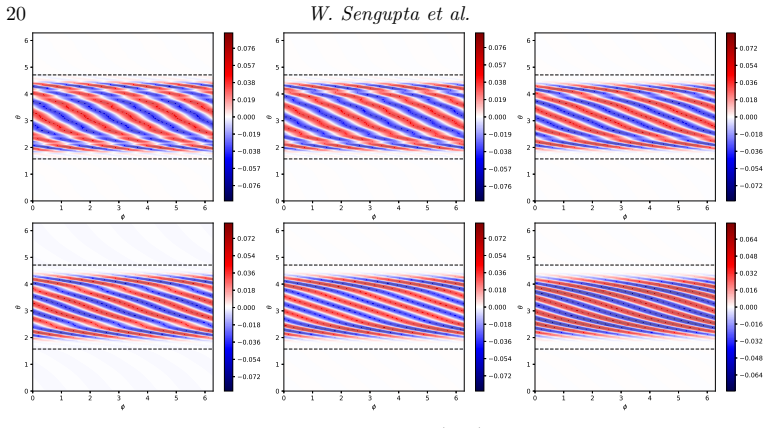
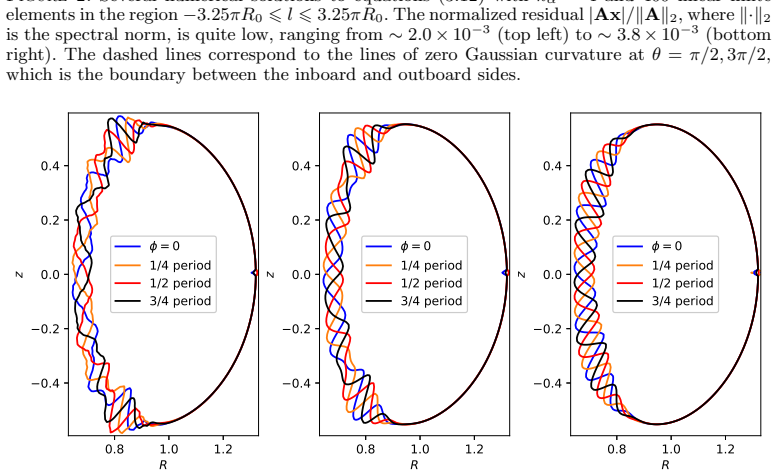
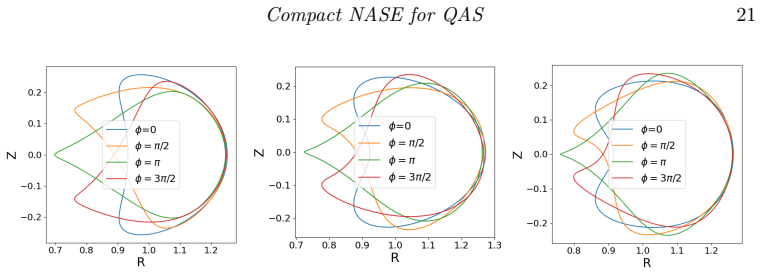
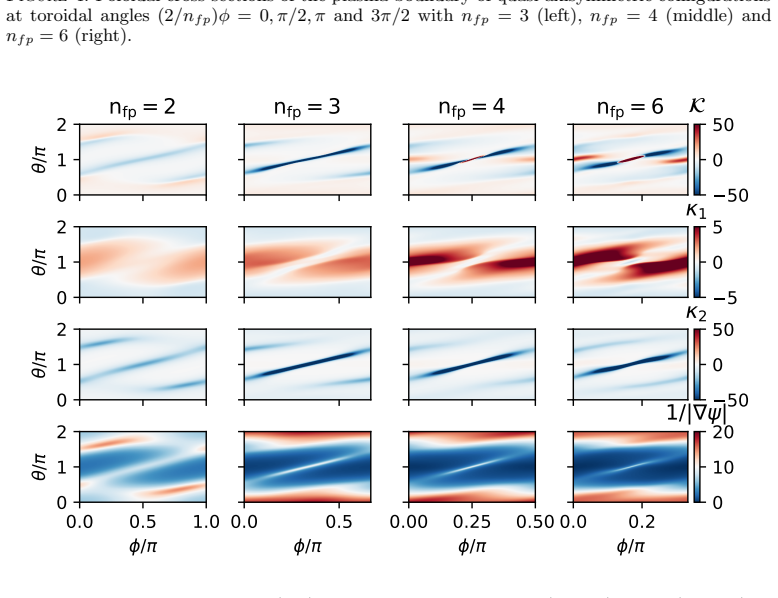
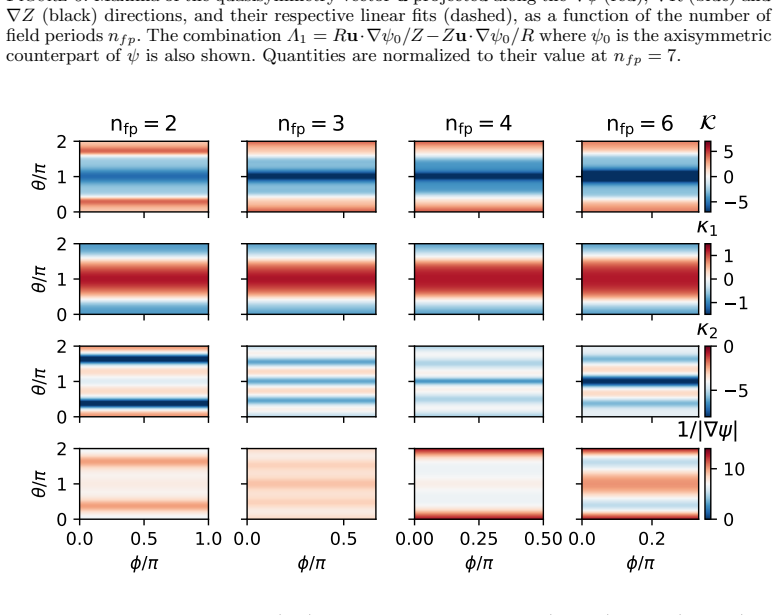
We develop a perturbative treatment of nearly axisymmetric quasisymmetric devices by expanding in the deviation from perfect axisymmetry. As a result, we can analytically describe the key features of compact QA devices, such as the tendency for ridges to be localized on the inboard side, where the Gaussian curvature is typically negative, and the field strength is maximum. We provide comprehensive numerical evidence in support of our analytical theory.
What carries the argument
Perturbative expansion in the deviation from perfect axisymmetry applied to ideal MHS equilibria of quasiaxisymmetric stellarators.
If this is right
- Ridges can attract divertor designs without requiring a rational rotational transform that covers the torus an integer number of times.
- Ridge localization to regions of negative Gaussian curvature and maximum field strength follows directly from the near-axisymmetric expansion.
- Field lines collimate near these localized sharp ridges in a manner analogous to X-points but confined to specific toroidal sectors.
- The analytic predictions apply to compact QA devices whose asymmetry remains small.
Where Pith is reading between the lines
- The same expansion could be used to scan candidate coil shapes for ridge positions before full 3-D equilibrium solves.
- If the inboard localization persists at larger deviations, the theory supplies a leading-order design rule even when the small-asymmetry assumption is only approximate.
- The approach suggests a route to analytic control of exhaust topology in other quasisymmetric classes by similar near-symmetry expansions.
Load-bearing premise
The deviation from perfect axisymmetry is small enough that the perturbative expansion accurately captures ridge localization.
What would settle it
Numerical construction of a QA equilibrium with moderate deviation from axisymmetry in which ridges fail to localize preferentially on the inboard side would falsify the predicted localization.
Figures




read the original abstract
We develop a theory of ridges in compact stellarators with quasiaxisymmetry (QA). The equilibrium with finite plasma currents and pressure is modeled by ideal magnetohydrostatics (MHS). Field lines are collimated near sharp ridges, much like X-points, making ridges attractive to divertor designs without the requirement of a rational rotational transform at the divertor. However, unlike X-points, which must cover the entire torus an integer number of times, sharp ridges are typically localized in certain parts of the flux surfaces. Motivated by recent work (Henneberg and Plunk, Phys. Rev. Research 6, L022052) on compact hybrid devices, we develop a perturbative treatment of nearly axisymmetric quasisymmetric devices by expanding in the deviation from perfect axisymmetry. As a result, we can analytically describe the key features of compact QA devices, such as the tendency for ridges to be localized on the inboard side, where the Gaussian curvature is typically negative, and the field strength is maximum. We provide comprehensive numerical evidence in support of our analytical theory.
Editorial analysis
A structured set of objections, weighed in public.
Referee Report
Summary. The paper develops a first-order perturbative expansion in the deviation from perfect axisymmetry for compact quasiaxisymmetric stellarators within ideal magnetohydrostatics (MHS). It analytically predicts key features of ridges, including their localization on the inboard side where Gaussian curvature is negative and |B| is maximum, motivated by recent hybrid-device work, and supports the predictions with numerical evidence.
Significance. If the small-deviation assumption holds for the reported configurations, the work supplies an analytical handle on ridge collimation and localization that could inform divertor concepts in compact QA stellarators without requiring rational rotational transform. The grounding in external ideal MHS and the attempt at independent numerical verification are positive features.
major comments (2)
- [Abstract] Abstract and the numerical-evidence section: the assertion of 'comprehensive numerical evidence' supporting the first-order analytic predictions is not accompanied by explicit quantification of the axisymmetry deviation (e.g., a measure such as max |B - B_axisym|/B or the size of the perturbation parameter) in the compact QA examples; without this, it is impossible to confirm that the configurations lie inside the regime where higher-order terms do not shift the leading-order ridge position.
- [Theory development] Perturbative derivation (near-axisymmetric expansion): the validity range of the expansion is not stated, nor is an estimate provided for the magnitude of the neglected O(ε²) terms relative to the O(ε) ridge-localization effect; this leaves open whether the analytic inboard-side preference survives for the finite deviations present in practical compact devices.
minor comments (2)
- Notation for the deviation parameter and the Gaussian-curvature sign convention should be introduced once and used consistently across equations and figures.
- Figure captions for the numerical comparisons would benefit from explicit labels indicating which curves correspond to the analytic prediction versus the full MHS solution.
Simulated Author's Rebuttal
We thank the referee for the constructive comments, which identify areas where additional detail will strengthen the manuscript. We address each major comment below and will revise accordingly.
read point-by-point responses
-
Referee: [Abstract] Abstract and the numerical-evidence section: the assertion of 'comprehensive numerical evidence' supporting the first-order analytic predictions is not accompanied by explicit quantification of the axisymmetry deviation (e.g., a measure such as max |B - B_axisym|/B or the size of the perturbation parameter) in the compact QA examples; without this, it is impossible to confirm that the configurations lie inside the regime where higher-order terms do not shift the leading-order ridge position.
Authors: We agree that explicit quantification is needed. The revised manuscript will include values of the perturbation parameter and measures such as max |B - B_axisym|/B for the compact QA examples shown. These additions will allow direct assessment of whether the configurations remain within the regime where the first-order ridge localization prediction holds. revision: yes
-
Referee: [Theory development] Perturbative derivation (near-axisymmetric expansion): the validity range of the expansion is not stated, nor is an estimate provided for the magnitude of the neglected O(ε²) terms relative to the O(ε) ridge-localization effect; this leaves open whether the analytic inboard-side preference survives for the finite deviations present in practical compact devices.
Authors: We accept this point. The revised theory section will state the assumed range of validity for the near-axisymmetric expansion and include an order-of-magnitude estimate of the O(ε²) contributions relative to the O(ε) ridge effect, based on the expansion parameter used in the derivation. revision: yes
Circularity Check
No significant circularity; perturbative expansion is independent
full rationale
The paper derives ridge localization via a first-order perturbative expansion in the deviation from axisymmetry inside the external ideal MHS equations. No step reduces a claimed prediction to a fitted parameter, self-defined quantity, or load-bearing self-citation. The cited Henneberg-Plunk work is by different authors and serves only as motivation. Numerical evidence is presented as independent verification rather than as the origin of the analytic result. The derivation chain therefore remains self-contained against external benchmarks.
Axiom & Free-Parameter Ledger
axioms (2)
- domain assumption Ideal magnetohydrostatics (MHS) equilibrium with finite plasma currents and pressure
- domain assumption Deviation from perfect axisymmetry is small enough for perturbative expansion to capture ridge features
Forward citations
Cited by 1 Pith paper
-
Understanding and Quantifying Banana Coil Magnetic Fields and Forces for Enhanced Optimisation
Optimizes banana coils for tokamak-stellarator hybrids under force constraints and quantifies resulting geometries, fields, and force-reduction mechanisms.
Reference graph
Works this paper leans on
-
[1]
Journal of Plasma Physics , volume =
Exploration of the parameter space of quasisymmetric stellarator vacuum fields through adjoint optimisation , author =. Journal of Plasma Physics , volume =. 2024 , publisher =
2024
-
[2]
Studies in Applied Mathematics , volume=
The inverse scattering transform-Fourier analysis for nonlinear problems , author=. Studies in Applied Mathematics , volume=. 1974 , publisher=
1974
-
[3]
Atiyah, M. F. and Macdonald, I. G. , title =. 1969 , pages =
1969
-
[4]
Anderson, F. S. B. and Almagri, A. F. and Anderson, D. T. and Matthews, P. G. and Talmadge, J. N. and Shohet, J. L. , journal =. Helically symmetric experiment, (. 1995 , month =
1995
-
[5]
, journal=
Aronsson, G. , journal=. On the partial differential equation u_x^2 u_. 1968 , publisher=
1968
-
[6]
Manuscripta mathematica , volume=
On certain singular solutions of the partial differential equation ux 2 u xx+ 2u xuyu xy+ uy 2 u yy= 0 , author=. Manuscripta mathematica , volume=. 1984 , publisher=
1984
-
[7]
Manuscripta mathematica , volume=
Construction of singular solutions to the p-harmonic equation and its limit equation for p= , author=. Manuscripta mathematica , volume=. 1986 , publisher=
1986
-
[8]
Bulletin of the American mathematical society , volume=
A tour of the theory of absolutely minimizing functions , author=. Bulletin of the American mathematical society , volume=
-
[9]
Physical Review Letters , volume=
Magnetic fields with precise quasisymmetry for plasma confinement , author=. Physical Review Letters , volume=. 2022 , publisher=
2022
-
[10]
2011 , publisher=
Nonlinear dispersive waves: asymptotic analysis and solitons , author=. 2011 , publisher=
2011
-
[11]
1978 , author =
Magnetic reconnection and m = 1 oscillations in current carrying plasmas , journal =. 1978 , author =
1978
-
[12]
2006 , publisher =
Calculus of Variations , author =. 2006 , publisher =
2006
-
[13]
Bader, A. and Drevlak, M. and Anderson, D. T. and Faber, B. J. and Hegna, C. C. and Likin, K. M. and Schmitt, J. C. and Talmadge, J. N. , year = 2019, pages =. Stellarator equilibria with reactor relevant energetic particle losses , volume =. Journal of Plasma Physics , publisher =. doi:10.1017/S0022377819000680 , number =
-
[14]
Baillod, A. and Loizu, J. and Qu, Z. S. and Arbez, H. P. and Graves, J. P. , year=. Equilibrium -limits dependence on bootstrap current in classical stellarators , volume=. Journal of Plasma Physics , publisher=. doi:10.1017/S0022377823000910 , number=
-
[15]
1978 , publisher =
A Computational Method in Plasma Physics , author =. 1978 , publisher =
1978
-
[16]
Beidler, C. D. and Harmeyer, E. and Herrnegger, F. and Igitkhanov, Y. and Kendl, A. and Kisslinger, J. and Kolesnichenko, Y. I. and Lutsenko, V. V. and N. The helias reactor. Nuclear Fusion , volume=. 2001 , publisher=
2001
-
[17]
1994 , publisher=
Algebro-geometric approach to nonlinear integrable equations , author=. 1994 , publisher=
1994
-
[18]
and Sandal, L
Berge, G. and Sandal, L. K. and Wesson, J. A. , title =
-
[19]
Bernardin, M. P. and Moses, R. W. and Tataronis, J. A. , title =. The Physics of Fluids , volume =. 1986 , doi =
1986
-
[20]
Journal of Physics A: Mathematical and General , volume=
Fake Airy functions and the asymptotics of reflectionlessness , author=. Journal of Physics A: Mathematical and General , volume=. 1990 , publisher=
1990
-
[21]
Berry, M. V. , journal=. Waves and. 1976 , publisher=
1976
-
[22]
Energy Principle with Global Invariants for Toroidal Plasmas , author =. Phys. Rev. Lett. , volume =. 1980 , month =
1980
-
[23]
and Dewar, R
Bhattacharjee, A. and Dewar, R. L. , title =. Physics of Fluids , volume =
-
[24]
1984 , issn =
Variational method for three-dimensional toroidal equilibria , journal =. 1984 , issn =
1984
-
[25]
and Hayashi, T
Bhattacharjee, A. and Hayashi, T. and Hegna, C. C. and Nakajima, N. and Sato, T. , title =. Physics of Plasmas , volume =
-
[26]
The Physics of fluids , volume=
Degenerate toroidal magnetohydrodynamic equilibria and minimum B , author=. The Physics of fluids , volume=. 1986 , publisher=
1986
-
[27]
Boozer, A. H. , title =. The Physics of Fluids , volume =
-
[28]
Physics of Plasmas , volume=
Local equilibrium of nonrotating plasmas , author=. Physics of Plasmas , volume=. 2002 , publisher=
2002
-
[29]
Reviews of modern physics , volume=
Physics of magnetically confined plasmas , author=. Reviews of modern physics , volume=. 2004 , publisher=
2004
-
[30]
Boozer, A. H. , journal=. Stellarators and the path from. 2008 , publisher=
2008
-
[31]
Boozer, A. H. , year=. Stellarator design , volume=. Journal of Plasma Physics , publisher=
-
[32]
Nuclear Fusion , volume=
Stellarators as a fast path to fusion , author=. Nuclear Fusion , volume=. 2021 , publisher=
2021
-
[33]
Braginskii, S. I. , title =. Reviews of Plasma Physics, Vol. 1 , publisher =
-
[34]
Philosophical Transactions of the Royal Society A: Mathematical, Physical and Engineering Sciences , volume=
What does integrability of finite-gap or soliton potentials mean? , author=. Philosophical Transactions of the Royal Society A: Mathematical, Physical and Engineering Sciences , volume=. 2008 , publisher=
2008
-
[35]
2019 , eprint =
Some mathematics for quasi-symmetry , author =. 2019 , eprint =
2019
-
[36]
Burby, J. W. and Kallinikos, N. and MacKay, R. S. , title =. Journal of Mathematical Physics , volume =. 2020 , doi =
2020
-
[37]
Journal of Mathematical Physics , volume=
Characterization of admissible quasisymmetries , author=. Journal of Mathematical Physics , volume=. 2024 , publisher=
2024
-
[38]
II.—The identity Pn= Qm , author=
Commutative ordinary differential operators. II.—The identity Pn= Qm , author=. Proceedings of the Royal Society of London. Series A, Containing Papers of a Mathematical and Physical Character , volume=. 1931 , publisher=
1931
-
[39]
Reviews of Modern Physics , volume=
Hidden symmetries of dynamics in classical and quantum physics , author=. Reviews of Modern Physics , volume=. 2014 , publisher=
2014
-
[40]
1983 , author =
Noncanonical Hamiltonian mechanics and its application to magnetic field line flow , journal =. 1983 , author =
1983
-
[41]
Cary, J. R. and Kotschenreuther, M. , title =. The Physics of Fluids , volume =
-
[42]
Hamiltonian theory of guiding-center motion , author =. Rev. Mod. Phys. , volume =
-
[43]
and Callen, J
Chang, Z. and Callen, J. D. , title =. Physics of Fluids B: Plasma Physics , volume =
-
[44]
Cole, A. J. and Hegna, C. C. and Callen, J. D. , title =. Physics of Plasmas , volume =
-
[45]
2020 , eprint =
On quasisymmetric plasma equilibria sustained by small force , author =. 2020 , eprint =
2020
-
[46]
Constantin, P. and Drivas, T. D. and Ginsberg, D. , year =. On quasisymmetric plasma equilibria sustained by small force , volume =. Journal of Plasma Physics , publisher =. doi:10.1017/S0022377820001610 , number =
-
[47]
Cooper, W. A. and Hirshman, S. P. and Merazzi, S. and Gruber, R. , title =. Computer Physics Communications , volume =
-
[48]
Annals of physics , volume=
Theory of the alternating-gradient synchrotron , author=. Annals of physics , volume=. 1958 , publisher=
1958
-
[49]
Physics of Fluids B: Plasma Physics , volume=
An analytic solution of high-beta equilibrium in a large aspect ratio tokamak , author=. Physics of Fluids B: Plasma Physics , volume=. 1991 , publisher=
1991
-
[50]
Craxton, R. S. and Anderson, K. S. and Boehly, T. R. and Goncharov, V. N. and Harding, D. R. and Knauer, J. P. and McCrory, R. L. and McKenty, P. W. and Meyerhofer, D. D. and Myatt, J. F. and Schmitt, A. J. and Sethian, J. D. and Short, R. W. and Skupsky, S. and Theobald, W. and Kruer, W. L. and Tanaka, K. and Betti, R. and Collins, T. J. B. and Delettrez...
-
[51]
Drevlak, M. and Brochard, F. and Helander, P. and Kisslinger, J. and Mikhailov, M. and Nührenberg, C. and Nührenberg, J. and Turkin, Y. , title =. Contributions to Plasma Physics , volume =. doi:https://doi.org/10.1002/ctpp.201200055 , year =
-
[52]
and Geiger, J
Drevlak, M. and Geiger, J. and Helander, P. and Turkin, Y. , title =
-
[53]
I , author=
Integrable systems. I , author=. Dynamical systems IV , pages=. 1990 , publisher=
1990
-
[54]
Journal of Mathematical Physics , volume=
Integrability, normal forms, and magnetic axis coordinates , author=. Journal of Mathematical Physics , volume=. 2021 , publisher=
2021
-
[55]
1923 , publisher=
Transformations of surfaces , author=. 1923 , publisher=
1923
-
[56]
1987 , publisher=
Hamiltonian methods in the theory of solitons , author=. 1987 , publisher=
1987
-
[57]
1906 , publisher=
Theory of Differential Equations, Part IV, Partial Differential Equations , author=. 1906 , publisher=
1906
-
[58]
and Hender, T
Fitzpatrick, R. and Hender, T. C. , title =. Physics of Fluids B: Plasma Physics , volume =
-
[59]
, title =
Fitzpatrick, R. , title =
-
[60]
, journal=
Froman, N. , journal=. Dispersion relation for energy bands and energy gaps derived by the use of a phase-integral method, with an application to the. 1979 , publisher=
1979
-
[61]
Freidberg, J. P. , year=. Ideal
-
[62]
2012 , publisher=
Flux coordinates and magnetic field structure: a guide to a fundamental tool of plasma theory , author=. 2012 , publisher=
2012
-
[63]
Fuller, E. J. , year =. The geometric and topological structure of holonomic knots , journal =
-
[64]
Garabedian, P. R. , title =. Physics of Plasmas , volume =
-
[65]
Proceedings of the National Academy of Sciences , volume =
Three-dimensional analysis of tokamaks and stellarators , author =. Proceedings of the National Academy of Sciences , volume =. 2008 , publisher =
2008
-
[66]
Garabedian, P. R. and McFadden, G. B. , journal =. Design of the. 2009 , publisher =
2009
-
[67]
Garren, D. A. and Boozer, A. H. , title =. Physics of Fluids B: Plasma Physics , volume =. 1991 , doi =
1991
-
[68]
Journal of Plasma Physics , volume=
Microstability of 1 tokamak equilibria , author=. Journal of Plasma Physics , volume=. 2023 , publisher=
2023
-
[69]
The Physics of fluids , volume=
Ballooning mode spectrum in general toroidal systems , author=. The Physics of fluids , volume=. 1983 , publisher=
1983
-
[70]
Plasma Physics and Controlled Fusion , volume=
Resilient stellarator divertor characteristics in the helically symmetric eXperiment , author=. Plasma Physics and Controlled Fusion , volume=. 2025 , publisher=
2025
-
[71]
Nuclear Fusion , volume=
Exploration of non-resonant divertor features on the Compact Toroidal Hybrid , author=. Nuclear Fusion , volume=. 2023 , publisher=
2023
-
[72]
and Buller, S
Gaur, R. and Buller, S. and Ruth, M. E. and Landreman, M. and Abel, I. G. and Dorland, W. D. , title=. Journal of Plasma Physics , publisher=. 2023 , pages=
2023
-
[73]
Gaur, R. , doi =. ideal-ballooning-solver , url =
-
[74]
Physical Review Letters , volume=
Shear, periodicity, and plasma ballooning modes , author=. Physical Review Letters , volume=. 1978 , publisher=
1978
-
[75]
2000 , publisher =
Calculus of Variations , author =. 2000 , publisher =
2000
-
[76]
Uspekhi Matematicheskikh Nauk , volume=
Asymptotic benaviour of the resolvent of Sturm--Liouville equations and the algebra of the Korteweg--de Vries equations , author=. Uspekhi Matematicheskikh Nauk , volume=. 1975 , publisher=
1975
-
[77]
Gerhardt, S. P. and Anderson, D. T. and Talmadge, J. N. , title =. Physics of Plasmas , volume =
-
[78]
Physical review letters , volume=
Experimental evidence of reduced plasma flow damping with quasisymmetry , author=. Physical review letters , volume=. 2005 , publisher=
2005
-
[79]
Acta Mathematica , volume=
Picard potentials and Hill's equation on a torus , author=. Acta Mathematica , volume=. 1996 , publisher=
1996
-
[80]
Physical review letters , volume=
Method for solving the Korteweg-deVries equation , author=. Physical review letters , volume=. 1967 , publisher=
1967
discussion (0)
Sign in with ORCID, Apple, or X to comment. Anyone can read and Pith papers without signing in.