Experimentally probing the Quantum Physics in the Inverted Harmonic Oscillator
Pith reviewed 2026-06-28 05:49 UTC · model grok-4.3
The pith
Radio-frequency dressing turns a trapped Bose-Einstein condensate into an inverted harmonic oscillator that squeezes its quantum state 10.6 dB below vacuum while remaining reversible.
A machine-rendered reading of the paper's core claim, the machinery that carries it, and where it could break.
Core claim
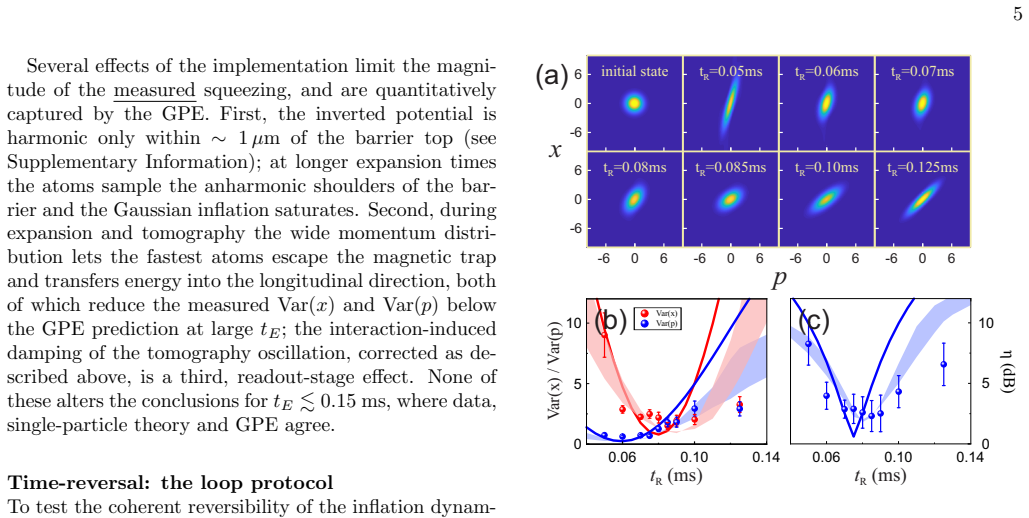
When a quantum system passes through an unstable fixed point the local dynamics reduces to the inverted harmonic oscillator. Radio-frequency dressing flips the transverse harmonic confinement into an IHO. Through phase-space tomography the full Wigner function of the evolving quantum state is followed, sub-vacuum squeezing of 10.6(1.3) dB is observed, and coherent reversibility is tested by time-reversing the IHO evolution. Matter-wave interference between the two daughter clouds confirms quantum coherence over timescales far beyond the initial expansion.
What carries the argument
The inverted harmonic oscillator whose Hamiltonian produces exponential amplification along one quadrature and squeezing along the other, realized by radio-frequency dressing that inverts the sign of the transverse trapping potential on the atom chip.
If this is right
- The full Wigner function of the state can be reconstructed at successive times during the unstable evolution.
- Sub-vacuum squeezing reaches 10.6(1.3) dB.
- Time reversal of the IHO evolution restores the initial quantum state, confirming reversibility.
- Matter-wave interference between the separated daughter clouds demonstrates preserved quantum coherence.
Where Pith is reading between the lines
- Coupling the IHO to additional degrees of freedom could allow analog tests of how quantum fluctuations are amplified in expanding cosmologies.
- The demonstrated reversibility might be combined with external force measurements to certify coherence in precision sensors.
- Similar radio-frequency techniques could be applied to other trap geometries to realize different classes of unstable fixed points.
Load-bearing premise
The radio-frequency dressing produces a clean inverted harmonic oscillator potential whose local dynamics are accurately described by the IHO Hamiltonian without significant residual trapping, anharmonicities, or atom-atom interaction effects that would alter the observed squeezing or reversibility.
What would settle it
Observation of squeezing substantially below the 10.6 dB value or failure of the time-reversed evolution to recover the initial Wigner function within experimental uncertainty would falsify the claim that the system realizes clean IHO dynamics.
Figures


read the original abstract
When a quantum system passes through an unstable fixed point the local dynamics reduces to the inverted harmonic oscillator (IHO). It exponentially amplifies along one quadrature while squeezing the other, producing macroscopically extended quantum states from microscopic zero-point fluctuations. We realize this dynamics with a Bose-Einstein condensate on an AtomChip. Radio-frequency dressing flips the transverse harmonic confinement into an IHO. Through phase-space tomography we follow the full Wigner function of the evolving quantum state, observe sub-vacuum squeezing of 10.6(1.3) dB, and test coherent reversibility by time-reversing the IHO evolution. Matter-wave interference between the two daughter clouds confirms quantum coherence over timescales far beyond the initial expansion. Our experiment establishes ultra-cold atoms as a clean, controlled, many-body platform for unstable quantum dynamics opening a route to force sensing with time-reversal-based coherence certification and to analog studies of the amplification of quantum fluctuations in inflationary field dynamics.
Editorial analysis
A structured set of objections, weighed in public.
Referee Report
Summary. The manuscript reports an experimental realization of the dynamics of the inverted harmonic oscillator (IHO) using a Bose-Einstein condensate on an AtomChip. Radio-frequency dressing is used to convert the transverse harmonic trap into an IHO potential. Phase-space tomography tracks the full Wigner function, yielding a reported sub-vacuum squeezing of 10.6(1.3) dB. Coherent reversibility is tested by time-reversing the evolution, and matter-wave interference between daughter clouds is used to confirm quantum coherence persisting beyond the initial expansion timescale. The work positions ultra-cold atoms as a platform for studying unstable quantum dynamics with potential applications to force sensing and analog cosmology.
Significance. If the reported squeezing and reversibility are shown to arise from a clean IHO potential without confounding residuals, the experiment would provide a controlled many-body system for probing quantum amplification near unstable fixed points. This could support time-reversal-based coherence certification for sensing and analog studies of fluctuation amplification. The phase-space tomography and interference tests are standard tools in the field and, if rigorously supported by data, would strengthen the platform claim.
major comments (1)
- [Methods (RF dressing and potential characterization)] The central claim that the observed 10.6(1.3) dB squeezing and time-reversal test map directly to IHO dynamics requires that the RF-dressed potential is accurately described by the pure IHO Hamiltonian without significant residual harmonic terms, anharmonicities, or mean-field shifts. The manuscript should include quantitative bounds (e.g., from trap spectroscopy or simulations in the relevant Methods section) showing these deviations are negligible relative to the instability rate over the evolution times; absent this, the interpretation of the Wigner-function evolution remains at risk.
Simulated Author's Rebuttal
We thank the referee for their careful reading and constructive comment on potential characterization. We address the point below and will revise the manuscript accordingly.
read point-by-point responses
-
Referee: [Methods (RF dressing and potential characterization)] The central claim that the observed 10.6(1.3) dB squeezing and time-reversal test map directly to IHO dynamics requires that the RF-dressed potential is accurately described by the pure IHO Hamiltonian without significant residual harmonic terms, anharmonicities, or mean-field shifts. The manuscript should include quantitative bounds (e.g., from trap spectroscopy or simulations in the relevant Methods section) showing these deviations are negligible relative to the instability rate over the evolution times; absent this, the interpretation of the Wigner-function evolution remains at risk.
Authors: We agree that explicit quantitative bounds are necessary to rigorously support the interpretation in terms of pure IHO dynamics. The current manuscript describes the RF-dressing procedure and presents comparisons to ideal IHO evolution but does not include dedicated bounds on residual terms relative to the instability rate. In the revised version we will expand the Methods section with trap spectroscopy data and numerical simulations of the dressed potential. These additions will quantify that residual harmonic confinement lies more than an order of magnitude below the IHO instability frequency over the relevant evolution times, anharmonic corrections remain below the percent level, and mean-field shifts are accounted for within the Gross-Pitaevskii modeling used for comparison. This will directly address the concern and strengthen the central claim. revision: yes
Circularity Check
Purely experimental report; no derivation chain or predictions reduce to inputs by construction
full rationale
The paper is an experimental realization of IHO dynamics in a BEC via RF dressing on an AtomChip, with direct measurements of Wigner-function evolution, 10.6 dB squeezing, and time-reversal coherence via interference. No load-bearing theoretical steps, fitted parameters renamed as predictions, or self-citation chains appear; all claims rest on external experimental observables compared to the standard IHO Hamiltonian without internal reduction. This is self-contained against external benchmarks.
Axiom & Free-Parameter Ledger
axioms (1)
- standard math Standard quantum mechanics and the Wigner-function description apply to the many-body state of the BEC under the engineered potential.
Forward citations
Cited by 1 Pith paper
-
Quantum Non-Gaussian State Preparation of Levitated Particles via Time-Dependent Control of Weakly Nonharmonic Hybrid Potentials
Proposes a protocol for preparing Fock and Schrödinger cat states in levitated particles via time-dependent modulation of weakly nonharmonic potentials combined with transient wave-function delocalization.
Reference graph
Works this paper leans on
-
[1]
Barton, Annals of Physics166, 322 (1986)
G. Barton, Annals of Physics166, 322 (1986)
1986
-
[2]
L.-A. Wu, H. J. Kimble, J. L. Hall, and H. Wu, Physical Review Letters57, 2520 (1986)
1986
-
[3]
A. I. Lvovsky, Photonics: Scientific Foundations, Tech- nology and Applications1, 121 (2015)
2015
-
[4]
Subramanyan, S
V. Subramanyan, S. S. Hegde, S. Vishveshwara, and B. Bradlyn, Annals of Physics435, 168470 (2021)
2021
-
[5]
S. S. Hegde, V. Subramanyan, B. Bradlyn, and S. Vishveshwara, Physical Review Letters123, 156802 (2019)
2019
-
[6]
Sierra and P
G. Sierra and P. K. Townsend, Physical Review Letters 101, 110201 (2008)
2008
-
[7]
Franz and M
M. Franz and M. Rozali, Nature Reviews Materials3, 491 (2018)
2018
-
[8]
Hashimoto and N
K. Hashimoto and N. Tanahashi, Physical Review D95, 024007 (2017)
2017
-
[9]
Dalui, B
S. Dalui, B. R. Majhi, and P. Mishra, Physics Letters B 788, 486 (2019)
2019
-
[10]
Dalui, B
S. Dalui, B. R. Majhi, and P. Mishra, Physical Review D 102, 044006 (2020)
2020
-
[11]
Albrecht, P
A. Albrecht, P. Ferreira, M. Joyce, and T. Prokopec, Physical Review D50, 4807 (1994)
1994
-
[12]
Romero-Isart, New Journal of Physics19, 123029 (2017)
O. Romero-Isart, New Journal of Physics19, 123029 (2017)
2017
-
[13]
H. Pino, J. Prat-Camps, K. Sinha, B. P. Venkatesh, and O. Romero-Isart, Quantum Science and Technology3, 025001 (2018)
2018
-
[14]
Weiss, M
T. Weiss, M. Roda-Llordes, E. Torrontegui, M. As- pelmeyer, and O. Romero-Isart, Physical Review Letters 127, 023601 (2021)
2021
-
[15]
Belenchia, R
A. Belenchia, R. M. Wald, F. Giacomini, E. Castro-Ruiz, ˇC. Brukner, and M. Aspelmeyer, Physical Review D98, 126009 (2018)
2018
-
[16]
Geraci and H
A. Geraci and H. Goldman, Physical Review D92, 062002 (2015)
2015
-
[17]
Hebestreit, M
E. Hebestreit, M. Frimmer, R. Reimann, and L. Novotny, Physical Review Letters121, 063602 (2018)
2018
-
[18]
Deli´ c, M
U. Deli´ c, M. Reisenbauer, K. Dare, D. Grass, V. Vuleti´ c, N. Kiesel, and M. Aspelmeyer, Science367, 892 (2020)
2020
-
[19]
Magrini, P
L. Magrini, P. Rosenzweig, C. Bach, A. Deutschmann- Olek, S. G. Hofer, S. Hong, N. Kiesel, A. Kugi, and M. Aspelmeyer, Nature595, 373 (2021)
2021
-
[20]
Tebbenjohanns, M
F. Tebbenjohanns, M. L. Mattana, M. Rossi, M. Frim- mer, and L. Novotny, Nature595, 378 (2021)
2021
-
[21]
Weiss and O
T. Weiss and O. Romero-Isart, Physical Review Research 1, 033157 (2019)
2019
-
[22]
G. F. M. Tomassi, D. Veldhuizen, B. Melo, D. Can- doli, A. Riera-Campeny, O. Romero-Isart, N. Meyer, and R. Quidant, Physical Review Research8, 013122 (2026), arXiv:2503.20707
arXiv 2026
-
[23]
Folman, P
R. Folman, P. Kr¨ uger, D. Cassettari, B. Hessmo, T. Maier, and J. Schmiedmayer, Physical Review Letters 84, 4749 (2000)
2000
-
[24]
Kr¨ uger, S
P. Kr¨ uger, S. Hofferberth, I. E. Mazets, I. Lesanovsky, and J. Schmiedmayer, Phys. Rev. Lett.105, 265302 (2010)
2010
-
[25]
Hofferberth, I
S. Hofferberth, I. Lesanovsky, B. Fischer, J. Verdu, and J. Schmiedmayer, Nature Physics2, 710 (2006)
2006
-
[26]
Lesanovsky, T
I. Lesanovsky, T. Schumm, S. Hofferberth, L. M. Ander- sson, P. Kr¨ uger, and J. Schmiedmayer, Phys. Rev. A73, 033619 (2006)
2006
-
[27]
Lesanovsky, S
I. Lesanovsky, S. Hofferberth, J. Schmiedmayer, and P. Schmelcher, Phys. Rev. A74, 033619 (2006)
2006
-
[28]
Leonhardt, Measuring the quantum state of light, Vol
U. Leonhardt, Measuring the quantum state of light, Vol. 22 (Cambridge university press, 1997)
1997
-
[29]
Roda-Llordes, A
M. Roda-Llordes, A. Riera-Campeny, D. Candoli, P. T. Grochowski, and O. Romero-Isart, Physical Review Let- ters132, 023601 (2024)
2024
-
[30]
S. Casulleras, P. T. Grochowski, and O. Romero-Isart, arXiv preprint arXiv:2406.19932 (2024)
arXiv 2024
-
[31]
Tajik, B
M. Tajik, B. Rauer, T. Schweigler, F. Cataldini, J. Sabino, F. S. Møller, S. Ji, I. E. Mazets, and J. Schmiedmayer, Opt. Express27, 33474 (2019)
2019
-
[32]
Kofman, A
L. Kofman, A. Linde, and A. A. Starobinsky, Phys. Rev. Lett.73, 3195 (1994). 7 SUPPLEMENTARY INFORMATION Experimental set-up and radio-frequency dressed potential A one-dimensional quasicondensate of 87Rb is prepared using standard magneto-optical trapping and laser cool- ing techniques, followed by radio-frequency (RF) knife evaporative cooling to reach ...
1994
discussion (0)
Sign in with ORCID, Apple, or X to comment. Anyone can read and Pith papers without signing in.