REVIEW 5 major objections 6 minor 1 cited by
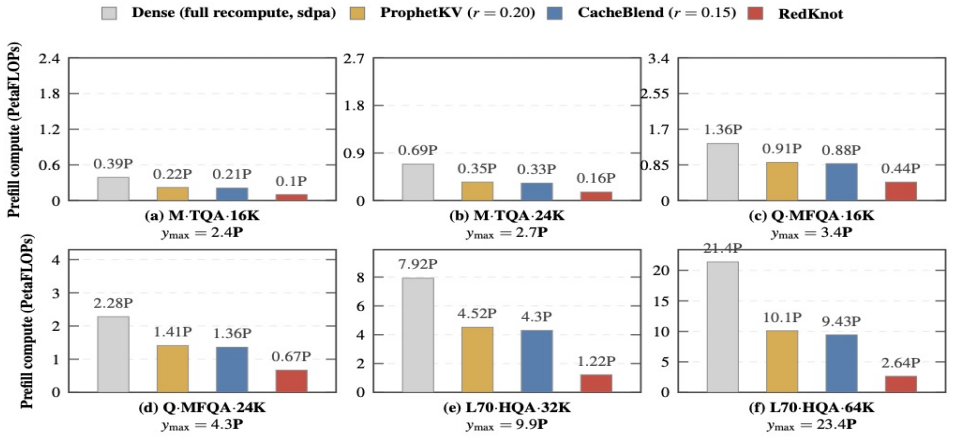
RedKnot claims LLM serving can cut prefill compute by up to 79.5% and raise concurrent sessions per GPU by 4.7–7.8× by managing the KV cache head-by-head instead of as a monolithic block, without retraining or fine-tuning.
Reviewed by Pith at T0; open to challenge. T0 means a machine referee read the full paper against a public rubric. the ladder, T0–T4 →
T0 review · deepseek-v4-flash
2026-08-02 12:16 UTC pith:SG6DEQXH
load-bearing objection Head-aware KV reuse is a real idea with a sharp diagnosis; the evaluation is disclaimed, unreproduced, and partly circular — send it out, but expect heavy revision. the 5 major comments →
RedKnot: Efficient Long-Context LLM Serving with Head-Aware KV Reuse and SegPagedAttention
The pith
A machine-rendered reading of the paper's core claim, the machinery that carries it, and where it could break.
Core claim
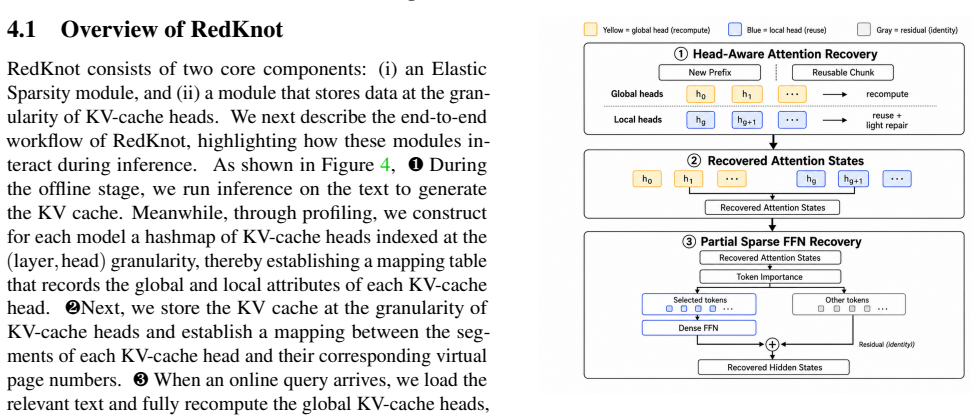
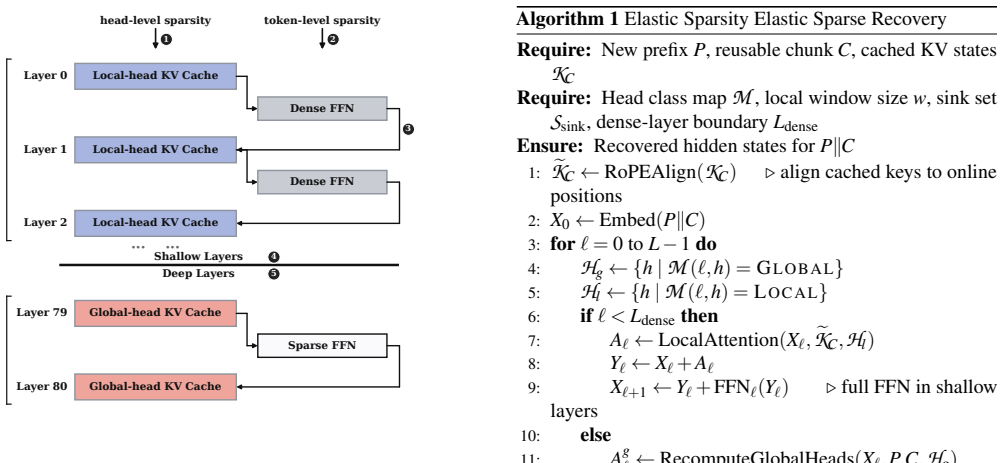
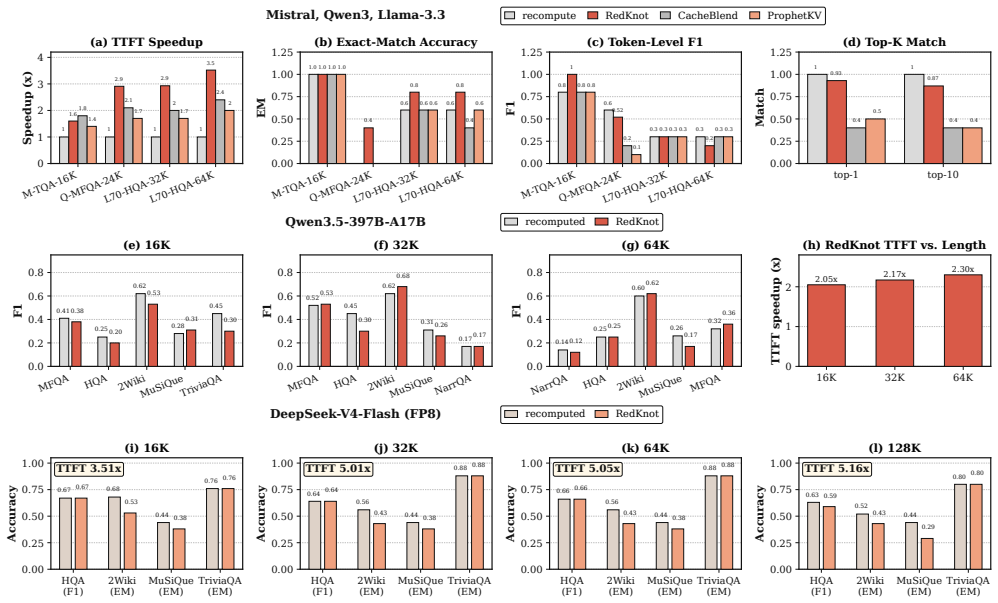
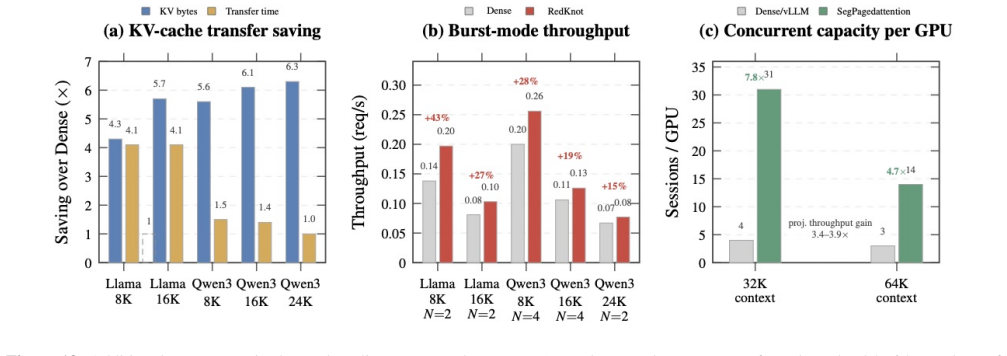
The paper's central claim is that the KV cache's utility is structured by head: offline profiling can classify each (layer, head) pair as global or local, and this classification transfers across prefixes, datasets, and context lengths. On reuse, only global heads are recomputed under the new prefix; local heads are reused with a lightweight repair confined to sink tokens and a sliding window, and low-attention token states skip the FFN update. The claimed result is a quality–efficiency frontier that dominates dense prefill: up to 3.54× TTFT speedup, 4.7–7.8× more concurrent sessions per GPU, 67–79.5% fewer prefill FLOPs, with end-to-end accuracy matching or exceeding the dense baseline, all
What carries the argument
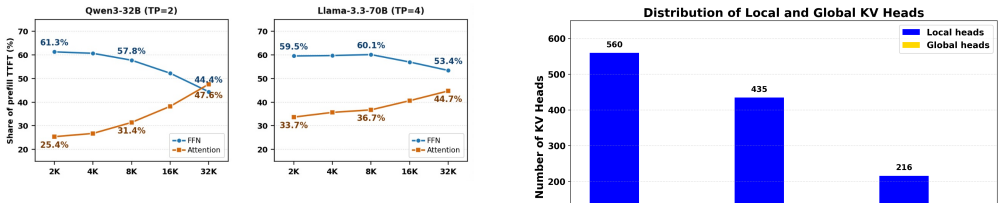
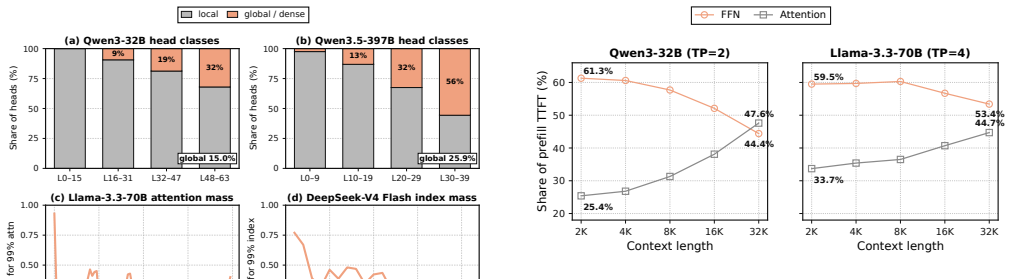
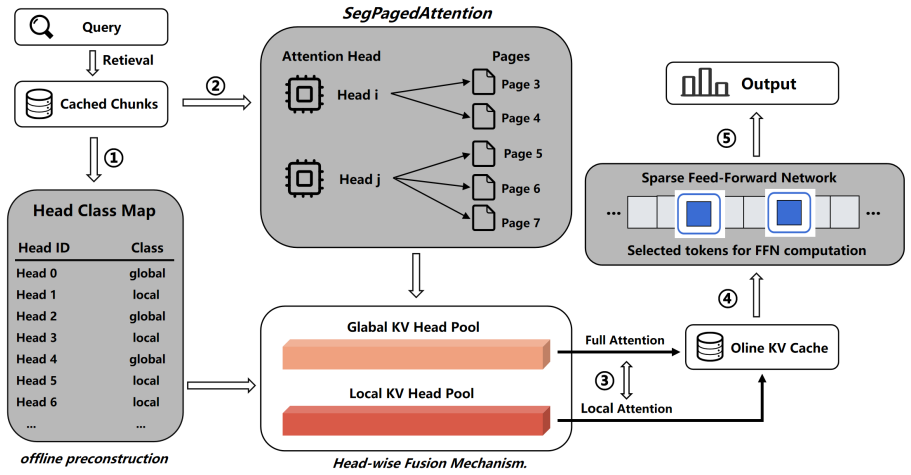
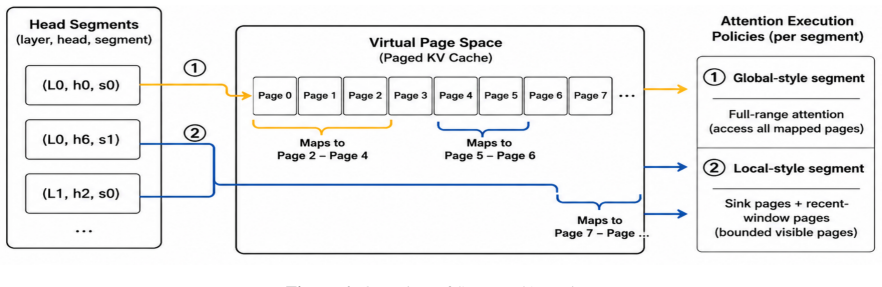
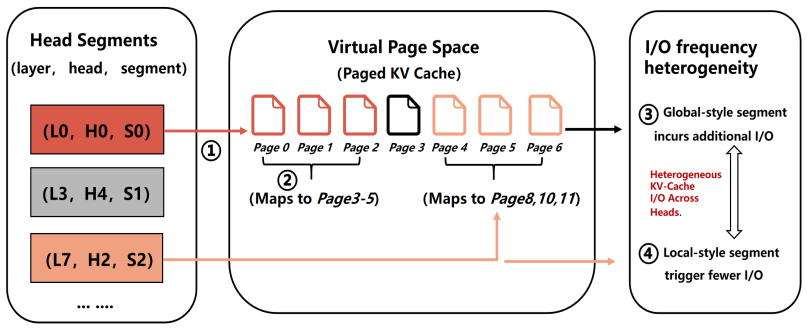
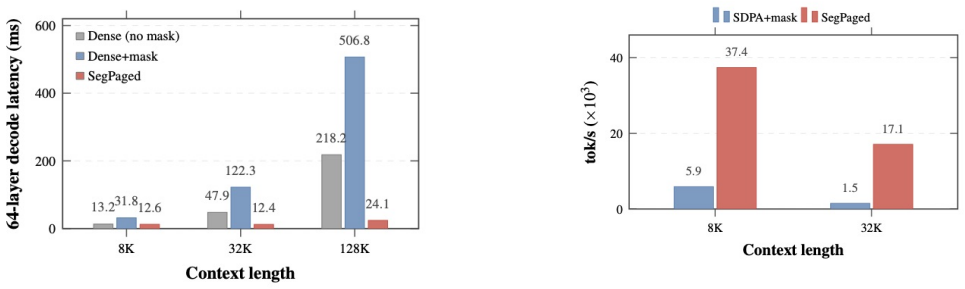
Head-class sparsification: an offline map assigning each KV head to global (12–15% of heads, recomputed on reuse) or local (85–88%, reused within a visible set of sink tokens plus a sliding window). SegPagedAttention: storage indexed by (layer, head, segment) with virtual-page indirection, so each head keeps only the pages it needs and runs through a fused variable-length attention kernel with no attention mask, converting byte savings into bandwidth savings. Sparse FFN: after head-aware recovery, only top-attention tokens execute the FFN; unselected tokens follow the residual identity, attacking the FFN-dominated short-context regime.
Load-bearing premise
The load-bearing premise is that each head's classification as global or local, assigned once during offline calibration, stays correct in deployment; if a 'local' head becomes prefix-sensitive for some query, its stale reused cache is never corrected because the described edge-mass restore is not specified or evaluated.
What would settle it
Run the system on a distribution-shifted workload, such as agent tool-call traces where the same chunk follows many different prefixes, and for each local head measure the attention mass falling outside its visible window on a sample of queries, then compare final accuracy against dense recompute. If that out-of-window mass exceeds the calibration threshold while accuracy drops below roughly 95% of dense, the central claim fails; alternatively, an ablation that removes the global-head recomputation path should show a sharp accuracy cliff if the classification is truly load-bearing.
If this is right
- Position-independent KV reuse shifts from token-level to head-level recovery, escaping the union-of-token-sets problem that makes token-level schemes recompute nearly everything.
- The same head classification supplies a unified mechanism for prefix compression (local heads evict the middle), hot/cold separation, and prefill–decode transfer reduction of 4.3–6.3× in KV bytes.
- Because sparse FFN is structurally independent of context length, the approach accelerates short-context agent workloads that attention-side optimization cannot reach.
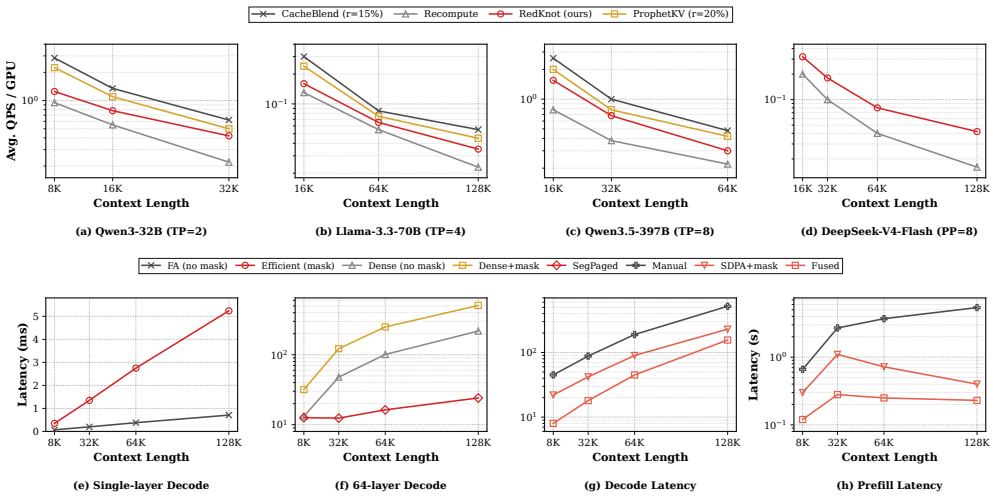
- With SegPagedAttention, local heads occupy constant-length windows, enabling 4.7–7.8× more concurrent sessions per GPU and shifting the memory bottleneck from full dense KV caches to compact per-head caches.
- Longer contexts make attention sparser, so sparse execution can act as denoising; the paper reports RedKnot crossing dense accuracy at 64K–128K contexts.
Where Pith is reading between the lines
- If head classes are stable, a serving engine should expose per-head KV as a first-class scheduling object, making cache admission and eviction head-aware rather than merely chunk-aware; the paper gestures at this but leaves it as future work.
- A testable extension is an online head-class monitor: randomize chunk order per query and measure whether local-head attention mass outside the visible window stays below calibration threshold; this would validate the transferability assumption under distribution shift.
- The sparse-FFN zeroing claim is the least mechanistically justified approximation; a direct probe comparing hidden states with and without FFN skipping on individual tokens would locate where fidelity loss actually concentrates.
- The long-context quality crossover suggests a broader noise-aware scheduling principle: intentionally skipping low-value tokens can improve quality even where no KV reuse occurs, a generalization the paper describes qualitatively but does not formalize.
Editorial analysis
A structured set of objections, weighed in public.
Referee Report
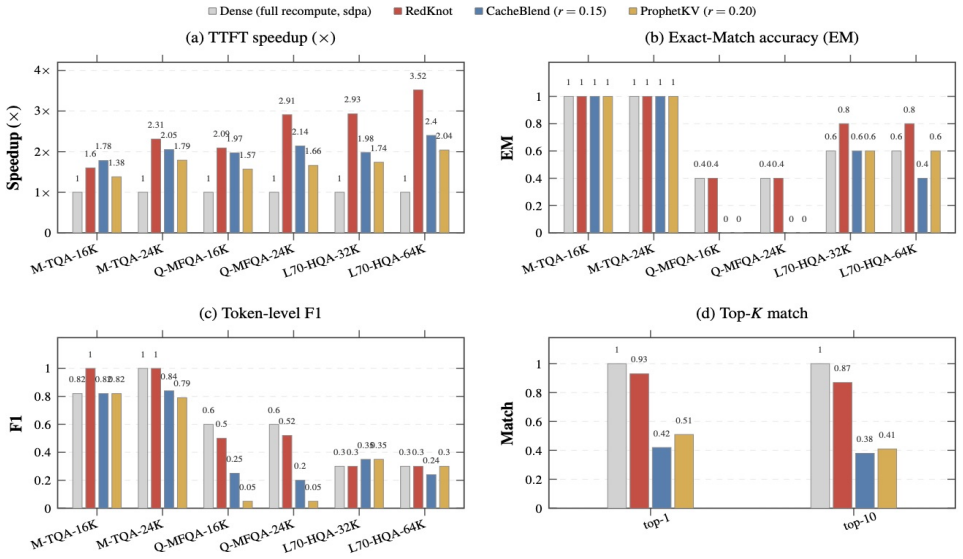
Summary. RedKnot proposes a head-aware KV cache management system that decomposes the KV cache along attention heads, classifies heads offline as global or local, reuses local-head KV with RoPE realignment and bounded-window repair, applies token-level sparse FFN, and introduces SegPagedAttention, a per-(layer,head) paged KV layout with a fused varlen attention kernel. The paper claims 1.6–3.54× TTFT speedup (up to 5.16× in §5.2), 4.7–7.8× concurrency gains, 67–79.5% prefill FLOP reduction, and accuracy matching or exceeding the dense baseline across three model families, six QA datasets, and context lengths 8K–128K, all without model retraining.
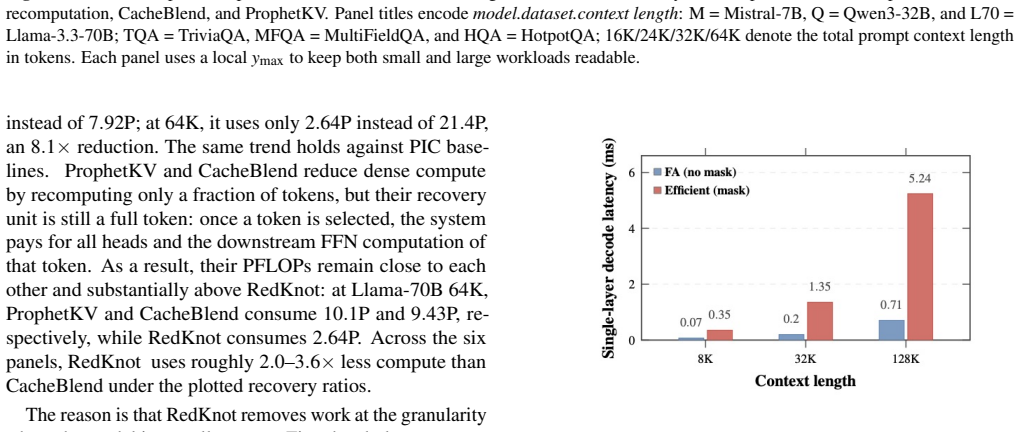
Significance. If the accuracy-preservation claim survives replication, the head-level decomposition is a genuinely useful systems abstraction: it unifies position-independent reuse, prefix compression, hot/cold separation, and distributed KV placement under one substrate. The paper has real strengths: the RoPE realignment is the standard identity, the LSE softmax fusion claim in §4.4 is stated correctly, and the SegPagedAttention microbenchmarks in §5.3 isolate the kernel and report numerical equivalence (cos>0.99998). The public code release is also a plus. However, the load-bearing empirical claim — dense-matching accuracy at 67–79% FLOP reduction — currently rests on an internally inconsistent algorithm listing, an unvalidated stability assumption, and configuration selection that partially predetermines the reported success metric. These issues are substantive but addressable, so the paper is viable in principle with major revision.
major comments (5)
- [§4.2, Algorithm 1, lines 20–23] As printed, Algorithm 1 is internally inconsistent: line 21 computes Z[S] = FFN(Y[S]), and line 22 immediately sets Z[S] = 0, so no FFN update survives. The surrounding text says unselected tokens should follow the residual path, meaning line 22 should zero the complement of S. As printed, the deep-layer sparse FFN is completely skipped, and all Sparse-FFN savings and accuracy results attached to Fig. 3 and §5.2 are not reproducible from the algorithm. This must be corrected and the implementation must be described precisely.
- [§1 vs. §4.2, Algorithm 1, §5] The abstract and introduction promise an 'adaptive runtime restore' that promotes local heads to full attention when an edge-mass signal detects misclassification. This safeguard is never specified in Algorithms 1–2, never implemented in the evaluation, and never tested. The accuracy claims rely on the offline head-class map M transferring to every new prefix, length, and dataset; §3.2/Fig. 4 only report average global/local proportions, not prefix-to-prefix stability. If a profiled local head becomes prefix-sensitive under distribution shift, its stale KV is reused without correction and the error propagates through deeper layers. This is load-bearing: the claimed 'strictly-better-than-dense' frontier depends on stability that is asserted, not demonstrated.
- [§5.1 and §5.4] Part of the accuracy-preservation claim is circular with configuration selection. §5.1 states the Qwen3.5-397B configuration is the 'sweet-spot... selected on the 397B sweep: it is lossless on the 32K TriviaQA calibration setting.' §5.4 states trim<32 was chosen 'as the accuracy-safe operating point' and then reports that first-decode-step cosine stays above the 0.99 pass threshold — the same threshold used for selection. The headline result that accuracy 'matches or exceeds the dense baseline' is therefore partly a consequence of picking configurations that satisfy the evaluation criterion. Please report the full configuration sweep, select thresholds a priori or on a held-out calibration set, and show results for configurations that are not tuned to the reported metric.
- [Abstract, §5.2, Fig. 8] The paper reports inconsistent maximum speedups: the abstract and conclusion state 'up to 3.54× TTFT speedup,' but §5.2 and Fig. 8(i)–(l) report RedKnot reaching 3.51× at 16K and 5.16× at 128K on DeepSeek-V4-Flash. If the 5.16× number is valid, the abstract understates the result; if it is not comparable (e.g., a different baseline or measurement protocol), the discrepancy must be explained. Either way, the headline claim should match the reported measurements.
- [§5.7 and Fig. 13] The 'sparse denoising' claim — that RedKnot overtakes dense accuracy at long context — is presented without statistical significance, error bars, or ablations separating the effect of head-class KV reuse from the effect of sparse FFN token selection. Given that the sparse FFN path zeroes the FFN update for many tokens, the observed accuracy crossover could be sensitive to the specific thresholds (mass_thresh=0.7, etc.). Please provide confidence intervals or repeated-run variance, and an ablation that isolates whether the gain comes from KV reuse, sparse FFN, or their interaction.
minor comments (6)
- [§4.4] Typo: 'Disgussed' should be 'Discussed'.
- [Fig. 5 caption / §5.2 text] 'Retieval' and 'achives' are typos; please proofread figure captions and captions in Fig. 8.
- [§1, footnote] The disclaimer 'The experimental results in the paper are for reference only, the test results from the open-source community code shall prevail' is unusual for a refereed paper and undermines reproducibility. It should be removed or replaced with a clear statement of how to reproduce the reported numbers from the released code and exact environment.
- [References] Several references are to models, datasets, and systems with future or very recent dates (Qwen3.5, DeepSeek-V4, ProphetKV, CacheSlide). Please verify all citations are publicly available and add arXiv identifiers or DOIs where possible.
- [§5.6] The PD-disaggregation experiments 'do not yet enable SegPagedAttention'; this is a significant caveat and should be stated in the main text near Fig. 12, not only in the setup, so readers do not attribute the transfer savings to the new kernel.
- [Algorithm 2] The notation H*ℓ, T*seg, and the packed varlen metadata are used without formal definition; a small example of segment-to-page mapping would improve clarity.
Circularity Check
Two evaluation configs are selected on the metric later reported as success; the central head-aware accuracy claim is independently benchmarked.
specific steps
-
fitted input called prediction
[Section 5.4 (Prefix Compression), Qwen3-32B trim<32 configuration and Fig. 10(a)]
"Because Qwen3-32B is a dense model with no native sliding-window mask, aggressive all-layer trimming collapses; the accuracy-safe operating point is trim<32, i.e. trimming local heads only in the first 32 of 64 layers, with window W=4096 and sink=128. All results use this single configuration. ... the first-decode-step logit cosine against the full-KV baseline stays above the 0.99 pass threshold at every prefix length (0.9911 at 8K, 0.9988 at 16K, 0.9987 at 32K)"
The 'accuracy-safe operating point' was selected precisely because it cleared the 0.99 cosine bar; Fig. 10(a) then reports the same bar as the success criterion ('stays above the 0.99 pass threshold'). Thus the primary pass/fail result of the prefix-compression experiment is the selection rule restated, not an out-of-sample prediction. The cross-dataset cosine/top-match results in Fig. 10(c) are not so forced, so this is a partial, section-local circularity.
-
fitted input called prediction
[Section 5.1 (Qwen3.5-397B-A17B configuration) and Fig. 8(e)-(g), Section 5.2]
"This is the sweet-spot configuration selected on the 397B sweep: it is lossless on the 32K TriviaQA calibration setting while saving about 52% total compute and giving about 2.07×TTFT speedup."
The 397B configuration was chosen by requiring losslessness at the 32K TriviaQA calibration setting, and the same 32K TriviaQA accuracy is then reported as evidence that RedKnot 'preserves accuracy close to full recompute' (Fig. 8). For that cell, matching dense accuracy is effectively guaranteed by the selection criterion; the 16K/64K and other-dataset panels retain independent content.
full rationale
The core RedKnot claim — head-level global/local KV recovery preserves dense-comparable QA accuracy while cutting FLOPs — does not reduce to its inputs. End-to-end accuracy is benchmarked against dense recompute and token-level PIC baselines across multiple datasets and lengths, with no fitted parameter renamed as the reported F1/EM. The two flagged steps are local to calibration-selected cells: the trim<32 prefix-compression result reports the same 0.99 cosine threshold used to pick the configuration, and the 397B 'sweet-spot' config was chosen to be lossless at 32K TriviaQA before that cell is reported as a quality result. These are genuine partial reductions, but they do not make the central multi-dataset comparison circular. Self-citations (EPIC [26], CacheSlide [39]) are contextual background and are not load-bearing. Separately, the intro's promised 'adaptive runtime restore' never appears in Algorithm 1 or Section 5; that is an unsupported robustness claim, relevant to correctness and reproducibility, but not a circularity. Algorithm 1's printed FFN lines (21-22) are internally inconsistent (line 22 zeros the just-written selected-token updates), but this is a reproducibility defect rather than a definitional circularity. Because the reductions are confined to specific calibration-selected evaluations while the central claim has independent content, the score is 4 rather than higher.
Axiom & Free-Parameter Ledger
free parameters (6)
- effective global-head budget ρg =
9.4% / 10.0% / 9.4% / 4.3% / 4.6% for Mistral, Llama-3.3-70B, Qwen3-32B, Qwen3.5-397B, DeepSeek-V4-Flash
- local window size W =
256 (Mistral/Llama); 4096 (Qwen3-32B); 2048 (Qwen3.5-397B); 128 (DeepSeek-V4-Flash, no sink)
- sink size S_sink =
4 tokens (GQA models); 128 (Qwen3 prefix compression); 0 (DeepSeek-V4)
- Sparse-FFN token-selection policy (mass_thresh, dense-layer boundary, recent-keep) =
0.2→0.05 (Llama/Qwen3), 0.7 (Qwen3.5 MoE), 0.6 (DeepSeek-V4); boundaries 20/5/48/9; recent-keep 512/128/256
- prefix-compression operating point =
'trim<32' with W=4096, sink=128, 0.99 cosine pass threshold
- edge-mass restore threshold =
unspecified
axioms (7)
- standard math RoPE rotation alignment: K(p_on) = R(p_on)R(p_off)^{-1} K(p_off)
- standard math LSE softmax fusion over split key sets is exact for a fixed query
- domain assumption (layer,head) global/local class is request-invariant and portable across datasets and lengths
- domain assumption Local-head attention mass concentrates inside W(i)=S_sink∪[i−w,i]
- domain assumption Zeroing FFN updates for low-attention-mass tokens preserves (and at long context improves) output quality
- domain assumption Materialized attn_mask forces a 4.9–7.6× slower SDPA path; mask-free varlen FlashAttention is the fast path
- domain assumption MuSiQue stream reuse statistics generalize to other workloads
read the original abstract
As the input length of large language model (LLM) serving continues to grow, the KV cache has become a dominant bottleneck in AI infrastructure. It limits GPU memory capacity, serving concurrency, cache reuse, and distributed scalability. Multiple important problems, including position-independent KV cache, prefix KV cache compression, hot/cold KV cache separation, and distributed KV cache management, all depend on how the KV cache is represented and managed. However, existing serving systems largely rely on a monolithic KV cache abstraction, where the KV cache is treated as a homogeneous sequence of token-level memory blocks and managed with similar policies across attention heads and serving scenarios. We observe that KV cache utility is highly structured across KV heads: different heads exhibit different functional roles, attention distances, and runtime importance. Therefore, a full KV cache is not always necessary for every head, token range, or serving scenario. We present RedKnot, a head-aware KV cache management system for LLM serving. RedKnot breaks the conventional monolithic KV cache abstraction by decomposing the KV cache along KV heads, whose importance and effective attention ranges vary significantly across serving scenarios. This head-level decomposition turns the KV cache from a monolithic tensor abstraction into a structured memory object, enabling RedKnot to uniformly support position-independent KV reuse, prefix KV compression, hot/cold KV separation, and distributed KV placement while preserving output fidelity and improving resource efficiency, without requiring model retraining or fine-tuning. RedKnot establishes a new foundation for AI infrastructure by transforming the KV cache from a monolithic, passive runtime artifact into a dynamic, model-aware runtime substrate for scalable LLM serving.
Figures






Forward citations
Cited by 1 Pith paper
-
Akashic: A Low-Overhead LLM Inference Service with MemAttention
Akashic’s MemAttention plus locality-aware placement improves agent task accuracy by up to 10.2 points and throughput by up to 1.21× over prior memory systems across four long-horizon workloads.
Reference graph
Works this paper leans on
-
[1]
Gulavani, Alexey Tu- manov, and Ramachandran Ramjee
Amey Agrawal, Nitin Kedia, Ashish Panwar, Jayashree Mohan, Nipun Kwatra, Bhargav S. Gulavani, Alexey Tu- manov, and Ramachandran Ramjee. Taming throughput- latency tradeoff in LLM inference with Sarathi-Serve. In18th USENIX Symposium on Operating Systems De- sign and Implementation (OSDI), pages 117–134, 2024
2024
-
[2]
GQA: Training generalized multi-query transformer models from multi-head checkpoints
Joshua Ainslie, James Lee-Thorp, Michiel de Jong, Yury Zemlyanskiy, Federico Lebrón, and Sumit Sanghai. GQA: Training generalized multi-query transformer models from multi-head checkpoints. InProceedings of the 2023 Conference on Empirical Methods in Natural Language Processing, pages 4895–4901. Association for Computational Linguistics, 2023
2023
-
[3]
Claude Code
Anthropic. Claude Code. https://www.anthropic.com/ claude-code, 2025. Accessed: 2026-06-04. 21
2025
-
[4]
Yushi Bai, Xin Lv, Jiajie Zhang, Hongchang Lyu, Jiankai Tang, Zhidian Huang, Zhengxiao Du, Xiao Liu, Aohan Zeng, Lei Hou, Yuxiao Dong, Jie Tang, and Juanzi Li. LongBench: A bilingual, multitask bench- mark for long context understanding.arXiv preprint arXiv:2308.14508, 2024
Pith/arXiv arXiv 2024
-
[5]
LongBench v2: Towards deeper understanding and reasoning on realis- tic long-context multitasks
Yushi Bai, Shangqing Tu, Jiajie Zhang, Hao Peng, Xi- aozhi Wang, Xin Lv, Shulin Cao, Jiazheng Xu, Lei Hou, Yuxiao Dong, Jie Tang, and Juanzi Li. LongBench v2: Towards deeper understanding and reasoning on realis- tic long-context multitasks. InProceedings of the 63rd Annual Meeting of the Association for Computational Linguistics (Volume 1: Long Papers), ...
2025
-
[6]
Extending context window of large language models via positional interpolation, 2023
Shouyuan Chen, Sherman Wong, Liangjian Chen, and Yuandong Tian. Extending context window of large language models via positional interpolation, 2023
2023
-
[7]
NVIDIA Hopper H100 GPU: Scaling performance.IEEE Micro, 43(3):9–17, 2023
Jack Choquette. NVIDIA Hopper H100 GPU: Scaling performance.IEEE Micro, 43(3):9–17, 2023
2023
-
[8]
Damai Dai, Chengqi Deng, Chenggang Zhao, R. X. Xu, Huazuo Gao, Deli Chen, Jiashi Li, Wangding Zeng, Xingkai Yu, Y . Wu, Zhenda Xie, Y . K. Li, Panpan Huang, Fuli Luo, Chong Ruan, Zhifang Sui, and Wen- feng Liang. DeepSeekMoE: Towards ultimate expert specialization in mixture-of-experts language models, 2024
2024
-
[9]
FlashAttention-2: Faster attention with better parallelism and work partitioning
Tri Dao. FlashAttention-2: Faster attention with better parallelism and work partitioning. InInternational Conference on Learning Representations (ICLR), 2024
2024
-
[10]
Smith, and Matt Gardner
Pradeep Dasigi, Kyle Lo, Iz Beltagy, Arman Cohan, Noah A. Smith, and Matt Gardner. A dataset of information-seeking questions and answers anchored in research papers. InProceedings of the 2021 Conference of the North American Chapter of the Association for Computational Linguistics (NAACL), pages 4599–4610, 2021
2021
-
[11]
DeepSeek-V2: A strong, economical, and efficient mixture-of-experts language model, 2024
DeepSeek-AI. DeepSeek-V2: A strong, economical, and efficient mixture-of-experts language model, 2024
2024
-
[12]
DeepSeek-V3 technical report, 2024
DeepSeek-AI. DeepSeek-V3 technical report, 2024
2024
-
[13]
FlashMLA: Efficient multi-head latent attention kernels
DeepSeek-AI. FlashMLA: Efficient multi-head latent attention kernels. https://github.com/deepseek-ai/Flas hMLA, 2025. Accessed: 2026-06-14
2025
-
[14]
DeepSeek-V4-Flash model card
DeepSeek-AI. DeepSeek-V4-Flash model card. https: //huggingface.co/deepseek-ai/DeepSeek-V4-Flash,
-
[15]
DeepSeek-V4-Pro model card
DeepSeek-AI. DeepSeek-V4-Pro model card. https: //huggingface.co/deepseek-ai/DeepSeek-V4-Pro, 2026. Accessed: 2026-06-14
2026
-
[16]
Huerta, and Hao Peng
Yufeng Du, Minyang Tian, Srikanth Ronanki, Subendhu Rongali, Sravan Babu Bodapati, Aram Galstyan, Az- ton Wells, Roy Schwartz, Eliu A. Huerta, and Hao Peng. Context length alone hurts LLM performance despite perfect retrieval. InFindings of the Association for Computational Linguistics: EMNLP 2025, pages 23281–23298, Suzhou, China, 2025. Association for C...
2025
-
[18]
Switch transformers: Scaling to trillion parameter models with simple and efficient sparsity, 2022
William Fedus, Barret Zoph, and Noam Shazeer. Switch transformers: Scaling to trillion parameter models with simple and efficient sparsity, 2022
2022
-
[19]
Tianyu Fu, Haofeng Huang, Xuefei Ning, Genghan Zhang, Boju Chen, Tianqi Wu, Hongyi Wang, Zix- iao Huang, Shiyao Li, Shengen Yan, Guohao Dai, Huazhong Yang, and Yu Wang. MoA: Mixture of sparse attention for automatic large language model compres- sion.arXiv preprint arXiv:2406.14909, 2024
arXiv 2024
-
[20]
Not all heads matter: A head- level KV cache compression method with integrated retrieval and reasoning
Yu Fu, Zefan Cai, Abedelkadir Asi, Wayne Xiong, Yue Dong, and Wen Xiao. Not all heads matter: A head- level KV cache compression method with integrated retrieval and reasoning. InInternational Conference on Learning Representations, 2025
2025
-
[21]
Yunfan Gao, Yun Xiong, Xinyu Gao, Kangxiang Jia, Jinliu Pan, Yuxi Bi, Yi Dai, Jiawei Sun, Meng Wang, and Haofen Wang. Retrieval-augmented generation for large language models: A survey.arXiv preprint arXiv:2312.10997, 2024
Pith/arXiv arXiv 2024
-
[22]
Prompt Cache: Modular attention reuse for low-latency inference
In Gim, Guojun Chen, Seung-seob Lee, Nikhil Sarda, Anurag Khandelwal, and Lin Zhong. Prompt Cache: Modular attention reuse for low-latency inference. In Proceedings of Machine Learning and Systems (MLSys), 2024
2024
-
[23]
The Llama 3 herd of models.arXiv preprint arXiv:2407.21783, 2024
Aaron Grattafiori, Abhimanyu Dubey, Abhinav Jauhri, et al. The Llama 3 herd of models.arXiv preprint arXiv:2407.21783, 2024
Pith/arXiv arXiv 2024
-
[24]
Constructing a multi-hop QA dataset for comprehensive evaluation of reasoning steps
Xanh Ho, Anh-Khoa Duong Nguyen, Saku Sugawara, and Akiko Aizawa. Constructing a multi-hop QA dataset for comprehensive evaluation of reasoning steps. InProceedings of the 28th International Conference on Computational Linguistics (COLING), pages 6609– 6625, 2020. 22
2020
-
[25]
RULER: What’s the real context size of your long-context language models?, 2024
Cheng-Ping Hsieh, Simeng Sun, Samuel Kriman, Shan- tanu Acharya, Dima Rekesh, Fei Jia, Yang Zhang, and Boris Ginsburg. RULER: What’s the real context size of your long-context language models?, 2024. COLM 2024
2024
-
[26]
EPIC: Efficient position-independent caching for serving large language models
Junhao Hu, Wenrui Huang, Weidong Wang, Haoyi Wang, Tiancheng Hu, Zhang Qin, Hao Feng, Xusheng Chen, Yizhou Shan, and Tao Xie. EPIC: Efficient position-independent caching for serving large language models. InProceedings of the 42nd International Conference on Machine Learning, volume 267 ofPro- ceedings of Machine Learning Research, pages 24391– 24402. PMLR, 2025
2025
-
[27]
Albert Q. Jiang, Alexandre Sablayrolles, Arthur Men- sch, Chris Bamford, Devendra Singh Chaplot, Diego de las Casas, Florian Bressand, Gianna Lengyel, Guil- laume Lample, Lucile Saulnier, Lélio Renard Lavaud, Marie-Anne Lachaux, Pierre Stock, Teven Le Scao, Thibaut Lavril, Thomas Wang, Timothée Lacroix, and William El Sayed. Mistral 7b.arXiv preprint arXi...
Pith/arXiv arXiv 2023
-
[28]
Abdi, Dongsheng Li, Chin-Yew Lin, Yuqing Yang, and Lili Qiu
Huiqiang Jiang, Yucheng Li, Chengruidong Zhang, Qianhui Wu, Xufang Luo, Surin Ahn, Zhenhua Han, Amir H. Abdi, Dongsheng Li, Chin-Yew Lin, Yuqing Yang, and Lili Qiu. MInference 1.0: Accelerating pre-filling for long-context LLMs via dynamic sparse at- tention. InAdvances in Neural Information Processing Systems, 2024
2024
-
[29]
Weld, and Luke Zettlemoyer
Mandar Joshi, Eunsol Choi, Daniel S. Weld, and Luke Zettlemoyer. TriviaQA: A large scale distantly su- pervised challenge dataset for reading comprehension. InProceedings of the 55th Annual Meeting of the As- sociation for Computational Linguistics (ACL), pages 1601–1611, 2017
2017
-
[30]
Gonza- lez, Hao Zhang, and Ion Stoica
Woosuk Kwon, Zhuohan Li, Siyuan Zhuang, Ying Sheng, Lianmin Zheng, Cody Hao Yu, Joseph E. Gonza- lez, Hao Zhang, and Ion Stoica. Efficient memory man- agement for large language model serving with Page- dAttention. InProceedings of the 29th Symposium on Operating Systems Principles (SOSP), pages 611–626, 2023
2023
-
[31]
CATS: Contextually- aware thresholding for sparsity in large language models
Donghyun Lee, Je-Yong Lee, Genghan Zhang, Mo Ti- wari, and Azalia Mirhoseini. CATS: Contextually- aware thresholding for sparsity in large language models. InConference on Language Modeling, 2024
2024
-
[32]
GShard: Scaling gi- ant models with conditional computation and automatic sharding
Dmitry Lepikhin, HyoukJoong Lee, Yuanzhong Xu, De- hao Chen, Orhan Firat, Yanping Huang, Maxim Krikun, Noam Shazeer, and Zhifeng Chen. GShard: Scaling gi- ant models with conditional computation and automatic sharding. InInternational Conference on Learning Representations, 2021
2021
-
[33]
Retrieval-augmented generation for knowledge-intensive NLP tasks
Patrick Lewis, Ethan Perez, Aleksandra Piktus, Fabio Petroni, Vladimir Karpukhin, Naman Goyal, Heinrich Küttler, Mike Lewis, Wen-tau Yih, Tim Rocktäschel, Se- bastian Riedel, and Douwe Kiela. Retrieval-augmented generation for knowledge-intensive NLP tasks. In Advances in Neural Information Processing Systems (NeurIPS), volume 33, pages 9459–9474, 2020
2020
-
[34]
NeedleBench: Evaluating LLM retrieval and reasoning across varying information densities, 2024
Mo Li, Songyang Zhang, Taolin Zhang, Haodong Duan, Yunxin Liu, and Kai Chen. NeedleBench: Evaluating LLM retrieval and reasoning across varying information densities, 2024
2024
-
[35]
Xiaolin Lin, Jingcun Wang, Olga Kondrateva, Yiyu Shi, Bing Li, and Grace Li Zhang. CompressKV: Seman- tic retrieval heads know what tokens are not important before generation.arXiv preprint arXiv:2508.02401, 2025
Pith/arXiv arXiv 2025
-
[36]
Rethinking RoPE: A mathematical blueprint for n-dimensional positional encoding, 2025
Haiping Liu and Hongpeng Zhou. Rethinking RoPE: A mathematical blueprint for n-dimensional positional encoding, 2025
2025
-
[37]
TEAL: Training- free activation sparsity in large language models
James Liu, Pragaash Ponnusamy, Tianle Cai, Han Guo, Yoon Kim, and Ben Athiwaratkun. TEAL: Training- free activation sparsity in large language models. In International Conference on Learning Representations, 2025
2025
-
[38]
Liu, Kevin Lin, John Hewitt, Ashwin Paran- jape, Michele Bevilacqua, Fabio Petroni, and Percy Liang
Nelson F. Liu, Kevin Lin, John Hewitt, Ashwin Paran- jape, Michele Bevilacqua, Fabio Petroni, and Percy Liang. Lost in the middle: How language models use long contexts.Transactions of the Association for Computational Linguistics, 12:157–173, 2024
2024
-
[39]
CacheSlide: Unlocking cross position-aware KV cache reuse for accelerating LLM serving
Yang Liu, Yunfei Gu, Liqiang Zhang, Chentao Wu, Guangtao Xue, Jie Li, Minyi Guo, Junhao Hu, and Jie Meng. CacheSlide: Unlocking cross position-aware KV cache reuse for accelerating LLM serving. InPro- ceedings of the 24th USENIX Conference on File and Storage Technologies, FAST ’26. USENIX Association, 2026
2026
-
[40]
Scissorhands: Exploiting the persistence of importance hypothesis for LLM KV cache compression at test time
Zichang Liu, Aditya Desai, Fangshuo Liao, Weitao Wang, Victor Xie, Zhaozhuo Xu, Anastasios Kyrillidis, and Anshumali Shrivastava. Scissorhands: Exploiting the persistence of importance hypothesis for LLM KV cache compression at test time. InAdvances in Neural Information Processing Systems (NeurIPS), 2023
2023
-
[41]
Deja Vu: Contextual sparsity for efficient LLMs at inference 23 time
Zichang Liu, Jue Wang, Tri Dao, Tianyi Zhou, Binhang Yuan, Zhao Song, Anshumali Shrivastava, Ce Zhang, Yuandong Tian, Christopher Ré, and Beidi Chen. Deja Vu: Contextual sparsity for efficient LLMs at inference 23 time. InProceedings of the 40th International Confer- ence on Machine Learning (ICML), pages 22137–22176, 2023
2023
-
[42]
Rossi, Seunghyun Yoon, and Hinrich Sch"utze
Ali Modarressi, Hanieh Deilamsalehy, Franck Dernon- court, Trung Bui, Ryan A. Rossi, Seunghyun Yoon, and Hinrich Sch"utze. NoLiMa: Long-context evaluation beyond literal matching, 2025. ICML 2025
2025
-
[43]
NVIDIA H100 Tensor Core GPU architecture
NVIDIA. NVIDIA H100 Tensor Core GPU architecture. Whitepaper, NVIDIA Corporation, 2023
2023
-
[44]
Introducing Codex: A cloud-based software engineering agent
OpenAI. Introducing Codex: A cloud-based software engineering agent. https://openai.com/index/introduci ng-codex/, 2025. Accessed: 2025-05-20
2025
-
[45]
OpenClaw, 2025
OpenClaw Contributors. OpenClaw, 2025
2025
-
[46]
Efficiently scal- ing transformer inference
Reiner Pope, Sholto Douglas, Aakanksha Chowdhery, Jacob Devlin, James Bradbury, Jonathan Heek, Kefan Xiao, Shivani Agrawal, and Jeff Dean. Efficiently scal- ing transformer inference. InProceedings of Machine Learning and Systems (MLSys), 2023
2023
-
[47]
Qwen3.5-35B-A3B model card
Qwen Team. Qwen3.5-35B-A3B model card. https: //huggingface.co/Qwen/Qwen3.5-35B-A3B, 2026. Accessed: 2026-06-14
2026
-
[48]
Qwen3.5-397B-A17B model card
Qwen Team. Qwen3.5-397B-A17B model card. https: //huggingface.co/Qwen/Qwen3.5-397B-A17B, 2026. Accessed: 2026-06-14
2026
-
[49]
Qwen3.5 model collection
Qwen Team. Qwen3.5 model collection. https://huggin gface.co/collections/Qwen/qwen35, 2026. Accessed: 2026-06-14
2026
-
[50]
Qwen3.5: Towards native multimodal agents
Qwen Team. Qwen3.5: Towards native multimodal agents. https://qwen.ai/blog?id=qwen3.5, 2026. Accessed: 2026-06-14
2026
-
[51]
HiCache system design and optimiza- tion
SGLang Team. HiCache system design and optimiza- tion. https://docs.sglang.ai/advanced_features/hicache _design.html, 2025. Accessed: 2026-05-31
2025
-
[53]
Jay Shah, Ganesh Bikshandi, Ying Zhang, Vijay Thakkar, Pradeep Ramani, and Tri Dao. FlashAttention- 3: Fast and accurate attention with asynchrony and low- precision.arXiv preprint arXiv:2407.08608, 2024
Pith/arXiv arXiv 2024
-
[54]
Fast transformer decoding: One write- head is all you need.arXiv preprint arXiv:1911.02150, 2019
Noam Shazeer. Fast transformer decoding: One write- head is all you need.arXiv preprint arXiv:1911.02150, 2019
Pith/arXiv arXiv 1911
-
[55]
Outrageously large neural networks: The sparsely-gated mixture-of-experts layer
Noam Shazeer, Azalia Mirhoseini, Krzysztof Maziarz, Andy Davis, Quoc Le, Geoffrey Hinton, and Jeff Dean. Outrageously large neural networks: The sparsely-gated mixture-of-experts layer. InInternational Conference on Learning Representations, 2017
2017
-
[56]
ProSparse: Intro- ducing and enhancing intrinsic activation sparsity within large language models
Chenyang Song, Xu Han, Zhengyan Zhang, Shengding Hu, Xiyu Shi, Kuai Li, Chen Chen, Zhiyuan Liu, Guan- gli Li, Tao Yang, and Maosong Sun. ProSparse: Intro- ducing and enhancing intrinsic activation sparsity within large language models. InProceedings of the 31st In- ternational Conference on Computational Linguistics, 2025
2025
-
[57]
PowerInfer: Fast large language model serving with a consumer-grade GPU
Yixin Song, Zeyu Mi, Haotong Xie, and Haibo Chen. PowerInfer: Fast large language model serving with a consumer-grade GPU. InProceedings of the 30th Symposium on Operating Systems Principles (SOSP), 2024
2024
-
[58]
RoFormer: Enhanced trans- former with rotary position embedding.Neurocomput- ing, 568:127063, 2024
Jianlin Su, Yu Lu, Shengfeng Pan, Ahmed Murtadha, Bo Wen, and Yunfeng Liu. RoFormer: Enhanced trans- former with rotary position embedding.Neurocomput- ing, 568:127063, 2024
2024
-
[59]
Ra- zorAttention: Efficient KV cache compression through retrieval heads
Hanlin Tang, Yang Lin, Jing Lin, Qingsen Han, Danning Ke, Shikuan Hong, Yiwu Yao, and Gongyi Wang. Ra- zorAttention: Efficient KV cache compression through retrieval heads. InInternational Conference on Learn- ing Representations, 2025
2025
-
[60]
Llama 2: Open foundation and fine-tuned chat models
Hugo Touvron, Louis Martin, Kevin Stone, Peter Albert, Amjad Almahairi, Yasmine Babaei, Nikolay Bashlykov, Soumya Batra, Prajjwal Bhargava, Shruti Bhosale, et al. Llama 2: Open foundation and fine-tuned chat models. arXiv preprint arXiv:2307.09288, 2023
Pith/arXiv arXiv 2023
-
[61]
MuSiQue: Multihop questions via single hop question composition.Transactions of the Association for Computational Linguistics, 10:539–554, 2022
Harsh Trivedi, Niranjan Balasubramanian, Tushar Khot, and Ashish Sabharwal. MuSiQue: Multihop questions via single hop question composition.Transactions of the Association for Computational Linguistics, 10:539–554, 2022
2022
-
[62]
Gomez, Łukasz Kaiser, and Illia Polosukhin
Ashish Vaswani, Noam Shazeer, Niki Parmar, Jakob Uszkoreit, Llion Jones, Aidan N. Gomez, Łukasz Kaiser, and Illia Polosukhin. Attention is all you need. InAdvances in Neural Information Processing Systems, 2017
2017
-
[63]
Shihao Wang, Jiahao Chen, Yanqi Pan, Hao Huang, Yichen Hao, Xiangyu Zou, Wen Xia, Wentao Zhang, Chongyang Qiu, and Pengfei Wang. Prophetkv: User- query-driven selective recomputation for efficient kv cache reuse in retrieval-augmented generation.arXiv preprint arXiv:2602.02579, 2026. 24
arXiv 2026
-
[64]
Thomas Wolf, Lysandre Debut, Victor Sanh, Julien Chaumond, Clement Delangue, Anthony Moi, Pierric Cistac, Tim Rault, Remi Louf, Morgan Funtowicz, Joe Davison, Sam Shleifer, Patrick von Platen, Clara Ma, Yacine Jernite, Julien Plu, Canwen Xu, Teven Le Scao, Sylvain Gugger, Mariama Drame, Quentin Lhoest, and Alexander M. Rush. Transformers: State-of-the-art...
2020
-
[65]
LongGenBench: Benchmarking long- form generation in long context LLMs
Yuhao Wu, Ming Shan Hee, Zhiqing Hu, and Roy Ka-Wei Lee. LongGenBench: Benchmarking long- form generation in long context LLMs. InInterna- tional Conference on Learning Representations, 2025. arXiv:2409.02076
Pith/arXiv arXiv 2025
-
[66]
DuoAttention: Efficient long-context LLM inference with retrieval and streaming heads
Guangxuan Xiao, Jiaming Tang, Jingwei Zuo, Junxian Guo, Shang Yang, Haotian Tang, Yao Fu, and Song Han. DuoAttention: Efficient long-context LLM inference with retrieval and streaming heads. InInternational Conference on Learning Representations, 2025
2025
-
[67]
Efficient streaming language models with attention sinks
Guangxuan Xiao, Yuandong Tian, Beidi Chen, Song Han, and Mike Lewis. Efficient streaming language models with attention sinks. InInternational Confer- ence on Learning Representations, 2024
2024
-
[68]
Qwen3 technical report.arXiv preprint arXiv:2505.09388, 2025
An Yang, Anfeng Li, Baosong Yang, Beichen Zhang, Binyuan Hui, Bo Zheng, Bowen Yu, Chang Gao, Chen- gen Huang, Chenxu Lv, Chujie Zheng, Dayiheng Liu, Fan Zhou, Fei Huang, Feng Hu, Hao Ge, Haoran Wei, Huan Lin, Jialong Tang, Jian Yang, Jianhong Tu, Jian- wei Zhang, Jianxin Yang, Jiaxi Yang, Jing Zhou, Jingren Zhou, Junyang Lin, Kai Dang, Keqin Bao, Kexin Ya...
Pith/arXiv arXiv 2025
-
[69]
Gated delta networks: Improving Mamba2 with delta rule,
Songlin Yang, Jan Kautz, and Ali Hatamizadeh. Gated delta networks: Improving Mamba2 with delta rule,
-
[70]
Cohen, Ruslan Salakhutdinov, and Christopher D
Zhilin Yang, Peng Qi, Saizheng Zhang, Yoshua Ben- gio, William W. Cohen, Ruslan Salakhutdinov, and Christopher D. Manning. HotpotQA: A dataset for diverse, explainable multi-hop question answering. In Proceedings of the 2018 Conference on Empirical Meth- ods in Natural Language Processing (EMNLP), pages 2369–2380, 2018
2018
-
[71]
CacheBlend: Fast large language model serving for RAG with cached knowledge fusion
Jiayi Yao, Hanchen Li, Yuhan Liu, Siddhant Du, Xie Han, Shan Cao, and Junchen Jiang. CacheBlend: Fast large language model serving for RAG with cached knowledge fusion. InProceedings of the 19th European Conference on Computer Systems (EuroSys), 2025
2025
-
[72]
H2O: Heavy-hitter oracle for efficient generative inference of large language models
Zhenyu Zhang, Ying Sheng, Tianyi Zhou, Tianlong Chen, Lianmin Zheng, Ruisi Cai, Zhao Song, Yuan- dong Tian, Christopher Ré, Clark Barrett, Zhangyang Wang, and Beidi Chen. H2O: Heavy-hitter oracle for efficient generative inference of large language models. InAdvances in Neural Information Processing Systems (NeurIPS), 2023
2023
-
[73]
Gonzalez, and Ying Sheng
Lianmin Zheng, Liangsheng Yin, Zhiqiang Xie, Jeff Huang, Chuyue Sun, Cody Hao Yu, Shiyi Cao, Christos Kober, Cedric Shi, Kefan Xiao, Ion Stoica, Hao Zhang, Joseph E. Gonzalez, and Ying Sheng. SGLang: Effi- cient execution of structured language model programs. InAdvances in Neural Information Processing Systems (NeurIPS), 2024
2024
-
[74]
Dist- Serve: Disaggregating prefill and decoding for goodput- optimized large language model serving
Yinmin Zhong, Shengyu Liu, Junda Chen, Jianbo Hu, Yibo Zhu, Xuanzhe Liu, Xin Jin, and Hao Zhang. Dist- Serve: Disaggregating prefill and decoding for goodput- optimized large language model serving. In18th USENIX Symposium on Operating Systems Design and Implementation (OSDI), pages 193–210, 2024. 25
2024
-
[2026]
Accessed: 2026-06-14
2026
discussion (0)
Sign in with ORCID, Apple, or X to comment. Anyone can read and Pith papers without signing in.