From Sampled Outcomes to Capability Distributions: Rethinking Supervision for LLM Routing
Pith reviewed 2026-06-27 22:52 UTC · model grok-4.3
The pith
Single LLM responses give noisy supervision for router training, while distribution-aware labels from multiple samples and query variants produce more reliable routing policies.
A machine-rendered reading of the paper's core claim, the machinery that carries it, and where it could break.
Core claim
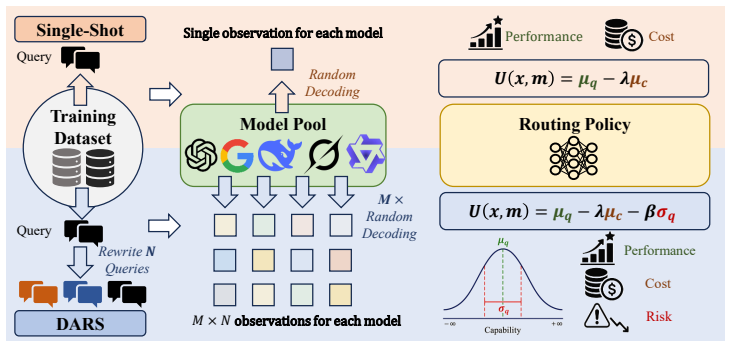
Existing LLM routing methods treat a model's single response to a query as its capability label, but stochastic generation makes this only a noisy observation rather than a reliable estimate. DARS constructs supervision from a distributional view by considering uncertainty from both input reformulations and output generations, producing more stable signals that improve learned routing behavior over single-response baselines.
What carries the argument
DARS (Distribution-Aware Routing Supervision), the framework that replaces single-response labels with aggregated performance across semantically equivalent queries and stochastic generations to estimate model capability distributions.
If this is right
- Routers trained on distribution-aware labels select models more accurately than those trained on single responses.
- Single-shot supervision introduces systematic noise that can be reduced by distributional aggregation.
- Capability estimates become more stable when both query formulation uncertainty and generation stochasticity are modeled.
- Routing performance improves across diverse tasks when supervision reflects query-level capability distributions.
Where Pith is reading between the lines
- The same distributional approach to supervision could apply to other LLM training settings that currently rely on single sampled outputs for labels.
- Routers might eventually output full capability distributions rather than point predictions for downstream decisions.
- This framing suggests re-examining single-sample evaluation practices in model capability assessment more broadly.
Load-bearing premise
Aggregating performance across multiple semantically equivalent query formulations and stochastic generations produces a more accurate estimate of underlying model capability than any single observation.
What would settle it
An experiment in which routers trained on single-shot labels achieve equal or higher accuracy than DARS-trained routers when evaluated on held-out queries and models.
Figures

read the original abstract
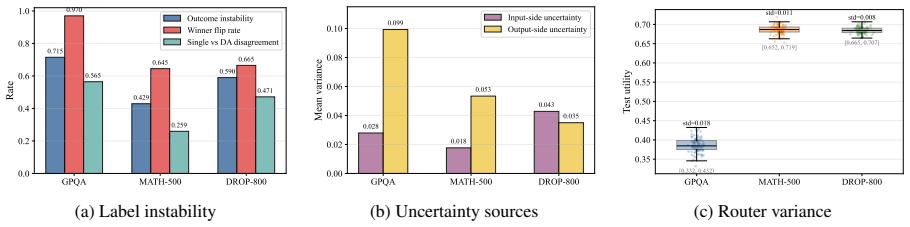
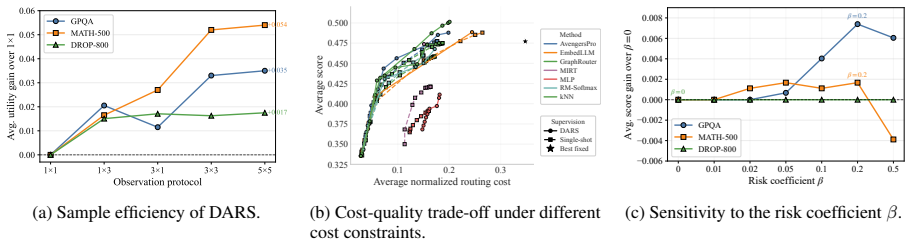
Existing LLM routing methods typically treat a model's single response to a query as its capability label for training routers. However, because LLM generation is inherently stochastic, such single-shot supervision provides only a noisy observation of a query-model pair's behavior rather than a reliable capability estimate. We show that this assumption introduces systematic noise into routing supervision, making learned routing policies less reliable. To address this issue, we propose DARS (Distribution-Aware Routing Supervision), a framework that constructs routing supervision from a distributional view of model behavior. Instead of relying on a single generated response, DARS considers uncertainty from both the input side and the output side, capturing how semantically equivalent query formulations and stochastic generations affect model performance. Based on these distribution-aware observations, DARS builds more reliable supervision signals for routing. Experiments across diverse tasks show that single-shot labels can be misleading for model selection, while distribution-aware supervision provides more stable labels and improves learned routing behavior. Our results suggest that reliable LLM routing should move beyond single-response observations and be grounded in query-level model capability distributions.
Editorial analysis
A structured set of objections, weighed in public.
Referee Report
Summary. The paper claims that single-shot supervision for LLM routing is noisy and unreliable due to the inherent stochasticity of LLM generation, providing only a point observation rather than a true capability estimate. It introduces DARS (Distribution-Aware Routing Supervision), a framework that constructs labels from distributions over semantically equivalent query reformulations (input-side uncertainty) and multiple stochastic outputs (output-side uncertainty). The abstract asserts that experiments across diverse tasks demonstrate single-shot labels can be misleading while distribution-aware supervision yields more stable labels and better routing performance, advocating a shift to query-level capability distributions.
Significance. If the empirical claims hold, the work could meaningfully influence LLM routing research and practice by identifying a systematic source of supervision noise and offering a practical alternative grounded in distributional observations. This addresses a real deployment issue in cost-aware model selection and could lead to more robust routers. The conceptual framing is coherent and the distinction between point and distributional supervision is clearly articulated without internal contradictions.
minor comments (1)
- Abstract: the claim that 'experiments across diverse tasks show' the superiority of distribution-aware supervision is stated without any reference to specific tasks, datasets, metrics, baselines, or quantitative results, which limits the ability to assess the strength of the central empirical claim from the provided material.
Simulated Author's Rebuttal
We thank the referee for their summary and for recognizing the conceptual coherence of our framing around point versus distributional supervision in LLM routing. The report does not list any specific major comments, so we have no point-by-point responses or revisions to propose at this stage. We remain available to address any additional questions the referee may have.
Circularity Check
No significant circularity; derivation is self-contained
full rationale
The paper advances a conceptual proposal (DARS) that single-shot labels are noisy due to stochastic generation while distributional supervision over query variants and outputs yields stabler signals. No equations, fitted parameters, or derivations appear in the abstract or described structure that reduce by construction to inputs, self-citations, or renamed empirical patterns. The central distinction between point observations and capability distributions is presented as an empirical modeling choice rather than a mathematical identity or load-bearing self-reference. The argument remains independent of any uniqueness theorem or ansatz imported from prior author work.
Axiom & Free-Parameter Ledger
Forward citations
Cited by 1 Pith paper
-
RouteJudge: An Open Platform for Reproducible and Preference-Aware LLM Routing
RouteJudge introduces an open platform for preference-based evaluation of LLM routers via pairwise user comparisons, along with the ORBIT toolbox for standardized routing workflows.
Reference graph
Works this paper leans on
-
[1]
Patricia S. Abril and Robert Plant. The patent holder's dilemma: Buy, sell, or troll?. Communications of the ACM. doi:10.1145/1188913.1188915
-
[2]
Deciding equivalances among conjunctive aggregate queries
Sarah Cohen and Werner Nutt and Yehoshua Sagic. Deciding equivalances among conjunctive aggregate queries. doi:10.1145/1219092.1219093
-
[3]
arXiv preprint arXiv:2602.03478 , year=
When Routing Collapses: On the Degenerate Convergence of LLM Routers , author=. arXiv preprint arXiv:2602.03478 , year=
-
[4]
Special issue: Digital Libraries. 1996
1996
-
[5]
Understanding Policy-Based Networking
David Kosiur. Understanding Policy-Based Networking
-
[8]
The title of book two. doi:10.1007/3-540-09237-4
-
[9]
Asad Z. Spector. Achieving application requirements. Distributed Systems. doi:10.1145/90417.90738
-
[10]
Douglass and David Harel and Mark B
Bruce P. Douglass and David Harel and Mark B. Trakhtenbrot. Statecarts in use: structured analysis and object-orientation. Lectures on Embedded Systems. doi:10.1007/3-540-65193-4_29
-
[11]
Donald E. Knuth. The Art of Computer Programming, Vol. 1: Fundamental Algorithms (3rd. ed.)
-
[12]
Donald E. Knuth. The Art of Computer Programming
-
[13]
Structured Variational Inference Procedures and their Realizations (as incol)
Dan Geiger and Christopher Meek. Structured Variational Inference Procedures and their Realizations (as incol). Proceedings of Tenth International Workshop on Artificial Intelligence and Statistics, The Barbados
-
[14]
Stan W. Smith. An experiment in bibliographic mark-up: Parsing metadata for XML export. Proceedings of the 3rd. annual workshop on Librarians and Computers
-
[15]
Catch me, if you can: Evading network signatures with web-based polymorphic worms
Matthew Van Gundy and Davide Balzarotti and Giovanni Vigna. Catch me, if you can: Evading network signatures with web-based polymorphic worms. Proceedings of the first USENIX workshop on Offensive Technologies
-
[16]
Sten Andler. Predicate Path expressions. Proceedings of the 6th. ACM SIGACT-SIGPLAN symposium on Principles of Programming Languages. doi:10.1145/567752.567774
-
[17]
LOGICS of Programs: AXIOMATICS and DESCRIPTIVE POWER
David Harel. LOGICS of Programs: AXIOMATICS and DESCRIPTIVE POWER
-
[18]
Anisi , title =
David A. Anisi , title =
-
[19]
Clarkson
Kenneth L. Clarkson. Algorithms for Closest-Point Problems (Computational Geometry)
-
[20]
Introduction to Bayesian Statistics
Harry Thornburg. Introduction to Bayesian Statistics. 2001
2001
-
[21]
CLIFFORD: a Maple 11 Package for Clifford Algebra Computations, version 11
Rafal Ablamowicz and Bertfried Fauser. CLIFFORD: a Maple 11 Package for Clifford Algebra Computations, version 11. 2007
2007
-
[22]
Stats and Analysis
Poker-Edge.Com. Stats and Analysis. 2006
2006
-
[23]
A more perfect union
Barack Obama. A more perfect union
-
[24]
The fountain of youth
Joseph Scientist. The fountain of youth
-
[25]
Solder man
Dave Novak. Solder man. ACM SIGGRAPH 2003 Video Review on Animation theater Program: Part I - Vol. 145 (July 27--27, 2003). doi:10.945/woot07-S422
2003
-
[26]
Interview with Bill Kinder: January 13, 2005
Newton Lee. Interview with Bill Kinder: January 13, 2005. Comput. Entertain. doi:10.1145/1057270.1057278
-
[27]
The Enabling of Digital Libraries
Bernard Rous. The Enabling of Digital Libraries. Digital Libraries
-
[29]
(new) Finding minimum congestion spanning trees , journal =
Werneck, Renato and Setubal, Jo\. (new) Finding minimum congestion spanning trees , journal =. doi:10.1145/351827.384253 , acmid = 384253, publisher =
-
[31]
Conti, Mauro and Di Pietro, Roberto and Mancini, Luigi V. and Mei, Alessandro , title =. Inf. Fusion , volume =. 2009 , issn =. doi:10.1016/j.inffus.2009.01.002 , acmid =
-
[32]
Li, Cheng-Lun and Buyuktur, Ayse G. and Hutchful, David K. and Sant, Natasha B. and Nainwal, Satyendra K. , title =. CHI '08 extended abstracts on Human factors in computing systems , year =. doi:10.1145/1358628.1358946 , acmid =
-
[33]
, title =
Hollis, Billy S. , title =. 1999 , isbn =
1999
-
[34]
Goossens, Michel and Rahtz, S. P. and Moore, Ross and Sutor, Robert S. , title =. 1999 , isbn =
1999
-
[35]
and Rosenberg, Arnold L
Buss, Jonathan F. and Rosenberg, Arnold L. and Knott, Judson D. , title =. 1987 , source =
1987
-
[36]
CHI '08: CHI '08 extended abstracts on Human factors in computing systems , year =
, note =. CHI '08: CHI '08 extended abstracts on Human factors in computing systems , year =
-
[37]
Algorithms for Closest-Point Problems (Computational Geometry) , year =
Clarkson, Kenneth Lee , advisor =. Algorithms for Closest-Point Problems (Computational Geometry) , year =
-
[38]
SIGCOMM Comput. Commun. Rev. , year =
-
[39]
IEEE TCSC Executive Committee , booktitle =. 2004 , isbn =. doi:http://dx.doi.org/10.1109/ICWS.2004.64 , acmid =
-
[40]
Distributed systems (2nd Ed.) , year =
-
[41]
, title =
Petrie, Charles J. , title =. 1986 , source =
1986
-
[42]
Donald E. Knuth. Seminumerical Algorithms. 1981
1981
-
[43]
E-commerce and cultural values , year =
Kong, Wei-Chang , Title =. E-commerce and cultural values , year =
-
[44]
E-commerce and cultural values , year =
Kong, Wei-Chang , type =. E-commerce and cultural values , year =
-
[45]
Chapter 9 , booktitle =
Kong, Wei-Chang , editor =. Chapter 9 , booktitle =
-
[46]
E-commerce and cultural values , editor =
Kong, Wei-Chang , title =. E-commerce and cultural values , editor =. 2003 , isbn =
2003
-
[47]
E-commerce and cultural values - (InBook-num-in-chap) , chapter =
Kong, Wei-Chang , editor =. E-commerce and cultural values - (InBook-num-in-chap) , chapter =. 2004 , address =
2004
-
[48]
E-commerce and cultural values (Inbook-text-in-chap) , chapter =
Kong, Wei-Chang , editor =. E-commerce and cultural values (Inbook-text-in-chap) , chapter =. 2005 , address =
2005
-
[49]
E-commerce and cultural values (Inbook-num chap) , chapter =
Kong, Wei-Chang , editor =. E-commerce and cultural values (Inbook-num chap) , chapter =. 2006 , address =
2006
-
[50]
Microelectron
Mehdi Saeedi and Morteza Saheb Zamani and Mehdi Sedighi , title =. Microelectron. J. , volume =. 2010 , pages =
2010
-
[51]
Mehdi Saeedi and Morteza Saheb Zamani and Mehdi Sedighi and Zahra Sasanian , title =. J. Emerg. Technol. Comput. Syst. , volume =
-
[52]
Kirschmer, Markus and Voight, John , title =. SIAM J. Comput. , issue_date =. 2010 , issn =. doi:https://doi.org/10.1137/080734467 , acmid =
-
[53]
Hoare, C. A. R. , title =. Structured programming (incoll) , editor =. 1972 , isbn =
1972
-
[54]
History of programming languages I (incoll) , editor =
Lee, Jan , title =. History of programming languages I (incoll) , editor =. 1981 , isbn =. doi:http://doi.acm.org/10.1145/800025.1198348 , acmid =
-
[55]
, title =
Dijkstra, E. , title =. Classics in software engineering (incoll) , year =
-
[56]
Wenzel, Elizabeth M. , title =. Multimedia interface design (incoll) , year =. doi:10.1145/146022.146089 , acmid =
-
[57]
, title =
Mumford, E. , title =. Critical issues in information systems research (incoll) , year =
-
[58]
and Golden, Donald G
McCracken, Daniel D. and Golden, Donald G. , title =. 1990 , isbn =
1990
-
[59]
The analysis of linear partial differential operators
H. The analysis of linear partial differential operators. 1985 , PAGES =
1985
-
[60]
IEEE", address =
A. Adya and P. Bahl and J. Padhye and A.Wolman and L. Zhou , title =. Proceedings of the IEEE 1st International Conference on Broadnets Networks (BroadNets'04) , publisher = "IEEE", address = "Los Alamitos, CA", year =
-
[61]
I. F. Akyildiz and W. Su and Y. Sankarasubramaniam and E. Cayirci , title =. Comm. ACM , volume = 38, number = "4", year =
-
[62]
I. F. Akyildiz and T. Melodia and K. R. Chowdhury , title =. Computer Netw. , volume = 51, number = "4", year =
-
[63]
ACM", address =
P. Bahl and R. Chancre and J. Dungeon , title =. Proceeding of the 10th International Conference on Mobile Computing and Networking (MobiCom'04) , publisher = "ACM", address = "New York, NY", year =
-
[64]
8 (Special Issue on Sensor Networks)
D. Culler and D. Estrin and M. Srivastava , title =. IEEE Comput. , volume = 37, number = "8 (Special Issue on Sensor Networks)", publisher = "IEEE", address = "Los Alamitos, CA", year =
-
[65]
Natarajan and M
A. Natarajan and M. Motani and B. de Silva and K. Yap and K. C. Chua , title =. Network Architectures , editor =. 960935712
-
[66]
Tzamaloukas and J
A. Tzamaloukas and J. J. Garcia-Luna-Aceves , title =
-
[67]
Zhou and J
G. Zhou and J. Lu and C.-Y. Wan and M. D. Yarvis and J. A. Stankovic , title =
-
[68]
Mapping Powerlists onto Hypercubes
Jacob Kornerup. Mapping Powerlists onto Hypercubes. 1994
1994
-
[69]
Automatic Parallelization for Distributed-Memory Multiprocessing Systems
Michael Gerndt. Automatic Parallelization for Distributed-Memory Multiprocessing Systems
-
[70]
J. E. Archer, Jr. and R. Conway and F. B. Schneider. User recovery and reversal in interactive systems. ACM Trans. Program. Lang. Syst
-
[71]
D. D. Dunlop and V. R. Basili. Generalizing specifications for uniformly implemented loops. ACM Trans. Program. Lang. Syst
-
[72]
Heering and P
J. Heering and P. Klint. Towards monolingual programming environments. ACM Trans. Program. Lang. Syst
-
[73]
Donald E. Knuth. The book
-
[74]
Korach and D
E. Korach and D. Rotem and N. Santoro. Distributed algorithms for finding centers and medians in networks. ACM Trans. Program. Lang. Syst
-
[75]
: A Document Preparation System
Leslie Lamport. : A Document Preparation System
-
[76]
F. Nielson. Program transformations in a denotational setting. ACM Trans. Program. Lang. Syst
-
[77]
AAAI , year=
Capability instruction tuning: A new paradigm for dynamic llm routing , author=. AAAI , year=
-
[78]
arXiv preprint arXiv:2601.17814 , year=
MMR-Bench: A Comprehensive Benchmark for Multimodal LLM Routing , author=. arXiv preprint arXiv:2601.17814 , year=
-
[79]
LLM -Blender: Ensembling Large Language Models with Pairwise Ranking and Generative Fusion
Jiang, Dongfu and Ren, Xiang and Lin, Bill Yuchen. LLM -Blender: Ensembling Large Language Models with Pairwise Ranking and Generative Fusion. ACL. 2023
2023
-
[80]
2025 , journal=
LLMRank: Understanding LLM Strengths for Model Routing , author=. 2025 , journal=
2025
-
[81]
arXiv preprint arXiv:2502.20576 , year=
OmniRouter: Budget and Performance Controllable Multi-LLM Routing , author=. arXiv preprint arXiv:2502.20576 , year=
-
[82]
IEEE Transactions on Mobile Computing , year=
Quality-of-Service Aware LLM Routing for Edge Computing with Multiple Experts , author=. IEEE Transactions on Mobile Computing , year=
-
[83]
arXiv preprint arXiv:2501.01818 , year=
Rerouting llm routers , author=. arXiv preprint arXiv:2501.01818 , year=
-
[84]
arXiv preprint arXiv:2407.10834 , year=
Metallm: A high-performant and cost-efficient dynamic framework for wrapping llms , author=. arXiv preprint arXiv:2407.10834 , year=
discussion (0)
Sign in with ORCID, Apple, or X to comment. Anyone can read and Pith papers without signing in.