REVIEW 2 minor 1 cited by
Cross-correlating CSST galaxies with future gravitational-wave catalogs can statistically identify primordial black hole contributions to mergers above 20-40 percent.
Reviewed by Pith at T0; open to challenge. T0 means a machine referee read the full paper against a public rubric. the ladder, T0–T4 →
T0 review · grok-4.3
2026-06-27 00:13 UTC pith:CMBMKZTX
load-bearing objection Forecasts show CSST plus ET2CE or BDET2CE can flag PBH contributions above 40% or 20% via clustering bias, but the numbers rest on mock assumptions.
Synergy between CSST and future gravitational-wave detectors: Probing primordial black holes by cross-correlating dark sirens with galaxies
The pith
A machine-rendered reading of the paper's core claim, the machinery that carries it, and where it could break.
Core claim
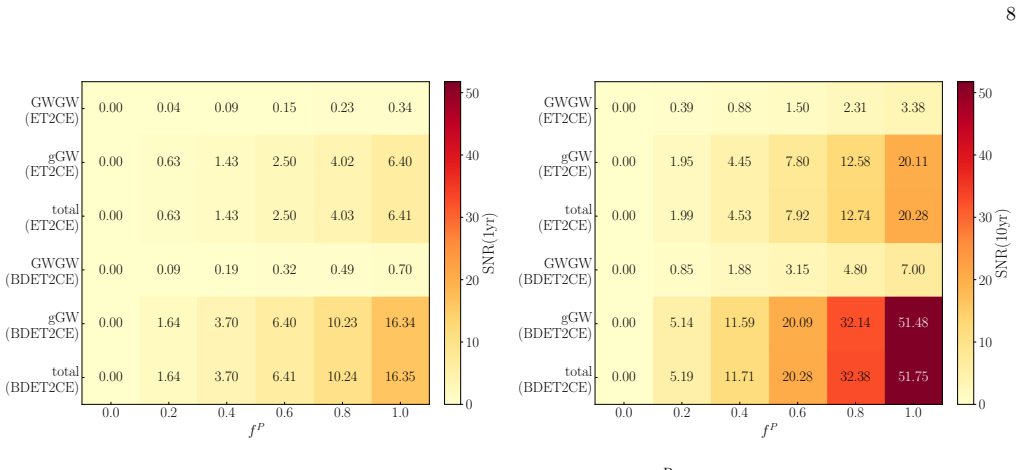
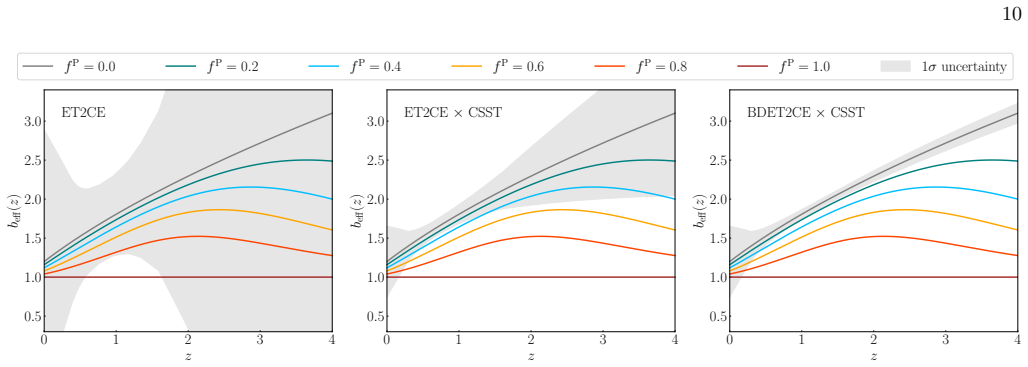
The cross-correlation between CSST galaxies and gravitational-wave events measures the effective clustering bias of the gravitational-wave population; because primordial black holes are expected to inhabit different environments than astrophysical black holes, this bias differs between the two populations, allowing a primordial black hole fraction above 40 percent to be detected with ET2CE and above 20 percent with BDET2CE after ten years of observation.
What carries the argument
The angular cross-power spectrum between galaxy overdensity and gravitational-wave event density, from which the effective bias of the gravitational-wave sources is extracted and compared against the bias expected for each population.
Load-bearing premise
Primordial black holes and astrophysical black holes populate different environments and therefore exhibit measurably different clustering biases with galaxies.
What would settle it
A measured cross-correlation amplitude between CSST galaxies and gravitational-wave events that remains consistent with the astrophysical-black-hole bias even in simulated catalogs containing a 50 percent primordial black hole fraction would falsify the separation method.
If this is right
- CSST combined with ten years of ET2CE data detects a primordial black hole contribution once it exceeds 40 percent of the total merger rate.
- The sharper sky localization provided by BDET2CE recovers small-scale clustering information and lowers the detectable threshold to 20 percent.
- The method works for dark sirens without electromagnetic counterparts by using only sky positions and the galaxy survey.
- This clustering-based approach supplies an independent probe of primordial black holes that does not rely on microlensing, accretion signatures, or cosmic microwave background constraints.
Where Pith is reading between the lines
- If the bias difference is confirmed, the same cross-correlation technique could be applied to future galaxy surveys with higher redshift reach to track changes in the primordial black hole merger fraction over cosmic time.
- Combining this method with improved detector networks could test whether primordial black holes contribute to the dark matter density through their merger-rate imprint on large-scale structure.
- The approach opens a route to cross-check results from other primordial black hole searches by using environmental clustering rather than mass or spin distributions alone.
Editorial analysis
A structured set of objections, weighed in public.
Referee Report
Summary. The manuscript presents a forecast study showing that cross-correlating galaxies from the CSST photometric survey with mock gravitational-wave (dark siren) catalogs from the ET2CE network can statistically reveal a primordial black hole (PBH) contribution to the total merger rate once that fraction exceeds ~40%; the BDET2CE network, with superior sky localization, lowers the threshold to ~20%. The separation relies on the assumption that PBHs and astrophysical black holes exhibit measurably different clustering biases with galaxies.
Significance. If the enabling premise of different clustering biases holds, the work supplies a largely independent statistical route to identifying PBHs that complements microlensing, dynamical, and CMB constraints. The use of mock catalogs to derive quantitative detection thresholds for two specific future detector networks, and the explicit demonstration that improved localization recovers small-scale clustering information, are clear strengths of the forecast approach.
minor comments (2)
- The abstract states the 40% and 20% thresholds but does not quote the specific bias values adopted for the PBH and astrophysical populations; adding these numbers would make the central claim more self-contained.
- Section describing the mock catalog construction (redshift distribution, number of events, and error modeling) should explicitly state how the assumed bias difference is implemented and whether it is varied in robustness checks.
Simulated Author's Rebuttal
We thank the referee for their positive summary and recommendation of minor revision. The report contains no specific major comments requiring point-by-point response.
Circularity Check
No significant circularity identified
full rationale
The paper's central result consists of numerical detection thresholds (40% and 20% PBH fractions) obtained from forecasts on mock GW catalogs cross-correlated with CSST galaxies, under the explicit input assumption that PBHs and astrophysical BHs exhibit different clustering biases. This is a standard simulation-based forecast rather than a closed derivation; the thresholds follow from the modeling choices and do not reduce to fitted parameters or self-citations by construction. No self-definitional steps, fitted-input predictions, or load-bearing self-citations appear in the abstract or described chain. The derivation remains self-contained against external benchmarks.
Axiom & Free-Parameter Ledger
axioms (1)
- domain assumption Primordial black holes and astrophysical black holes populate different environments and therefore cluster with different biases relative to galaxies.
read the original abstract
Gravitational-wave (GW) events and galaxies both trace the cosmic matter distribution, but the mergers of astrophysical black holes and primordial black holes (PBHs) are expected to populate different environments and therefore to cluster with different biases. The GW clustering bias is thus a statistical observable that can separate the two populations. We assess how well this can be done by cross-correlating the photometric galaxy survey of the Chinese Space-station Survey Telescope (CSST) with mock GW catalogs from two future detector networks: the third-generation ET2CE network (the Einstein Telescope and two Cosmic Explorer detectors) and the multi-band BDET2CE network, which adds the space-based baseline Decihertz Interferometer Gravitational-Wave Observatory. We find that CSST combined with 10 years of ET2CE observations can reveal a PBH contribution once its fraction in the total merger rate exceeds about $40\%$, while the much sharper sky localization of BDET2CE lowers this threshold to about $20\%$. The improvement comes from recovering the small-scale clustering information that localization errors would otherwise erase. These results show that combining future GW detector networks with CSST galaxy clustering offers a promising and largely independent route to identifying PBHs statistically.
Figures


Forward citations
Cited by 1 Pith paper
-
Identifying lensed gravitational waves with physics-informed posterior learning
Fusing a simulation-trained common-source mass posterior with waveform features raises lensed-event detection efficiency from 20.8% to 35.2% at 1% false-positive rate and lowers the SNR for 50% efficiency from 45.3 to 33.5.
Reference graph
Works this paper leans on
-
[1]
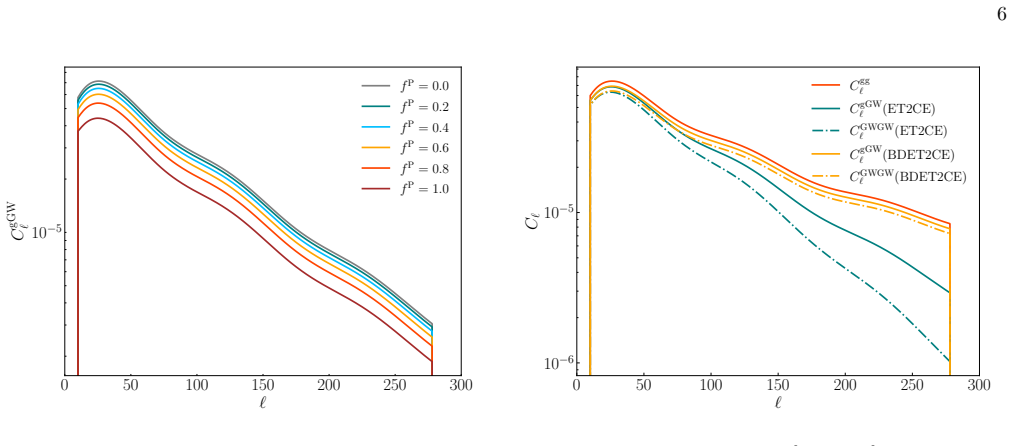
with the Limber approximation to compute the the- oretical angular power spectra. For the GW-GW auto-correlation and galaxy-GW cross-correlation, we account for the signal attenuation due to sky localization errors of GW sources, as follows: CgGW ℓ (dL,i, zj)7→C gGW ℓ (dL,i, zj)×e −ℓ(ℓ+1)/ℓ2 damp ,(13) CGWGW ℓ (dL,i, dL,j)7→C GWGW ℓ (dL,i, dL,j) ×e −2ℓ(ℓ+...
2018
-
[2]
B. P. Abbottet al.(LIGO Scientific, Virgo), Phys. Rev. Lett.116, 061102 (2016), arXiv:1602.03837 [gr-qc]
work page internal anchor Pith review Pith/arXiv arXiv 2016
-
[3]
A. G. Abacet al.(LIGO Scientific, VIRGO, KAGRA), (2025), arXiv:2508.18083 [astro-ph.HE]
work page internal anchor Pith review Pith/arXiv arXiv 2025
-
[4]
Black holes, gravitational waves and fundamental physics: a roadmap
L. Baracket al., Class. Quant. Grav.36, 143001 (2019), arXiv:1806.05195 [gr-qc]
work page internal anchor Pith review Pith/arXiv arXiv 2019
-
[5]
B. J. Carr and S. W. Hawking, Mon. Not. Roy. Astron. Soc.168, 399 (1974)
1974
-
[6]
B. Carr, F. Kuhnel, and M. Sandstad, Phys. Rev. D 94, 083504 (2016), arXiv:1607.06077 [astro-ph.CO]
work page internal anchor Pith review Pith/arXiv arXiv 2016
-
[7]
Primordial Black Holes as Dark Matter Candidates
B. Carr and F. Kuhnel, SciPost Phys. Lect. Notes48, 1 (2022), arXiv:2110.02821 [astro-ph.CO]
work page Pith review arXiv 2022
-
[8]
C. Zhang and X. Zhang, JHEP10, 037 (2023), arXiv:2302.07002 [hep-ph]
-
[9]
C. Zhang and X. Zhang, Eur. Phys. J. C84, 100 (2024), arXiv:2308.07166 [hep-ph]
-
[10]
G. Dom` enech, S. Pi, and A. Wang, (2026), arXiv:2602.24061 [astro-ph.CO]
- [11]
-
[12]
V. De Luca, G. Franciolini, A. Kehagias, M. Peloso, A. Riotto, and C. ¨Unal, JCAP07, 048 (2019), arXiv:1904.00970 [astro-ph.CO]
-
[13]
C.-M. Yoo, T. Harada, J. Garriga, and K. Kohri, PTEP 2018, 123E01 (2018), [Erratum: PTEP 2024, 049202 (2024)], arXiv:1805.03946 [astro-ph.CO]
work page Pith review arXiv 2018
-
[14]
Primordial blackholes and gravitational waves for an inflection-point model of inflation
S. Choudhury and A. Mazumdar, Phys. Lett. B733, 270 (2014), arXiv:1307.5119 [astro-ph.CO]
work page internal anchor Pith review Pith/arXiv arXiv 2014
- [15]
- [16]
-
[17]
S. W. Hawking, I. G. Moss, and J. M. Stewart, Phys. Rev. D26, 2681 (1982)
1982
-
[18]
I. G. Moss, Phys. Rev. D32, 1333 (1985)
1985
-
[19]
Primordial Black Holes - Perspectives in Gravitational Wave Astronomy -
M. Sasaki, T. Suyama, T. Tanaka, and S. Yokoyama, Class. Quant. Grav.35, 063001 (2018), arXiv:1801.05235 [astro-ph.CO]
work page internal anchor Pith review Pith/arXiv arXiv 2018
-
[20]
N. Bellomo, J. L. Bernal, A. Raccanelli, and L. Verde, JCAP01, 004 (2018), arXiv:1709.07467 [astro-ph.CO]
work page internal anchor Pith review Pith/arXiv arXiv 2018
- [21]
- [22]
- [23]
-
[24]
C. Yang, J.-D. Pan, and X. Zhang, JCAP09, 004 (2025), arXiv:2504.17478 [astro-ph.HE]
-
[25]
C. Yang, J.-D. Pan, and X. Zhang, Commun. Theor. Phys.78, 045402 (2026), arXiv:2412.09297 [astro- ph.CO]
-
[26]
Z. Caoet al.(LHAASO), Phys. Rev. Lett.135, 181005 (2025), arXiv:2505.24586 [astro-ph.HE]
- [27]
- [28]
- [29]
- [30]
-
[31]
J. Fumagalli, J. Garriga, C. Germani, and R. K. Sheth, Phys. Rev. D111, 123518 (2025), arXiv:2412.07709 [astro-ph.CO]
-
[32]
S. Bird, I. Cholis, J. B. Mu˜ noz, Y. Ali-Ha¨ ımoud, M. Kamionkowski, E. D. Kovetz, A. Raccanelli, and A. G. Riess, Phys. Rev. Lett.116, 201301 (2016), arXiv:1603.00464 [astro-ph.CO]
work page internal anchor Pith review Pith/arXiv arXiv 2016
-
[33]
V. De Luca, G. Franciolini, P. Pani, and A. Riotto, JCAP06, 044 (2020), arXiv:2005.05641 [astro-ph.CO]
-
[34]
G. Franciolini, V. Baibhav, V. De Luca, K. K. Y. Ng, K. W. K. Wong, E. Berti, P. Pani, A. Riotto, and S. Vitale, Phys. Rev. D105, 083526 (2022), arXiv:2105.03349 [gr-qc]
-
[35]
Constraints on primordial black holes from the first part of LIGO-Virgo-KAGRA fourth observing run
M. Andr´ es-Carcasona, A. J. Iovino, E. Vallejo-Pag` es, V. Vaskonen, H. Veerm¨ ae, M. Mart´ ınez, and L. M. Mir, (2026), arXiv:2605.15749 [astro-ph.CO]
work page internal anchor Pith review Pith/arXiv arXiv 2026
- [36]
-
[37]
Determining the progenitors of merging black-hole binaries
A. Raccanelli, E. D. Kovetz, S. Bird, I. Cholis, and J. B. Munoz, Phys. Rev. D94, 023516 (2016), arXiv:1605.01405 [astro-ph.CO]
work page internal anchor Pith review Pith/arXiv arXiv 2016
- [38]
-
[39]
T. Namikawa, A. Nishizawa, and A. Taruya, Phys. Rev. Lett.116, 121302 (2016), arXiv:1511.04638 [astro- ph.CO]
work page internal anchor Pith review Pith/arXiv arXiv 2016
- [40]
-
[41]
S. Libanore, M. C. Artale, D. Karagiannis, M. Liguori, N. Bartolo, Y. Bouffanais, N. Gia- cobbo, M. Mapelli, and S. Matarrese, JCAP02, 035 (2021), arXiv:2007.06905 [astro-ph.CO]
-
[42]
S. Libanore, M. C. Artale, D. Karagiannis, M. Liguori, N. Bartolo, Y. Bouffanais, M. Mapelli, and S. Matar- rese, JCAP02, 003 (2022), arXiv:2109.10857 [astro- ph.CO]
-
[43]
B. F. Schutz, Nature323, 310 (1986)
1986
-
[44]
W. Zhao, C. Van Den Broeck, D. Baskaran, and T. G. F. Li, Phys. Rev. D83, 023005 (2011), arXiv:1009.0206 [astro-ph.CO]
work page internal anchor Pith review Pith/arXiv arXiv 2011
-
[45]
R.-G. Cai and T. Yang, Phys. Rev. D95, 044024 (2017), arXiv:1608.08008 [astro-ph.CO]
work page internal anchor Pith review Pith/arXiv arXiv 2017
-
[46]
L.-F. Wang, X.-N. Zhang, J.-F. Zhang, and X. Zhang, Phys. Lett. B782, 87 (2018), arXiv:1802.04720 [astro- ph.CO]
work page internal anchor Pith review Pith/arXiv arXiv 2018
-
[47]
X.-N. Zhang, L.-F. Wang, J.-F. Zhang, and X. Zhang, Phys. Rev. D99, 063510 (2019), arXiv:1804.08379 [astro-ph.CO]
work page internal anchor Pith review Pith/arXiv arXiv 2019
-
[48]
X. Zhang, Sci. China Phys. Mech. Astron.62, 110431 (2019), arXiv:1905.11122 [astro-ph.CO]
- [49]
-
[50]
L.-F. Wang, Z.-W. Zhao, J.-F. Zhang, and X. Zhang, JCAP11, 012 (2020), arXiv:1907.01838 [astro-ph.CO]
- [51]
- [52]
- [53]
-
[54]
L.-F. Wang, S.-J. Jin, J.-F. Zhang, and X. Zhang, Sci. China Phys. Mech. Astron.65, 210411 (2022), arXiv:2101.11882 [gr-qc]
- [55]
- [56]
- [57]
- [58]
- [59]
- [60]
- [61]
- [62]
- [63]
- [64]
- [65]
- [66]
- [67]
-
[68]
Z.-W. Zhao, L.-F. Wang, J.-F. Zhang, and X. Zhang, Sci. Bull.65, 1340 (2020), arXiv:1912.11629 [astro- ph.CO]
- [69]
-
[70]
H.-Y. Chen, M. Fishbach, and D. E. Holz, Nature562, 545 (2018), arXiv:1712.06531 [astro-ph.CO]
work page internal anchor Pith review Pith/arXiv arXiv 2018
-
[71]
R. Grayet al., Phys. Rev. D101, 122001 (2020), arXiv:1908.06050 [gr-qc]
- [72]
- [73]
- [74]
- [75]
- [76]
- [77]
- [78]
- [79]
-
[80]
J. Zheng, X.-H. Liu, and J.-Z. Qi, Astrophys. J.975, 215 (2024), arXiv:2407.05686 [astro-ph.CO]
discussion (0)
Sign in with ORCID, Apple, or X to comment. Anyone can read and Pith papers without signing in.