LeWRON: Agentic Analysis of Electroweak Phase Transitions
Pith reviewed 2026-06-26 20:05 UTC · model grok-4.3
The pith
LeWRON is an agentic framework that orchestrates the full pipeline for electroweak phase transition analysis from an input Lagrangian.
A machine-rendered reading of the paper's core claim, the machinery that carries it, and where it could break.
Core claim
LeWRON orchestrates the EWPT analysis pipeline starting from an input Lagrangian by combining audited toolbox construction with an Explorer module that uses the generated model-specific code for further analysis, including scans and plots, with intermediate analytic outputs checked by auditor agents and stored as structured artifacts, supporting both a reproduction mode that infers conventions from the literature and a discovery mode that guides users through structured checkpoints for new models.
What carries the argument
LeWRON, the agentic framework that uses audited toolbox construction together with an Explorer module to generate, execute, and validate the sequence of finite-temperature potential, nucleation, and gravitational-wave calculations.
If this is right
- Published EWPT results can be reproduced by supplying only the Lagrangian and letting the system infer conventions.
- New models can be analyzed by following structured checkpoints that produce scans, plots, and stored artifacts without manual code rewriting.
- Intermediate results remain available as human-readable structured outputs for verification or reuse in downstream studies.
- The same pipeline can connect collider constraints to cosmological observables such as gravitational-wave signals across multiple scenarios.
Where Pith is reading between the lines
- Successful operation would allow systematic comparison of many Lagrangians for first-order transitions without each researcher rebuilding the calculation chain.
- The stored artifacts could serve as standardized inputs for further studies linking phase-transition strength to baryogenesis efficiency.
- If the framework scales, it could be tested on Lagrangians with additional fields or symmetries to check consistency across increasingly complex models.
Load-bearing premise
The audited toolbox construction and Explorer module agents can reliably generate, execute, and validate the full sequence of calculations without introducing undetected errors or convention mismatches for arbitrary input Lagrangians.
What would settle it
Run the reproduction mode on a published beyond-Standard-Model Lagrangian whose gravitational-wave spectrum or nucleation rate is already reported in the literature; exact numerical agreement with the original published values would support the claim, while any mismatch in the output spectra or rates would falsify reliable automation.
Figures

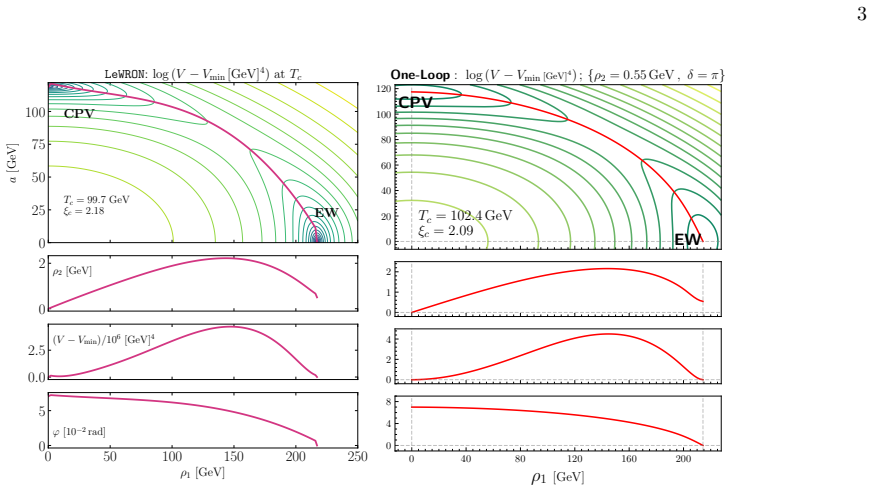


read the original abstract
The electroweak phase transition (EWPT) is a central topic in particle physics and cosmology, connecting collider phenomenology, baryogenesis, and gravitational-wave observatories. Its analysis requires a technically demanding, convention-sensitive, and model-dependent pipeline, from constructing the finite-temperature effective potential to tracking thermal histories, computing bubble nucleation rates, and predicting gravitational-wave spectra. We present LeWRON (Learning ElectroWeak phase tRansitiON), an agentic framework that orchestrates this pipeline starting from an input Lagrangian. LeWRON combines audited toolbox construction with an Explorer module that uses the generated model-specific code for further analysis, including scans and plots. Intermediate analytic outputs are checked by auditor agents and stored as structured artifacts, enabling reproducible human inspection and downstream use through both a command-line interface and a public Python API. The framework supports a reproduction mode, which infers conventions from the literature and reproduces published results, and a discovery mode, which guides users through structured checkpoints for new models. We demonstrate LeWRON across representative beyond-the-Standard-Model scenarios and release the code on GitHub.
Editorial analysis
A structured set of objections, weighed in public.
Referee Report
Summary. The paper presents LeWRON (Learning ElectroWeak phase tRansitiON), an agentic software framework that orchestrates the full electroweak phase transition analysis pipeline from an input Lagrangian. This includes construction of the finite-temperature effective potential, thermal history tracking, bubble nucleation rates, and gravitational-wave spectra predictions. The framework uses audited toolbox construction and an Explorer module, supports a reproduction mode that infers conventions to match published results and a discovery mode with structured checkpoints, stores intermediate analytic outputs as inspectable artifacts, provides both CLI and public Python API access, demonstrates the tool on representative BSM scenarios, and releases the code on GitHub.
Significance. If the described agentic orchestration and auditing mechanisms function reliably, the framework would provide a valuable, reproducible tool for a technically demanding calculation chain that connects collider phenomenology, baryogenesis, and gravitational-wave astronomy. The explicit support for human inspection of artifacts, dual reproduction/discovery modes, and public code release are concrete strengths that align with community needs for verifiable and extensible EWPT analyses.
minor comments (2)
- [Abstract] The abstract states that LeWRON is demonstrated 'across representative beyond-the-Standard-Model scenarios' but does not name the specific models or list the corresponding reproduction results; adding this information (e.g., in a dedicated demonstration section) would strengthen the reproducibility claim.
- The description of the auditor agents and structured artifacts would benefit from a brief example of an intermediate output (such as a checked finite-T potential or nucleation rate) to illustrate how convention mismatches are flagged in practice.
Simulated Author's Rebuttal
We thank the referee for the positive assessment of LeWRON, the recognition of its value for reproducible EWPT analyses, and the recommendation for minor revision. No specific major comments were provided in the report.
Circularity Check
No significant circularity: framework description only
full rationale
The paper presents LeWRON as an agentic software framework that orchestrates existing EWPT analysis steps (finite-T potential, nucleation, GW spectra) from an input Lagrangian, with reproduction and discovery modes. No derivation chain, first-principles predictions, fitted parameters, or uniqueness theorems are claimed. The central claim is the reliability of the pipeline orchestration itself, which is an empirical/software claim rather than a mathematical reduction. No self-citation load-bearing steps, ansatzes, or renamings of known results appear in the provided text. The derivation is self-contained as a tool description.
Axiom & Free-Parameter Ledger
Forward citations
Cited by 1 Pith paper
-
Large Language Model-Assisted Framework for BSM Model Building
An open-source framework that automates BSM Lagrangian construction, anomaly checks, and mass-matrix derivation from natural-language field specifications by using an LLM only as an orchestration layer over a determin...
Reference graph
Works this paper leans on
-
[1]
A Lattice Monte Carlo study of the hot electroweak phase transition,
K. Kajantie, K. Rummukainen, and M. E. Shaposhnikov, “A Lattice Monte Carlo study of the hot electroweak phase transition,”Nucl. Phys. B407 (1993) 356–372,arXiv:hep-ph/9305345
Pith/arXiv arXiv 1993
-
[2]
The Electroweak phase transition at m(H) approximately = m(W),
K. Farakos, K. Kajantie, K. Rummukainen, and M. E. Shaposhnikov, “The Electroweak phase transition at m(H) approximately = m(W),”Phys. Lett. B336 (1994) 494–501,arXiv:hep-ph/9405234
Pith/arXiv arXiv 1994
-
[3]
Status of the Finite Temperature Electroweak Phase Transition on the Lattice,
K. Jansen, “Status of the Finite Temperature Electroweak Phase Transition on the Lattice,”Nuclear Physics B - Proceedings Supplements47(1996) 196–211,arXiv:hep-lat/9509018
Pith/arXiv arXiv 1996
-
[4]
The Electroweak phase transition: A Nonperturbative analysis,
K. Kajantie, M. Laine, K. Rummukainen, and M. E. Shaposhnikov, “The Electroweak phase transition: A Nonperturbative analysis,”Nucl. Phys. B466(1996) 189–258,arXiv:hep-lat/9510020
Pith/arXiv arXiv 1996
-
[5]
Finite T Electroweak Phase Transition on the Lattice,
K. Rummukainen, “Finite T Electroweak Phase Transition on the Lattice,”Nuclear Physics B - Proceedings Supplements53(1997) 30–42, arXiv:hep-lat/9608079
Pith/arXiv arXiv 1997
-
[6]
Is there a hot electroweak phase transition atm H ≳m W ?,
K. Kajantie, M. Laine, K. Rummukainen, and M. E. Shaposhnikov, “Is there a hot electroweak phase transition atm H ≳m W ?,”Phys. Rev. Lett.77(1996) 2887–2890,arXiv:hep-ph/9605288
Pith/arXiv arXiv 1996
-
[7]
Where the electroweak phase transition ends,
M. Gurtler, E.-M. Ilgenfritz, and A. Schiller, “Where the electroweak phase transition ends,”Phys. Rev. D 56(1997) 3888–3895,arXiv:hep-lat/9704013
Pith/arXiv arXiv 1997
-
[8]
Endpoint of the hot electroweak phase transition,
F. Csikor, Z. Fodor, and J. Heitger, “Endpoint of the hot electroweak phase transition,”Phys. Rev. Lett.82 (1999) 21–24,arXiv:hep-ph/9809291
Pith/arXiv arXiv 1999
-
[9]
A Strong electroweak phase transition up to m(H) is about 105-GeV,
M. Laine and K. Rummukainen, “A Strong electroweak phase transition up to m(H) is about 105-GeV,”Phys. Rev. Lett.80(1998) 5259–5262, arXiv:hep-ph/9804255
Pith/arXiv arXiv 1998
-
[10]
The MSSM Electroweak Phase Transition on the Lattice,
M. Laine and K. Rummukainen, “The MSSM Electroweak Phase Transition on the Lattice,”Nuclear Physics B535(1998) 423–457, arXiv:hep-lat/9804019
Pith/arXiv arXiv 1998
-
[11]
The Universality class of the electroweak theory,
K. Rummukainen, M. Tsypin, K. Kajantie, M. Laine, and M. E. Shaposhnikov, “The Universality class of the electroweak theory,”Nucl. Phys. B532(1998) 283–314,arXiv:hep-lat/9805013
Pith/arXiv arXiv 1998
-
[12]
Electroweak Phase Transitions,
Z. Fodor, “Electroweak Phase Transitions,”Nuclear Physics B - Proceedings Supplements83–84(2000) 121–125,arXiv:hep-lat/9909162
Pith/arXiv arXiv 2000
-
[13]
The Electroweak phase transition and baryogenesis,
G. W. Anderson and L. J. Hall, “The Electroweak phase transition and baryogenesis,”Phys. Rev. D45 (1992) 2685–2698
1992
-
[14]
The Electroweak phase transition in a nonminimal supersymmetric model,
M. Pietroni, “The Electroweak phase transition in a nonminimal supersymmetric model,”Nucl. Phys. B 402(1993) 27–45,arXiv:hep-ph/9207227
Pith/arXiv arXiv 1993
-
[15]
The Electroweak phase transition with a singlet,
J. R. Espinosa and M. Quiros, “The Electroweak phase transition with a singlet,”Phys. Lett. B305(1993) 98–105,arXiv:hep-ph/9301285
Pith/arXiv arXiv 1993
-
[16]
Electroweak baryogenesis and dark matter via a gauge singlet scalar,
J. McDonald, “Electroweak baryogenesis and dark matter via a gauge singlet scalar,”Phys. Lett. B323 (1994) 339–346
1994
-
[17]
Real Higgs singlet and the electroweak phase transition in the Standard Model,
J. Choi and R. R. Volkas, “Real Higgs singlet and the electroweak phase transition in the Standard Model,” Phys. Lett.B317(1993) 385–391, arXiv:hep-ph/9308234 [hep-ph]
Pith/arXiv arXiv 1993
-
[18]
Efficient electroweak baryogenesis from lepton transport,
M. Joyce, T. Prokopec, and N. Turok, “Efficient electroweak baryogenesis from lepton transport,”Phys. Lett. B338(1994) 269–275,arXiv:hep-ph/9401352
Pith/arXiv arXiv 1994
-
[19]
Dynamics of two Higgs doublet CP violation and baryogenesis at the electroweak phase transition,
J. M. Cline, K. Kainulainen, and A. P. Vischer, “Dynamics of two Higgs doublet CP violation and baryogenesis at the electroweak phase transition,” Phys. Rev. D54(1996) 2451–2472, arXiv:hep-ph/9506284
Pith/arXiv arXiv 1996
-
[20]
Strong First Order Electroweak Phase Transition in the CP-Conserving 2HDM Revisited,
P. Basler, M. Krause, M. Muhlleitner, J. Wittbrodt, and A. Wlotzka, “Strong First Order Electroweak Phase Transition in the CP-Conserving 2HDM Revisited,”JHEP02(2017) 121,arXiv:1612.04086 [hep-ph]
Pith/arXiv arXiv 2017
-
[21]
P. Basler, M. M¨ uhlleitner, and J. Wittbrodt, “The CP-Violating 2HDM in Light of a Strong First Order Electroweak Phase Transition and Implications for Higgs Pair Production,”JHEP03(2018) 061, arXiv:1711.04097 [hep-ph]
Pith/arXiv arXiv 2018
-
[22]
Adiabatic electroweak baryogenesis driven by an axionlike particle,
K. S. Jeong, T. H. Jung, and C. S. Shin, “Adiabatic electroweak baryogenesis driven by an axionlike particle,”Phys. Rev. D101no. 3, (2020) 035009, arXiv:1811.03294 [hep-ph]
arXiv 2020
-
[23]
Axionic Electroweak Baryogenesis,
K. S. Jeong, T. H. Jung, and C. S. Shin, “Axionic Electroweak Baryogenesis,”Phys. Lett. B790(2019) 326–331,arXiv:1806.02591 [hep-ph]
Pith/arXiv arXiv 2019
-
[24]
Spontaneous CP-Violating Electroweak Baryogenesis and Dark Matter from a Complex Singlet Scalar,
B. Grzadkowski and D. Huang, “Spontaneous CP-Violating Electroweak Baryogenesis and Dark Matter from a Complex Singlet Scalar,”JHEP08 (2018) 135,arXiv:1807.06987 [hep-ph]
Pith/arXiv arXiv 2018
-
[25]
Electroweak Phase Transition in Non-Minimal Higgs Sectors,
P. Basler, M. M¨ uhlleitner, and J. M¨ uller, “Electroweak Phase Transition in Non-Minimal Higgs Sectors,” JHEP05(2020) 016,arXiv:1912.10477 [hep-ph]
arXiv 2020
-
[26]
Electroweak phase transition with spontaneous Z 2-breaking,
M. Carena, Z. Liu, and Y. Wang, “Electroweak phase transition with spontaneous Z 2-breaking,”JHEP08 (2020) 107,arXiv:1911.10206 [hep-ph]
arXiv 2020
-
[27]
CP violation in the top-assisted electroweak baryogenesis,
W. Chao and Y. Liu, “CP violation in the top-assisted electroweak baryogenesis,”arXiv:1910.09303 [hep-ph]
arXiv 1910
-
[28]
Lepton-mediated electroweak baryogenesis, gravitational waves and the 4τfinal state at the collider,
K.-P. Xie, “Lepton-mediated electroweak baryogenesis, gravitational waves and the 4τfinal state at the collider,”JHEP02(2021) 090,arXiv:2011.04821 [hep-ph]. [Erratum: JHEP 8, 052 (2022)]
arXiv 2021
-
[29]
K.-P. Xie, L. Bian, and Y. Wu, “Electroweak baryogenesis and gravitational waves in a composite Higgs model with high dimensional fermion representations,”JHEP12(2020) 047, arXiv:2005.13552 [hep-ph]
arXiv 2020
-
[30]
E. Fern´ andez-Mart´ ınez, J. L´ opez-Pav´ on, T. Ota, and S. Rosauro-Alcaraz, “νelectroweak baryogenesis,” JHEP10(2020) 063,arXiv:2007.11008 [hep-ph]
arXiv 2020
-
[31]
Electroweak baryogenesis in the CP-violating two-Higgs doublet model,
P. Basler, L. Biermann, M. M¨ uhlleitner, and J. M¨ uller, “Electroweak baryogenesis in the CP-violating two-Higgs doublet model,”Eur. Phys. J. C83no. 1, (2023) 57,arXiv:2108.03580 [hep-ph]
arXiv 2023
-
[32]
Electroweak phase transition in a dark sector with CP violation,
L. Biermann, M. M¨ uhlleitner, and J. M¨ uller, “Electroweak phase transition in a dark sector with CP violation,”Eur. Phys. J. C83no. 5, (2023) 439, arXiv:2204.13425 [hep-ph]
arXiv 2023
-
[33]
Two Higgs doublets, effective interactions and a strong first-order electroweak phase transition,
Anisha, L. Biermann, C. Englert, and M. M¨ uhlleitner, “Two Higgs doublets, effective interactions and a strong first-order electroweak phase transition,”JHEP 08(2022) 091,arXiv:2204.06966 [hep-ph]
arXiv 2022
-
[34]
Effective 2HDM Yukawa interactions 7 and a strong first-order electroweak phase transition,
Anisha, D. Azevedo, L. Biermann, C. Englert, and M. M¨ uhlleitner, “Effective 2HDM Yukawa interactions 7 and a strong first-order electroweak phase transition,” JHEP02(2024) 045,arXiv:2311.06353 [hep-ph]
arXiv 2024
-
[35]
νElectroweak baryogenesis: the scalar singlet strikes back,
E. Fern´ andez-Mart´ ınez, J. L´ opez-Pav´ on, J. M. No, T. Ota, and S. Rosauro-Alcaraz, “νElectroweak baryogenesis: the scalar singlet strikes back,”Eur. Phys. J. C83no. 8, (2023) 715,arXiv:2210.16279 [hep-ph]
arXiv 2023
-
[36]
ALP-assisted strong first-order electroweak phase transition and baryogenesis,
K. Harigaya and I. R. Wang, “ALP-assisted strong first-order electroweak phase transition and baryogenesis,”JHEP04(2024) 108, arXiv:2309.00587 [hep-ph]
arXiv 2024
-
[37]
New approach to electroweak symmetry nonrestoration,
M. Carena, C. Krause, Z. Liu, and Y. Wang, “New approach to electroweak symmetry nonrestoration,” Phys. Rev. D104no. 5, (2021) 055016, arXiv:2104.00638 [hep-ph]
arXiv 2021
-
[38]
Electroweak asymmetric early Universe via a scalar condensate,
J. H. Chang, M. O. Olea-Romacho, and E. H. Tanin, “Electroweak asymmetric early Universe via a scalar condensate,”Phys. Rev. D106no. 11, (2022) 113003, arXiv:2210.05680 [hep-ph]
arXiv 2022
-
[39]
On the Anomalous Electroweak Baryon Number Nonconservation in the Early Universe,
V. A. Kuzmin, V. A. Rubakov, and M. E. Shaposhnikov, “On the Anomalous Electroweak Baryon Number Nonconservation in the Early Universe,”Phys. Lett. B155(1985) 36
1985
-
[40]
Possible Appearance of the Baryon Asymmetry of the Universe in an Electroweak Theory,
M. E. Shaposhnikov, “Possible Appearance of the Baryon Asymmetry of the Universe in an Electroweak Theory,”JETP Lett.44(1986) 465–468
1986
-
[41]
Baryon asymmetry of the universe in the standard electroweak theory,
G. R. Farrar and M. E. Shaposhnikov, “Baryon asymmetry of the universe in the standard electroweak theory,”Phys. Rev. D50(1994) 774, arXiv:hep-ph/9305275
Pith/arXiv arXiv 1994
-
[42]
Baryon asymmetry of the universe in the minimal Standard Model,
G. R. Farrar and M. E. Shaposhnikov, “Baryon asymmetry of the universe in the minimal Standard Model,”Phys. Rev. Lett.70(1993) 2833–2836, arXiv:hep-ph/9305274. [Erratum: Phys.Rev.Lett. 71, 210 (1993)]
Pith/arXiv arXiv 1993
-
[43]
Gravitational radiation from first order phase transitions,
M. Kamionkowski, A. Kosowsky, and M. S. Turner, “Gravitational radiation from first order phase transitions,”Phys. Rev. D49(1994) 2837–2851, arXiv:astro-ph/9310044
Pith/arXiv arXiv 1994
-
[44]
C. Caprini, R. Durrer, and G. Servant, “Gravitational wave generation from bubble collisions in first-order phase transitions: An analytic approach,”Phys. Rev. D77(2008) 124015,arXiv:0711.2593 [astro-ph]
Pith/arXiv arXiv 2008
-
[45]
Gravitational Wave Production by Collisions: More Bubbles,
S. J. Huber and T. Konstandin, “Gravitational Wave Production by Collisions: More Bubbles,”JCAP09 (2008) 022,arXiv:0806.1828 [hep-ph]
Pith/arXiv arXiv 2008
-
[46]
Gravitational waves from the sound of a first order phase transition,
M. Hindmarsh, S. J. Huber, K. Rummukainen, and D. J. Weir, “Gravitational waves from the sound of a first order phase transition,”Phys. Rev. Lett.112 (2014) 041301,arXiv:1304.2433 [hep-ph]
Pith/arXiv arXiv 2014
-
[47]
M. Hindmarsh, “Sound shell model for acoustic gravitational wave production at a first-order phase transition in the early Universe,”Phys. Rev. Lett.120 no. 7, (2018) 071301,arXiv:1608.04735 [astro-ph.CO]
Pith/arXiv arXiv 2018
-
[48]
Gravitational radiation from cosmological turbulence,
A. Kosowsky, A. Mack, and T. Kahniashvili, “Gravitational radiation from cosmological turbulence,”Phys. Rev. D66(Jul, 2002) 024030. https: //link.aps.org/doi/10.1103/PhysRevD.66.024030
-
[49]
Gravitational waves from stochastic relativistic sources: Primordial turbulence and magnetic fields,
C. Caprini and R. Durrer, “Gravitational waves from stochastic relativistic sources: Primordial turbulence and magnetic fields,”Phys. Rev. D74(Sep, 2006) 063521.https: //link.aps.org/doi/10.1103/PhysRevD.74.063521
-
[50]
C. Caprini, R. Durrer, and G. Servant, “The stochastic gravitational wave background from turbulence and magnetic fields generated by a first-order phase transition,”JCAP12(2009) 024,arXiv:0909.0622 [astro-ph.CO]
Pith/arXiv arXiv 2009
-
[51]
C. L. Wainwright, “CosmoTransitions: Computing Cosmological Phase Transition Temperatures and Bubble Profiles with Multiple Fields,”Comput. Phys. Commun.183(2012) 2006–2013,arXiv:1109.4189 [hep-ph]
Pith/arXiv arXiv 2012
-
[52]
HEPTAPOD: Orchestrating High Energy Physics Workflows Towards Autonomous Agency,
T. Menzo, A. Roman, S. Gleyzer, K. Matchev, G. T. Fleming, S. H¨ oche, S. Mrenna, and P. Shyamsundar, “HEPTAPOD: Orchestrating High Energy Physics Workflows Towards Autonomous Agency,” arXiv:2512.15867 [hep-ph]
-
[53]
The FERMIACC: Agents for Particle Theory,
P. Agrawal, N. Craig, A. Madden, and I. V. Lombera, “The FERMIACC: Agents for Particle Theory,” arXiv:2603.22538 [hep-ph]
-
[54]
RooAgent: An LLM Agent for Root-Based High Energy Physics Analysis,
A. Desai, “RooAgent: An LLM Agent for Root-Based High Energy Physics Analysis,”arXiv:2605.17318 [hep-ph]
-
[55]
Agentic Diagrammatica: Towards Autonomous Symbolic Computation in High Energy Physics,
T. Menzo, A. Roman, G. T. Fleming, S. Gleyzer, K. T. Matchev, and S. Mrenna, “Agentic Diagrammatica: Towards Autonomous Symbolic Computation in High Energy Physics,”arXiv:2603.26990 [hep-ph]
-
[56]
An End-to-end Architecture for Collider Physics and Beyond,
S. Qiu, Z. Cai, J. Wei, Z. Li, Y. Yin, Q.-H. Cao, C. Liu, M.-x. Luo, X.-B. Yuan, and H. X. Zhu, “An End-to-end Architecture for Collider Physics and Beyond,”arXiv:2603.14553 [hep-ph]
-
[57]
ArgoLOOM: agentic AI for fundamental physics from quarks to cosmos,
S. D. Bakshiet al., “ArgoLOOM: agentic AI for fundamental physics from quarks to cosmos,” arXiv:2510.02426 [hep-ph]
-
[58]
T. Plehn, D. Schiller, and N. Schmal, “MadAgents,” arXiv:2601.21015 [hep-ph]
-
[59]
Collider-Bench: Benchmarking AI Agents with Particle Physics Analysis Reproduction,
D. A. Faroughy, S. Palacios Schweitzer, I. Pang, S. Mishra-Sharma, and D. Shih, “Collider-Bench: Benchmarking AI Agents with Particle Physics Analysis Reproduction,”arXiv:2605.13950 [cs.LG]
-
[60]
M. Lucente, S. Pascoli, F. Sala, and M. Zandi, “DarkAgents,”arXiv:2606.11157 [hep-ph]
-
[61]
Towards precise baryogenesis in the 2HDM+a,
T. Gent, S. Huber, K. Mimasu, and J. M. No, “Towards precise baryogenesis in the 2HDM+a,” arXiv:2512.22081 [hep-ph]
-
[62]
Resummation in a hot scalar field theory,
R. R. Parwani, “Resummation in a hot scalar field theory,”Phys. Rev. D45(1992) 4695, arXiv:hep-ph/9204216. [Erratum: Phys.Rev.D 48, 5965 (1993)]
Pith/arXiv arXiv 1992
-
[63]
Wall speed and shape in singlet-assisted strong electroweak phase transitions,
A. Friedlander, I. Banta, J. M. Cline, and D. Tucker-Smith, “Wall speed and shape in singlet-assisted strong electroweak phase transitions,” Phys. Rev. D103no. 5, (2021) 055020, arXiv:2009.14295 [hep-ph]
arXiv 2021
-
[64]
The Effective potential and first order phase transitions: Beyond leading-order,
P. B. Arnold and O. Espinosa, “The Effective potential and first order phase transitions: Beyond leading-order,”Phys. Rev. D47(1993) 3546, arXiv:hep-ph/9212235. [Erratum: Phys.Rev.D 50, 6662 (1994)]
Pith/arXiv arXiv 1993
-
[65]
First principles determination of bubble wall velocity,
B. Laurent and J. M. Cline, “First principles determination of bubble wall velocity,”Phys. Rev. D 106no. 2, (2022) 023501,arXiv:2204.13120 [hep-ph]
arXiv 2022
-
[66]
Bubble wall dynamics at the 8 electroweak phase transition,
S. De Curtis, L. D. Rose, A. Guiggiani, A. G. Muyor, and G. Panico, “Bubble wall dynamics at the 8 electroweak phase transition,”JHEP03(2022) 163, arXiv:2201.08220 [hep-ph]
arXiv 2022
-
[67]
Collision integrals for cosmological phase transitions,
S. De Curtis, L. Delle Rose, A. Guiggiani, A. Gil Muyor, and G. Panico, “Collision integrals for cosmological phase transitions,”JHEP05(2023) 194, arXiv:2303.05846 [hep-ph]
arXiv 2023
-
[68]
Non-linearities in cosmological bubble wall dynamics,
S. De Curtis, L. Delle Rose, A. Guiggiani, A. Gil Muyor, and G. Panico, “Non-linearities in cosmological bubble wall dynamics,”JHEP05(2024) 009,arXiv:2401.13522 [hep-ph]
arXiv 2024
-
[69]
Bubble wall velocities in local equilibrium,
W.-Y. Ai, B. Garbrecht, and C. Tamarit, “Bubble wall velocities in local equilibrium,”JCAP03no. 03, (2022) 015,arXiv:2109.13710 [hep-ph]
arXiv 2022
-
[70]
Model-independent bubble wall velocities in local thermal equilibrium,
W.-Y. Ai, B. Laurent, and J. van de Vis, “Model-independent bubble wall velocities in local thermal equilibrium,”JCAP07(2023) 002, arXiv:2303.10171 [astro-ph.CO]
arXiv 2023
-
[71]
Criterion for ultra-fast bubble walls: the impact of hydrodynamic obstruction,
W.-Y. Ai, X. Nagels, and M. Vanvlasselaer, “Criterion for ultra-fast bubble walls: the impact of hydrodynamic obstruction,”JCAP03(2024) 037, arXiv:2401.05911 [hep-ph]
arXiv 2024
-
[72]
Bubble wall velocity from Kadanoff-Baym equations: fluid dynamics and microscopic interactions,
M. J. Ramsey-Musolf and J. Zhu, “Bubble wall velocity from Kadanoff-Baym equations: fluid dynamics and microscopic interactions,” arXiv:2504.13724 [hep-ph]
-
[73]
Bubble wall dynamics from nonequilibrium quantum field theory,
W.-Y. Ai, M. Carosi, B. Garbrecht, C. Tamarit, and M. Vanvlasselaer, “Bubble wall dynamics from nonequilibrium quantum field theory,”JHEP08 (2025) 077,arXiv:2504.13725 [hep-ph]
arXiv 2025
-
[74]
Bounds on the bubble wall velocity,
W.-Y. Ai, B. Laurent, and J. van de Vis, “Bounds on the bubble wall velocity,”JHEP02(2025) 119, arXiv:2411.13641 [hep-ph]
arXiv 2025
-
[75]
The discriminant power of bubble wall velocities: gravitational waves and electroweak baryogenesis,
M. Carena, A. Ireland, T. Ou, and I. R. Wang, “The discriminant power of bubble wall velocities: gravitational waves and electroweak baryogenesis,” JHEP09(2025) 175,arXiv:2504.17841 [hep-ph]
arXiv 2025
-
[76]
T. Krajewski, M. Lewicki, and M. Zych, “Bubble-wall velocity in local thermal equilibrium: hydrodynamical simulations vs analytical treatment,”JHEP05(2024) 011,arXiv:2402.15408 [astro-ph.CO]
arXiv 2024
-
[77]
Steady-state bubbles beyond local thermal equilibrium,
T. Krajewski, M. Lewicki, I. Nalecz, and M. Zych, “Steady-state bubbles beyond local thermal equilibrium,”JHEP06(2025) 118,arXiv:2411.16580 [astro-ph.CO]
arXiv 2025
-
[78]
Entropy production at electroweak bubble walls from scalar field fluctuations,
M. Eriksson and M. Laine, “Entropy production at electroweak bubble walls from scalar field fluctuations,”JCAP09(2025) 027,arXiv:2507.07755 [hep-ph]
arXiv 2025
-
[79]
First Order and Second Order Phase Transitions in Gauge Theories at Finite Temperature,
P. H. Ginsparg, “First Order and Second Order Phase Transitions in Gauge Theories at Finite Temperature,” Nucl. Phys. B170(1980) 388–408
1980
-
[80]
High-Temperature Yang-Mills Theories and Three-Dimensional Quantum Chromodynamics,
T. Appelquist and R. D. Pisarski, “High-Temperature Yang-Mills Theories and Three-Dimensional Quantum Chromodynamics,”Phys. Rev. D23(1981) 2305
1981
discussion (0)
Sign in with ORCID, Apple, or X to comment. Anyone can read and Pith papers without signing in.