Pion structure from its light-front wave function
Pith reviewed 2026-06-26 14:11 UTC · model grok-4.3
The pith
Light-front wave functions provide practical representations for the pion's distribution amplitudes, distribution functions, and elastic and gravitational form factors.
A machine-rendered reading of the paper's core claim, the machinery that carries it, and where it could break.
Core claim
The central claim is that well-founded and practical representations of the pion's light-front wave function can be obtained, enabling the computation of distribution amplitudes and distribution functions, elastic and gravitational form factors, and the associated momentum and spatial distributions. The results are stated to be consistent with expectations and subject to experimental tests at modern facilities including new electron-ion colliders.
What carries the argument
The light-front wave function, which directly encodes the pion's internal quark-gluon structure and supplies the link to generalized parton distributions and transverse-momentum-dependent distributions.
If this is right
- Distribution amplitudes for the pion become directly calculable from the wave-function representations.
- Parton distribution functions follow from the same representations without additional modeling.
- Elastic form factors and gravitational form factors are obtained as integrals over the wave function.
- Momentum and spatial distributions inside the pion are extracted as concrete outputs.
- All computed quantities remain testable at electron-ion collider experiments.
Where Pith is reading between the lines
- The same wave-function approach could be applied to other light mesons once comparable representations are constructed.
- Discrepancies between the computed distributions and future collider data would indicate where the input structure needs refinement.
- The momentum and spatial distributions derived here could be compared with independent lattice calculations of the same quantities.
- Gravitational form factors obtained this way offer a route to estimate the pion's internal pressure and mass distributions without separate modeling.
Load-bearing premise
The representations of the light-front wave function accurately capture the pion's valence and sea quark structure at the momentum scales needed for the derived distributions and form factors.
What would settle it
A high-precision measurement of the pion's gravitational form factor or a valence distribution amplitude at an electron-ion collider that lies significantly outside the range predicted by the derived wave-function representations.
Figures



read the original abstract
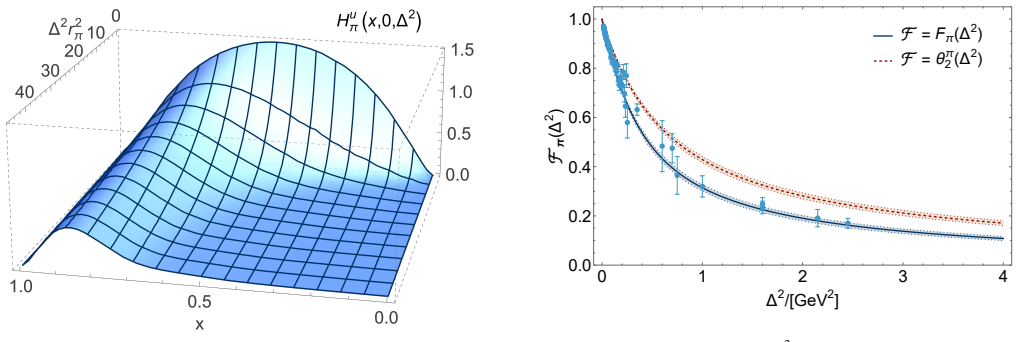
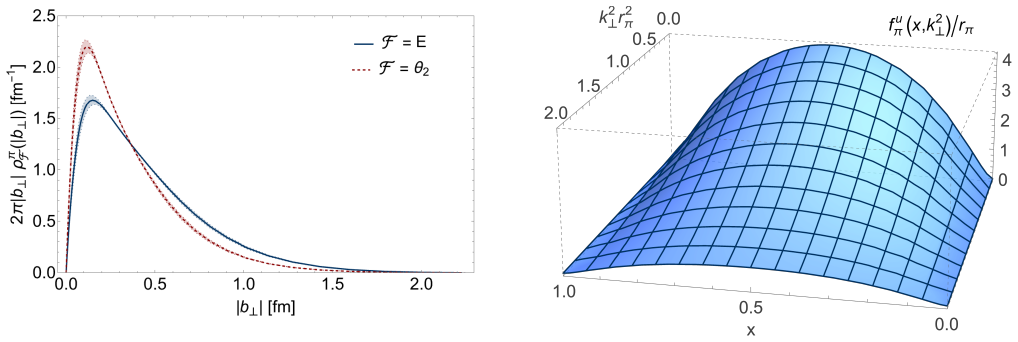
Understanding the structural properties of the pion is essential for elucidating the mechanisms of mass generation within the Standard Model and their role in the emergence and properties of the hadronic matter. Light-front wave functions encode extensive information about the internal structure of these systems and provide the link to measurable quantities such as generalized parton distributions and transverse-momentum-dependent distributions. Guided by recent progress in continuum Schwinger methods, we derive well-founded and practical representations of these quantities, enabling the exploration of several facets of the pion structure, including distribution amplitudes and distribution functions, elastic and gravitational form factors, and the associated momentum and spatial distributions. The results presented here are consistent with expectations and can be tested at modern experimental facilities, including the new generation of electron-ion colliders.
Editorial analysis
A structured set of objections, weighed in public.
Referee Report
Summary. The paper derives explicit functional representations for the pion's light-front wave functions, guided by continuum Schwinger-method results. These representations are applied to compute distribution amplitudes, parton distribution functions, elastic and gravitational form factors, and the associated momentum and spatial distributions. The constructions are shown to satisfy normalization, asymptotic limits, and other consistency conditions expected from QCD.
Significance. If the representations hold, the work supplies a practical, unified framework linking Schwinger-method inputs to a broad set of light-front observables for the pion. Explicit functional forms and internal consistency checks (normalization, asymptotic behavior) are strengths that enable direct comparison with data from facilities such as the EIC. The approach is framed as a derivation rather than an ab-initio computation, so its value lies in the transparency and testability of the resulting expressions.
major comments (1)
- [§4, Eq. (22)] §4, Eq. (22): the gravitational form factor A(t) is obtained by integrating the LFWF representation; the paper must demonstrate explicitly that the Schwinger-method input for the quark-mass function at the relevant scale produces the correct t-dependence, rather than inheriting it by construction from the input parametrization.
minor comments (2)
- [Figure 3] Figure 3: the legend for the valence and sea contributions is difficult to distinguish in grayscale; add line styles or markers.
- [§2.3] §2.3: the notation for the light-front momentum fractions x and 1-x is introduced without a clear statement of the integration measure used in subsequent observables.
Simulated Author's Rebuttal
We thank the referee for the positive evaluation of our manuscript and for the constructive comment. We address the major comment below.
read point-by-point responses
-
Referee: [§4, Eq. (22)] §4, Eq. (22): the gravitational form factor A(t) is obtained by integrating the LFWF representation; the paper must demonstrate explicitly that the Schwinger-method input for the quark-mass function at the relevant scale produces the correct t-dependence, rather than inheriting it by construction from the input parametrization.
Authors: The LFWF representation is explicitly constructed so that its functional form and parameters are determined by matching to the Schwinger-method quark-mass function at the relevant renormalization scale; the resulting t-dependence of A(t) therefore originates from the momentum dependence encoded in that input rather than from an independent parametrization choice. Nevertheless, we agree that an explicit demonstration strengthens the presentation. In the revised manuscript we will add a short subsection (or appendix) that varies the Schwinger input mass function within its uncertainty band and shows the consequent variation in A(t), thereby confirming that the observed t-dependence tracks the input rather than being fixed by the LFWF ansatz alone. revision: yes
Circularity Check
No significant circularity; derivation guided by external Schwinger inputs
full rationale
The paper states that its light-front wave-function representations are derived guided by continuum Schwinger methods as external inputs. No equations, self-citations, or steps are exhibited in the provided text that reduce any claimed prediction or first-principles result to the paper's own fitted parameters or prior outputs by construction. The central claim remains a derivation from those independent Schwinger-method foundations, with internal consistency checks against known limits, making the work self-contained rather than circular.
Axiom & Free-Parameter Ledger
axioms (1)
- domain assumption Continuum Schwinger methods provide accurate light-front wave functions for the pion
Forward citations
Cited by 1 Pith paper
-
Pseudoscalar charmonium and bottomonium: light-front wave functions, distribution amplitudes and distribution functions
A modified non-separable LFWF ansatz for pseudoscalar heavy quarkonia enables computation of zero-skewness GPDs, EM and gravitational form factors, and transverse distributions within the Schwinger-function framework.
Reference graph
Works this paper leans on
-
[1]
Electron scattering and nuclear struc- ture.Rev
Robert Hofstadter. Electron scattering and nuclear struc- ture.Rev. Mod. Phys., 28:214–254, 1956
1956
-
[2]
Friedman, Henry W
Martin Breidenbach, Jerome I. Friedman, Henry W. Kendall, Elliott D. Bloom, D. H. Coward, H. C. DeStae- bler, J. Drees, Luke W. Mo, and Richard E. Taylor. Ob- served behavior of highly inelastic electron-proton scat- tering.Phys. Rev. Lett., 23:935–939, 1969
1969
-
[3]
Aguilar et al
Arlene C. Aguilar et al. Pion and Kaon Structure at the Electron-Ion Collider.Eur. Phys. J. A, 55(10):190, 2019
2019
-
[4]
Roberts, David G
Craig D. Roberts, David G. Richards, Tanja Horn, and Lei Chang. Insights into the emergence of mass from stud- ies of pion and kaon structure.Prog. Part. Nucl. Phys., 120:103883, 2021
2021
-
[5]
Roberts, and José Rodríguez-Quintero
Khépani Raya, Adnan Bashir, Daniele Binosi, Craig D. Roberts, and José Rodríguez-Quintero. Pseudoscalar Mesons and Emergent Mass.Few Body Syst., 65(2):60, 2024
2024
-
[6]
Empirical Consequences of Emergent Mass.Symmetry, 12(9):1468, 2020
Craig D Roberts. Empirical Consequences of Emergent Mass.Symmetry, 12(9):1468, 2020
2020
-
[7]
An Introductory Lecture on Generalised Parton Distributions.Few Body Syst., 63(3):62, 2022
Cédric Mezrag. An Introductory Lecture on Generalised Parton Distributions.Few Body Syst., 63(3):62, 2022
2022
-
[8]
Polyakov and Peter Schweitzer
Maxim V . Polyakov and Peter Schweitzer. Forces inside hadrons: pressure, surface tension, mechanical radius, and all that.Int. J. Mod. Phys. A, 33(26):1830025, 2018
2018
-
[9]
M. Diehl. Generalized parton distributions in impact pa- rameter space.Eur. Phys. J. C, 25:223–232, 2002. [Erra- tum: Eur.Phys.J.C 31, 277–278 (2003)]
2002
-
[10]
Impact parameter dependent par- ton distributions and offforward parton distributions for zeta —>0.Phys
Matthias Burkardt. Impact parameter dependent par- ton distributions and offforward parton distributions for zeta —>0.Phys. Rev. D, 62:071503, 2000. [Erratum: Phys.Rev.D 66, 119903 (2002)]
2000
-
[11]
Diehl, T
M. Diehl, T. Feldmann, R. Jakob, and P. Kroll. The overlap representation of skewed quark and gluon dis- tributions.Nucl. Phys. B, 596:33–65, 2001. [Erratum: Nucl.Phys.B 605, 647–647 (2001)]
2001
-
[12]
Impact parameter space interpretation for generalized parton distributions.Int
Matthias Burkardt. Impact parameter space interpretation for generalized parton distributions.Int. J. Mod. Phys. A, 18:173–208, 2003
2003
-
[13]
Pasquini and P
B. Pasquini and P. Schweitzer. Pion transverse momentum dependent parton distributions in a light-front constituent approach, and the Boer-Mulders effect in the pion-induced Drell-Yan process.Phys. Rev. D, 90(1):014050, 2014
2014
-
[14]
Measures of pion and kaon struc- ture from generalised parton distributions.Phys
Jin-Li Zhang, Khépani Raya, Lei Chang, Zhu-Fang Cui, José Manuel Morgado, Craig D Roberts, and Jose Rodríguez-Quintero. Measures of pion and kaon struc- ture from generalised parton distributions.Phys. Lett. B, 815:136158, 2021
2021
-
[15]
Roberts, and Jose Rodriguez- Quintero
Khepani Raya, Zhu-Fang Cui, Lei Chang, Jose-Manuel Morgado, Craig D. Roberts, and Jose Rodriguez- Quintero. Revealing pion and kaon structure via gener- alised parton distributions *.Chin. Phys. C, 46(1):013105, 2022
2022
-
[16]
Highlights of pion and kaon structure from continuum analyses.Rev
Khépani Raya and José Rodríguez-Quintero. Highlights of pion and kaon structure from continuum analyses.Rev. Mex. Fis. Suppl., 3(3):0308008, 2022
2022
-
[17]
Accardi et al
A. Accardi et al. Electron Ion Collider: The Next QCD Frontier: Understanding the glue that binds us all.Eur. Phys. J. A, 52(9):268, 2016
2016
-
[18]
Arrington et al
J. Arrington et al. Revealing the structure of light pseu- doscalar mesons at the electron–ion collider.J. Phys. G, 48(7):075106, 2021
2021
-
[19]
Anderle et al
Daniele P. Anderle et al. Electron-ion collider in China. Front. Phys. (Beijing), 16(6):64701, 2021
2021
-
[20]
The New AMBER Experiment at the CERN SPS.Few Body Syst., 63(4):72, 2022
Catarina Quintans. The New AMBER Experiment at the CERN SPS.Few Body Syst., 63(4):72, 2022
2022
-
[21]
Accardi et al
A. Accardi et al. Strong interaction physics at the luminos- ity frontier with 22 GeV electrons at Jefferson Lab.Eur. Phys. J. A, 60(9):173, 2024. 9
2024
-
[22]
Chouika, C
N. Chouika, C. Mezrag, H. Moutarde, and J. Rodríguez- Quintero. Covariant Extension of the GPD overlap repre- sentation at low Fock states.Eur. Phys. J. C, 77(12):906, 2017
2017
-
[23]
Chouika, C
N. Chouika, C. Mezrag, H. Moutarde, and J. Rodríguez- Quintero. A Nakanishi-based model illustrating the co- variant extension of the pion GPD overlap representation and its ambiguities.Phys. Lett. B, 780:287–293, 2018
2018
-
[24]
Mezrag, H
C. Mezrag, H. Moutarde, and J. Rodriguez-Quintero. From Bethe–Salpeter Wave functions to Generalised Par- ton Distributions.Few Body Syst., 57(9):729–772, 2016
2016
-
[25]
A Two-Dimensional Model for Mesons
Gerard ’t Hooft. A Two-Dimensional Model for Mesons. Nucl. Phys. B, 75:461–470, 1974
1974
-
[26]
Lei Chang, I. C. Cloet, J. J. Cobos-Martinez, C. D. Roberts, S. M. Schmidt, and P. C. Tandy. Imaging dy- namical chiral symmetry breaking: pion wave function on the light front.Phys. Rev. Lett., 110(13):132001, 2013
2013
-
[27]
Kaon and pion parton distributions.Eur
Zhu-Fang Cui, Minghui Ding, Fei Gao, Khépani Raya, Daniele Binosi, Lei Chang, Craig D Roberts, Jose Rodríguez-Quintero, and Sebastian M Schmidt. Kaon and pion parton distributions.Eur. Phys. J. C, 80(11):1064, 2020
2020
-
[28]
Roberts, Jose Rodriguez-Quintero, and Sebastian M
Zhu-Fang Cui, Minghui Ding, Fei Gao, Khepani Raya, Daniele Binosi, Lei Chang, Craig D. Roberts, Jose Rodriguez-Quintero, and Sebastian M. Schmidt. Higgs modulation of emergent mass as revealed in kaon and pion parton distributions.Eur. Phys. J. A, 57(1):5, 2021
2021
-
[29]
Mapping Spatial Distributions within Pseu- doscalar Mesons.Chin
Khépani Raya, Adnan Bashir, and José Rodríguez- Quintero. Mapping Spatial Distributions within Pseu- doscalar Mesons.Chin. Phys. Lett., 42(2):020201, 2025
2025
-
[30]
Albino, I
L. Albino, I. M. Higuera-Angulo, K. Raya, and A. Bashir. Pseudoscalar mesons: Light front wave functions, GPDs, and PDFs.Phys. Rev. D, 106(3):034003, 2022
2022
-
[31]
Almeida-Zamora, J
B. Almeida-Zamora, J. J. Cobos-Martínez, A. Bashir, K. Raya, J. Rodríguez-Quintero, and J. Segovia. Alge- braic model to study the internal structure of pseudoscalar mesons with heavy-light quark content.Phys. Rev. D, 109(1):014016, 2024
2024
-
[32]
Almeida-Zamora, J
B. Almeida-Zamora, J. J. Cobos-Martínez, A. Bashir, K. Raya, J. Rodríguez-Quintero, and J. Segovia. Light- front wave functions of vector mesons in an algebraic model.Phys. Rev. D, 107(7):074037, 2023
2023
-
[33]
I. M. Higuera-Angulo, R. J. Hernández-Pinto, K. Raya, and A. Bashir. Electromagnetic and two-photon transition form factors of the pseudoscalar mesons: An algebraic model computation.Phys. Rev. D, 110(3):034013, 2024
2024
-
[34]
Albino, K
L. Albino, K. Raya, R. J. Hernández-Pinto, B. Almeida- Zamora, J. Segovia, A. Huet, and A. Bashir. Multidimen- sional landscape of theηandη’ mesons.Phys. Rev. D, 113(3):034019, 2026
2026
-
[35]
Roberts, and Hong- Shi Zong
Shu-Sheng Xu, Lei Chang, Craig D. Roberts, and Hong- Shi Zong. Pion and kaon valence-quark parton quasidis- tributions.Phys. Rev. D, 97(9):094014, 2018
2018
-
[36]
A. V . Efremov and A. V . Radyushkin. Factorization and Asymptotical Behavior of Pion Form-Factor in QCD. Phys. Lett. B, 94:245–250, 1980
1980
-
[37]
Peter Lepage and Stanley J
G. Peter Lepage and Stanley J. Brodsky. Exclusive Pro- cesses in Quantum Chromodynamics: Evolution Equa- tions for Hadronic Wave Functions and the Form-Factors of Mesons.Phys. Lett. B, 87:359–365, 1979
1979
-
[38]
Peter Lepage and Stanley J
G. Peter Lepage and Stanley J. Brodsky. Exclusive Pro- cesses in Perturbative Quantum Chromodynamics.Phys. Rev. D, 22:2157, 1980
1980
-
[39]
Dokshitzer
Yuri L. Dokshitzer. Calculation of the Structure Functions for Deep Inelastic Scattering and e+e- Annihilation by Perturbation Theory in Quantum Chromodynamics.Sov. Phys. JETP, 46:641–653, 1977
1977
-
[40]
V . N. Gribov and L. N. Lipatov. Deep inelastic e p scat- tering in perturbation theory.Sov. J. Nucl. Phys., 15:438– 450, 1972
1972
-
[41]
L. N. Lipatov. The parton model and perturbation theory. Yad. Fiz., 20:181–198, 1974
1974
-
[42]
Guido Altarelli and G. Parisi. Asymptotic Freedom in Par- ton Language.Nucl. Phys. B, 126:298–318, 1977
1977
-
[43]
Pieter Maris and Craig D. Roberts. Pi- and K meson Bethe-Salpeter amplitudes.Phys. Rev. C, 56:3369–3383, 1997
1997
-
[44]
Pieter Maris and Craig D. Roberts. Pseudovector com- ponents of the pion, pi0 —>gamma gamma, and F(pi) (q**2).Phys. Rev. C, 58:3659–3665, 1998
1998
-
[45]
Roberts, and Jose Rodriguez-Quintero
Zhao-Qian Yao, Zhen-Ni Xu, Yu-Yang Xiao, Craig D. Roberts, and Jose Rodriguez-Quintero. Symmetry- preserving calculation of pion light-front wave functions. 12 2025
2025
-
[46]
Pire, Jacques Soffer, and O
B. Pire, Jacques Soffer, and O. Teryaev. Positivity con- straints for off- forward parton distributions.Eur. Phys. J. C, 8:103–106, 1999
1999
-
[47]
Pion generalized parton distributions: A path toward phe- nomenology.Phys
José Manuel Morgado Chavez, Valerio Bertone, Feliciano De Soto Borrero, Maxime Defurne, Cédric Mezrag, Hervé Moutarde, José Rodríguez-Quintero, and Jorge Segovia. Pion generalized parton distributions: A path toward phe- nomenology.Phys. Rev. D, 105(9):094012, 2022
2022
-
[48]
Dall’Olio, F
P. Dall’Olio, F. De Soto, C. Mezrag, J. M. Mor- gado Chávez, H. Moutarde, J. Rodríguez-Quintero, P. Sz- najder, and J. Segovia. Unraveling generalized parton dis- tributions through Lorentz symmetry and partial DGLAP knowledge.Phys. Rev. D, 109(9):096013, 2024. 10
2024
-
[49]
Roberts, and J
Yin-Zhen Xu, Khépani Raya, Zhu-Fang Cui, Craig D. Roberts, and J. Rodríguez-Quintero. Empirical Determi- nation of the Pion Mass Distribution.Chin. Phys. Lett., 40(4):041201, 2023
2023
-
[50]
Roberts, José Rodríguez-Quintero, and Sebastian M
Yin-Zhen Xu, Minghui Ding, Khépani Raya, Craig D. Roberts, José Rodríguez-Quintero, and Sebastian M. Schmidt. Pion and kaon electromagnetic and gravitational form factors.Eur. Phys. J. C, 84(2):191, 2024
2024
-
[51]
Z. Q. Yao, Y . Z. Xu, D. Binosi, Z. F. Cui, M. Ding, K. Raya, C. D. Roberts, J. Rodríguez-Quintero, and S. M. Schmidt. Nucleon gravitational form factors.Eur. Phys. J. A, 61(5):92, 2025
2025
-
[52]
Z. Q. Yao, Y . Z. Xu, D. Binosi, Z. F. Cui, M. Ding, K. Raya, C. D. Roberts, and J. Rodríguez-Quintero. Pion, Kaon and nucleon gravitational form factors. In16th Con- ference on Quark Confinement and the Hadron Spectrum, 3 2025
2025
-
[53]
Xiaobin Wang, Zanbin Xing, Lei Chang, Minghui Ding, Khépani Raya, and Craig D. Roberts. Sketching pion and proton mass distributions.Phys. Lett. B, 862:139280, 2025
2025
-
[54]
Hackett, Patrick R
Daniel C. Hackett, Patrick R. Oare, Dimitra A. Pefkou, and Phiala E. Shanahan. Gravitational form factors of the pion from lattice QCD.Phys. Rev. D, 108(11):114504, 2023
2023
-
[55]
Kumano, Qin-Tao Song, and O
S. Kumano, Qin-Tao Song, and O. V . Teryaev. Hadron to- mography by generalized distribution amplitudes in pion- pair production processγ ∗γ→π 0π0 and gravitational form factors for pion.Phys. Rev. D, 97(1):014020, 2018
2018
-
[56]
Navas et al
S. Navas et al. Review of particle physics.Phys. Rev. D, 110(3):030001, 2024
2024
-
[57]
Roberts, and Se- bastian M
Zhu-Fang Cui, Daniele Binosi, Craig D. Roberts, and Se- bastian M. Schmidt. Hadron and light nucleus radii from electron scattering*.Chin. Phys. C, 46(12):122001, 2022
2022
-
[58]
S. R. Amendolia et al. A Measurement of the Space - Like Pion Electromagnetic Form-Factor.Nucl. Phys. B, 277:168, 1986
1986
-
[59]
Horn et al
T. Horn et al. Scaling study of the pion electroproduction cross sections and the pion form factor.Phys. Rev. C, 78:058201, 2008
2008
-
[60]
G. M. Huber et al. Charged pion form-factor between Q**2=0.60-GeV**2 and 2.45-GeV**2. II. Determina- tion of, and results for, the pion form-factor.Phys. Rev. C, 78:045203, 2008
2008
-
[61]
Brodsky and Feng Yuan
Stanley J. Brodsky and Feng Yuan. Single transverse-spin asymmetries at large-x.Phys. Rev. D, 74:094018, 2006
2006
-
[62]
Davison E. Soper. The Parton Model and the Bethe- Salpeter Wave Function.Phys. Rev. D, 15:1141, 1977
1977
-
[63]
Farrar and Darrell R
Glennys R. Farrar and Darrell R. Jackson. Pion and Nu- cleon Structure Functions Near x=1.Phys. Rev. Lett., 35:1416, 1975
1975
-
[64]
Berger and Stanley J
Edmond L. Berger and Stanley J. Brodsky. Quark Struc- ture Functions of Mesons and the Drell-Yan Process. Phys. Rev. Lett., 42:940–944, 1979
1979
-
[65]
Pion Valence-Quark TMD from Contin- uum Schwinger Function Methods and Gaussian GTMD
Minghui Ding. Pion Valence-Quark TMD from Contin- uum Schwinger Function Methods and Gaussian GTMD. 11 2025
2025
-
[66]
Roberts, and José Rodríguez-Quintero
Ya Lu, Yin-Zhen Xu, Khépani Raya, Craig D. Roberts, and José Rodríguez-Quintero. Pion distribution func- tions from low-order Mellin moments.Phys. Lett. B, 850:138534, 2024
2024
-
[67]
Anselmino, M
M. Anselmino, M. Boglione, U. D’Alesio, A. Kotzinian, F. Murgia, and A. Prokudin. The Role of Cahn and sivers effects in deep inelastic scattering.Phys. Rev. D, 71:074006, 2005
2005
-
[68]
J. C. Collins, A. V . Efremov, K. Goeke, S. Menzel, A. Metz, and P. Schweitzer. Sivers effect in semi-inclusive deeply inelastic scattering.Phys. Rev. D, 73:014021, 2006
2006
-
[69]
Schweitzer, T
P. Schweitzer, T. Teckentrup, and A. Metz. Intrinsic trans- verse parton momenta in deeply inelastic reactions.Phys. Rev. D, 81:094019, 2010. 11
2010
discussion (0)
Sign in with ORCID, Apple, or X to comment. Anyone can read and Pith papers without signing in.