REVIEW 2 major objections 1 minor 5 cited by
Cross-run hidden-state convergence at step 4 predicts whether LLM agents will maintain consistent trajectories on reasoning tasks.
Reviewed by Pith at T0; open to challenge. T0 means a machine referee read the full paper against a public rubric. the ladder, T0–T4 →
T0 review · grok-4.3
2026-06-26 08:30 UTC pith:F53EGRGN
load-bearing objection The paper introduces a hidden-state diagnostic for premature commitment but the negative correlation with consistency runs opposite to the claimed mapping and needs direct explanation. the 2 major comments →
When Agents Commit Too Soon: Diagnosing Premature Commitment in LLM Agents
The pith
A machine-rendered reading of the paper's core claim, the machinery that carries it, and where it could break.
Core claim
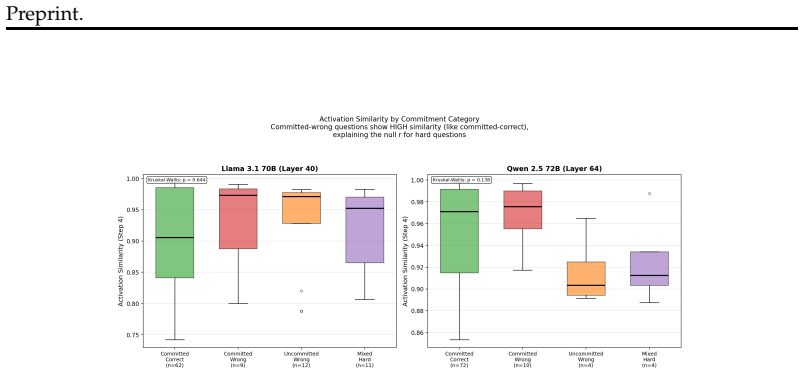
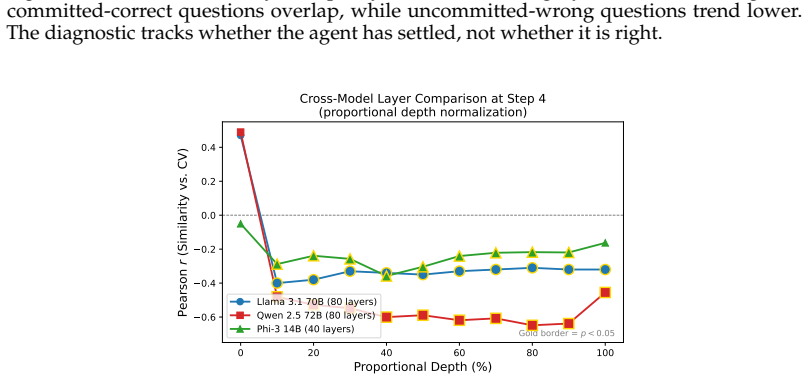
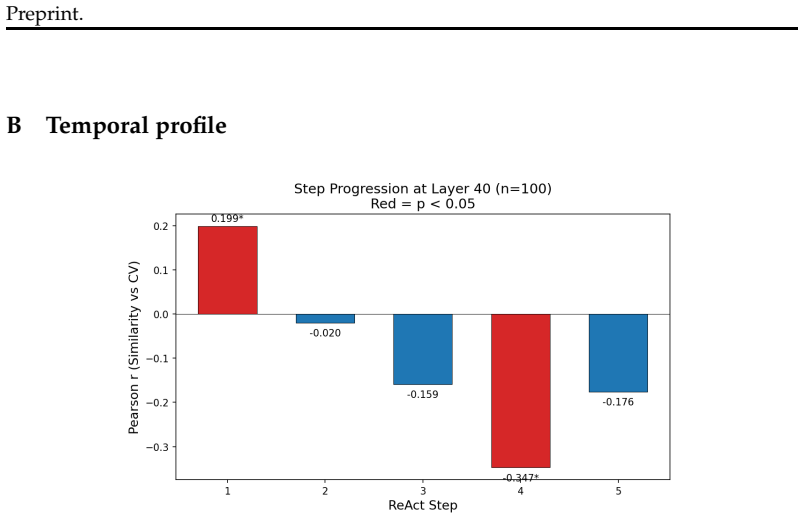
Representational commitment, measured as cross-run hidden-state convergence at a fixed reasoning step, diagnoses premature commitment in LLM agent trajectories. On Llama-3.1-70B running ReAct on HotpotQA, step-4 hidden-state similarity predicts downstream behavioral consistency with r = -0.35 and partial r = -0.45; the relation replicates on Qwen-2.5-72B, Phi-3-14B, and StrategyQA with r = -0.83. The signal does not separate committed-wrong from committed-correct cases and therefore tracks whether an agent has settled rather than whether it is right. A hidden-state monitor reaches AUROC 0.97 for detecting inconsistent trajectories, while a prompting intervention reduces behavioral variance b
What carries the argument
Representational commitment defined as cross-run hidden-state convergence at a fixed reasoning step, serving as an early indicator of trajectory consistency.
Load-bearing premise
Cross-run hidden-state convergence at one fixed step measures a distinct process of representational commitment that is separate from correctness or output variance.
What would settle it
Observing no correlation between step-4 hidden-state similarity and later behavioral consistency on a held-out set of questions, or finding that committed-wrong and committed-correct cases become separable in the same activations.
If this is right
- Early hidden-state monitoring can identify agents that will produce consistent but potentially narrow trajectories before the run ends.
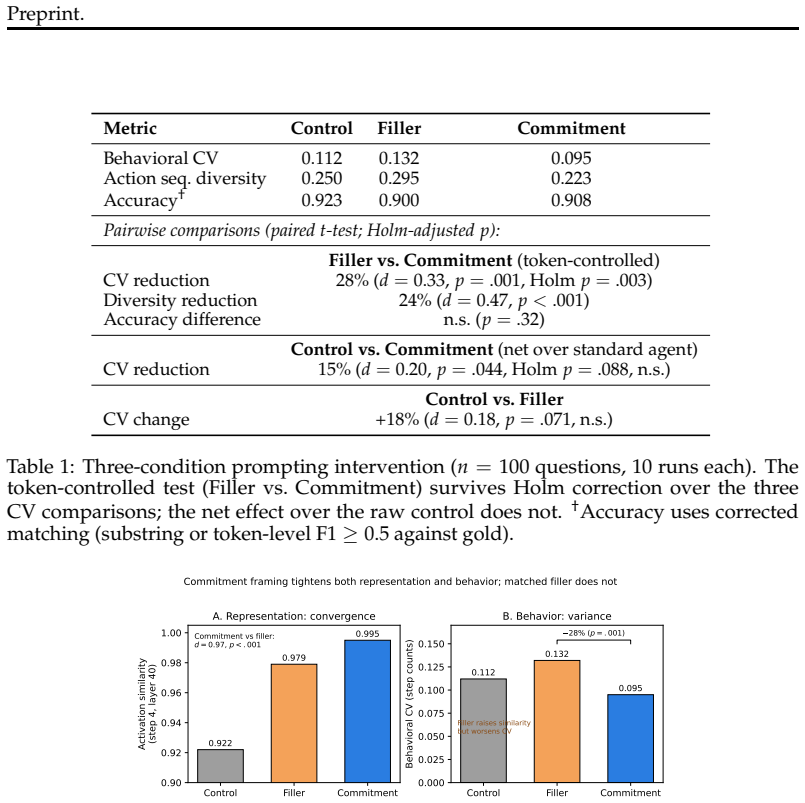
- A prompting intervention derived from the signal reduces output variance by 28 percent while leaving accuracy unchanged.
- The diagnostic transfers across model sizes and across HotpotQA and StrategyQA but provides only modest help for routing self-consistency compute on harder tasks.
- Because the signal is orthogonal to correctness, it can flag settled-wrong paths without conflating them with accuracy failures.
Where Pith is reading between the lines
- Agents could be modified to inject diversity at the specific step where convergence is first detected, potentially avoiding premature settling.
- The layer-wise and temporal signature of the signal suggests targeted monitoring or editing at particular layers rather than full-run checks.
- Combining the commitment monitor with separate correctness checks could produce agents that are both more consistent and more accurate than either method alone.
- The approach may generalize to other long-horizon sequential tasks where early stabilization of internal representations limits exploration.
Editorial analysis
A structured set of objections, weighed in public.
Referee Report
Summary. The manuscript defines representational commitment as cross-run hidden-state convergence at a fixed early reasoning step in LLM agents and claims this measure predicts downstream behavioral consistency (r = -0.35, partial r = -0.45 on Llama-3.1-70B ReAct HotpotQA; r = -0.83 on StrategyQA), replicates across models, is independent of correctness, supports an AUROC-0.97 runtime monitor for inconsistent trajectories, and enables a prompting intervention that reduces behavioral variance by 28% without harming accuracy.
Significance. If the central correlation and its separation from correctness hold after clarification, the work supplies a process-level diagnostic for a failure mode missed by final-answer metrics, with demonstrated runtime utility and cross-model replication. The modest gains when routing self-consistency compute and the explicit limits noted in the abstract keep the practical impact focused rather than overstated.
major comments (2)
- [Abstract] Abstract: the reported negative correlation (r = -0.35) between hidden-state similarity (commitment) and behavioral consistency contradicts the directional prediction implied by the definition. Higher cross-run similarity at step 4 should correspond to higher (not lower) trajectory consistency if consistency is an agreement metric; the sign reversal affects interpretation of the partial correlation, the AUROC monitor, and the intervention result. The manuscript must define the exact behavioral-consistency metric (agreement rate, variance, or divergence) and justify the observed polarity.
- [Methods / Results] Methods and results sections: the abstract supplies AUROC values, partial correlations, and a 28% variance reduction but provides no details on the similarity metric, chosen layers, exact step selection, controls for output variance, or whether layer/step choices were pre-specified versus post-hoc. These choices are load-bearing for the claim that the signal is a distinct process failure mode.
minor comments (1)
- [Abstract] Abstract: state explicitly whether behavioral consistency is quantified as agreement (higher = more consistent) or as a divergence score.
Simulated Author's Rebuttal
We thank the referee for the constructive comments. We address both major points by clarifying the behavioral-consistency metric and expanding methodological details in the revised manuscript.
read point-by-point responses
-
Referee: [Abstract] Abstract: the reported negative correlation (r = -0.35) between hidden-state similarity (commitment) and behavioral consistency contradicts the directional prediction implied by the definition. Higher cross-run similarity at step 4 should correspond to higher (not lower) trajectory consistency if consistency is an agreement metric; the sign reversal affects interpretation of the partial correlation, the AUROC monitor, and the intervention result. The manuscript must define the exact behavioral-consistency metric (agreement rate, variance, or divergence) and justify the observed polarity.
Authors: We agree the metric requires explicit definition. Behavioral consistency is operationalized as normalized cross-run answer variance (equivalently, disagreement rate), so higher values indicate greater inconsistency. Greater hidden-state convergence therefore predicts lower variance scores, producing the negative correlation. We will add this definition and polarity justification to the abstract and methods, and update related interpretations. revision: yes
-
Referee: [Methods / Results] Methods and results sections: the abstract supplies AUROC values, partial correlations, and a 28% variance reduction but provides no details on the similarity metric, chosen layers, exact step selection, controls for output variance, or whether layer/step choices were pre-specified versus post-hoc. These choices are load-bearing for the claim that the signal is a distinct process failure mode.
Authors: The methods section specifies cosine similarity on hidden states, but we acknowledge the need for greater transparency. We will expand it to report the exact metric, specific layers, step-4 rationale, output-length controls, and whether layer/step selection was pre-specified or exploratory. This will strengthen the claim that the signal is distinct from correctness. revision: yes
Circularity Check
No significant circularity in derivation chain
full rationale
The paper defines representational commitment explicitly as cross-run hidden-state convergence at a fixed step and reports its empirical correlation with separately measured behavioral consistency (r values, AUROC for trajectory detection). No equations, parameters, or self-citations reduce the diagnostic signal, the reported correlations, or the intervention results to a fitted input, self-definition, or renamed prior result. The negative sign of the correlation is a potential interpretive or correctness concern but does not create a circular reduction by construction. The central claim remains an independent empirical mapping between two distinct measurements.
Axiom & Free-Parameter Ledger
axioms (1)
- domain assumption LLM hidden states at intermediate layers and steps capture aspects of the agent's current reasoning trajectory that are comparable across runs
invented entities (1)
-
representational commitment
no independent evidence
read the original abstract
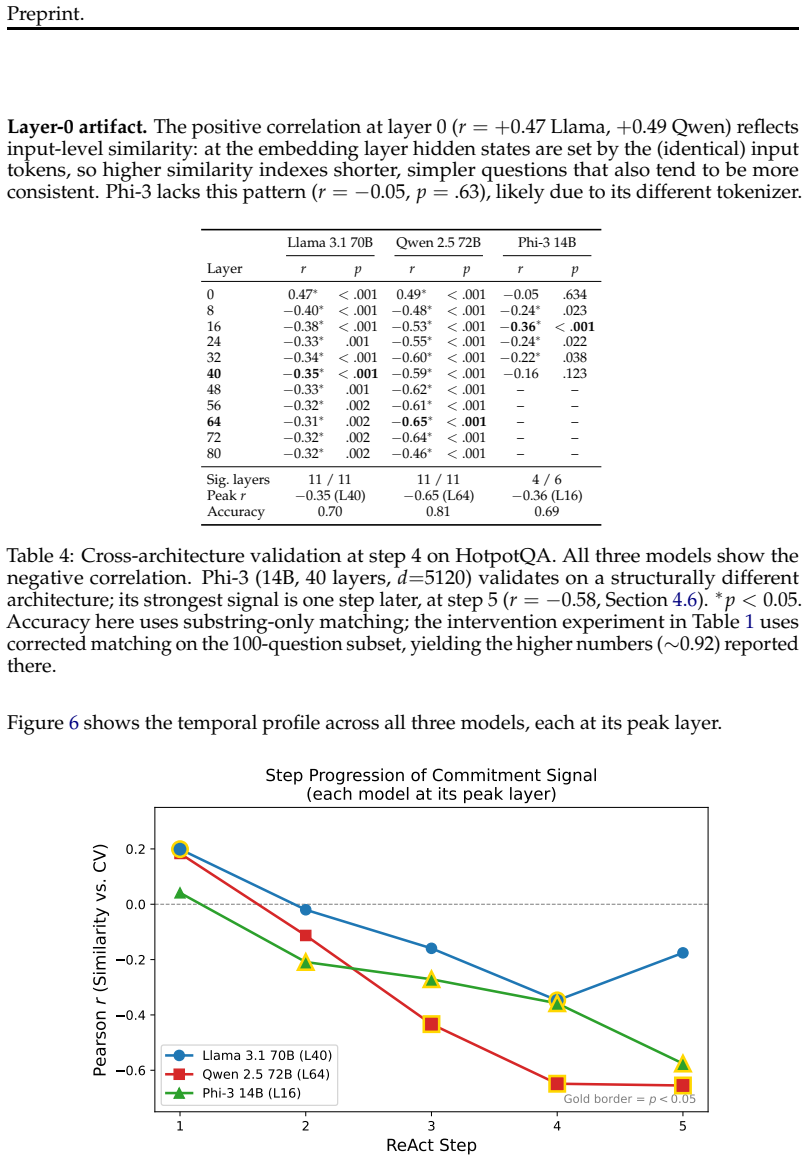
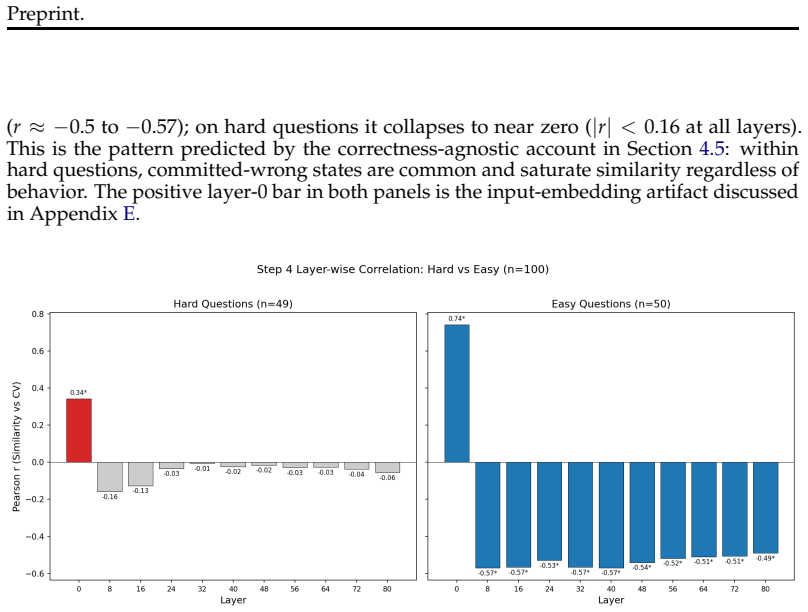
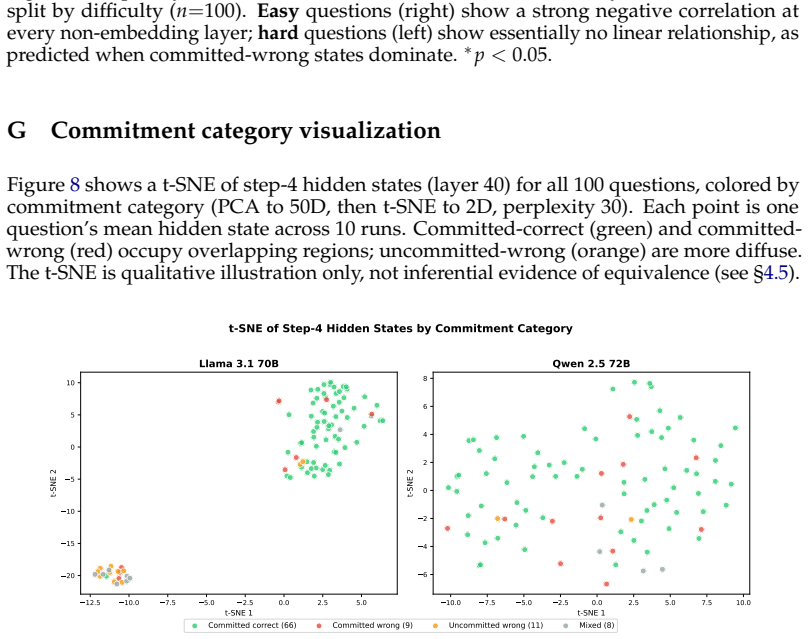
Long-horizon LLM agents can fail quietly: they settle on one reading of the evidence early, then spend the rest of the run defending it. We call this premature commitment. Final-answer scoring misses the failure mode because it sees only the answer, not whether the process has already collapsed to a stable path. We define representational commitment as cross-run hidden-state convergence at a fixed reasoning step, and use it as an early diagnostic of trajectory consistency. On Llama-3.1-70B running ReAct on HotpotQA, step-4 hidden-state similarity predicts downstream behavioral consistency (r = -0.35, partial r = -0.45), with a localized temporal and layer-wise signature. The signal replicates across Qwen-2.5-72B and Phi-3-14B, and on StrategyQA (r = -0.83). It does not track correctness: committed-wrong and committed-correct questions are not separable in activation similarity. That boundary is central to the claim. Commitment tells us whether an agent has settled, not whether it is right. A runtime monitor detects inconsistent trajectories from hidden states at AUROC up to 0.97 (0.85--0.88 under a stricter split), and a prompting intervention cuts behavioral variance by 28% against a token-matched control while leaving accuracy statistically unchanged. We also test whether the signal can route self-consistency compute; on a harder benchmark it helps only modestly and is matched by a simpler output-based baseline. The result is a diagnostic for a hidden process failure, with clear limits rather than a general accuracy lever.
Figures




Forward citations
Cited by 5 Pith papers
-
AllocBench: Measuring Online Tool Allocation Capability in LLM Agents
Frontier LLMs allocate a limited budget near-optimally in an abstract task but fail to transfer that allocation behavior to writing reusable scripts.
-
AllocBench: Measuring Online Tool Allocation Capability in LLM Agents
LLM agents allocate budgets near-optimally in abstract tasks but lose this ability when the same decisions require writing reusable scripts.
-
Doomed from the Start: Early Abort of LLM Agent Episodes via a Recall-Controlled Probe Cascade
A cascade of recall-calibrated gates on LLM agent hidden states aborts doomed episodes early, saving up to 47% compute at a 90% global success-recall target.
-
From Cognitive Architectures to Language Agents: A Mechanism-Level Review of Lineage, Convergence, and Migration Gaps
Coding each mechanism for evidence of lineage and implementation depth, the review closes one candidate gap (GraSP) and isolates five residual control bundles for language agents.
-
Doomed from the Start: Early Abort of LLM Agent Episodes via a Recall-Controlled Probe Cascade
Hidden-state probes can flag doomed LLM-agent episodes from the first round, and a recall-calibrated cascade of abort gates cuts generated tokens by up to 60% while preserving a chosen success-recall target.
Reference graph
Works this paper leans on
-
[1]
Phi-3 Technical Report: A Highly Capable Language Model Locally on Your Phone
Marah Abdin, Sam Ade Jacobs, Ammar Ahmad Amin, et al. Phi-3 technical report: A highly capable language model locally on your phone.arXiv preprint arXiv:2404.14219,
work page internal anchor Pith review Pith/arXiv arXiv
-
[2]
Let’s sample step by step: Adaptive-consistency for efficient reasoning and coding with LLMs
Pranjal Aggarwal, Aman Madaan, Yiming Yang, and Mausam. Let’s sample step by step: Adaptive-consistency for efficient reasoning and coding with LLMs. InProceedings of the 2023 Conference on Empirical Methods in Natural Language Processing,
2023
-
[3]
The Internal State of an LLM Knows When It's Lying
Amos Azaria and Tom Mitchell. The internal state of an LLM knows when it’s lying.arXiv preprint arXiv:2304.13734,
work page internal anchor Pith review Pith/arXiv arXiv
-
[4]
Discovering Latent Knowledge in Language Models Without Supervision
Collin Burns, Haotian Ye, Dan Klein, and Jacob Steinhardt. Discovering latent knowledge in language models without supervision.arXiv preprint arXiv:2212.03827,
work page internal anchor Pith review Pith/arXiv arXiv
-
[5]
Persona Vectors: Monitoring and Controlling Character Traits in Language Models
Runjin Chen, Andy Arditi, Henry Sleight, Owain Evans, and Jack Lindsey. Persona vec- tors: Monitoring and controlling character traits in language models.arXiv preprint arXiv:2507.21509,
work page internal anchor Pith review Pith/arXiv arXiv
-
[6]
Aaron Grattafiori, Abhimanyu Dubey, Abhinav Jauhri, Abhinav Pandey, Abhishek Kadian, Ahmad Al-Dahle, Aieleen Letman, Akhil Mathur, Alan Schelten, Amy Yang, et al. The Llama 3 herd of models.arXiv preprint arXiv:2407.21783,
work page internal anchor Pith review Pith/arXiv arXiv
-
[7]
Language Models (Mostly) Know What They Know
Saurav Kadavath, Tom Conerly, Amanda Askell, Tom Henighan, Dawn Drain, Ethan Perez, Nicholas Schiefer, Zac Hatfield-Dodds, Nova DasSarma, Eli Tran-Johnson, et al. Language models (mostly) know what they know.arXiv preprint arXiv:2207.05221,
work page internal anchor Pith review Pith/arXiv arXiv
-
[8]
Christina Lu, Jack Gallagher, Jonathan Michala, Kyle Fish, and Jack Lindsey. The assistant axis: Situating and stabilizing the default persona of language models.arXiv preprint arXiv:2601.10387,
-
[9]
Samuel Marks and Max Tegmark. The geometry of truth: Emergent linear structure in large language model representations of true/false datasets.arXiv preprint arXiv:2310.06824,
work page internal anchor Pith review Pith/arXiv arXiv
-
[10]
When Agents Disagree With Themselves: Measuring Behavioral Consistency in LLM -Based Agents
Aman Mehta. When agents disagree with themselves: Measuring behavioral consistency in LLM-based agents.arXiv preprint arXiv:2602.11619, 2026a. Aman Mehta. Consistency amplifies: How behavioral variance shapes agent accuracy.arXiv preprint arXiv:2603.25764, 2026b. Kiho Park, Yo Joong Choe, and Victor Veitch. The linear representation hypothesis and the geo...
work page internal anchor Pith review arXiv
-
[11]
Steering Language Models With Activation Engineering
10 Preprint. Alexander Matt Turner, Lisa Thiergart, David Udell, Gavin Leech, Ulisse Mini, and Leela Castricato. Activation addition: Steering language models without optimization.arXiv preprint arXiv:2308.10248,
work page internal anchor Pith review Pith/arXiv arXiv
-
[12]
Self-Consistency Improves Chain of Thought Reasoning in Language Models
Xuezhi Wang, Jason Wei, Dale Schuurmans, Quoc Le, Ed Chi, Sharan Narang, Aakanksha Chowdhery, and Denny Zhou. Self-consistency improves chain of thought reasoning in language models.arXiv preprint arXiv:2203.11171,
work page internal anchor Pith review Pith/arXiv arXiv
-
[13]
An Yang, Baosong Yang, Beichen Zhang, Binyuan Hui, Bo Wang, Bowen Zheng, Chengyuan Yu, et al. Qwen2.5 technical report.arXiv preprint arXiv:2412.15115,
work page internal anchor Pith review Pith/arXiv arXiv
-
[14]
HotpotQA: A Dataset for Diverse, Explainable Multi-hop Question Answering
Zhilin Yang, Peng Qi, Saizheng Zhang, Yoshua Bengio, William W Cohen, Ruslan Salakhutdi- nov, and Christopher D Manning. HotpotQA: A dataset for diverse, explainable multi-hop question answering.arXiv preprint arXiv:1809.09600,
work page internal anchor Pith review Pith/arXiv arXiv
-
[15]
ReAct: Synergizing Reasoning and Acting in Language Models
Shunyu Yao, Jeffrey Zhao, Dian Yu, Nan Du, Izhak Shafran, Karthik Narasimhan, and Yuan Cao. ReAct: Synergizing reasoning and acting in language models.arXiv preprint arXiv:2210.03629,
work page internal anchor Pith review Pith/arXiv arXiv
-
[16]
Anqi Zhang, Yulin Chen, Jane Pan, Chen Zhao, Aurojit Panda, Jinyang Li, and He He. Reasoning models know when they’re right: Probing hidden states for self-verification. arXiv preprint arXiv:2504.05419,
-
[17]
Representation Engineering: A Top-Down Approach to AI Transparency
Andy Zou, Long Phan, Sarah Chen, James Campbell, Phillip Guo, Richard Ren, Alexander Pan, Xuwang Yin, Mantas Mazeika, Ann-Kathrin Dombrowski, et al. Representation engineering: A top-down approach to AI transparency.arXiv preprint arXiv:2310.01405,
work page internal anchor Pith review Pith/arXiv arXiv
-
[18]
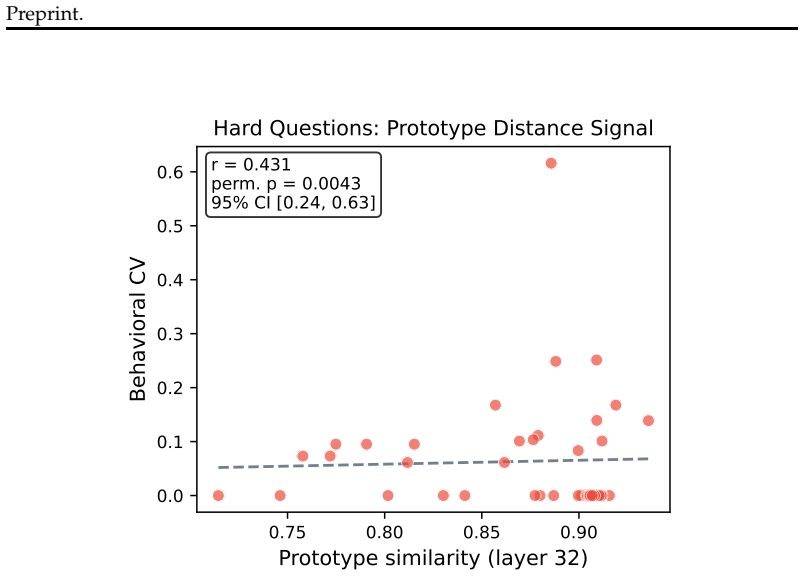
p = 0.0043 95% CI [0.24, 0.63] Hard Questions: Prototype Distance Signal Figure 9: Hard-question prototype signal: cosine similarity to hard-question centroid vs
0.0 0.1 0.2 0.3 0.4 0.5 0.6Behavioral CV r = 0.431 perm. p = 0.0043 95% CI [0.24, 0.63] Hard Questions: Prototype Distance Signal Figure 9: Hard-question prototype signal: cosine similarity to hard-question centroid vs. behavioral CV (step 4, layer 32). Questions further from the centroid are more consistent (r=0.43, perm.p=0.004). J Commitment as a linea...
2023
discussion (0)
Sign in with ORCID, Apple, or X to comment. Anyone can read and Pith papers without signing in.