REVIEW 2 major objections 2 minor 1 cited by
A self-consistent single-fluid framework for neutron stars admixed with mirror dark matter
T0 review · 2 major / 2 minor · reviewed 2026-07-02 · grok-4.3
Pith's one-line read Mirror dark matter admixed with neutron stars softens the equation of state and lowers their maximum masses.
desk verdict The paper couples mirror DM to baryons via mutual chemical-potential shifts but still fixes the global DM fraction as input, so the reported EOS softening and NS changes are conditional on that choice. read the letter →
The pith
A machine-rendered reading of the paper's core claim, the machinery that carries it, and where it could break.
The reading
What carries the argument
Contact vector current-current interaction that couples the chemical potentials of dark matter and baryonic matter through mutual mean-field shifts, with fixed global DM fraction as input.
What would settle it
An observed neutron star mass exceeding the lowered maximum for any dark matter fraction allowed by the model, or cooling data showing rapid cooling onset at masses inconsistent with the predicted shift in direct Urca threshold.
Extended reading notes
Core claim
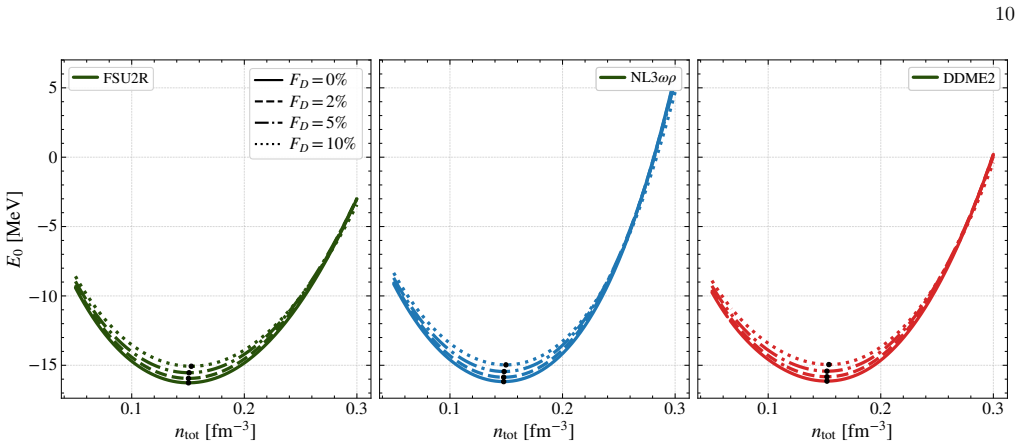
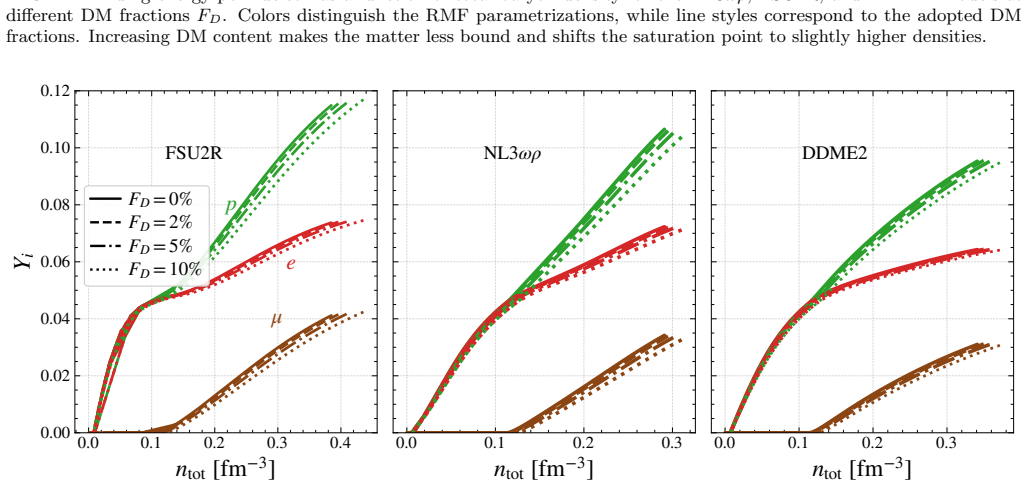
We develop a self-consistent framework based on a contact vector current-current interaction that couples the chemical potentials of both sectors through mutual mean-field shifts, with the dark matter fraction F_D = N_D/N_B fixed as a global input parameter. This formulation provides a physically motivated alternative to fixed-density prescriptions, allowing the local DM density to follow the baryonic matter density throughout the stellar interior. As an application, we consider a mirror-DM scenario with exact symmetry between the dark and visible sectors and investigate NS matter using the NL3ωρ, FSU2R, NL3, and DDME2 equations of state. We find that the DM-BM interaction weakens the bindin
Load-bearing premise
The dark matter fraction is treated as a fixed global input parameter and mirror dark matter is assumed to have exact symmetry with the visible sector.
Editorial extensions
If this is right
- Maximum masses of neutron stars decrease with increasing dark matter fraction.
- Central densities and compactness of neutron stars increase.
- The direct Urca process onset moves to higher stellar densities.
- Rapid cooling onsets shift to more massive stars for stiff symmetry energy models and to less massive stars for soft symmetry energy models.
Reading between the lines
- Mass-radius measurements from gravitational wave events could be reinterpreted to bound the dark matter fraction in neutron stars.
- The model suggests that scatter in observed neutron star properties might partly arise from varying dark matter admixtures between individual stars.
- Cooling curve data from isolated neutron stars offers a potential observational test independent of mass limits.
Editorial analysis
A structured set of objections, weighed in public.
Referee Report
Summary. The manuscript develops a single-fluid framework for neutron stars admixed with mirror dark matter based on a contact vector current-current interaction that mutually shifts chemical potentials between baryonic and dark sectors, with the global DM fraction F_D = N_D/N_B imposed as a fixed input parameter. This allows local DM density to track baryonic density. For the NL3ωρ, FSU2R, NL3, and DDME2 RMF equations of state under exact mirror symmetry, the interaction is reported to weaken binding, reduce incompressibility, soften the EOS, raise central densities and compactness, lower maximum masses, and shift the direct Urca onset (to higher masses for stiff symmetry energy models and lower masses for soft ones).
Significance. If the framework holds, the approach supplies a density-following alternative to fixed-density DM prescriptions and yields testable implications for NS maximum masses and cooling curves across multiple EOS families, with potential relevance to multimessenger constraints. Explicit use of four distinct RMF models is a positive feature that allows qualitative trends to be checked for robustness.
major comments (2)
- [Framework description] Framework section (abstract and model description): the claim of self-consistency rests on the contact interaction shifting chemical potentials, yet F_D is introduced and held fixed as a global input rather than obtained by solving the coupled equilibrium conditions together with total particle-number conservation; this renders the reported EOS softening, central-density increase, M_max reduction, and Urca shift conditional on externally chosen F_D values.
- [Application to RMF EOS models] Results paragraphs for the four EOS models: the shifts in Urca onset and maximum mass are stated only qualitatively, with no tabulated values, no error estimates on the density or mass changes, and no explicit comparison of the interaction-modified EOS against the baseline case at the same F_D; this weakens the ability to judge the size of the reported effects.
minor comments (2)
- [Framework description] Notation for the vector coupling strength and the precise form of the mean-field shift in the chemical potentials should be written explicitly (ideally with an equation) rather than described only in words.
- [Framework description] The statement that local DM density 'follows' the baryonic density needs a short clarification of how the single-fluid ansatz enforces this while keeping the global ratio fixed.
Simulated Author's Rebuttal
We thank the referee for their careful reading of the manuscript and for the constructive comments. We address each major comment below.
read point-by-point responses
-
Referee: Framework section (abstract and model description): the claim of self-consistency rests on the contact interaction shifting chemical potentials, yet F_D is introduced and held fixed as a global input parameter rather than obtained by solving the coupled equilibrium conditions together with total particle-number conservation; this renders the reported EOS softening, central-density increase, M_max reduction, and Urca shift conditional on externally chosen F_D values.
Authors: We agree that F_D is imposed as a fixed global input parameter and that the quantitative results depend on the specific value chosen for it. The self-consistency of the framework refers to the local DM density being determined dynamically via the mutual mean-field shifts once F_D is specified, rather than being prescribed independently at each density. We will revise the text to make this distinction explicit and to emphasize that F_D functions as a model parameter analogous to those in other admixture studies. revision: yes
-
Referee: Results paragraphs for the four EOS models: the shifts in Urca onset and maximum mass are stated only qualitatively, with no tabulated values, no error estimates on the density or mass changes, and no explicit comparison of the interaction-modified EOS against the baseline case at the same F_D; this weakens the ability to judge the size of the reported effects.
Authors: We accept that the results section would benefit from quantitative presentation. In the revised manuscript we will include tables listing the changes in maximum mass, central density, and the stellar mass at direct Urca onset for each of the four RMF models, both with and without the DM interaction, evaluated at the same fixed F_D values. This will enable direct comparison to the baseline cases. revision: yes
Circularity Check
No significant circularity; framework treats F_D explicitly as input
full rationale
The paper states that F_D is fixed as a global input parameter and computes consequences for the EOS and stellar structure from the contact interaction and chosen RMF models (NL3ωρ, FSU2R, NL3, DDME2). No step reduces a claimed prediction to a fitted quantity by construction, nor does any load-bearing premise rest on self-citation chains or imported uniqueness theorems. The mean-field coupling of chemical potentials is defined independently of the fixed F_D, and results are presented as conditional on that parameter. This is a standard parametric study with no self-definitional or renaming circularity.
Assumptions & free parameters
free parameters (1)
- F_D = N_D/N_B
assumptions (1)
- domain assumption Exact symmetry between dark and visible sectors
Cite this review
Pith. "Pith review of A self-consistent single-fluid framework for neutron stars admixed with mirror dark matter." pith.science (2026). https://pith.science/paper/DPUVYIZ7
@misc{pith2026260700888,
  author       = {Pith},
  title        = {Pith review of: A self-consistent single-fluid framework for neutron stars admixed with mirror dark matter},
  year         = {2026},
  howpublished = {\url{https://pith.science/paper/DPUVYIZ7}},
  note         = {Machine review of arXiv:2607.00888}
}
abstract
We develop a self-consistent framework based on a contact vector current-current interaction that couples the chemical potentials of both sectors through mutual mean-field shifts, with the dark matter (DM) fraction $F_D = N_D/N_B$ fixed as a global input parameter. This formulation provides a physically motivated alternative to fixed-density prescriptions, allowing the local DM density to follow the baryonic matter (BM) density throughout the stellar interior. As an application, we consider a mirror-DM scenario with exact symmetry between the dark and visible sectors and investigate NS matter using the NL3$\omega\rho$, FSU2R, NL3, and DDME2 equations of state (EOSs). We find that the DM--BM interaction weakens the binding of dense matter, reduces its incompressibility, and softens the EOS. Consequently, DM increases the central density and compactness of NSs, lowers their maximum masses, and shifts the onset of the direct Urca process to higher stellar densities. As a consequence, the onset of rapid cooling is shifted to more massive stars for models with a stiff symmetry energy and to less massive stars for models with a soft symmetry energy, depending on the extra compactness that results from the DM admixture. These results demonstrate that mirror-DM admixtures modify both the microscopic composition and macroscopic structure of NSs, with potential implications for their thermal evolution and multimessenger observational signatures.
Figures

Figures from the paper (4 more)


Forward citations
Cited by 1 Pith paper
-
A self-consistent Higgs-portal framework for dark matter--admixed neutron stars: Collider-motivated benchmarks meet multimessenger constraints
Adding heavy dark matter to neutron stars via nχ=FχnB softens the equation of state and lowers the maximum mass, but the vector interaction invoked is numerically negligible.
Reference graph
Works this paper leans on
-
[1]
and FAPESP Thematic Grants (2023/13749-1 and 2024/17816-8). F.M.S. would like to thank CNPq for fi- nancial support under research project No. 403007/2024-0 and research fellowship No. 201145/2025-1. This work was partially supported by national funds from FCT (Funda¸ c˜ ao para a Ciˆ encia e a Tecnologia, I.P, Portu- gal) under project UID/04564/2025, id...
-
[2]
V. C. Rubin, W. K. Ford, Jr., and N. Thonnard, Rota- tional properties of 21 SC galaxies with a large range of luminosities and radii, from NGC 4605 (R=4kpc) to UGC 2885 (R=122kpc)., Astrophys. J.238, 471 (1980)
work page 1980
-
[3]
Bosma, 21-cm line studies of spiral galaxies
A. Bosma, 21-cm line studies of spiral galaxies. II. The distribution and kinematics of neutral hydrogen in spiral galaxies of various morphological types., ApJ86, 1825 (1981)
work page 1981
-
[4]
A direct empirical proof of the existence of dark matter
D. Clowe, M. Bradac, A. H. Gonzalez, M. Markevitch, S. W. Randall, C. Jones, and D. Zaritsky, A direct empir- 16 ical proof of the existence of dark matter, Astrophys. J. Lett.648, L109 (2006), arXiv:astro-ph/0608407
work page Pith review arXiv 2006
-
[5]
Simulating the joint evolution of quasars, galaxies and their large-scale distribution
V. Springelet al., Simulating the joint evolution of quasars, galaxies and their large-scale distribution, Nature435, 629 (2005), arXiv:astro-ph/0504097
work page Pith review arXiv 2005
-
[6]
P. A. R. Adeet al.(Planck), Planck 2015 results. XIII. Cosmological parameters, Astron. Astrophys.594, A13 (2016), arXiv:1502.01589 [astro-ph.CO]
work page Pith review arXiv 2015
-
[7]
T. Totani, 20 GeV halo-like excess of the Galactic diffuse emission and implications for dark matter annihilation, JCAP11, 080, arXiv:2507.07209 [astro-ph.HE]
-
[8]
Profumo, Dark baryon black holes, Phys
S. Profumo, Dark baryon black holes, Phys. Rev. D111, 095010 (2025), arXiv:2502.16439 [hep-ph]
work page Pith review arXiv 2025
Show all 78 references
-
[9]
Aprileet al.(XENON), Dark Matter Search Results from a One Ton-Year Exposure of XENON1T, Phys
E. Aprileet al.(XENON), Dark Matter Search Results from a One Ton-Year Exposure of XENON1T, Phys. Rev. Lett.121, 111302 (2018), arXiv:1805.12562 [astro-ph.CO]
2018 arXiv
-
[10]
Aprileet al.(XENON), WIMP Dark Matter Search Using a 3.1 Tonne-Year Exposure of the XENONnT Experiment, Phys
E. Aprileet al.(XENON), WIMP Dark Matter Search Using a 3.1 Tonne-Year Exposure of the XENONnT Experiment, Phys. Rev. Lett.135, 221003 (2025), arXiv:2502.18005 [hep-ex]
2025
-
[11]
Aalberset al.(LZ), Dark Matter Search Results from 4.2 Tonne-Years of Exposure of the LUX-ZEPLIN (LZ) Experiment, Phys
J. Aalberset al.(LZ), Dark Matter Search Results from 4.2 Tonne-Years of Exposure of the LUX-ZEPLIN (LZ) Experiment, Phys. Rev. Lett.135, 011802 (2025), arXiv:2410.17036 [hep-ex]
2025 arXiv
-
[12]
Boet al.(PandaX), Dark Matter Search Results from 1.54 Tonne·Year Exposure of PandaX-4T, Phys
Z. Boet al.(PandaX), Dark Matter Search Results from 1.54 Tonne·Year Exposure of PandaX-4T, Phys. Rev. Lett. 134, 011805 (2025), arXiv:2408.00664 [hep-ex]
2025
-
[13]
Kouvaris, WIMP Annihilation and Cooling of Neutron Stars, Phys
C. Kouvaris, WIMP Annihilation and Cooling of Neutron Stars, Phys. Rev. D77, 023006 (2008), arXiv:0708.2362 [astro-ph]
2008 arXiv
-
[14]
Issifu, P
A. Issifu, P. Thakur, F. M. da Silva, K. D. Marquez, D. P. Menezes, M. Dutra, O. Louren¸ co, and T. Frederico, Supernova remnants with mirror dark matter and hyper- ons, Phys. Rev. D111, 083026 (2025), arXiv:2412.17946 [hep-ph]
2025
-
[15]
L. L. Lopes and A. Issifu, XTE J1814-338 as a dark mat- ter admixed neutron star, Phys. Dark Univ.48, 101922 (2025), arXiv:2411.17105 [astro-ph.HE]
2025
-
[16]
de Lavallaz and M
A. de Lavallaz and M. Fairbairn, Neutron Stars as Dark Matter Probes, Phys. Rev. D81, 123521 (2010), arXiv:1004.0629 [astro-ph.GA]
2010 arXiv
-
[17]
Kouvaris and P
C. Kouvaris and P. Tinyakov, Can Neutron stars con- strain Dark Matter?, Phys. Rev. D82, 063531 (2010), arXiv:1004.0586 [astro-ph.GA]
2010 arXiv
-
[18]
Bertone, D
G. Bertone, D. Hooper, and J. Silk, Particle dark matter: Evidence, candidates and constraints, Phys. Rept.405, 279 (2005), arXiv:hep-ph/0404175
2005 arXiv
-
[19]
Shakeri and D
S. Shakeri and D. R. Karkevandi, Bosonic dark matter in light of the NICER precise mass-radius measurements, Phys. Rev. D109, 043029 (2024), arXiv:2210.17308 [astro- ph.HE]
2024
-
[20]
A. Das, T. Malik, and A. C. Nayak, Dark matter admixed neutron star properties in light of gravitational wave observations: A two fluid approach, Phys. Rev. D105, 123034 (2022), arXiv:2011.01318 [nucl-th]
2022
-
[21]
Issifu, P
A. Issifu, P. Thakur, D. R. Karkevandi, F. M. da Silva, D. P. Menezes, Y. Lim, and T. Frederico, Dark matter heating in evolving protoneutron stars: A two-fluid ap- proach, Phys. Rev. D113, 103042 (2026)
2026
-
[22]
Thakur, T
P. Thakur, T. Malik, A. Das, T. K. Jha, and C. Providˆ encia, Exploring robust correlations between fermionic dark matter model parameters and neutron star properties: A two-fluid perspective, Phys. Rev. D109, 043030 (2024), arXiv:2308.00650 [hep-ph]
2024
-
[23]
D. R. Karkevandi, S. Shakeri, V. Sagun, and O. Ivanyt- skyi, Bosonic dark matter in neutron stars and its effect on gravitational wave signal, Phys. Rev. D105, 023001 (2022), arXiv:2109.03801 [astro-ph.HE]
2022
-
[24]
Issifu, A
A. Issifu, A. Konstantinou, P. Thakur, and T. Frederico, Rotating protoneutron star admixed with mirror dark matter: A two-fluid approach, Phys. Rev. D112, 103026 (2025), arXiv:2507.20823 [astro-ph.HE]
2025
-
[25]
Kain, Dark matter admixed neutron stars, Phys
B. Kain, Dark matter admixed neutron stars, Phys. Rev. D103, 043009 (2021), arXiv:2102.08257 [gr-qc]
2021
-
[26]
Biesdorf, J
C. Biesdorf, J. Schaffner-Bielich, and L. Tolos, Masquerad- ing hybrid stars with dark matter, Phys. Rev. D111, 083038 (2025), arXiv:2412.05207 [hep-ph]
2025
-
[27]
Rezaei, Study of Dark-Matter Admixed Neutron Stars using the Equation of State from the Rotational Curves of Galaxies, Astrophys
Z. Rezaei, Study of Dark-Matter Admixed Neutron Stars using the Equation of State from the Rotational Curves of Galaxies, Astrophys. J.835, 33 (2017), arXiv:1612.02804 [astro-ph.HE]
2017 arXiv
-
[28]
Bertoni, A
B. Bertoni, A. E. Nelson, and S. Reddy, Dark Matter Thermalization in Neutron Stars, Phys. Rev. D88, 123505 (2013), arXiv:1309.1721 [hep-ph]
2013 arXiv
-
[29]
Bramante, K
J. Bramante, K. Fukushima, J. Kumar, and E. Stopnitzky, Bounds on self-interacting fermion dark matter from ob- servations of old neutron stars, Phys. Rev. D89, 015010 (2014), arXiv:1310.3509 [hep-ph]
2014 arXiv
-
[30]
A. Das, T. Malik, and A. C. Nayak, Confronting nuclear equation of state in the presence of dark matter using GW170817 observation in relativistic mean field theory ap- proach, Phys. Rev. D99, 043016 (2019), arXiv:1807.10013 [hep-ph]
2019 arXiv
-
[31]
Issifu, D
A. Issifu, D. P. Menezes, and T. Frederico, Proto-neutron stars with dark matter admixture: A single-fluid approach, Phys. Dark Univ.50, 102149 (2025), arXiv:2506.21378 [astro-ph.HE]
2025
-
[32]
H. C. Das, A. Kumar, B. Kumar, S. Kumar Biswal, T. Nakatsukasa, A. Li, and S. K. Patra, Effects of dark matter on the nuclear and neutron star matter, Mon. Not. Roy. Astron. Soc.495, 4893 (2020), arXiv:2002.00594 [nucl-th]
2020
-
[33]
M. I. Gresham and K. M. Zurek, Asymmetric Dark Stars and Neutron Star Stability, Phys. Rev. D99, 083008 (2019), arXiv:1809.08254 [astro-ph.CO]
2019 arXiv
-
[34]
Sahoo, S
R. Sahoo, S. Mukhopadhyay, and M. Bhuyan, Dark matter admixed white dwarfs: A single-fluid approach, Phys. Rev. D113, 123005 (2026), arXiv:2511.17120 [astro-ph.SR]
2026
-
[35]
Garani, Y
R. Garani, Y. Genolini, and T. Hambye, New analysis of neutron star constraints on asymmetric dark matter, JCAP2019, 035 (2019), arXiv:1812.08773 [hep-ph]
2019 arXiv
-
[36]
Bramante and N
J. Bramante and N. Raj, Dark matter in compact stars, Phys. Rept.1052, 1 (2024), arXiv:2307.14435 [hep-ph]
2024
-
[37]
Sen and A
D. Sen and A. Guha, Implications of feebly interacting dark sector on neutron star properties and constraints from GW170817, Mon. Not. Roy. Astron. Soc.504, 3354 (2021), arXiv:2104.06141 [hep-ph]
2021
-
[38]
Guha and D
A. Guha and D. Sen, Constraining the mass of fermionic dark matter from its feeble interaction with hadronic matter via dark mediators in neutron stars, Phys. Rev. D109, 043038 (2024), arXiv:2401.14419 [astro-ph.HE]
2024
-
[39]
Panotopoulos and I
G. Panotopoulos and I. Lopes, Dark matter effect on realistic equation of state in neutron stars, Phys. Rev. D 96, 083004 (2017), arXiv:1709.06312 [hep-ph]
2017 arXiv
-
[40]
Narain, J
G. Narain, J. Schaffner-Bielich, and I. N. Mishustin, Com- pact stars made of fermionic dark matter, Phys. Rev. D 74, 063003 (2006), arXiv:astro-ph/0605724
2006 arXiv
-
[41]
T. F. Motta, P. A. M. Guichon, and A. W. Thomas, Neutron to Dark Matter Decay in Neutron Stars, Int. J. Mod. Phys. A33, 1844020 (2018), arXiv:1806.00903 17 [nucl-th]
2018 arXiv
-
[42]
G. Baym, D. H. Beck, P. Geltenbort, and J. Shelton, Testing dark decays of baryons in neutron stars, Phys. Rev. Lett.121, 061801 (2018), arXiv:1802.08282 [hep-ph]
2018 arXiv
-
[43]
Husain, T
W. Husain, T. F. Motta, and A. W. Thomas, Conse- quences of neutron decay inside neutron stars, JCAP 2022, 028 (2022), arXiv:2203.02758 [hep-ph]
2022
-
[44]
N. F. Bell, G. Busoni, S. Robles, and M. Virgato, Ther- malization and annihilation of dark matter in neutron stars, JCAP2024, 006 (2024), arXiv:2312.11892 [hep-ph]
2024
-
[45]
J. M. Berryman, S. Gardner, and M. Zakeri, How macro- scopic limits on neutron-star baryon loss yield microscopic limits on non-standard-model baryon decay, Phys. Rev. D109, 023021 (2024), arXiv:2305.13377 [hep-ph]
2024
-
[46]
Garani, A
R. Garani, A. Gupta, and N. Raj, Observing the ther- malization of dark matter in neutron stars, Phys. Rev. D 103, 043019 (2021), arXiv:2009.10728 [hep-ph]
2021
-
[47]
Oliveira, C
O. Oliveira, C. A. Bertulani, M. S. Hussein, W. de Paula, and T. Frederico, Cosmological and Particle Physics Con- straints on a New Non-Abelian SU(3) Gauge Model for Ordinary/Dark Matter Interaction, Braz. J. Phys.46, 721 (2016), arXiv:1508.01049 [hep-ph]
2016 arXiv
-
[48]
Aprileet al.(XENON), First Dark Matter Search with Nuclear Recoils from the XENONnT Experiment, Phys
E. Aprileet al.(XENON), First Dark Matter Search with Nuclear Recoils from the XENONnT Experiment, Phys. Rev. Lett.131, 041003 (2023), arXiv:2303.14729 [hep-ex]
2023
-
[49]
A. H. Abdelhameedet al.(CRESST), First results from the CRESST-III low-mass dark matter program, Phys. Rev. D100, 102002 (2019), arXiv:1904.00498 [astro- ph.CO]
2019
-
[50]
Petriccaet al.(CRESST), First results on low-mass dark matter from the CRESST-III experiment, J
F. Petriccaet al.(CRESST), First results on low-mass dark matter from the CRESST-III experiment, J. Phys. Conf. Ser.1342, 012076 (2020), arXiv:1711.07692 [astro- ph.CO]
2020 arXiv
-
[51]
Agneseet al.(SuperCDMS), Search for Low-Mass Dark Matter with CDMSlite Using a Profile Likelihood Fit, Phys
R. Agneseet al.(SuperCDMS), Search for Low-Mass Dark Matter with CDMSlite Using a Profile Likelihood Fit, Phys. Rev. D99, 062001 (2019), arXiv:1808.09098 [astro-ph.CO]
2019
-
[52]
Agneseet al.(SuperCDMS), Results from the Super Cryogenic Dark Matter Search Experiment at Soudan, Phys
R. Agneseet al.(SuperCDMS), Results from the Super Cryogenic Dark Matter Search Experiment at Soudan, Phys. Rev. Lett.120, 061802 (2018), arXiv:1708.08869 [hep-ex]
2018 arXiv
-
[53]
Agneseet al.(SuperCDMS), Low-mass dark matter search with CDMSlite, Phys
R. Agneseet al.(SuperCDMS), Low-mass dark matter search with CDMSlite, Phys. Rev. D97, 022002 (2018), arXiv:1707.01632 [astro-ph.CO]
2018 arXiv
-
[54]
Providencia and A
C. Providencia and A. Rabhi, Interplay between the sym- metry energy and the strangeness content of neutron stars, Phys. Rev. C87, 055801 (2013), arXiv:1212.5911 [nucl-th]
2013 arXiv
-
[55]
Tolos, M
L. Tolos, M. Centelles, and A. Ramos, Equation of State for Nucleonic and Hyperonic Neutron Stars with Mass and Radius Constraints, Astrophys. J.834, 3 (2017), arXiv:1610.00919 [astro-ph.HE]
2017 arXiv
-
[56]
Tolos, M
L. Tolos, M. Centelles, and A. Ramos, The Equation of State for the Nucleonic and Hyperonic Core of Neu- tron Stars, Publ. Astron. Soc. Austral.34, e065 (2017), arXiv:1708.08681 [astro-ph.HE]
2017 arXiv
-
[57]
C. J. Horowitz and J. Piekarewicz, Neutron star structure and the neutron radius of Pb-208, Phys. Rev. Lett.86, 5647 (2001), arXiv:astro-ph/0010227
2001 arXiv
-
[58]
G. A. Lalazissis, T. Nikˇ si´ c, D. Vretenar, and P. Ring, New relativistic mean-field interaction with density-dependent meson-nucleon couplings, Phys. Rev. C71, 024312 (2005)
2005
-
[59]
D. P. Menezes, A Neutron Star Is Born, Universe7, 267 (2021), arXiv:2106.09515 [astro-ph.HE]
2021
-
[60]
Typel and H
S. Typel and H. H. Wolter, Relativistic mean field calcu- lations with density dependent meson nucleon coupling, Nucl. Phys. A656, 331 (1999)
1999
-
[61]
Fuchs, H
C. Fuchs, H. Lenske, and H. H. Wolter, Density depen- dent hadron field theory, Phys. Rev. C52, 3043 (1995), arXiv:nucl-th/9507044
1995 arXiv
-
[62]
Sedrakian and A
A. Sedrakian and A. Harutyunyan, Delta-resonances and hyperons in proto-neutron stars and merger remnants, Eur. Phys. J. A58, 137 (2022), arXiv:2202.12083 [nucl- th]
2022
-
[63]
Hajkarim, J
F. Hajkarim, J. Schaffner-Bielich, and L. Tolos, Thermody- namic consistent description of compact stars of two inter- acting fluids: the case of neutron stars with Higgs portal dark matter, JCAP2025, 070 (2025), arXiv:2412.04585 [hep-ph]
2025
-
[64]
Glendenning,Compact Stars: Nuclear Physics, Parti- cle Physics and General Relativity, Astronomy and Astro- physics Library (Springer New York, 2012)
N. Glendenning,Compact Stars: Nuclear Physics, Parti- cle Physics and General Relativity, Astronomy and Astro- physics Library (Springer New York, 2012)
2012
-
[65]
N. M. Hugenholtz and L. van Hove, A theorem on the single particle energy in a Fermi gas with interaction, Physica24, 363 (1958)
1958
-
[66]
S. S. Avancini, M. E. Bracco, M. Chiapparini, and D. P. Menezes, On the density dependent hadron field theory at finite temperature and its thermodynamical consistency, J. Phys. G30, 27 (2004), arXiv:nucl-th/0311019
2004 arXiv
-
[67]
J. M. Lattimer, M. Prakash, C. J. Pethick, and P. Haensel, Direct URCA process in neutron stars, Phys. Rev. Lett. 66, 2701 (1991)
1991
-
[68]
Fortin, C
M. Fortin, C. Providencia, A. R. Raduta, F. Gulminelli, J. L. Zdunik, P. Haensel, and M. Bejger, Neutron star radii and crusts: uncertainties and unified equations of state, Phys. Rev. C94, 035804 (2016), arXiv:1604.01944 [astro-ph.SR]
2016 arXiv
-
[69]
Klahnet al., Constraints on the high-density nuclear equation of state from the phenomenology of compact stars and heavy-ion collisions, Phys
T. Klahnet al., Constraints on the high-density nuclear equation of state from the phenomenology of compact stars and heavy-ion collisions, Phys. Rev. C74, 035802 (2006), arXiv:nucl-th/0602038
2006 arXiv
-
[70]
D. Page, J. M. Lattimer, M. Prakash, and A. W. Steiner, Minimal cooling of neutron stars: A New paradigm, Astro- phys. J. Suppl.155, 623 (2004), arXiv:astro-ph/0403657
2004 arXiv
-
[71]
D. Page, U. Geppert, and F. Weber, The Cooling of compact stars, Nucl. Phys. A777, 497 (2006), arXiv:astro- ph/0508056
2006
-
[72]
B. P. Abbott, R. Abbott, T. D. Abbott, S. Abraham, F. Acernese,et al., GWTC-1: A Gravitational-Wave Transient Catalog of Compact Binary Mergers Observed by LIGO and Virgo during the First and Second Observing Runs, Phys. Rev. X9, 031040 (2019)
2019
-
[73]
Doroshenko, V
V. Doroshenko, V. Suleimanov, G. P¨ uhlhofer, and A. San- tangelo, A strangely light neutron star within a supernova remnant, Nature Astronomy6, 1444 (2022)
2022
-
[74]
M. C. Miller, F. K. Lamb, A. J. Dittmann,et al., The Radius of PSR J0740+6620 from NICER and XMM- Newton Data, Astrophys. J. Lett.918, L28 (2021)
2021
-
[75]
T. E. Riley, A. L. Watts, P. S. Ray,et al., A nicer view of the massive pulsar psr j0740+6620 informed by radio tim- ing and xmm-newton spectroscopy, Astrophysical Journal Letters918, L27 (2021), arXiv:2105.06979 [astro-ph.HE]
2021 arXiv
-
[77]
T. E. Riley, A. L. Watts, S. Bogdanov,et al., A nicer view of psr j0030+0451: Millisecond pulsar parameter estimation, Astrophysical Journal Letters887, L21 (2019), 18 arXiv:1912.05705 [astro-ph.HE]
2019 arXiv
-
[78]
Louren¸ co, T
O. Louren¸ co, T. Frederico, and M. Dutra, Dark matter component in hadronic models with short-range correla- tions, Phys. Rev. D105, 023008 (2022), arXiv:2112.07716 [nucl-th]
2022
-
[79]
Shirke, S
S. Shirke, S. Ghosh, D. Chatterjee, L. Sagunski, and J. Schaffner-Bielich, R-modes as a new probe of dark matter in neutron stars, JCAP2023, 008 (2023), arXiv:2305.05664 [astro-ph.HE]
2023
Reviewed July 2, 2026 · model on record in the stance chip above.
Discussion (0). Sign in to comment.