REVIEW 2 major objections 6 minor 1 cited by
Reuse of AI agent skills is mostly a one-time copy: half stay untouched after adoption, and the behavioural contract almost never changes.
Reviewed by Pith at T0; open to challenge. T0 means a machine referee read the full paper against a public rubric. the ladder, T0–T4 →
T0 review · grok-4.5
2026-07-12 09:10 UTC pith:XPK23WBM
load-bearing objection First real empirical map of agent skills as reusable artefacts: one-time copy, additive local drift, and a mostly untouched behavioural contract—solid methods, disclosed limits, worth engaging. the 2 major comments →
From Registry to Repository: How AI Agent Skills Are Written, Adapted, and Maintained
The pith
A machine-rendered reading of the paper's core claim, the machinery that carries it, and where it could break.
Core claim
Reuse of AI agent skills is largely a one-time copy operation: most reused skills remain near-verbatim, 53% are never modified after adoption, subsequent local maintenance is overwhelmingly additive, customisation primarily adapts skills to local environments while evolution accretes new inline domain knowledge, and across both a stable behavioural contract (user interaction, runtime monitoring, failure recovery) remains almost untouched.
What carries the argument
Recovered registry-to-repository reuse links (YAML name field plus longest-common-subsequence body similarity) that let the study separate customisation-at-adoption from later local evolution and measure how little the behavioural contract moves.
Load-bearing premise
The name-plus-similarity heuristic correctly recovers genuine reuse links at scale, so the one-time-copy story is not an artefact of missed renames, heavy rewrites, reverse reuse, or unlinked third-party sources.
What would settle it
A large audit of linked pairs that finds many heavy rewrites or reverse-direction copies, or a longitudinal check showing most local copies later re-sync with upstream registry revisions, would collapse the one-time-copy claim.
If this is right
- Maintainers should prioritise keeping project-specific paths, tools, and activation metadata current rather than rewriting interaction and failure-recovery rules.
- Registries should offer agent-neutral templates and shared domain-knowledge packs so individual skills stop re-authoring the same facts in isolation.
- Skill authors should invest most care in the behavioural contract at creation time, because downstream adopters almost never revise it.
- Tooling that alerts adopters to upstream changes and traces when a skill actually fires would reduce silent drift and mis-activation.
Where Pith is reading between the lines
- Skills may become a distinct dependency class that needs its own supply-chain hygiene (version pins, provenance, vulnerability scanning) beyond ordinary documentation or libraries.
- The additive growth pattern implies skills will accumulate technical debt unless registries or editors supply pruning and consolidation tools.
- The under-representation of planning and management knowledge areas suggests a market gap that registry designers or specialised skill authors could fill.
Editorial analysis
A structured set of objections, weighed in public.
Referee Report
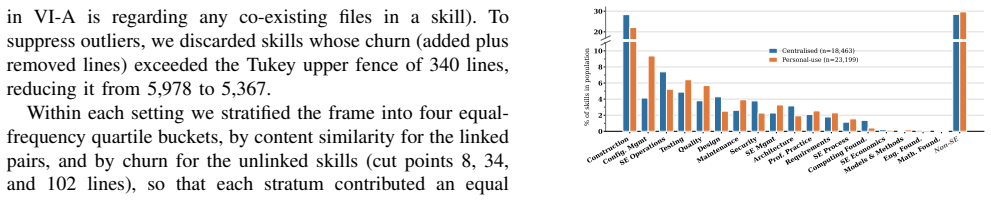
Summary. This paper presents the first large-scale empirical study of AI agent skills treated as engineered software artefacts rather than only agent capabilities. The authors mine 18,463 skills from the skills.sh registry and 23,199 personal-use skills from 5,876 GitHub repositories, recover 3,709 reuse links, classify skills into SWEBOK knowledge areas (Software Construction dominant, long tail elsewhere), induce a six-theme content taxonomy from 180 stratified SKILL.md documents, and code 444 customisation/evolution diffs into six change themes. The central claim is that registry reuse is largely a one-time copy: most recovered adoptions are near-verbatim, about 53% of reused skills receive no local post-adoption change, local maintenance is overwhelmingly additive, customisation mainly re-grounds skills to host projects, evolution accretes inline domain knowledge, and a behavioural contract (user interaction, runtime monitoring, failure recovery) is almost never revised.
Significance. If the results hold, the paper establishes skills as a first-class reuse and maintenance object in agent-based software engineering, with concrete implications for maintainers (focus on project-specific bindings and activation criteria), registries (agent-neutral formats and templates), and researchers (consolidating re-authored domain knowledge; tracing activation). Strengths include the dual-channel corpus at unusual scale, dual-LLM then dual-author gold-standard KA labelling (final human κ 0.85; model vs gold κ 0.82), dual-author thematic coding with stratified sampling of both content and change, Fisher tests with Benjamini–Hochberg correction for customisation vs evolution contrasts, an explicit threats section, and a public replication package. These are the right tools for an observational empirical SE study of a new artefact class.
major comments (2)
- Section III-A (Reuse-linkage Construction) and the reuse claims in §VI-A / abstract: the name-field + LCS body-similarity heuristic with threshold 0.1 is the load-bearing bridge from registry to repository. Validation is limited to two 30-pair audits (93% genuine in [0.1,0.3); 0/30 genuine below 0.1). The high-similarity majority (≥0.99 for 70.3% of pairs; 1,841/2,462 near-verbatim) carries the one-time-copy pattern and is robust to boundary error, but absolute reuse rates (16% of personal-use skills linked; 8.5% of centralised skills reused) and the claim that skills “rarely incorporate subsequent upstream updates” are sensitive to missed renames, heavy rewrites, reverse reuse, and other registries. Expand the audit (larger stratified samples across similarity bins and a sample of unlinked name-collisions) or report sensitivity under alternative thresholds/matchers so the reuse-rate fra
- Section III-D and Discussion VII-A: evolution is measured as net initial-to-final SKILL.md diffs (with churn fence), not full edit histories. The paper correctly discloses that this collapses intermediate add/remove/revert sequences, yet VII-A presents a strong directional claim that evolution is “overwhelmingly additive” (6.1:1 add:remove among coded key points; overall 2.7:1). Net endpoint growth is consistent with accretion, but the coded add/remove ratio on collapsed diffs can understate temporary churn and overstate pure additive maintenance behaviour. Either (a) re-frame the claim strictly as net accretion of content, or (b) quantify intermediate history on a subsample of the 256 evolution skills (e.g., commit-level add/remove balance) so the maintenance-behaviour interpretation is not stronger than the measurement design.
minor comments (6)
- Section III-B / IV / VIII: the gold standard is stratified by the LLM’s predicted KA labels, so reported KA proportions (Figure 2) are classifier-based estimates. The threats section already notes this; a short explicit caveat in the RQ1 results paragraph would prevent readers from treating the percentages as fully human-validated corpus prevalence.
- Section III-D: Fisher exact tests with BH correction are reported without accounting for repository clustering or multi-label dependence; the authors already call the comparison exploratory. State that limitation once in the RQ3 results text (not only in methodology) next to Table III so effect-size contrasts are not over-read.
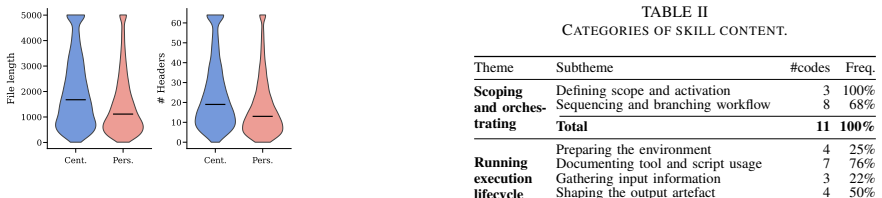
- Table I and RQ2.1: conformance rates for optional fields and assets are useful; a one-sentence note on whether multi-file skills (scripts/references present) differ systematically in length or KA would help readers interpret packaging discipline.
- Figure 1 workflow diagram and the abstract both use “53%” never modified; body text gives 1,167/2,462 = 47.4% updated (hence ~52.6% never). Align the rounded figure and state the denominator (reused SE skills) wherever the percentage appears.
- Section II and implications: related work on AGENTS.md / Claude manifests is well cited; a brief contrast sentence on how SKILL.md progressive disclosure differs from always-on agent manifests would sharpen the novelty claim for readers new to the ecosystem.
- Minor polish: consistent hyphenation of “personal-use” / “personal use”; ensure SWEBOK KA names match the official list spelling throughout Figure 2 labels; check that all arXiv-linked related work have stable identifiers in the reference list.
Circularity Check
No significant circularity: observational empirical SE study whose quantitative and qualitative claims are measured from mined diffs, commit histories, and coded samples rather than derived by construction from fitted inputs or self-citation chains.
full rationale
The paper is a large-scale mining and qualitative study of AI agent skills (registry vs personal-use corpora, reuse-link recovery, SWEBOK KA classification, thematic content analysis, and open coding of customisation/evolution diffs). Its strongest claims (near-verbatim one-time copy adoption, 53% never modified after adoption, additive maintenance asymmetry, customisation re-grounding vs evolution accreting domain knowledge, stable behavioural contract) are descriptive statistics and coded frequencies computed on recovered pairs and commit histories, not predictions forced by fitted parameters or definitions. The name+LCS linkage heuristic and LLM KA labels are measurement instruments with disclosed validation (boundary audits, gold-standard Cohen’s κ); they do not make the reported rates true by construction. Self-citations are ordinary related-work pointers and are not load-bearing uniqueness or ansatz imports. No self-definitional equations, fitted-input-as-prediction steps, or renaming of known results as novel derivations appear. Score 0 is therefore the correct outcome.
Axiom & Free-Parameter Ledger
free parameters (5)
- reuse_similarity_threshold =
0.1 (link); 0.99 (verbatim)
- registry_install_cutoff =
20 installs
- personal_use_repo_skill_count_fence =
18 skills / Tukey fence
- evolution_churn_fence =
340 lines
- qualitative_sample_sizes_and_strata =
180 content; 444 change samples
axioms (5)
- domain assumption SWEBOK v4’s 18 knowledge areas plus a Non-SE bin are an adequate primary classification of what software-engineering knowledge skills encode.
- domain assumption skills.sh is a sufficiently representative centralised registry for studying third-party skill reuse, better than star-based scrapers such as SkillMP.
- ad hoc to paper YAML name plus body LCS similarity recovers genuine adoption from registry to personal-use, and reuse direction is registry→local rather than reverse or multi-hop.
- ad hoc to paper Net initial-to-final SKILL.md diffs adequately represent evolution behaviour for theme coding, even though intermediate add/remove/revert sequences are collapsed.
- domain assumption Dual-author open coding with consensus yields reliable content and change taxonomies for the stratified samples.
invented entities (2)
-
Six-theme SKILL.md content taxonomy
no independent evidence
-
Six-theme skill change taxonomy (customisation vs evolution)
no independent evidence
read the original abstract
AI coding agents increasingly rely on skills: structured context bundles, typically a SKILL$.$md file with a YAML header and Markdown body, loaded on demand for domain knowledge, workflows, and scripts. Public registries such as skills$.$sh now host tens of thousands of skills, making them an emerging unit of reuse in agent-based software engineering. Yet skills have largely been viewed as agent capabilities rather than software artefacts whose content and evolution shape agent behaviour. We present the first empirical study of AI agent skills as engineered artefacts that are authored, reused, customised and maintained, across public registries and personal-use repositories. We mined 18,463 skills from skills$.$sh and 23,199 personal-use skills from 5,876 GitHub repositories, identifying 3,709 reuse links. LLM-based classification into SWEBOK knowledge areas (KAs) shows Software Construction dominates alongside a long tail of specialised areas. A thematic analysis of 180 skills identifies six content categories. Qualitative coding of 444 modifications reveals six themes, of which reworking operational specifications and adapting knowledge and resources are the primary target of change. Our findings show that reuse is largely a one-time copy operation: most reused skills remain near-verbatim, 53% are never modified after adoption, and subsequent local maintenance is overwhelmingly additive. Customisation primarily adapts skills to local environments, whereas evolution accretes new inline domain knowledge. Across both, a stable behavioural contract - how a skill interacts with users, monitors runtime state, and recovers from failures - remains almost untouched. These results suggest maintenance effort should focus on project-specific bindings, and that registries and tool support should enable consolidating the domain knowledge skills re-author in isolation.
Figures

Forward citations
Cited by 1 Pith paper
-
Skillware: A Software Ontology and Engineering Lifecycle for Persistent Behavioral Artifacts
Agent skills should be managed as persistent software units with identity, lifecycle, and engineering structure, not just prompt files.
Reference graph
Works this paper leans on
-
[1]
Codereval: A benchmark of pragmatic code generation with generative pre-trained models,
H. Yu, B. Shen, D. Ran, J. Zhang, Q. Zhang, Y . Ma, G. Liang, Y . Li, Q. Wang, and T. Xie, “Codereval: A benchmark of pragmatic code generation with generative pre-trained models,” inProceedings of the 46th IEEE/ACM International Conference on Software Engineering, 2024, pp. 1–12
2024
-
[2]
Codere- viewqa: The code review comprehension assessment for large language models,
H. Y . Lin, C. Liu, H. Gao, P. Thongtanunam, and C. Treude, “Codere- viewqa: The code review comprehension assessment for large language models,” inFindings of the Association for Computational Linguistics: ACL 2025, 2025, pp. 9138–9166
2025
-
[3]
Repairagent: An autonomous, llm-based agent for program repair,
I. Bouzenia, P. Devanbu, and M. Pradel, “Repairagent: An autonomous, llm-based agent for program repair,” in2025 IEEE/ACM 47th Interna- tional Conference on Software Engineering (ICSE). IEEE, 2025, pp. 2188–2200
2025
-
[4]
An empirical evaluation of using large language models for automated unit test generation,
M. Sch ¨afer, S. Nadi, A. Eghbali, and F. Tip, “An empirical evaluation of using large language models for automated unit test generation,”IEEE Transactions on Software Engineering, vol. 50, no. 1, pp. 85–105, 2023
2023
-
[5]
Does my readme file need to be updated? exploring llm-based readme maintenance,
H. Gao, H. Y . Lin, C. Treude, G. Gay, and M. Zahedi, “Does my readme file need to be updated? exploring llm-based readme maintenance,”arXiv preprint arXiv:2603.00489, 2026
arXiv 2026
-
[6]
The Agent Skills Directory — skills.sh,
“The Agent Skills Directory — skills.sh,” https://www.skills.sh/, [Ac- cessed 28-06-2026]
2026
-
[7]
G. Ling, S. Zhong, and R. Huang, “Agent skills: A data-driven analysis of claude skills for extending large language model functionality,”arXiv preprint arXiv:2602.08004, 2026
arXiv 2026
-
[8]
Agent skills in the wild: An empirical study of security vulnerabilities at scale,
Y . Liu, W. Wang, R. Feng, Y . Zhang, G. Xu, G. Deng, Y . Li, and L. Zhang, “Agent skills in the wild: An empirical study of security vulnerabilities at scale,”arXiv preprint arXiv:2601.10338, 2026
Pith/arXiv arXiv 2026
-
[9]
Credential leakage in llm agent skills: A large-scale empirical study,
Z. Chen, Y . Zhang, Y . Liu, G. Deng, Y . Li, Y . Zhang, J. Ning, L. Y . Zhang, L. Ma, and Z. Li, “Credential leakage in llm agent skills: A large-scale empirical study,”arXiv preprint arXiv:2604.03070, 2026
Pith/arXiv arXiv 2026
-
[10]
Skillsbench: Benchmarking how well agent skills work across diverse tasks,
X. Li, W. Chen, Y . Liu, S. Zheng, X. Chen, Y . He, Y . Li, B. You, H. Shen, J. Sunet al., “Skillsbench: Benchmarking how well agent skills work across diverse tasks,”arXiv preprint arXiv:2602.12670, 2026
Pith/arXiv arXiv 2026
-
[11]
On the untriviality of trivial packages: An empirical study of npm javascript packages,
M. A. R. Chowdhury, R. Abdalkareem, E. Shihab, and B. Adams, “On the untriviality of trivial packages: An empirical study of npm javascript packages,”IEEE Transactions on Software Engineering, vol. 48, no. 8, pp. 2695–2708, 2021
2021
-
[12]
Small world with high risks: A study of security threats in the npm ecosystem,
M. Zimmermann, C.-A. Staicu, C. Tenny, and M. Pradel, “Small world with high risks: A study of security threats in the npm ecosystem,” in28th USENIX Security symposium (USENIX security 19), 2019, pp. 995–1010
2019
-
[13]
An empirical comparison of dependency network evolution in seven software packaging ecosystems,
A. Decan, T. Mens, and P. Grosjean, “An empirical comparison of dependency network evolution in seven software packaging ecosystems,” Empirical Software Engineering, vol. 24, no. 1, pp. 381–416, 2019
2019
-
[14]
Adapting installation instructions in rapidly evolving software ecosystems,
H. Gao, C. Treude, and M. Zahedi, “Adapting installation instructions in rapidly evolving software ecosystems,”IEEE Transactions on Software Engineering, 2025
2025
-
[15]
Software documentation issues unveiled,
E. Aghajani, C. Nagy, O. L. Vega-M ´arquez, M. Linares-V ´asquez, L. Moreno, G. Bavota, and M. Lanza, “Software documentation issues unveiled,” in2019 IEEE/ACM 41st International Conference on Software Engineering (ICSE). IEEE, 2019, pp. 1199–1210
2019
-
[16]
Evaluating large language models trained on code,
M. Chen, J. Tworek, H. Jun, Q. Yuan, H. P. d. O. Pinto, J. Kaplan, H. Edwards, Y . Burda, N. Joseph, G. Brockmanet al., “Evaluating large language models trained on code,”arXiv preprint arXiv:2107.03374, 2021
Pith/arXiv arXiv 2021
-
[17]
Large language models for software engi- neering: A systematic literature review,
X. Hou, Y . Zhao, Y . Liu, Z. Yang, K. Wang, L. Li, X. Luo, D. Lo, J. Grundy, and H. Wang, “Large language models for software engi- neering: A systematic literature review,”ACM Transactions on Software Engineering and Methodology, vol. 33, no. 8, 2024
2024
-
[18]
A prompt pattern catalog to enhance prompt engineering with chatgpt,
J. White, Q. Fu, S. Hays, M. Sandborn, C. Olea, H. Gilbert, A. El- nashar, J. Spencer-Smith, and D. C. Schmidt, “A prompt pattern catalog to enhance prompt engineering with chatgpt,”arXiv preprint arXiv:2302.11382, 2023
Pith/arXiv arXiv 2023
-
[19]
ReAct: Synergizing reasoning and acting in language models,
S. Yao, J. Zhao, D. Yu, N. Du, I. Shafran, K. Narasimhan, and Y . Cao, “ReAct: Synergizing reasoning and acting in language models,” in International Conference on Learning Representations (ICLR), 2023
2023
-
[20]
Toolformer: Language models can teach themselves to use tools,
T. Schick, J. Dwivedi-Yu, R. Dess `ı, R. Raileanu, M. Lomeli, E. Hambro, L. Zettlemoyer, N. Cancedda, and T. Scialom, “Toolformer: Language models can teach themselves to use tools,” inAdvances in Neural Information Processing Systems (NeurIPS), 2023
2023
-
[21]
SWE-agent: Agent-computer interfaces enable automated software engineering,
J. Yang, C. E. Jimenez, A. Wettig, K. Lieret, S. Yao, K. Narasimhan, and O. Press, “SWE-agent: Agent-computer interfaces enable automated software engineering,” inAdvances in Neural Information Processing Systems (NeurIPS), 2024
2024
-
[22]
SWE-bench: Can language models resolve real-world GitHub issues?
C. E. Jimenez, J. Yang, A. Wettig, S. Yao, K. Pei, O. Press, and K. Narasimhan, “SWE-bench: Can language models resolve real-world GitHub issues?” inInternational Conference on Learning Representa- tions (ICLR), 2024
2024
-
[23]
Large language model-based agents for software engineering: A sur- vey,
J. Liu, K. Wang, Y . Chen, X. Peng, Z. Chen, L. Zhang, and Y . Lou, “Large language model-based agents for software engineering: A sur- vey,”arXiv preprint arXiv:2409.02977, 2024
Pith/arXiv arXiv 2024
-
[24]
Model context protocol (MCP): Landscape, security threats, and future research directions,
X. Hou, Y . Zhao, S. Wang, and H. Wang, “Model context protocol (MCP): Landscape, security threats, and future research directions,” arXiv preprint arXiv:2503.23278, 2025
Pith/arXiv arXiv 2025
-
[25]
M. M. Hasan, H. Li, E. Fallahzadeh, G. K. Rajbahadur, B. Adams, and A. E. Hassan, “Model context protocol (MCP) at first glance: Study- ing the security and maintainability of MCP servers,”arXiv preprint arXiv:2506.13538, 2025
Pith/arXiv arXiv 2025
-
[26]
Agent READMEs: An empirical study of context files for agentic coding,
W. Chatlatanagulchai, H. Li, Y . Kashiwa, B. Reid, K. Thonglek, P. Lee- laprute, A. Rungsawang, B. Manaskasemsak, B. Adams, A. E. Hassan, and H. Iida, “Agent READMEs: An empirical study of context files for agentic coding,”arXiv preprint arXiv:2511.12884, 2025
arXiv 2025
-
[27]
On the use of agentic coding manifests: An empirical study of Claude Code,
W. Chatlatanagulchai, K. Thonglek, B. Reid, Y . Kashiwa, P. Leelaprute, A. Rungsawang, B. Manaskasemsak, and H. Iida, “On the use of agentic coding manifests: An empirical study of Claude Code,”arXiv preprint arXiv:2509.14744, 2025
arXiv 2025
-
[28]
On the impact of agents.md files on the efficiency of ai coding agents,
J. L. Lulla, S. Mohsenimofidi, M. Galster, J. M. Zhang, S. Baltes, and C. Treude, “On the impact of agents.md files on the efficiency of ai coding agents,” inProceedings of the 1st Journal Ahead Workshop (JAWs) at the International Conference on Software Engineering (ICSE), 2026, accepted. [Online]. Available: https://arxiv.org/abs/2601.20404
arXiv 2026
-
[29]
An empirical study of usages, updates and risks of third-party libraries in Java projects,
Y . Wang, B. Chen, K. Huang, B. Shi, C. Xu, X. Peng, Y . Wu, and Y . Liu, “An empirical study of usages, updates and risks of third-party libraries in Java projects,” in2020 IEEE International Conference on Software Maintenance and Evolution (ICSME). IEEE, 2020
2020
-
[30]
Backstabber’s knife collection: A review of open source software supply chain attacks,
M. Ohm, H. Plate, A. Sykosch, and M. Meier, “Backstabber’s knife collection: A review of open source software supply chain attacks,” in International Conference on Detection of Intrusions and Malware, and Vulnerability Assessment (DIMVA). Springer, 2020
2020
-
[31]
SoK: Taxonomy of attacks on open-source software supply chains,
P. Ladisa, H. Plate, M. Martinez, and O. Barais, “SoK: Taxonomy of attacks on open-source software supply chains,” in2023 IEEE Symposium on Security and Privacy (SP). IEEE, 2023
2023
-
[32]
An empirical study of pre-trained model reuse in the Hugging Face deep learning model registry,
W. Jiang, N. Synovic, M. Hyatt, T. R. Schorlemmer, R. Sethi, Y .- H. Lu, G. K. Thiruvathukal, and J. C. Davis, “An empirical study of pre-trained model reuse in the Hugging Face deep learning model registry,” in2023 IEEE/ACM 45th International Conference on Software Engineering (ICSE). IEEE, 2023
2023
-
[33]
PeaTMOSS: A dataset and initial analysis of pre-trained models in open-source software,
W. Jiang, J. Yasmin, J. Jones, N. Synovic, J. Kuo, N. Bielanski, Y . Tian, G. K. Thiruvathukal, and J. C. Davis, “PeaTMOSS: A dataset and initial analysis of pre-trained models in open-source software,” in 2024 IEEE/ACM 21st International Conference on Mining Software Repositories (MSR). IEEE, 2024
2024
-
[34]
Programs, life cycles, and laws of software evolution,
M. M. Lehman, “Programs, life cycles, and laws of software evolution,” Proceedings of the IEEE, vol. 68, no. 9, pp. 1060–1076, 1980
1980
-
[35]
A large-scale empirical study on code-comment inconsistencies,
F. Wen, C. Nagy, G. Bavota, and M. Lanza, “A large-scale empirical study on code-comment inconsistencies,” in2019 IEEE/ACM 27th International Conference on Program Comprehension (ICPC). IEEE, 2019, pp. 53–64
2019
-
[36]
Docable: Evaluating the executability of software tutorials,
S. Mirhosseini and C. Parnin, “Docable: Evaluating the executability of software tutorials,” inProceedings of the 28th ACM Joint Meeting on European Software Engineering Conference and Symposium on the Foundations of Software Engineering, 2020, pp. 375–385
2020
-
[37]
Cat- egorizing the content of GitHub README files,
G. A. A. Prana, C. Treude, F. Thung, T. Atapattu, and D. Lo, “Cat- egorizing the content of GitHub README files,”Empirical Software Engineering, vol. 24, pp. 1296–1327, 2019
2019
-
[38]
Augmenting api documentation with insights from stack overflow,
C. Treude and M. P. Robillard, “Augmenting api documentation with insights from stack overflow,” inProceedings of the 38th International Conference on Software Engineering, 2016, pp. 392–403
2016
-
[39]
Improving api caveats accessibility by mining api caveats knowledge graph,
H. Li, S. Li, J. Sun, Z. Xing, X. Peng, M. Liu, and X. Zhao, “Improving api caveats accessibility by mining api caveats knowledge graph,” in 2018 IEEE International Conference on Software Maintenance and Evolution (ICSME). IEEE, 2018, pp. 183–193
2018
-
[40]
J. W. Tukey,Exploratory Data Analysis. Reading, MA: Addison- Wesley, 1977
1977
-
[41]
Software Engineering Body of Knowledge (SWEBOK) — com- puter.org,
“Software Engineering Body of Knowledge (SWEBOK) — com- puter.org,” https://www.computer.org/education/bodies-of-knowledge/ software-engineering#about, [Accessed 24-06-2026]
2026
-
[42]
Can llms re- place manual annotation of software engineering artifacts?
T. Ahmed, P. Devanbu, C. Treude, and M. Pradel, “Can llms re- place manual annotation of software engineering artifacts?” in2025 IEEE/ACM 22nd International Conference on Mining Software Reposi- tories (MSR). IEEE, 2025, pp. 526–538
2025
-
[43]
Interrater reliability: the kappa statistic,
M. L. McHugh, “Interrater reliability: the kappa statistic,”Biochemia medica, vol. 22, no. 3, pp. 276–282, 2012
2012
-
[44]
Specification - Agent Skills — agentskills.io,
“Specification - Agent Skills — agentskills.io,” https://agentskills.io/ specification, [Accessed 28-06-2026]
2026
-
[45]
Sampling in software engineering research: A critical review and guidelines,
S. Baltes and P. Ralph, “Sampling in software engineering research: A critical review and guidelines,”Empirical Software Engineering, vol. 27, no. 4, p. 94, 2022
2022
-
[46]
Recommended steps for thematic synthesis in software engineering,
D. S. Cruzes and T. Dyba, “Recommended steps for thematic synthesis in software engineering,” in2011 international symposium on empirical software engineering and measurement. IEEE, 2011, pp. 275–284
2011
-
[47]
Self-organizing roles on agile soft- ware development teams,
R. Hoda, J. Noble, and S. Marshall, “Self-organizing roles on agile soft- ware development teams,”IEEE Transactions on Software Engineering, vol. 39, no. 3, pp. 422–444, 2012
2012
-
[48]
Fisher’s exact test,
G. J. Upton, “Fisher’s exact test,”Journal of the Royal Statistical Society: Series A (Statistics in Society), vol. 155, no. 3, pp. 395–402, 1992
1992
-
[49]
Controlling the false discovery rate: a practical and powerful approach to multiple testing,
Y . Benjamini and Y . Hochberg, “Controlling the false discovery rate: a practical and powerful approach to multiple testing,”Journal of the Royal statistical society: series B (Methodological), vol. 57, no. 1, pp. 289–300, 1995
1995
-
[50]
Cohen,Statistical Power Analysis for the Behavioral Sciences, 2nd ed
J. Cohen,Statistical Power Analysis for the Behavioral Sciences, 2nd ed. Hillsdale, NJ: Lawrence Erlbaum Associates, 1988
1988
-
[51]
On a test of whether one of two random variables is stochastically larger than the other,
H. B. Mann and D. R. Whitney, “On a test of whether one of two random variables is stochastically larger than the other,”The annals of mathematical statistics, pp. 50–60, 1947
1947
-
[52]
Dominance statistics: Ordinal analyses to answer ordinal questions
N. Cliff, “Dominance statistics: Ordinal analyses to answer ordinal questions.”Psychological bulletin, vol. 114, no. 3, p. 494, 1993
1993
-
[53]
EASYTOOL: Enhancing LLM-based agents with concise tool instruction,
S. Yuan, K. Song, J. Chen, X. Tan, Y . Shen, K. Ren, D. Li, and D. Yang, “EASYTOOL: Enhancing LLM-based agents with concise tool instruction,” inProceedings of the 2025 Conference of the Nations of the Americas Chapter of the Association for Computational Linguistics: Human Language Technologies (Volume 1: Long Papers), L. Chiruzzo, A. Ritter, and L. Wang...
2025
-
[54]
Skillops: Managing llm agent skill libraries as self-maintaining software ecosystems,
H. Pu, X. Song, and L. Zhao, “Skillops: Managing llm agent skill libraries as self-maintaining software ecosystems,”arXiv preprint arXiv:2605.13716, 2026
Pith/arXiv arXiv 2026
-
[55]
An empirical study of the non-determinism of chatgpt in code generation,
S. Ouyang, J. M. Zhang, M. Harman, and M. Wang, “An empirical study of the non-determinism of chatgpt in code generation,”ACM Transactions on Software Engineering and Methodology, vol. 34, no. 2, pp. 1–28, 2025
2025
-
[56]
Let me speak freely? a study on the impact of format restrictions on large language model performance
Z. R. Tam, C.-K. Wu, Y .-L. Tsai, C.-Y . Lin, H.-y. Lee, and Y .-N. Chen, “Let me speak freely? a study on the impact of format restrictions on large language model performance.” inProceedings of the 2024 Conference on Empirical Methods in Natural Language Processing: Industry Track, 2024, pp. 1218–1236
2024
discussion (0)
Sign in with ORCID, Apple, or X to comment. Anyone can read and Pith papers without signing in.