REVIEW 2 major objections 2 minor 2 cited by
A Tsallis entropy of fermionic occupation numbers is monotonic under Gaussian protocols and lower-bounds the number of non-Gaussian gates needed for state preparation.
Reviewed by Pith at T0; open to challenge. T0 means a machine referee read the full paper against a public rubric. the ladder, T0–T4 →
T0 review · grok-4.3
2026-07-03 12:17 UTC pith:IRWZIKWR
load-bearing objection The paper gives two new families of covariance-based measures for fermionic non-Gaussianity on pure states, with a monotonicity proof under Gaussian protocols for one Tsallis case. the 2 major comments →
Computable fermionic non-Gaussianity from the covariance matrix
The pith
A machine-rendered reading of the paper's core claim, the machinery that carries it, and where it could break.
Core claim
From the Williamson normal form of the covariance matrix of a pure fermionic state, occupation number entropies are defined as the Tsallis-α entropy of the resulting occupation numbers; one member of this family is monotonic under Gaussian protocols and hence a computable convex resource monotone for fermionic non-Gaussianity that lower-bounds the number of non-Gaussian gates needed for state preparation. A second family of natural-orbital participation entropies, given by the Rényi-α entropy of the squared amplitudes in the natural-orbital basis, quantifies compressibility and upper-bounds classical simulation cost.
What carries the argument
The occupation number entropies, obtained as the Tsallis-α entropy of the occupation numbers that appear in the Williamson normal form of the covariance matrix.
Load-bearing premise
The measures are defined only for pure fermionic states and assume that the covariance matrix alone encodes all information needed to quantify the relevant non-Gaussianity.
What would settle it
A concrete Gaussian operation that strictly increases the value of the proposed Tsallis monotone on some pure fermionic state, or an explicit state preparation sequence whose non-Gaussian gate count falls below the lower bound supplied by the monotone.
If this is right
- The monotone lower-bounds the number of non-Gaussian gates required to prepare any given pure fermionic state.
- The natural-orbital measures upper-bound the classical simulation cost of the state in an orthonormal Gaussian basis.
- Both families become simple explicit functions for stabilizer states and for translation-invariant states.
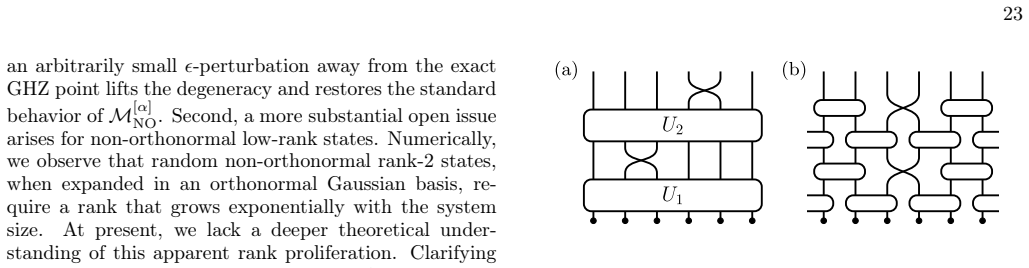
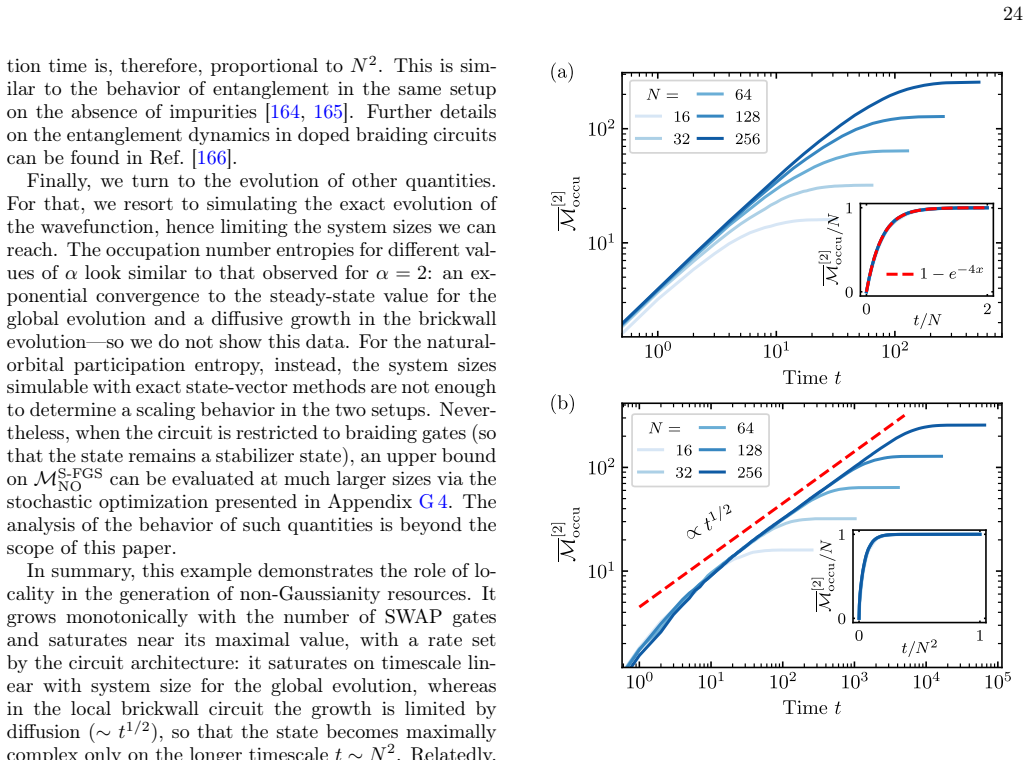
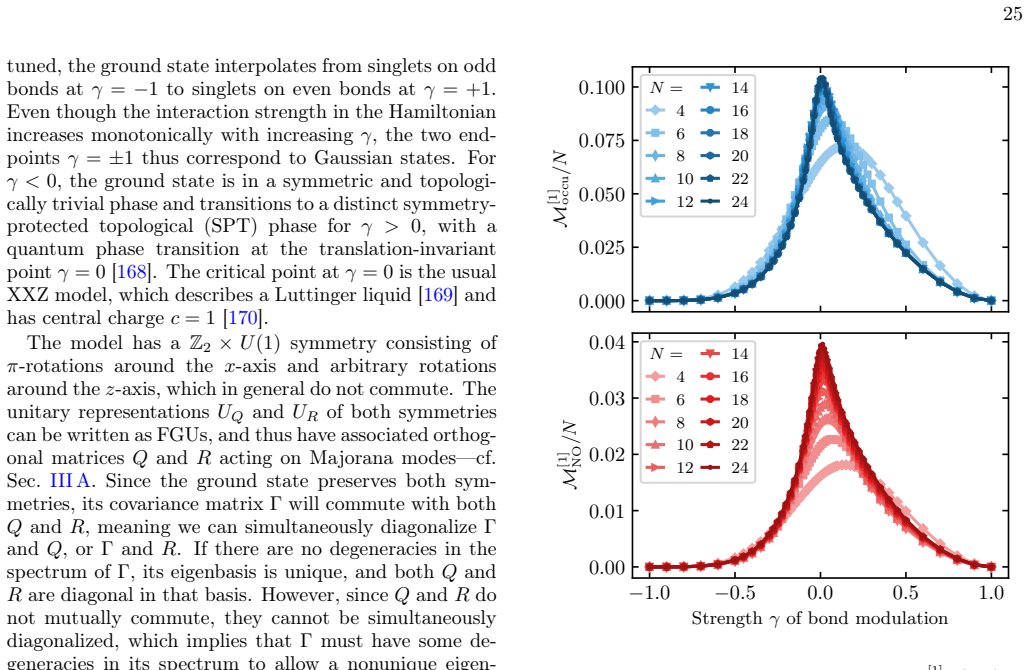
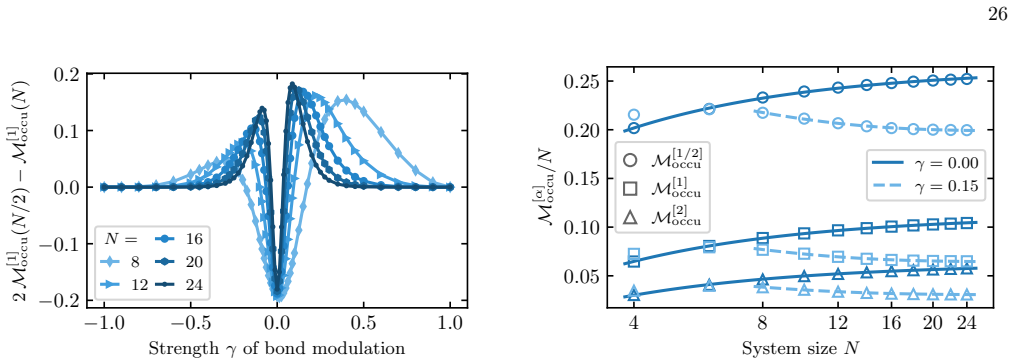
- The measures can be evaluated on states generated by random SWAP-doped matchgate circuits and on ground states of the bond-modulated XXZ model.
- The resource-theoretic framework supplies practical tools for assessing classical simulability of fermionic states.
Where Pith is reading between the lines
- If the covariance matrix ceases to be sufficient for mixed states, the monotonicity and bounding properties would require additional correlation terms.
- The same construction might be tested for its ability to detect non-Gaussianity in open-system dynamics where Gaussian noise is added.
- The upper bound on simulation cost could be compared directly with existing tensor-network contraction costs for the same states.
Editorial analysis
A structured set of objections, weighed in public.
Referee Report
Summary. The paper develops a convex resource theory for fermionic non-Gaussianity and proposes two families of computable measures for pure fermionic states derived from the Williamson normal form of the covariance matrix. The first family consists of occupation-number entropies given by the Tsallis-α entropy of the occupation numbers; the authors prove that one specific member (Tsallis-2) is monotonic under Gaussian protocols and hence a convex resource monotone that lower-bounds the number of non-Gaussian gates required for state preparation. The second family consists of natural-orbital participation entropies given by the Rényi-α entropy of the squared amplitudes of the state in the natural-orbital basis; these are shown to upper-bound classical simulation cost. The measures are evaluated on stabilizer states, translation-invariant states, random SWAP-doped matchgate circuits, and the bond-modulated XXZ model.
Significance. If the central monotonicity result holds, the work supplies the first explicitly computable convex monotones for fermionic magic that are directly obtainable from the covariance matrix, together with operational interpretations (gate lower bound and simulation-cost upper bound). The unification of resource-theoretic, condensed-matter, and quantum-chemistry perspectives, together with the concrete analyses of physically relevant states, would make the framework immediately usable for assessing simulability and complexity in fermionic many-body systems.
major comments (2)
- [§4] §4 (proof of monotonicity): The claim that the Tsallis-2 occupation-number entropy is a convex resource monotone rests on the covariance matrix (via its Williamson eigenvalues) being a sufficient statistic. Because a pure fermionic state is not uniquely determined by its covariance matrix, two states can share identical occupation numbers yet differ in higher-order correlators. The proof must therefore demonstrate that any Gaussian protocol (matchgate circuit) cannot increase the underlying non-Gaussianity resource while leaving the measure unchanged; the manuscript does not explicitly address this case.
- [Abstract, §3.2] Abstract and §3.2: The statement that the Tsallis-2 measure 'consequently lower bounds the number of non-Gaussian gates needed for state preparation' assumes that the resource cost is fully captured by the occupation-number entropy. If states with identical covariance but different higher-order magic require different numbers of non-Gaussian gates, the bound remains valid but its tightness and operational meaning require explicit justification or a counter-example check.
minor comments (2)
- [§2] Notation for the Williamson eigenvalues and occupation numbers should be unified across §2 and §3 to avoid ambiguity between the covariance-matrix spectrum and the one-body reduced-density-matrix eigenvalues.
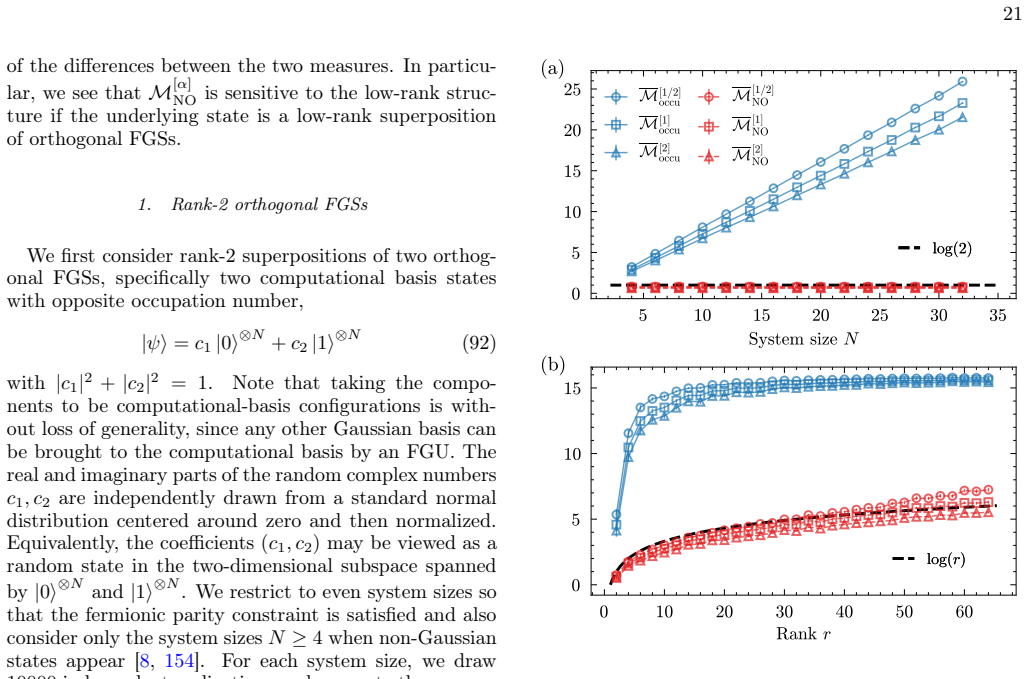
- [§5] Figure captions for the XXZ-model and SWAP-doped-circuit plots should state the system size, boundary conditions, and exact parameter values used, as these affect the reported entropy values.
Simulated Author's Rebuttal
We thank the referee for their careful reading and constructive comments on our manuscript. We address each major comment point by point below, providing the strongest honest defense of the results while acknowledging where additional clarification is warranted.
read point-by-point responses
-
Referee: [§4] §4 (proof of monotonicity): The claim that the Tsallis-2 occupation-number entropy is a convex resource monotone rests on the covariance matrix (via its Williamson eigenvalues) being a sufficient statistic. Because a pure fermionic state is not uniquely determined by its covariance matrix, two states can share identical occupation numbers yet differ in higher-order correlators. The proof must therefore demonstrate that any Gaussian protocol (matchgate circuit) cannot increase the underlying non-Gaussianity resource while leaving the measure unchanged; the manuscript does not explicitly address this case.
Authors: We agree that the manuscript would benefit from an explicit remark on this point. The proof in §4 proceeds by showing that Gaussian operations (matchgate circuits) induce orthogonal transformations on the Majorana covariance matrix, which in the Williamson basis act as permutations and sign flips on the eigenvalues (occupation numbers). The Tsallis-2 entropy is Schur-concave, hence non-increasing under these transformations, establishing monotonicity under free operations. Because the free operations depend only on the covariance matrix and cannot access or create higher-order correlators, states sharing the same covariance matrix necessarily share the same value of the monotone; any apparent difference in higher-order magic is invisible to the free operations and therefore does not affect the resource-theoretic accounting. We will add a clarifying paragraph in §4 making this reasoning explicit. revision: partial
-
Referee: [Abstract, §3.2] Abstract and §3.2: The statement that the Tsallis-2 measure 'consequently lower bounds the number of non-Gaussian gates needed for state preparation' assumes that the resource cost is fully captured by the occupation-number entropy. If states with identical covariance but different higher-order magic require different numbers of non-Gaussian gates, the bound remains valid but its tightness and operational meaning require explicit justification or a counter-example check.
Authors: The lower-bound claim follows directly from the definition of a convex resource monotone: the minimal number of non-Gaussian gates required to prepare a state is at least the value of any monotone. This inequality holds irrespective of whether two states with identical covariance matrices possess different higher-order correlators; the monotone supplies a valid (if possibly loose) lower bound based solely on the covariance. We will revise the abstract and §3.2 to state explicitly that the bound is derived from the Tsallis-2 monotone within the resource theory and is not asserted to be tight for every state. revision: partial
Circularity Check
No circularity: definitions and monotonicity proof are independent of inputs
full rationale
The paper defines the occupation-number entropies explicitly as the Tsallis-α entropy applied to the occupation numbers extracted from the Williamson normal form of the covariance matrix, then separately states that monotonicity under Gaussian protocols is proved for one member. This is a standard resource-theoretic construction rather than a self-definitional loop, fitted parameter renamed as prediction, or load-bearing self-citation. No equations or claims in the abstract reduce the central result to its own inputs by construction; the covariance-to-occupation mapping is a standard fact for pure fermionic states and does not presuppose the monotonicity result. The derivation is therefore self-contained.
Axiom & Free-Parameter Ledger
read the original abstract
Fermionic non-Gaussianity, or fermionic magic, is a key resource underlying the computational complexity of fermionic quantum systems, yet tractable and operationally meaningful ways to quantify it remain limited. We address this challenge by developing a convex resource theory of fermionic non-Gaussianity and introducing two families of computable quantities for pure fermionic states, both derived from the Williamson normal form of the covariance matrix. The first family, occupation number entropies, is defined as the Tsallis-$\alpha$ entropy of the occupation numbers. We prove that one member of this family is monotonic under Gaussian protocols, establishing it as a computable convex resource monotone. It consequently lower bounds the number of non-Gaussian gates needed for state preparation. The second family, natural-orbital participation entropies, is given by the R\'enyi-$\alpha$ entropy of the squared amplitudes of the state in the natural-orbital basis, defined by the eigenvectors of the covariance matrix. They quantify state compressibility in this basis and thus upper bound the classical simulation cost in an orthonormal Gaussian basis. We analyze both families for stabilizer and translation-invariant states, where they simplify and reveal additional structure. We further study representative examples, including random SWAP-doped matchgate circuits and the bond-modulated XXZ model, highlighting the role of non-Gaussianity in many-body phenomena. Our work establishes a resource-theoretic framework for computable fermionic non-Gaussianity that unifies notions arising across quantum information, condensed-matter physics, and quantum chemistry, opening new directions for studying the complexity of quantum many-body systems and providing practical tools to assess the classical simulability of fermionic states relevant for quantum advantage.
Figures



Forward citations
Cited by 2 Pith papers
-
Learning the closest Slater determinant
First provable algorithms with complexity bounds for learning the closest Slater determinant to an arbitrary fermionic state, plus a sharp 2/3 fidelity threshold in the optimization landscape.
-
Fermionic entropy: an efficiently measurable strong monotone for non-Gaussianity
Fermionic entropy is proven to be a strong, efficiently measurable monotone for fermionic non-Gaussianity, yielding a Theta(n) doping lower bound for matchgate-based approximate state designs.
discussion (0)
Sign in with ORCID, Apple, or X to comment. Anyone can read and Pith papers without signing in.