Commensal discovery of four Fast Radio Bursts during Parkes Pulsar Timing Array observations
Pith reviewed 2026-05-25 17:22 UTC · model grok-4.3
The pith
Four fast radio bursts were discovered during routine pulsar timing observations at Parkes, including one with the highest signal-to-noise ratio recorded there.
A machine-rendered reading of the paper's core claim, the machinery that carries it, and where it could break.
Core claim
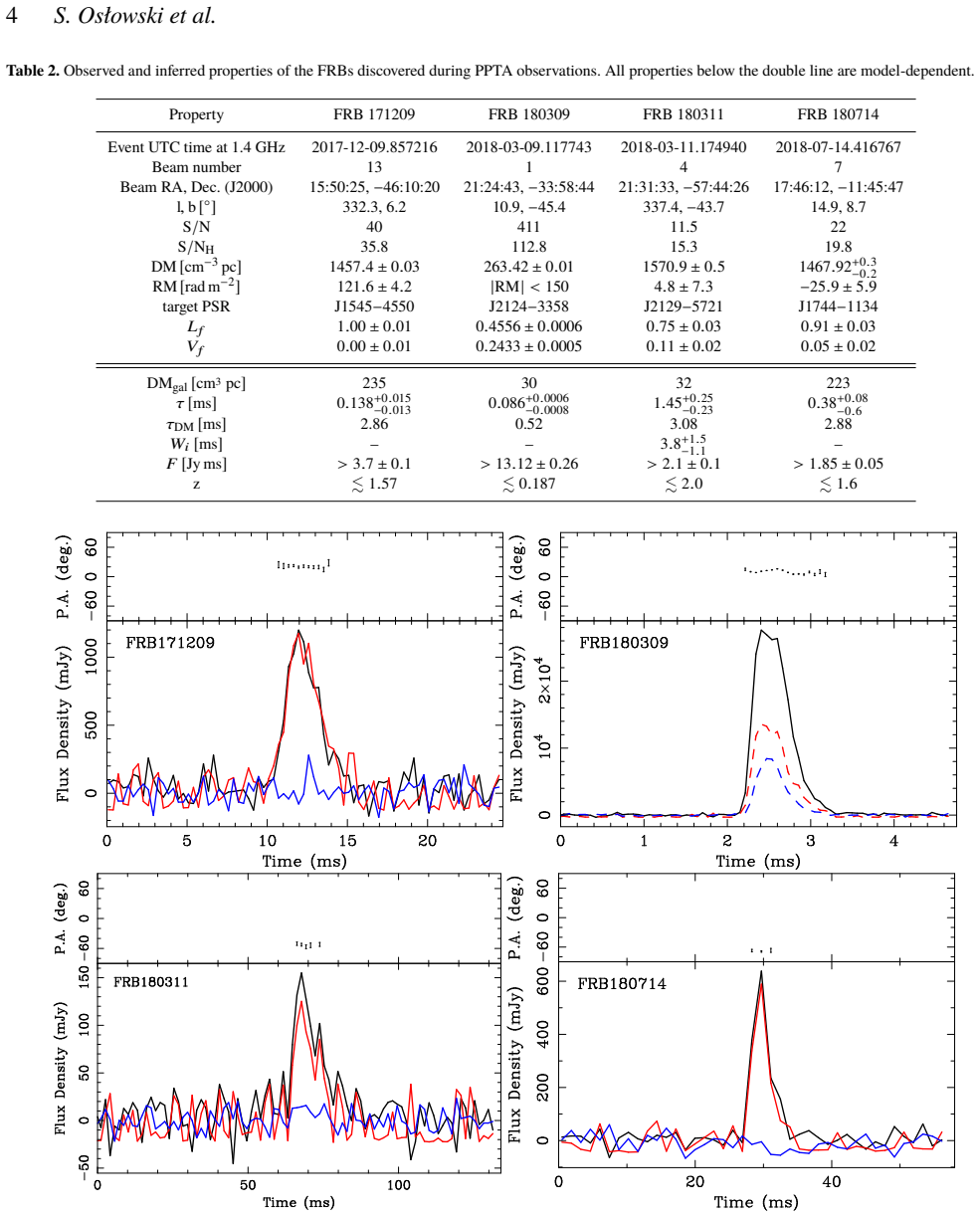
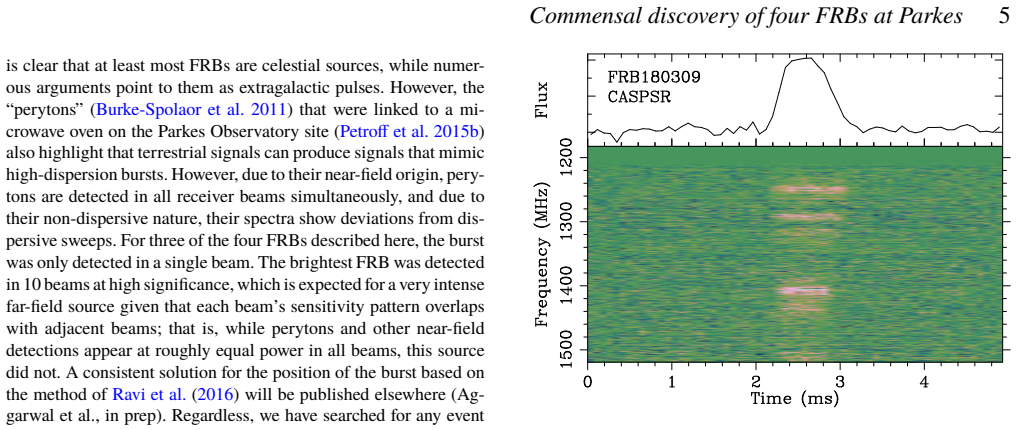
We report the discovery of four FRBs (171209, 180309, 180311 and 180714) during commensal searches in PPTA observations. The detected events include an FRB with the highest signal-to-noise ratio ever detected at the Parkes observatory, which exhibits unusual spectral properties. All four FRBs are highly polarized.
What carries the argument
The commensal FRB search pipeline applied to Parkes Pulsar Timing Array data, which identifies dispersed, polarized pulses in the same observations used for pulsar timing.
If this is right
- Existing pulsar timing array observations can be used to detect FRBs without dedicated observing time.
- High signal-to-noise FRBs found this way allow detailed study of spectral and polarization properties.
- The method can be extended to other telescopes running similar pulsar monitoring programs.
- Accumulating more such events will improve statistics on FRB rates and sky distribution.
Where Pith is reading between the lines
- Commensal searches may raise the overall FRB detection rate by using time already allocated to other projects.
- The high polarization fraction could indicate that these bursts share propagation effects or emission physics with other known FRBs.
- If the unusual spectral properties prove common, they may constrain models of the burst emission region or intervening plasma.
Load-bearing premise
The detected signals are genuine astrophysical fast radio bursts and not terrestrial radio-frequency interference or instrumental artifacts.
What would settle it
Reprocessing the raw voltage data and finding that the signals lack the expected dispersion measure sweep, Faraday rotation, or polarization signature consistent with an astrophysical origin would falsify the claim.
Figures


read the original abstract
The Parkes Pulsar Timing Array (PPTA) project monitors two dozen millisecond pulsars (MSPs) in order to undertake a variety of fundamental physics experiments using the Parkes 64m radio telescope. Since June 2017 we have been undertaking commensal searches for fast radio bursts (FRBs) during the MSP observations. Here, we report the discovery of four FRBs (171209, 180309, 180311 and 180714). The detected events include an FRB with the highest signal-to-noise ratio ever detected at the Parkes observatory, which exhibits unusual spectral properties. All four FRBs are highly polarized. We discuss the future of commensal searches for FRBs at Parkes.
Editorial analysis
A structured set of objections, weighed in public.
Referee Report
Summary. The manuscript reports the discovery of four fast radio bursts (FRBs 171209, 180309, 180311 and 180714) found during commensal searches in Parkes Pulsar Timing Array observations of millisecond pulsars. One event has the highest signal-to-noise ratio yet recorded at Parkes and shows unusual spectral properties; all four are highly polarized. The paper discusses the value of such commensal searches going forward.
Significance. If the detections are confirmed as astrophysical, the work adds four new FRBs to the sample, including a record-S/N event and a set of highly polarized bursts that may constrain emission physics. It also demonstrates an efficient use of existing telescope time for FRB discovery, which could increase detection rates without dedicated allocations.
major comments (1)
- [Observations / data processing (methods section describing the search pipeline)] The abstract and methods description provide no quantitative false-positive rate for the commensal pipeline, no blind-injection recovery statistics, and no explicit tests against known Parkes RFI families. These details are load-bearing for the central claim that the four signals are genuine astrophysical FRBs rather than terrestrial interference or artifacts.
Simulated Author's Rebuttal
We thank the referee for their constructive feedback and for identifying a key area where the manuscript can be strengthened. We address the single major comment below and will revise the manuscript accordingly.
read point-by-point responses
-
Referee: [Observations / data processing (methods section describing the search pipeline)] The abstract and methods description provide no quantitative false-positive rate for the commensal pipeline, no blind-injection recovery statistics, and no explicit tests against known Parkes RFI families. These details are load-bearing for the central claim that the four signals are genuine astrophysical FRBs rather than terrestrial interference or artifacts.
Authors: We agree that these quantitative assessments are important for rigorously supporting the astrophysical nature of the detections. The original manuscript did not include them explicitly. In the revised version we will add a new subsection to the Methods section that reports: (i) the false-positive rate estimated from the total number of independent trials performed across the dataset together with the rate of candidate events in off-beam and off-pulse data; (ii) results from blind-injection tests in which synthetic dispersed pulses with a range of S/N, DM and widths were inserted into the raw filterbank files and the recovery efficiency of the pipeline was measured; and (iii) direct comparisons of the four events against the known families of Parkes RFI (e.g., perytons, narrow-band radar, and persistent narrow-band interference), showing that none of the detected bursts share the temporal, spectral or polarization properties of these contaminants. These additions will be accompanied by a short table or figure summarizing the statistics. revision: yes
Circularity Check
No circularity: pure observational discovery report with no derivations or fitted predictions
full rationale
The paper is an empirical report of four FRB detections during commensal PPTA observations. It contains no equations, no fitted parameters, no model predictions, and no derivation chain. Claims rest on direct telescope data, polarization measurements, and DM consistency, which are external to any self-referential construction. No self-citation load-bearing steps exist because there is no mathematical argument to reduce. This matches the default expectation for non-circular observational papers.
Axiom & Free-Parameter Ledger
Reference graph
Works this paper leans on
-
[1]
" write newline "" before.all 'output.state := FUNCTION fin.entry write newline FUNCTION new.block output.state before.all = 'skip after.block 'output.state := if FUNCTION new.sentence output.state after.block = 'skip output.state before.all = 'skip after.sentence 'output.state := if if FUNCTION not #0 #1 if FUNCTION and 'skip pop #0 if FUNCTION or pop #1...
-
[2]
R., 2012, PhD thesis, Swinburne University of Technology
Barsdell B. R., 2012, PhD thesis, Swinburne University of Technology
work page 2012
-
[3]
Beloborodov A. M., 2017, @doi [ ] 10.3847/2041-8213/aa78f3 , https://ui.adsabs.harvard.edu/\#abs/2017ApJ...843L..26B 843, L26
-
[4]
Bhandari S., et al., 2018, @doi [ ] 10.1093/mnras/stx3074 , https://ui.adsabs.harvard.edu/\#abs/2018MNRAS.475.1427B 475, 1427
-
[5]
Burke-Spolaor S., Bannister K. W., 2014, @doi [ ] 10.1088/0004-637X/792/1/19 , https://ui.adsabs.harvard.edu/\#abs/2014ApJ...792...19B 792, 19
-
[6]
Burke-Spolaor S., Bailes M., Ekers R., Macquart J.-P., Crawford III F., 2011, @doi [ ] 10.1088/0004-637X/727/1/18 , http://adsabs.harvard.edu/abs/2011ApJ...727...18B 727, 18
-
[7]
CHIME/FRB Collaboration et al., 2019a, @doi [ ] 10.1038/s41586-018-0867-7 , https://ui.adsabs.harvard.edu/abs/2019Natur.566..230C 566, 230
-
[8]
CHIME/FRB Collaboration et al., 2019b, @doi [ ] 10.1038/s41586-018-0864-x , https://ui.adsabs.harvard.edu/abs/2019Natur.566..235C 566, 235
-
[9]
Caleb M., et al., 2017, @doi [ ] 10.1093/mnras/stx638 , https://ui.adsabs.harvard.edu/\#abs/2017MNRAS.468.3746C 468, 3746
-
[10]
Caleb M., et al., 2018, @doi [ ] 10.1093/mnras/sty1137 , https://ui.adsabs.harvard.edu/\#abs/2018MNRAS.478.2046C 478, 2046
-
[11]
Cao X.-F., Yu Y.-W., Zhou X., 2018, @doi [ ] 10.3847/1538-4357/aabadd , https://ui.adsabs.harvard.edu/\#abs/2018ApJ...858...89C 858, 89
-
[12]
Champion D. J., et al., 2010, @doi [ ] 10.1088/2041-8205/720/2/L201 , https://ui.adsabs.harvard.edu/#abs/2010ApJ...720L.201C 720, L201
-
[13]
Chatterjee S., et al., 2017, @doi [ ] 10.1038/nature20797 , http://adsabs.harvard.edu/abs/2017Natur.541...58C 541, 58
-
[14]
Dai S., et al., 2015, @doi [ ] 10.1093/mnras/stv508 , https://ui.adsabs.harvard.edu/#abs/2015MNRAS.449.3223D 449, 3223
-
[15]
Farah W., et al., 2018, @doi [ ] 10.1093/mnras/sty1122 , https://ui.adsabs.harvard.edu/\#abs/2018MNRAS.478.1209F 478, 1209
-
[16]
Fender R., Oosterloo T., 2015, @doi [ ] 10.1093/mnrasl/slv065 , https://ui.adsabs.harvard.edu/\#abs/2015MNRAS.451L..75F 451, L75
-
[17]
Fialkov A., Loeb A., 2016, @doi [Journal of Cosmology and Astro-Particle Physics] 10.1088/1475-7516/2016/05/004 , https://ui.adsabs.harvard.edu/\#abs/2016JCAP...05..004F 2016, 004
-
[18]
Gajjar V., et al., 2018, @doi [ ] 10.3847/1538-4357/aad005 , https://ui.adsabs.harvard.edu/\#abs/2018ApJ...863....2G 863, 2
-
[19]
Gehrels N., et al., 2004, @doi [ ] 10.1086/422091 , https://ui.adsabs.harvard.edu/\#abs/2004ApJ...611.1005G 611, 1005
-
[20]
Ghisellini G., 2017, @doi [ ] 10.1093/mnrasl/slw202 , https://ui.adsabs.harvard.edu/\#abs/2017MNRAS.465L..30G 465, L30
-
[21]
Granet C., et al., 2005, @doi [IEEE Antennas and Propagation Magazine] 10.1109/MAP.2005.1532537 , 47, 13
-
[22]
Han J. L., Manchester R. N., Lyne A. G., Qiao G. J., van Straten W., 2006, @doi [ ] 10.1086/501444 , https://ui.adsabs.harvard.edu/#abs/2006ApJ...642..868H 642, 868
-
[23]
Hobbs G., et al., 2012, @doi [ ] 10.1111/j.1365-2966.2012.21946.x , https://ui.adsabs.harvard.edu/#abs/2012MNRAS.427.2780H 427, 2780
-
[24]
W., van Straten W., Manchester R
Hotan A. W., van Straten W., Manchester R. N., 2004, @doi [ ] 10.1071/AS04022 , http://adsabs.harvard.edu/abs/2004PASA...21..302H 21, 302
-
[25]
Houde M., Rajabi F., Gaensler B. M., Mathews A., Tranchant V., 2019, @doi [ ] 10.1093/mnras/sty3046 , https://ui.adsabs.harvard.edu/\#abs/2019MNRAS.482.5492H 482, 5492
-
[26]
James C. W., 2019, @doi [ ] 10.1093/mnras/stz1224 , https://ui.adsabs.harvard.edu/abs/2019MNRAS.486.5934J 486, 5934
-
[27]
Jaroszynski M., 2019, @doi [ ] 10.1093/mnras/sty3529 , https://ui.adsabs.harvard.edu/\#abs/2019MNRAS.484.1637J 484, 1637
-
[28]
Keane E. F., et al., 2018, @doi [ ] 10.1093/mnras/stx2126 , http://adsabs.harvard.edu/abs/2018MNRAS.473..116K 473, 116
-
[29]
Keith M. J., et al., 2010, @doi [ ] 10.1111/j.1365-2966.2010.17325.x , https://ui.adsabs.harvard.edu/\#abs/2010MNRAS.409..619K 409, 619
-
[30]
Lorimer D. R., Bailes M., McLaughlin M. A., Narkevic D. J., Crawford F., 2007, @doi [Science] 10.1126/science.1147532 , http://adsabs.harvard.edu/abs/2007Sci...318..777L 318, 777
-
[31]
Lu W., Kumar P., Narayan R., 2019, @doi [ ] 10.1093/mnras/sty2829 , https://ui.adsabs.harvard.edu/\#abs/2019MNRAS.483..359L 483, 359
-
[32]
Lyubarsky Y., 2014, @doi [ ] 10.1093/mnrasl/slu046 , https://ui.adsabs.harvard.edu/\#abs/2014MNRAS.442L...9L 442, L9
-
[33]
Macquart J.-P., Johnston S., 2015, @doi [ ] 10.1093/mnras/stv1184 , https://ui.adsabs.harvard.edu/\#abs/2015MNRAS.451.3278M 451, 3278
-
[34]
Macquart J. P., Shannon R. M., Bannister K. W., James C. W., Ekers R. D., Bunton J. D., 2019, @doi [ ] 10.3847/2041-8213/ab03d6 , https://ui.adsabs.harvard.edu/abs/2019ApJ...872L..19M 872, L19
-
[35]
Manchester R. N., Hobbs G. B., Teoh A., Hobbs M., 2005, @doi [ ] 10.1086/428488 , https://ui.adsabs.harvard.edu/\#abs/2005AJ....129.1993M 129, 1993
work page internal anchor Pith review doi:10.1086/428488 2005
-
[36]
Manchester R. N., et al., 2013, @doi [Publications of the Astronomical Society of Australia] 10.1017/pasa.2012.017 , https://ui.adsabs.harvard.edu/#abs/2013PASA...30...17M 30
-
[37]
McQuinn M., 2014, @doi [ ] 10.1088/2041-8205/780/2/L33 , http://adsabs.harvard.edu/abs/2014ApJ...780L..33M 780, L33
work page internal anchor Pith review doi:10.1088/2041-8205/780/2/l33 2014
-
[38]
Michilli D., et al., 2018, @doi [ ] 10.1038/nature25149 , http://adsabs.harvard.edu/abs/2018Natur.553..182M 553, 182
-
[39]
Morganti R., Tadhunter C. N., Oosterloo T. A., 2005, @doi [ ] 10.1051/0004-6361:200500197 , http://adsabs.harvard.edu/abs/2005A
-
[40]
Nicholl M., Williams P. K. G., Berger E., Villar V. A., Alexander K. D., Eftekhari T., Metzger B. D., 2017, @doi [ ] 10.3847/1538-4357/aa794d , https://ui.adsabs.harvard.edu/\#abs/2017ApJ...843...84N 843, 84
-
[41]
Os owski S., et al., 2018a, Parkes observations of fast radio bursts FRB 171209, FRB 180309, FRB 180311 and FRB 180714, @doi 10.25919/5cb0344970ef3
-
[42]
Os owski S., et al., 2018b, The Astronomer's Telegram, https://ui.adsabs.harvard.edu/#abs/2018ATel11385....1O 11385, 1
-
[43]
Os owski S., et al., 2018c, The Astronomer's Telegram, https://ui.adsabs.harvard.edu/#abs/2018ATel11396....1O 11396, 1
-
[44]
Os owski S., et al., 2018d, The Astronomer's Telegram, https://ui.adsabs.harvard.edu/#abs/2018ATel11851....1O 11851, 1
-
[45]
Petroff E., et al., 2014, @doi [ ] 10.1088/2041-8205/789/2/L26 , https://ui.adsabs.harvard.edu/\#abs/2014ApJ...789L..26P 789, L26
-
[46]
Petroff E., et al., 2015a, @doi [ ] 10.1093/mnras/stu2419 , https://ui.adsabs.harvard.edu/\#abs/2015MNRAS.447..246P 447, 246
-
[47]
Petroff E., et al., 2015b, @doi [ ] 10.1093/mnras/stv1242 , http://adsabs.harvard.edu/abs/2015MNRAS.451.3933P 451, 3933
-
[48]
Petroff E., et al., 2016, @doi [ ] 10.1017/pasa.2016.35 , 33, e045
-
[49]
Petroff E., et al., 2017, @doi [ ] 10.1093/mnras/stx1098 , https://ui.adsabs.harvard.edu/\#abs/2017MNRAS.469.4465P 469, 4465
-
[50]
Price D. C., et al., 2019, @doi [ ] 10.1093/mnras/stz958 , https://ui.adsabs.harvard.edu/abs/2019MNRAS.486.3636P 486, 3636
-
[51]
Prochaska J. X., Zheng Y., 2019, @doi [ ] 10.1093/mnras/stz261 , https://ui.adsabs.harvard.edu/abs/2019MNRAS.485..648P 485, 648
-
[52]
Ravi V., 2019, @doi [ ] 10.1093/mnras/sty1551 , http://adsabs.harvard.edu/abs/2019MNRAS.482.1966R 482, 1966
-
[53]
Ravi V., et al., 2016, @doi [Science] 10.1126/science.aaf6807 , http://adsabs.harvard.edu/abs/2016Sci...354.1249R 354, 1249
-
[54]
Ravi V., et al., 2019, in . p. 420 ( @eprint arXiv 1903.06535 )
work page internal anchor Pith review Pith/arXiv arXiv 2019
-
[55]
Statist.] 10.1214/aos/1176344136 , 6, 461
Schwarz G., 1978, @doi [Ann. Statist.] 10.1214/aos/1176344136 , 6, 461
-
[56]
M., et al., 2015, @doi [Science] 10.1126/science.aab1910 , 349, 1522
Shannon R. M., et al., 2015, @doi [Science] 10.1126/science.aab1910 , 349, 1522
-
[57]
Shannon R. M., et al., 2017, The Astronomer's Telegram, https://ui.adsabs.harvard.edu/#abs/2017ATel11046....1S 11046, 1
work page 2017
-
[58]
Shannon R. M., et al., 2018, @doi [ ] 10.1038/s41586-018-0588-y , https://ui.adsabs.harvard.edu/\#abs/2018Natur.562..386S 562, 386
-
[59]
Spitler L. G., et al., 2016, @doi [ ] 10.1038/nature17168 , https://ui.adsabs.harvard.edu/abs/2016Natur.531..202S 531, 202
-
[60]
Staveley-Smith L., et al., 1996, , http://adsabs.harvard.edu/abs/1996PASA...13..243S 13, 243
work page 1996
-
[61]
Tendulkar S. P., et al., 2017, @doi [ ] 10.3847/2041-8213/834/2/L7 , https://ui.adsabs.harvard.edu/\#abs/2017ApJ...834L...7T 834, L7
-
[62]
Thornton D., et al., 2013, @doi [Science] 10.1126/science.1236789 , https://ui.adsabs.harvard.edu/\#abs/2013Sci...341...53T 341, 53
-
[63]
Waxman E., 2017, @doi [ ] 10.3847/1538-4357/aa713e , https://ui.adsabs.harvard.edu/\#abs/2017ApJ...842...34W 842, 34
-
[64]
Yao J. M., Manchester R. N., Wang N., 2017, @doi [ ] 10.3847/1538-4357/835/1/29 , http://adsabs.harvard.edu/abs/2017ApJ...835...29Y 835, 29
-
[65]
B., Hobbs G., Dai S., Toomey L., Staveley-Smith L., Russell C
Zhang S. B., Hobbs G., Dai S., Toomey L., Staveley-Smith L., Russell C. J., Wu X. F., 2019, @doi [ ] 10.1093/mnrasl/slz023 , https://ui.adsabs.harvard.edu/abs/2019MNRAS.484L.147Z 484, L147
-
[66]
van Straten W., Demorest P., Os owski S., 2012, Astronomical Research and Technology, https://ui.adsabs.harvard.edu/#abs/2012AR&T....9..237V 9, 237
work page 2012
discussion (0)
Sign in with ORCID, Apple, or X to comment. Anyone can read and Pith papers without signing in.