Design of a Simplified Wireless Sensor Network Node based on MQTT Protocol
Pith reviewed 2026-05-25 17:53 UTC · model grok-4.3
The pith
A wireless sensor network node built with MQTT, Arduino, and WiFi delivers simple structure and low power consumption.
A machine-rendered reading of the paper's core claim, the machinery that carries it, and where it could break.
Core claim
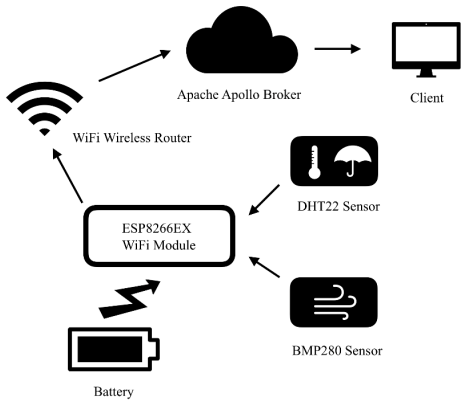
In this paper, a simplified wireless sensor network node was designed based on MQTT protocol. The node was designed to use the Arduino development environment and use the WiFi for networking. It has the characteristics of simple structure, low power consumption and so on. The design can be widely used in smart home, environmental monitoring and medical applications, and is the main contents of the Internet of things (IoT).
What carries the argument
MQTT publish/subscribe protocol running on an Arduino board with WiFi networking for wireless sensor data exchange.
If this is right
- The node supports deployment in smart home systems.
- It enables environmental monitoring tasks.
- Medical applications can incorporate the design.
- It forms part of Internet of Things networks.
Where Pith is reading between the lines
- Hobbyists and small teams could replicate the node quickly using off-the-shelf Arduino hardware.
- The design might extend to battery-powered field sensors if power measurements confirm the low-consumption claim.
- Integration with existing MQTT brokers could allow scaling to multiple nodes without custom server code.
Load-bearing premise
Choosing MQTT, Arduino, and WiFi will by itself produce a node with simple structure and low power consumption.
What would settle it
Build the described node, measure its power draw during operation, and compare the results against an equivalent node using HTTP or another protocol.
Figures
read the original abstract
MQTT protocol is a publish/subscribe message protocol based on TCP/IP protocol. It has the characteristics of low power consumption, scalability, openness and simplicity. HTTP protocol is an open and low-cost request/reply message protocol based on TCP/IP protocol. It is the main protocol of Internet communication, but it is not suitable for the environment of computing, processing and bandwidth limited. In this paper, a simplified wireless sensor network node was designed based on MQTT protocol. The node was designed to use the Arduino development environment and use the WiFi for networking. It has the characteristics of simple structure, low power consumption and so on. The design can be widely used in smart home, environmental monitoring and medical applications, and is the main contents of the Internet of things (IoT).
Editorial analysis
A structured set of objections, weighed in public.
Referee Report
Summary. The paper describes the design of a simplified wireless sensor network node based on the MQTT publish/subscribe protocol over TCP/IP. It selects the Arduino development environment and WiFi for networking, contrasting MQTT with HTTP, and asserts that the resulting node has a simple structure, low power consumption, and applicability to smart-home, environmental-monitoring, and medical IoT scenarios.
Significance. A verified, low-power MQTT-based Arduino/WiFi node design could offer a practical template for resource-constrained IoT deployments. The manuscript, however, supplies only component-selection rationale and qualitative assertions; no power measurements, memory footprints, packet-size comparisons, schematics, or code are provided, so the claimed advantages remain untested and the contribution is presently limited to a high-level design sketch.
major comments (2)
- [Abstract] Abstract (and any design-description sections): the central claim that the node 'has the characteristics of simple structure, low power consumption and so on' is unsupported by any quantitative evidence. No current-draw figures, timing measurements, memory-usage metrics, or baseline comparisons (e.g., MQTT vs. HTTP or Arduino vs. other MCUs) appear anywhere in the manuscript.
- [Full text (design description)] The manuscript contains no experimental verification, circuit diagrams, firmware listings, or performance tables. Without these, the design choices (MQTT, Arduino IDE, WiFi) cannot be shown to deliver the asserted simplicity or power savings.
Simulated Author's Rebuttal
We thank the referee for the comments. The manuscript is a high-level design description of an MQTT-based node using Arduino and WiFi. We address the major comments below.
read point-by-point responses
-
Referee: [Abstract] Abstract (and any design-description sections): the central claim that the node 'has the characteristics of simple structure, low power consumption and so on' is unsupported by any quantitative evidence. No current-draw figures, timing measurements, memory-usage metrics, or baseline comparisons (e.g., MQTT vs. HTTP or Arduino vs. other MCUs) appear anywhere in the manuscript.
Authors: The claims derive from documented properties of MQTT (lightweight publish/subscribe messaging) and the Arduino platform (accessible prototyping environment). The manuscript does not contain measurements because it is a design proposal, not an experimental evaluation. We will revise the abstract and design sections to qualify the statements as design objectives based on protocol and platform selection rather than verified results. revision: yes
-
Referee: [Full text (design description)] The manuscript contains no experimental verification, circuit diagrams, firmware listings, or performance tables. Without these, the design choices (MQTT, Arduino IDE, WiFi) cannot be shown to deliver the asserted simplicity or power savings.
Authors: The contribution is the architectural rationale and protocol choice for a simplified node. Implementation details such as schematics and code were not included. We agree that the absence prevents verification of the performance claims. We will revise the text to frame the work explicitly as a conceptual design and remove or qualify assertions of achieved simplicity and power savings. revision: yes
- Provision of experimental verification, circuit diagrams, firmware listings, or performance tables, as these were not part of the original design study.
Circularity Check
No circularity; descriptive design paper lacks any derivation chain or equations
full rationale
The paper is a qualitative design description selecting MQTT, Arduino, and WiFi for a WSN node and asserting 'simple structure, low power consumption' without any equations, fitted parameters, predictions, self-citations, or mathematical steps. No load-bearing claim reduces to its own inputs by construction, and the absence of a derivation chain means the result is not equivalent to the inputs. This is a normal non-finding for a component-selection report.
Axiom & Free-Parameter Ledger
axioms (1)
- domain assumption MQTT protocol exhibits low power consumption, scalability, openness and simplicity as general properties
Reference graph
Works this paper leans on
-
[1]
Wireless sensor network survey[J]
Yick J, Mukherjee B, Ghosal D. Wireless sensor network survey[J]. Computer Networks, 2008, 52(12):2292-2330
work page 2008
-
[3]
Application of MQTT Protocol in Internet of Things[J]
Gong Y G, Jun -Ying F U, Wang X Y, et al. Application of MQTT Protocol in Internet of Things[J]. Computer & Telecommunication, 2017
work page 2017
-
[4]
Naik N. Choice of effective messaging protocols for IoT systems: MQTT, CoAP, AMQP and HTTP[C]// Systems Engineering Symposium. IEEE, 2017:1-7
work page 2017
-
[5]
Research and Implementation of MQTT protocol on the Internet of Things communication system[J]
Yao D, Xie X, Yang J, et al. Research and Implementation of MQTT protocol on the Internet of Things communication system[J]. Information & Communications, 2016
work page 2016
-
[6]
Design and Implementation of Push Notification System Based on the MQTT Protocol[J]
Tang K, Wang Y, Liu H, et al. Design and Implementation of Push Notification System Based on the MQTT Protocol[J]. 2013, 92:116-119
work page 2013
-
[7]
Luzuriaga J E, Cano J C, Calafate C, et al. Handling mobility in IoT applications using the MQTT protocol[C]// Internet Technologies and Applications. IEEE, 2015:245-250
work page 2015
-
[8]
Kodali R K, Mahesh K S. A low cost implementation of MQTT using ESP8266[C]// International Conference on Contemporary Computing and Informatics. IEEE, 2017:404-408
work page 2017
-
[9]
MQTT based home automation system using ESP8266[C]// Humanitarian Technology Conference
Kodali R K, Soratkal S R. MQTT based home automation system using ESP8266[C]// Humanitarian Technology Conference. IEEE, 2017:1-5
work page 2017
-
[10]
Mariappan V, Mfitumukiza J, Khudaybergen ov T, et al. MQTT based cloud -connectivity enabled Optical Wireless Light Sensory Network (OWLSN) Device Design using ESP8266 Controller[C]// Korea Telecom Society 2018 Winter Conference, KICS. 2018
work page 2018
-
[11]
Artanto D, Sulistyanto M P, Pranowo I D, et al. Drowsiness detection system based on eye-closure using a low -cost EMG and ESP8266[C]// International Conferences on Information Technology, Information Systems and Electrical Engineering. 2017:235-238
work page 2017
-
[12]
How to Use the DHT22 Sensor for Measuring Temperature and Humidity with the Arduino Board[J]
Bogdan M. How to Use the DHT22 Sensor for Measuring Temperature and Humidity with the Arduino Board[J]. Acta Universitatis Cibiniensis, 2016, 68
work page 2016
-
[13]
Design of a Zig Bee wireless sensor node hardware circuit based on Arduino[J]
Zhang Y L. Design of a Zig Bee wireless sensor node hardware circuit based on Arduino[J]. Electronic Design Engineering, 2015
work page 2015
- [14]
-
[15]
Liu, B, Cheng, J, Cai, K, Shi, P, &Tang, X. . (2017). Singular Point Probability Improve LSTM Network Performance for Long -term Traffic Flow Predi ction. National Conference of Theoretical Computer Science, 328-340
work page 2017
discussion (0)
Sign in with ORCID, Apple, or X to comment. Anyone can read and Pith papers without signing in.