Observational evidence for bar formation in disk galaxies via cluster-cluster interaction
Pith reviewed 2026-05-25 16:37 UTC · model grok-4.3
The pith
Disk galaxies show 1.5 times more bars in interacting galaxy clusters than in non-interacting ones.
A machine-rendered reading of the paper's core claim, the machinery that carries it, and where it could break.
Core claim
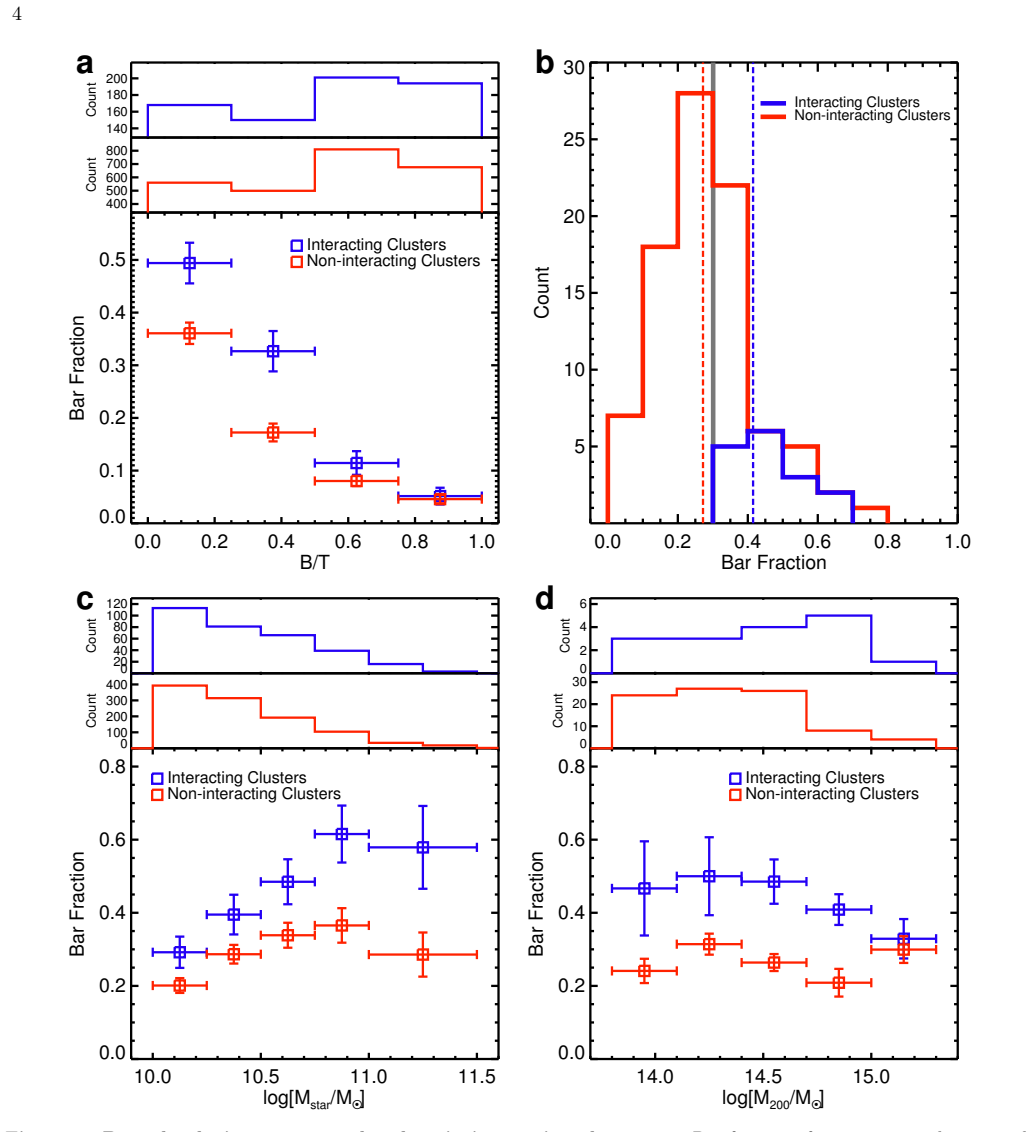
We examined 105 galaxy clusters at redshift 0.015 < z < 0.060 selected from the Sloan Digital Sky Survey data, and identified 16 interacting clusters. We find that the barred disk-dominated galaxy fraction is about 1.5 times higher in interacting clusters than in clusters with no clear signs of ongoing interaction (42% versus 27%). Our result indicates that bars can form through a large-scale violent phenomenon, and cluster-cluster interaction should be considered an important mechanism of bar formation.
What carries the argument
Comparison of barred fractions in disk-dominated galaxies between clusters classified as interacting versus non-interacting on the basis of visible signs of ongoing cluster-cluster encounters.
If this is right
- Bars can form through large-scale violent phenomena in addition to internal processes or galaxy-galaxy interactions.
- Cluster-cluster interaction must be included among the mechanisms that set the observed bar fraction in disk galaxies.
- The bar fraction in disk-dominated galaxies rises by roughly 50 percent when their host cluster is undergoing an interaction.
- Environmental effects on galaxy structure operate on the scale of entire cluster mergers, not only on individual galaxy encounters.
Where Pith is reading between the lines
- Bar formation efficiency may depend on the dynamical stage of the host cluster, rising during mergers and falling afterward.
- Bars induced by cluster interactions could exhibit different lengths, strengths, or pattern speeds than those formed internally.
- Surveys that do not separate interacting and non-interacting clusters will underestimate the role of environment in bar statistics.
- The same cluster interaction that raises the bar fraction may also alter the overall morphology or star-formation history of member galaxies.
Load-bearing premise
The observed difference in bar fraction is produced by the cluster interactions themselves rather than by selection biases, galaxy properties that affect bar detection, or other environmental factors.
What would settle it
Repeating the measurement after reclassifying the same clusters with an independent indicator of interaction (such as X-ray morphology or velocity dispersion maps) and finding that the 42-to-27 percent difference disappears.
Figures


read the original abstract
Bars are an elongated structure that extends from the centre of galaxies, and about one-third of disk galaxies are known to possess bars. These bars are thought to form either through a physical process inherent in galaxies, or through an external process such as galaxy-galaxy interactions. However, there are other plausible mechanisms of bar formation that still need to be observationally tested. Here we present the observational evidence that bars can form via cluster-cluster interaction. We examined 105 galaxy clusters at redshift $0.015 < z < 0.060$ that are selected from the Sloan Digital Sky Survey data, and identified 16 interacting clusters. We find that the barred disk-dominated galaxy fraction is about 1.5 times higher in interacting clusters than in clusters with no clear signs of ongoing interaction (42% versus 27%). Our result indicates that bars can form through a large-scale violent phenomenon, and cluster-cluster interaction should be considered an important mechanism of bar formation.
Editorial analysis
A structured set of objections, weighed in public.
Referee Report
Summary. The paper claims that analysis of 105 SDSS galaxy clusters at 0.015 < z < 0.060, of which 16 are identified as interacting, shows the barred disk-dominated galaxy fraction is ~1.5 times higher in interacting clusters (42%) than in non-interacting ones (27%), providing observational evidence that cluster-cluster interactions can drive bar formation in disk galaxies.
Significance. If the central observational difference holds after addressing classification and statistical controls, the result would be moderately significant for galaxy evolution, as it identifies a previously untested large-scale environmental channel for bar formation distinct from internal secular processes or galaxy-galaxy interactions. The work is purely observational with no derivations or machine-checked elements.
major comments (3)
- [Abstract] Abstract and results: the headline fractions (42% versus 27%) are stated without uncertainties, the number of disk-dominated galaxies per cluster subsample, or any statistical test (e.g., binomial proportion test or bootstrap) for the difference; this directly undermines assessment of whether the 1.5× enhancement is significant given only 16 interacting clusters.
- [Methods] Methods/cluster selection: no quantitative criteria are supplied for labeling the 16 clusters as 'interacting' (visual merger signatures? X-ray substructure? velocity dispersion offsets?); without an explicit, reproducible definition independent of galaxy morphology, the classification cannot be shown to be unbiased with respect to bar detectability or other environmental properties.
- [Results] Results and discussion: the analysis does not report controls or matching for potential confounders (cluster mass, richness, local galaxy density, or redshift slice) that could drive both the interaction flag and elevated bar fraction; the small interacting sample (N=16) makes the result sensitive to even modest misclassification or selection effects.
minor comments (2)
- [Abstract] The abstract states 'about one-third of disk galaxies are known to possess bars' without a reference; a citation to the relevant observational literature should be added.
- [Introduction] Notation for the redshift range uses $0.015 < z < 0.060$; ensure consistent formatting and that the exact selection function (magnitude limits, completeness) is stated in the methods.
Simulated Author's Rebuttal
We thank the referee for the constructive comments, which help clarify the presentation and robustness of our results. We address each major comment below.
read point-by-point responses
-
Referee: [Abstract] Abstract and results: the headline fractions (42% versus 27%) are stated without uncertainties, the number of disk-dominated galaxies per cluster subsample, or any statistical test (e.g., binomial proportion test or bootstrap) for the difference; this directly undermines assessment of whether the 1.5× enhancement is significant given only 16 interacting clusters.
Authors: We agree that uncertainties and a formal statistical assessment are required. The revised manuscript will report the number of disk-dominated galaxies in each subsample, include binomial uncertainties on the reported fractions, and add the result of a two-proportion z-test (or bootstrap equivalent) to evaluate the significance of the difference. revision: yes
-
Referee: [Methods] Methods/cluster selection: no quantitative criteria are supplied for labeling the 16 clusters as 'interacting' (visual merger signatures? X-ray substructure? velocity dispersion offsets?); without an explicit, reproducible definition independent of galaxy morphology, the classification cannot be shown to be unbiased with respect to bar detectability or other environmental properties.
Authors: Cluster interaction status was assigned via visual inspection of SDSS optical and, where available, X-ray images for clear merger signatures such as overlapping envelopes, tidal bridges, or multiple X-ray peaks. We will expand the Methods section with an explicit, step-by-step description of the visual criteria, example images, and confirmation that the classification was performed without reference to individual galaxy morphologies or bar properties. Potential residual biases will be discussed. revision: yes
-
Referee: [Results] Results and discussion: the analysis does not report controls or matching for potential confounders (cluster mass, richness, local galaxy density, or redshift slice) that could drive both the interaction flag and elevated bar fraction; the small interacting sample (N=16) makes the result sensitive to even modest misclassification or selection effects.
Authors: All clusters lie in the same narrow redshift interval by selection. In revision we will add explicit comparisons of the mass and richness distributions of the interacting versus non-interacting subsamples and, where numbers permit, repeat the bar-fraction measurement on a mass-matched control subsample. We will also expand the discussion to highlight the limitations inherent to the small interacting sample size and the consequent sensitivity to misclassification. revision: partial
Circularity Check
Purely observational comparison; no derivations or self-referential reductions present.
full rationale
The paper reports an observational measurement: selection of 105 clusters at 0.015 < z < 0.060, identification of 16 as interacting, and a direct count showing barred disk-dominated galaxy fraction of 42% vs 27%. No equations, model fits, predictions, or derivations are described. The result is a straightforward empirical ratio between two independently classified subsamples; the classification criteria and bar identification do not reduce to each other by construction or via self-citation chains. This is the expected non-finding for a purely observational study.
Axiom & Free-Parameter Ledger
axioms (1)
- domain assumption Galaxy clusters can be classified as interacting or non-interacting based on observable properties without bias from galaxy internal structures.
Reference graph
Works this paper leans on
-
[1]
Jogee, S. et al. Bar evolution over the last 8 billion years: a constant fraction of strong bars in the GEMS survey. Astrophys. J. Lett. 615, L105-L108 (2004)
work page 2004
-
[2]
Marinova, I. et al. Barred galaxies in the Abell 901/2 supercluster with stages. Astrophys. J. 698, 1639-1658 (2009)
work page 2009
-
[3]
Lee, G.-H., Park, C., Lee, M. G. & Choi, Y.-Y. Dependence of barred galaxy fraction on galaxy properties and environment. Astrophys. J. 745, 125 (2012)
work page 2012
-
[4]
Athanassoula, E. & Sellwood, J. A. Bi-symmetric instabilities of the Kuz’min/Toomre disc. Mon. Not. R. Astron. Soc. 221, 213-232 (1986)
work page 1986
- [5]
-
[6]
Zana, T. et al. External versus internal triggers of bar formation in cosmological zoom-in simulations. Mon. Not. R. Astron. Soc. 473, 2608-2621 (2018)
work page 2018
-
[7]
Miwa, T. & Noguchi, M. Dynamical properties of tidally induced galactic bars. Astrophys. J. 499, 149-166 (1998)
work page 1998
-
[8]
Berentzen, I., Athanassoula, E., Heller, C. H. & Fricke, K. J. The regeneration of stellar bars by tidal interactions: numerical simulations of fly-by encounters. Mon. Not. R. Astron. Soc. 347, 220-236 (2004)
work page 2004
-
[9]
Lokas, E. L. et al. Adventures of a tidally induced bar. Mon. Not. R. Astron. Soc. 445, 1339-1350 (2014)
work page 2014
-
[10]
Group-cluster merging and the formation of starburst galaxies
Bekki, K. Group-cluster merging and the formation of starburst galaxies. Astrophys. J. Lett. 510, L15-L19 (1999)
work page 1999
-
[11]
Barazza, F. D. et al. Frequency and properties of bars in cluster and field galaxies at intermediate redshifts. Astron. Astrophys. 497, 713-728 (2009). 10
work page 2009
-
[12]
Aguerri, J. A. L., M´ endez-Abreu, J. & Corsini, E. M. The population of barred galaxies in the local universe. I. Detection and characterisation of bars. Astron. Astrophys. 495, 491-504 (2009)
work page 2009
-
[13]
Shen, J. & Sellwood, J. A. The destruction of bars by central mass concentrations. 604, 614-631 (2004)
work page 2004
-
[14]
Athanassoula, E., Lambert, J. C. & Dehnen, W. Can bars be destroyed by a central mass concentration?- I. Simulations. Mon. Not. R. Astron. Soc. 363, 496-508 (2005)
work page 2005
-
[15]
Bournaud, F., Combes, F. & Semelin, B. The lifetime of galactic bars: central mass concentrations and gravity torques. Mon. Not. R. Astron. Soc. Lett. 364, L18-L22 (2005)
work page 2005
-
[16]
Fukugita, M., Hogan, C. J. & Peebles, P. J. E. The cosmic baryon budget. Astrophys. J. 503, 518-530 (1998)
work page 1998
-
[17]
Im, M. et al. The DEEP Groth Strip Survey. X. Number density and luminosity function of field E/S0 galaxies at z <1. Astrophys. J. 571, 136-171 (2002)
work page 2002
-
[18]
Bullet Cluster: A Challenge to LambdaCDM Cosmology
Lee, J., & Komatsu, E. Bullet Cluster: A Challenge to LambdaCDM Cosmology. Astrophys. J. 718, 60-65 (2010)
work page 2010
-
[19]
Vijayaraghavan, R. & Ricker, P. M. Pre-processing and post-processing in group-cluster mergers. Mon. Not. R. Astron. Soc. 435, 2713-2735 (2013)
work page 2013
-
[20]
Zhang, C., Yu, Q. & Lu, Y. A baryonic effect on the merger timescale of galaxy clusters. Astrophys. J 820, 85 (2016)
work page 2016
-
[21]
Lokas, E. L. et al. Tidally induced bars of galaxies in clusters. Astrophys. J. 826, 227 (2016)
work page 2016
-
[22]
Lang, M., Holley-Bockelmann, K. & Sinha, M. Bar formation from galaxy flybys. Astrophys. J. Lett. 790, L33 (2014)
work page 2014
-
[23]
Casteels, K. R. V. et al. Galaxy Zoo: quantifying morphological indicators of galaxy interaction. Mon. Not. R. Astron. Soc. 429, 1051-1065 (2013)
work page 2013
- [24]
-
[25]
Do bars trigger activity in galactic nuclei? Astrophys
Lee, G.-H et al. Do bars trigger activity in galactic nuclei? Astrophys. J. 750, 141 (2012)
work page 2012
-
[26]
Masters, K. L., Nichol, R. C., Haynes, M. P., et al. Galaxy Zoo and ALFALFA: atomic gas and the regulation of star formation in barred disc galaxies. Mon. Not. R. Astron. Soc. 424, 2180-2192 (2012)
work page 2012
-
[27]
Davoust, E. & Contini, T. Starbursts in barred spiral galaxies. VI. HI observations and the K-band Tully-Fisher relation. Astron. Astrophys. 416, 515-527 (2004)
work page 2004
-
[28]
Berentzen, I., Heller, C. H., Shlosman, I. & Fricke, K. J. Gas-driven evolution of stellar orbits in barred galaxies. Mon. Not. R. Astron. Soc. 300, 49-63 (1998)
work page 1998
-
[29]
Villa-Vargas, J., Shlosman, I. & Heller, C. Dark matter halos and evolution of bars in disk galaxies: varying gas fraction and gas spatial resolution. Astrophys. J. 719, 1470-1480 (2010)
work page 2010
-
[30]
Wetzel, A. R., Schulz, A. E., Holz, D. E. & Warren, M. S. Close pairs as proxies for galaxy cluster mergers. Astrophys. J. 683, 1-11 (2008)
work page 2008
-
[31]
Demarco, R. et al. Spectroscopic confirmation of three red-sequence selected galaxy clusters at z = 0.87, 1.16, and 1.21 from the SpARCS Survey. Astrophys. J. 711, 1185-1197 (2010)
work page 2010
-
[32]
Kim, J.-W. et al. Discovery of a supercluster at z∼ 0.91 and testing the ΛCDM cosmological model. Astrophys. J. Lett. 821, L10 (2016)
work page 2016
-
[33]
Cole, S., Lacey, C. G., Baugh, C. M. & Frenk, C. S. Hierarchical galaxy formation. Mon. Not. R. Astron. Soc. 319, 168-204 (2000)
work page 2000
-
[34]
Lagos, C. d. P. et al. Predictions for the CO emission of galaxies from a coupled simulation of galaxy formation and photon-dominated regions. Mon. Not. R. Astron. Soc. 426, 2142-2165 (2012)
work page 2012
-
[35]
Bahcall, N. A. & Oh, S. P. The peculiar velocity function of galaxy clusters. Astrophys. J. Lett. 462, L49 (1996)
work page 1996
-
[36]
Thompson, R. & Nagamine, K. Pairwise velocities of dark matter haloes: a test for the Λ cold dark matter model using the bullet cluster. Mon. Not. R. Astron. Soc. 419, 3560-3570 (2012)
work page 2012
-
[37]
Hwang, H. S. & Lee, M. G. Galaxy activity in merging binary galaxy clusters. Mon. Not. R. Astron. Soc. 397, 2111-2122 (2009)
work page 2009
-
[38]
Shim, H. et al. Merging galaxy cluster A2255 in mid-infrared. Astrophys. J. 727, 14 (2011)
work page 2011
-
[39]
Hou, A. et al. Substructure in the most massive GEEC groups: field-like populations in dynamically active groups. Mon. Not. R. Astron. Soc. 421, 3594-3611 (2012)
work page 2012
-
[40]
Dressler, A. & Shectman, S. A. Evidence for substructure in rich clusters of galaxies from radial-velocity measurements. Astron. J. 95, 985-995 (1988)
work page 1988
-
[41]
Einasto, M. et al. Multimodality in galaxy clusters from SDSS DR8: substructure and velocity distribution. Astron. Astrophys. 540, A123 (2012)
work page 2012
-
[42]
Pinkney, J., Roettiger, K., Burns, J. O. & Bird, C. M. Evaluation of statistical tests for substructure in clusters of galaxies. Astrophys. J. Suppl. Ser. 104, 1 (1996). 11
work page 1996
-
[43]
Jedrzejewski, R. I. CCD surface photometry of elliptical galaxies. I - Observations, reduction and results. Mon. Not. R. Astron. Soc. 226, 747-768 (1987)
work page 1987
-
[44]
Simard, L., Mendel, J. T., Patton, D. R., Ellison, S. L. & McConnachie, A. W. A catalog of bulge+disk decompositions and updated photometry for 1.12 million galaxies in the Sloan Digital Sky Survey. Astrophys. J. Suppl. Ser. 196, 11 (2011)
work page 2011
-
[45]
Men´ endez-Delmestre, K., Sheth, K., Schinnerer, E., Jarrett, T. H. & Scoville, N. Z. A near-infrared study of 2MASS bars in local galaxies: an anchor for high-redshift studies. Astrophys. J. 657, 790-804 (2007). 12 Acknowledgements We thank Woong-Tae Kim and SungWon Kwak for helpful comments and discussions. This work was supported by the National Resear...
work page 2007
discussion (0)
Sign in with ORCID, Apple, or X to comment. Anyone can read and Pith papers without signing in.