Flexible Anonymous Network
Pith reviewed 2026-05-25 14:50 UTC · model grok-4.3
The pith
A software architecture can deliver the robustness principle's flexibility while restricting it to authentic protocol evolution only.
A machine-rendered reading of the paper's core claim, the machinery that carries it, and where it could break.
Core claim
The authors argue that a software architecture can be defined to retain the benefits of the robustness principle—efficient network operation despite varied software versions—while guaranteeing that this tolerance is used solely to support authentic evolution of the protocol specification rather than being exploited.
What carries the argument
A software architecture that enforces distinction between authentic protocol evolution and exploitative uses of robustness tolerance.
If this is right
- Network services continue to function when multiple software versions coexist.
- Protocol evolution remains possible without opening avenues for attack through excessive tolerance.
- Flexibility across specifications, designs, and implementations is preserved under a single controlled mechanism.
- Security requirements are met by design rather than added after the fact.
Where Pith is reading between the lines
- The same mechanism could be applied to anonymous communication systems to allow updates without leaking identifying information through version-specific behavior.
- If the distinction works, it suggests a general pattern for making other tolerance-based systems, such as parsers or configuration loaders, resistant to misuse.
- Real-world testing would require concrete rules for what counts as an authentic evolution, which the paper leaves open.
Load-bearing premise
A software architecture can be built that reliably identifies and permits only authentic protocol specification changes while blocking all other uses of implementation tolerance.
What would settle it
Build and deploy a prototype of the architecture for an existing protocol such as TCP or Tor and observe whether it accepts only documented specification updates while rejecting malformed inputs that exploit tolerance.
Figures
read the original abstract
Internet technologies have been designed from guidelines like the robustness principle also known as Postel's law. Jon Postel's law is described as: "Be conservative in what you do, be liberal in what you accept from others." Fundamentally, it advises protocol designs to be tolerant with what they accept from the other peers. We propose to take a step back and wonder how the robustness principle could be revisited to support security requirements as well as unifying flexibility from specifications, protocol design and software implementations. Our goal would be to define a software architecture that offers the benefits of the robustness principle (i.e., efficient network services despite the presence of various software versions), while also guaranteeing that this robustness cannot be exploited by making sure that it is only used to support authentic evolution of the protocol specification.
Editorial analysis
A structured set of objections, weighed in public.
Referee Report
Summary. The manuscript proposes revisiting Postel's robustness principle to support security requirements in Internet protocols. It aims to define a software architecture that retains the benefits of tolerance to variant implementations (efficient services despite different software versions) while ensuring this flexibility supports only authentic evolution of the protocol specification and cannot be exploited.
Significance. A concrete architecture achieving the stated separation between authentic evolution and exploitative use of robustness would be significant for protocol design and security. The manuscript, however, contains no design, mechanisms, invariants, or analysis to indicate that the required distinction is achievable.
major comments (1)
- [Abstract] Abstract (and full text): the central claim is that a software architecture can be defined to guarantee robustness is used only for authentic evolution. No mechanism, cryptographic primitive, negotiation protocol, or even informal invariant is provided that would allow an implementation to decide authentic vs. exploitative input while preserving interoperability. This absence is load-bearing for the stated goal.
minor comments (1)
- The title 'Flexible Anonymous Network' does not match the manuscript content, which addresses the robustness principle rather than anonymity or anonymous networks.
Simulated Author's Rebuttal
We thank the referee for the detailed review. The manuscript is a position paper that articulates a goal for revisiting Postel's robustness principle to incorporate security constraints on protocol evolution. It does not claim to deliver a concrete architecture or mechanisms. We address the major comment below.
read point-by-point responses
-
Referee: [Abstract] Abstract (and full text): the central claim is that a software architecture can be defined to guarantee robustness is used only for authentic evolution. No mechanism, cryptographic primitive, negotiation protocol, or even informal invariant is provided that would allow an implementation to decide authentic vs. exploitative input while preserving interoperability. This absence is load-bearing for the stated goal.
Authors: The manuscript states a goal ('Our goal would be to define a software architecture...') rather than asserting that such an architecture has been defined or that the authentic-vs-exploitative distinction is currently achievable. No mechanisms, primitives, or invariants are supplied because the contribution is conceptual: to motivate the need for an architecture that preserves interoperability benefits while preventing exploitation of robustness. We acknowledge that the paper contains no design or analysis that would allow an implementation to make the required distinction. If the editor concurs, we will revise the abstract and introduction to explicitly frame the work as a position paper whose detailed realization is left to future research. revision: yes
Circularity Check
No derivation chain present; conceptual proposal only
full rationale
The manuscript states a high-level goal of defining a software architecture that preserves robustness benefits while restricting it to authentic protocol evolution. No equations, fitted parameters, predictions, self-citations, or uniqueness theorems appear in the abstract or described content. The claim is aspirational and supplies no mechanism or derivation that could reduce to its own inputs. Therefore no load-bearing step exists to analyze for circularity.
Axiom & Free-Parameter Ledger
Reference graph
Works this paper leans on
-
[1]
Be conservative in what you do, be liberal in what you accept from others
REVISITING PROTOCOL FLEXIBILITY Internet technologies have been designed from guidelines like the robustness principle also known as Postel’s law [1] . Jon Postel’s law is described as: “Be conservative in what you do, be liberal in what you accept from others.” Fun- damentally, it advises protocol designs to be tolerant with what they accept from the oth...
-
[2]
FLEXIBLE ANONYMOUS NETWOK We call F AN, for Flexible Anonymous Network, an anony- mous network architecture able to transparently change its behavior for one or many users without having to restart relays or perturbing other user connections while proceed- ing to add, remove or modify protocol features. A F AN is achieved using what we call “Protocol Plug...
-
[3]
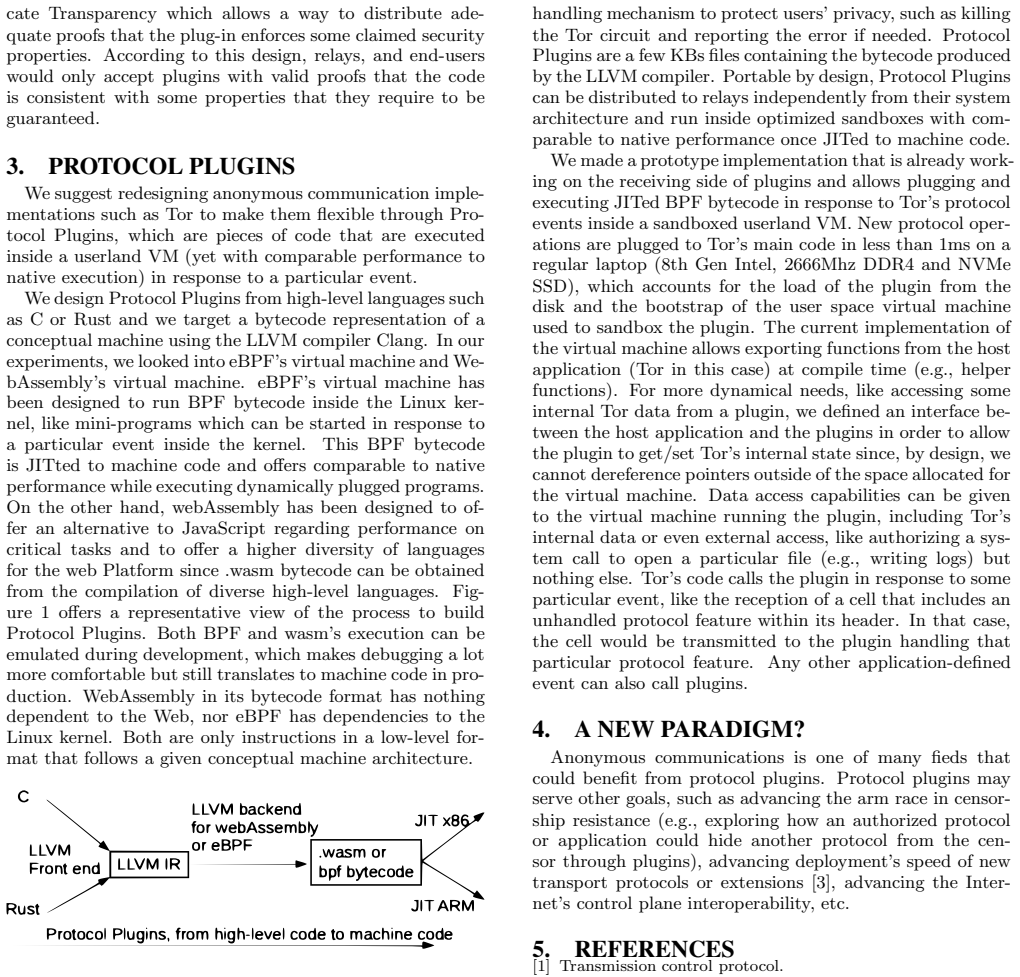
PROTOCOL PLUGINS We suggest redesigning anonymous communication imple- mentations such as Tor to make them flexible through Pro- tocol Plugins, which are pieces of code that are executed inside a userland VM (yet with comparable performance to native execution) in response to a particular event. We design Protocol Plugins from high-level languages such as ...
-
[4]
A NEW PARADIGM? Anonymous communications is one of many fieds that could benefit from protocol plugins. Protocol plugins may serve other goals, such as advancing the arm race in censor- ship resistance (e.g., exploring how an authorized protoco l or application could hide another protocol from the cen- sor through plugins), advancing deployment’s speed of n...
-
[5]
https://tools.ietf.org/html/rfc793, September 1981
Transmission control protocol. https://tools.ietf.org/html/rfc793, September 1981
work page 1981
-
[6]
https://blog.torproject.org/blog/tor-security-advisory-relay-early-traffic-confirmation-attack ,
Relay early confirmation attack. https://blog.torproject.org/blog/tor-security-advisory-relay-early-traffic-confirmation-attack ,
-
[7]
Accessed: 2018-05-02
work page 2018
-
[8]
Q. De Coninck, F. Michel, M. Piraux, F. Rochet, T. Given-Wilson, A. Legay, O. Pereira, and O. Bonaventure. Pluginizing QUIC. In K. Winstein and X. Jin, editors, Proceedings of the 2019 Conference of the ACM Special Interest Group on Data Communication, SIGCOMM 2019, Beijing, China, August 19-24, 2019 . ACM, 2019
work page 2019
-
[9]
F. Rochet and O. Pereira. Dropping on the edge: Flexibili ty and traffic confirmation in onion routing protocols. Proceedings on Privacy Enhancing Technologies , 2018(2):27–46, 2018
work page 2018
- [10]
discussion (0)
Sign in with ORCID, Apple, or X to comment. Anyone can read and Pith papers without signing in.