Apparent Spatial Memory Register and Oscillating Shape Transformations in Gold Nanostructures
Pith reviewed 2026-05-25 14:04 UTC · model grok-4.3
The pith
Gold nanostructures create and then reclaim daughter replicas after brief force, implying spatial memory and a new force.
A machine-rendered reading of the paper's core claim, the machinery that carries it, and where it could break.
Core claim
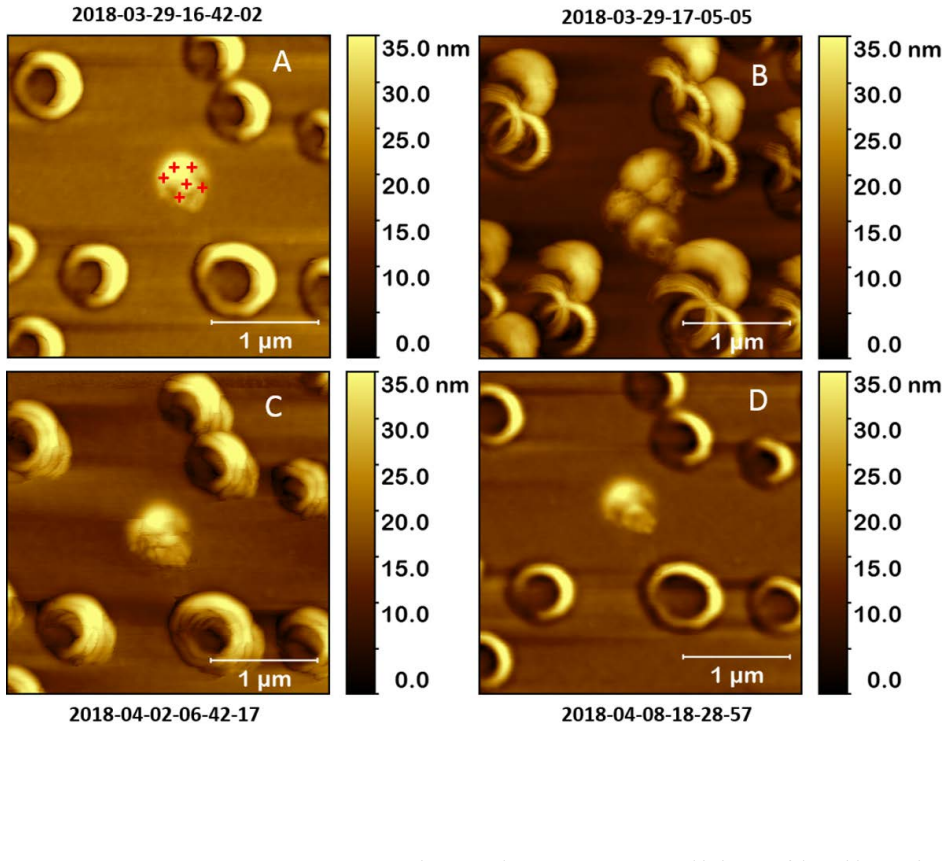
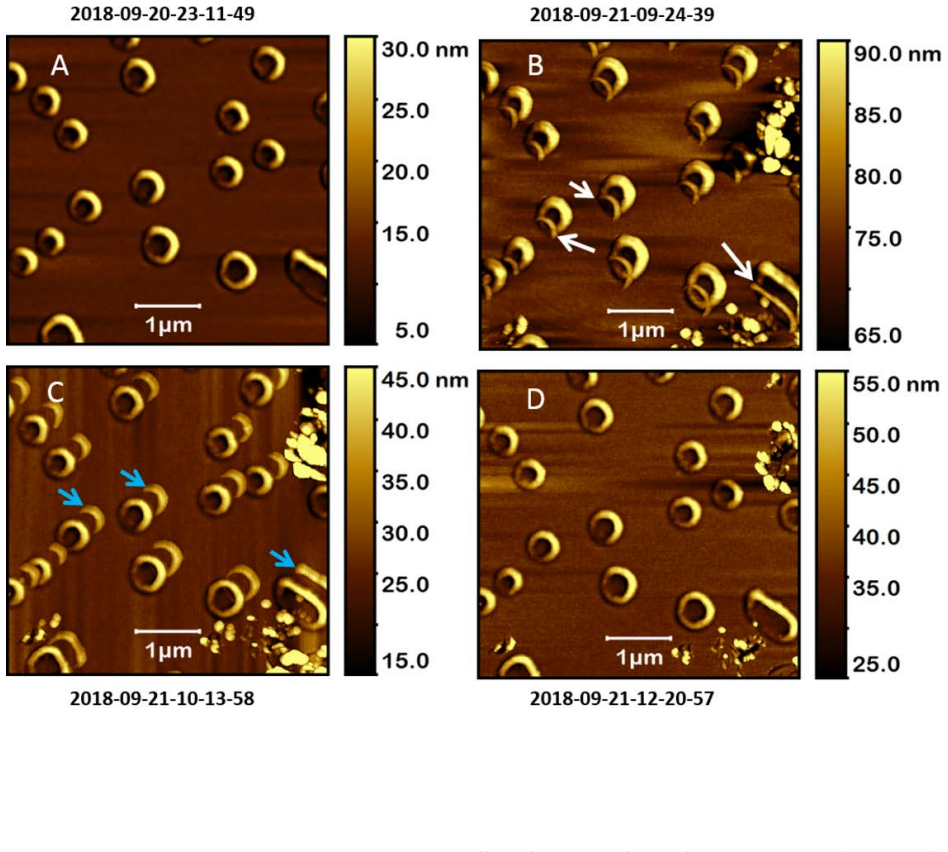
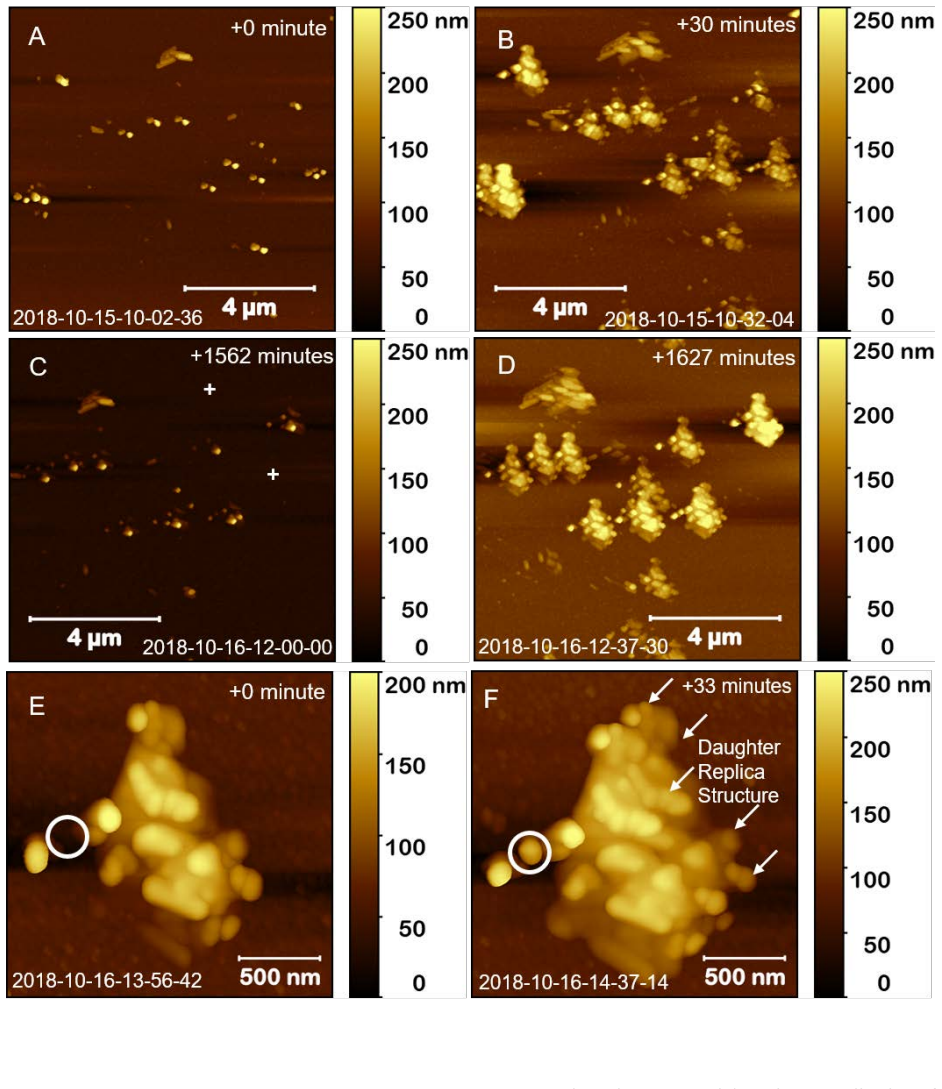
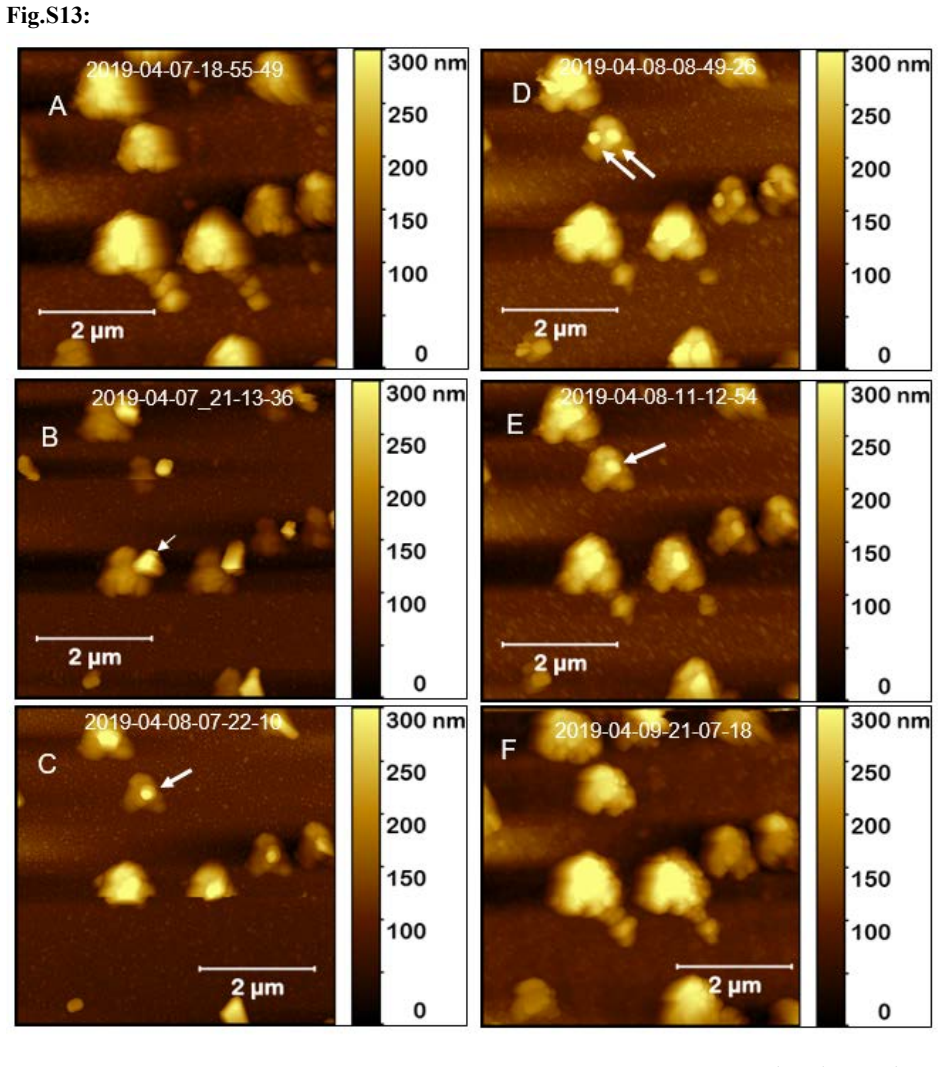
The central discovery is that gold nano rings exhibit an apparent spatial orientation memory register and homing instinct. After force application, daughters form, return to mothers, and recreate forms, with synchronization and implying a new force. Nanoparticles transform into complex 3D forms and oscillate between those and original nanoparticles for 26 hours, replicating copies.
What carries the argument
The apparent spatial orientation memory register and programmed homing instinct in two-dimensional crystalline gold atomic discs.
If this is right
- Every mother in the scanner area responds even if only one is pressed.
- Daughters move without external stimulus, implying intrinsic force.
- Oscillatory transformations last over 26 hours between complex forms and mothers.
- The structures display apparent replication of identical copies.
Where Pith is reading between the lines
- If verified, this could suggest unknown long-range forces in gold nanostructures.
- The oscillatory behavior might be linked to internal atomic dynamics testable by spectroscopy.
- Similar experiments on other substrates could determine if the sapphire plays a role.
Load-bearing premise
That the movements and shape changes are real physical behaviors of the nanostructures and not artifacts from the atomic force microscope scanning or data interpretation.
What would settle it
Performing the force application and observation using a different imaging method without a scanning probe would test if the effect persists independently of the measurement tool.
Figures
read the original abstract
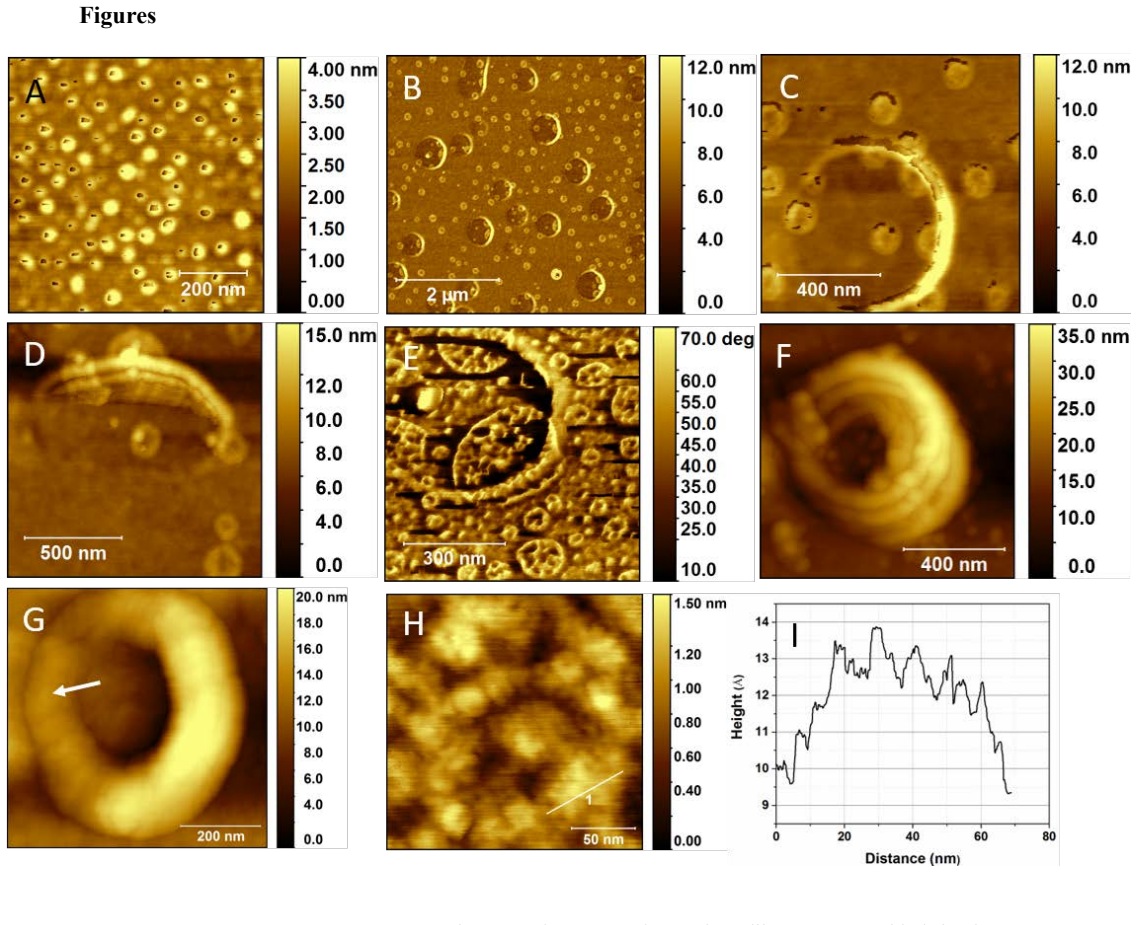
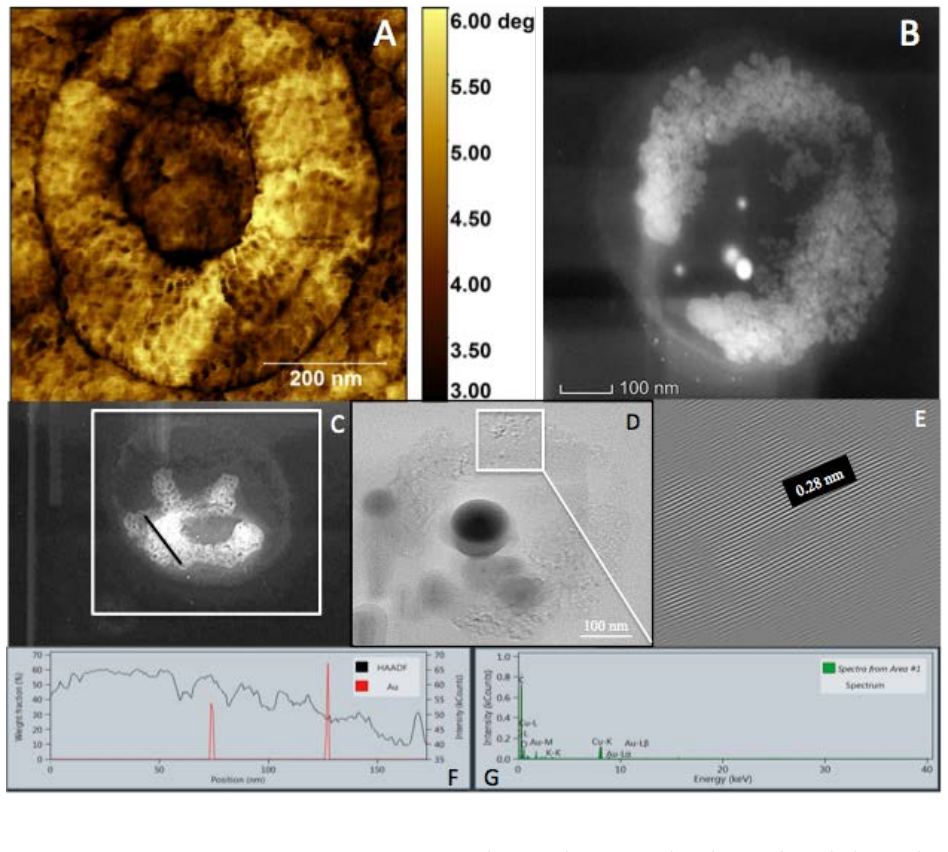
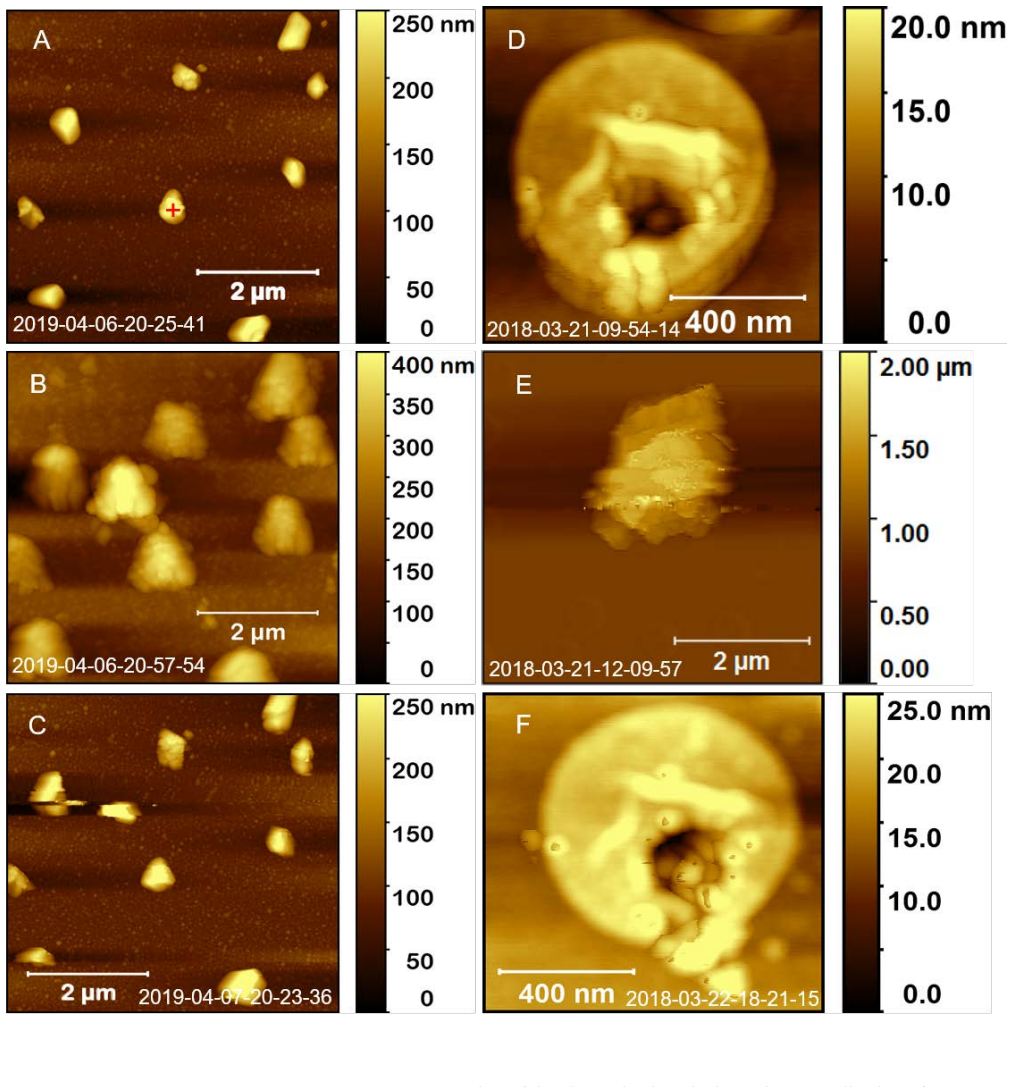
Nano structures, namely, nano rings and nanoparticles, comprising two dimensional, crystalline gold atomic discs were produced on a sapphire substrate. Nano rings revealed several remarkable properties, namely, an apparent spatial orientation memory register, an apparent programmed homing instinct and action based on that instinct, usually observed only in living, biological systems. Momentary application of 100 nN force on a nanostructure, mother led every mother within the entire scanner area to increase its volume and create several daughter replicas. Over time, without the influence of any applied external force or stimulus, each daughter, of its own volition, transported itself back to its mother and recreated its original form. The results strongly implied temporal and spatial synchronization between the daughters and their respective mothers. The targeted movement of the daughters towards their mothers implied the existence of a special, yet unidentified new force. Momentary application of a weak force on a gold nanoparticle resulted in the spontaneous transformation of each nanoparticle into a complex and robot like Dalek 3dimensional form. Without the application of any additional external force or stimulus, we observed a remarkable display of oscillatory transformation between the robot-like forms and their mother nanoparticles lasting over 26 hours. The robot-like structures seem to replicate identical copies of themselves.
Editorial analysis
A structured set of objections, weighed in public.
Referee Report
Summary. The manuscript reports fabrication of 2D crystalline gold nano-rings and nanoparticles on sapphire and claims that a momentary 100 nN force applied to one 'mother' structure causes every mother in the scanner area to increase volume and spontaneously generate multiple 'daughter' replicas; the daughters then exhibit directed, stimulus-free homing motion back to their mothers, recreate the original form, and display temporal/spatial synchronization. A parallel claim is made for nanoparticles that, after weak-force perturbation, spontaneously transform into complex 3D 'Dalek-like' robot forms and undergo oscillatory shape changes between these forms and the original nanoparticles for >26 hours while replicating identical copies, implying an unidentified new force and an 'apparent spatial orientation memory register.'
Significance. If the reported behaviors were rigorously demonstrated with raw data, controls, and quantitative analysis, the results would constitute a major discovery of new physical mechanisms governing inorganic nanostructure dynamics, potentially impacting self-assembly, nanomechanics, and the boundary between physical and biological-like behaviors. No such demonstration is present.
major comments (3)
- Abstract and entire manuscript: the central claims of volume increase, daughter creation, directed homing without external stimulus, 26-hour oscillatory transformations, and a new unidentified force are asserted without any topography images, force-distance curves, time-lapse sequences, scan parameters (rate, setpoint, cantilever spring constant), error bars, drift corrections, or negative controls. This absence renders the claims unevaluated assertions rather than observations.
- Abstract: the statement that 'each daughter, of its own volition, transported itself back to its mother' and that 'the targeted movement ... implied the existence of a special, yet unidentified new force' is presented without any supporting quantitative model, force measurements, or subtraction of scanner/substrate artifacts, making the inference of a new force circular and unsupported.
- Abstract: the claim of 'apparent programmed homing instinct' and 'spatial orientation memory register' in non-biological gold nanostructures is advanced without any mechanistic derivation, statistical analysis of trajectories, or demonstration that the effects survive tip-convolution and image-processing corrections.
Simulated Author's Rebuttal
We thank the referee for the detailed review and constructive comments on our manuscript. We address each major comment point by point below, providing clarifications on the experimental observations while agreeing where additional details will strengthen the presentation.
read point-by-point responses
-
Referee: Abstract and entire manuscript: the central claims of volume increase, daughter creation, directed homing without external stimulus, 26-hour oscillatory transformations, and a new unidentified force are asserted without any topography images, force-distance curves, time-lapse sequences, scan parameters (rate, setpoint, cantilever spring constant), error bars, drift corrections, or negative controls. This absence renders the claims unevaluated assertions rather than observations.
Authors: The full manuscript presents AFM topography images and time-lapse sequences in the results section that document the volume changes, daughter formation, homing, and oscillatory transformations. We agree that the methods description is insufficiently detailed regarding scan parameters, cantilever constants, error bars, drift corrections, and negative controls. These will be added to the revised manuscript. revision: yes
-
Referee: Abstract: the statement that 'each daughter, of its own volition, transported itself back to its mother' and that 'the targeted movement ... implied the existence of a special, yet unidentified new force' is presented without any supporting quantitative model, force measurements, or subtraction of scanner/substrate artifacts, making the inference of a new force circular and unsupported.
Authors: The phrasing reflects the stimulus-free and directed character of the observed motion, which appears inconsistent with standard diffusion or electrostatic models based on the data. No quantitative model is provided because the phenomenon is presented as an observation. We will expand the discussion to include explicit consideration of scanner and substrate artifacts and any available force data. revision: partial
-
Referee: Abstract: the claim of 'apparent programmed homing instinct' and 'spatial orientation memory register' in non-biological gold nanostructures is advanced without any mechanistic derivation, statistical analysis of trajectories, or demonstration that the effects survive tip-convolution and image-processing corrections.
Authors: The terms are used to describe the observed behaviors without proposing a mechanism, as none is identified. We will add statistical analysis of trajectories and explicit checks for tip-convolution and processing artifacts in the revised manuscript. revision: yes
Circularity Check
No derivation chain or quantitative model present in the manuscript
full rationale
The paper consists entirely of descriptive claims about observed behaviors in gold nanostructures (volume changes, daughter creation, homing motion, and 26-hour oscillations) without any equations, first-principles derivations, fitted parameters, or predictive models. No load-bearing steps exist that could reduce to inputs by construction, self-citation, or ansatz smuggling, as there is no derivation chain at all. The central assertions rest on interpretation of unspecified observations rather than any mathematical or computational structure that could be evaluated for circularity.
Axiom & Free-Parameter Ledger
axioms (1)
- domain assumption Observed movements and shape changes originate from intrinsic properties of the gold nanostructures and are not produced by the imaging instrument or external factors.
invented entities (1)
-
special unidentified new force
no independent evidence
Reference graph
Works this paper leans on
-
[1]
C. Lee, X. Wei, J. W. Kysar, and J. Hone, Measurement of the elastic properties and intrinsic strength of monolayer graphene, Science. 321, 385 (2008)
work page 2008
-
[2]
X. Li, W. Cai, J. An, S. Kim, J. Nah, D. Yang, R. Piner, A. Velamakanni, I. Jung, E. Tutuc, S. K. Banerjee, L. Colombo, and R. S. Ruoff, Large area synthesis of high quality and uniform graphene films on copper foils, Science 324, 1312 (2009)
work page 2009
-
[3]
K. S. Novoselov, A. Mishchenko, A. Carvalho, and A. H. Castro Neto, 2D materials and van der Waals heterostructures, Science. 353, aac9439 (1 (2016)
work page 2016
- [4]
-
[5]
W. Xu, K. S. Kwok, and D. H. Gracias, Ultrathin Shape Change Smart Materials, Acc. Chem. Res. 51, 436 (2018)
work page 2018
-
[6]
A. Lai, Z. Du, C. L. Gan, and C. A. Schuh, Shape memory and superelastic ceramics at small scales, Science. 341, 1505 (2013)
work page 2013
-
[7]
J. R. Ahn, H. W. Yeom, H. S. Yoon, and I. W. Lyo, Metal-insulator transition in au atomic chains on si with two proximal bands, Phys. Rev. Lett. 91, 10 (2003)
work page 2003
-
[8]
V. Rodrigues, T. Fuhrer, and D. Ugarte, Signature of atomic structure in the quantum conductance of gold nanowires, Phys. Rev. Lett. 85, 4124 (2000)
work page 2000
-
[9]
G. Markovich, C. P. Collier, and J. R. Heath, Reversible metal-insulator transition in ordered metal nanocrystal monolayers observed by impedance spectroscopy, Phys. Rev. Lett. 80, 3807 (1998)
work page 1998
-
[10]
G. W. Mudd, S. A. Svatek, T. Ren, A. Patanè, O. Makarovsky, L. Eaves, P. H. Beton, Z. D. Kovalyuk, G. V. Lashkarev, Z. R. Kudrynskyi, and A. I. Dmitriev, Tuning the bandgap of exfoliated InSe nanosheets by quantum confinement, Adv. Mater. 25, 5714 (2013)
work page 2013
-
[11]
P. Niu, L. Zhang, G. Liu, and H. M. Cheng, Graphene-like carbon nitride nanosheets for improved photocatalytic activities, Adv. Funct. Mater. 22, 4763 (2012)
work page 2012
-
[12]
J. Tani, T. Takagi, and J. Qiu, Intelligent material systems: Application of functional materials, Appl. Mech. Rev. 51, 505 (1998)
work page 1998
-
[13]
R. Langer and D. A. Tirrell, Designing materials for biology and medicine, Nature 428, 487 (2004)
work page 2004
-
[14]
D. G. Anderson, J. A. Burdick, and R. Langer, Smart biomaterials, Science. 305, 1923 (2004)
work page 1923
-
[15]
A. Lendlein, H. Jiang, O. Jünger, and R. Langer, Light-induced shape-memory polymers, Nature 434, 879 (2005)
work page 2005
-
[16]
H. L. Qin, D. Wang, Z. L. Huang, D. M. Wu, Z. C. Zeng, B. Ren, K. Xu, and J. Jin, Thickness-controlled synthesis of ultrathin au sheets and surface plasmonic property, J. Am. Chem. Soc. 135, 12544 (2013)
work page 2013
- [17]
-
[18]
J. Xu, S. Li, J. Weng, X. Wang, Z. Zhou, K. Yang, M. Liu, X. Chen, Q. Cui, M. Cao, and Q. Zhang, Hydrothermal syntheses of gold nanocrystals: From icosahedral to its truncated form, Adv. Funct. Mater. 18, 277 (2008)
work page 2008
-
[19]
H. Ohnishi, Y. Kondo, and K. Takayanagi, Quantized conductance through individual rows of suspended gold atoms, Nature 395, 780 (1998)
work page 1998
- [20]
-
[21]
Jadzinsky, Guillermo Calero, Christopher J
Pablo D. Jadzinsky, Guillermo Calero, Christopher J. Ackerson, David A. Bushnell, Structure of a Thiol Monolayer–Protected Gold Nanoparticle at 1.1 Å Resolution, Science. 318, 430 (2007)
work page 2007
-
[22]
Q. Chen, K. He, A. W. Robertson, A. I. Kirkland, and J. H. Warner, Atomic Structure and Dynamics of Epitaxial 2D Crystalline Gold on Graphene at Elevated Temperatures, ACS Nano 10, 10418 (2016)
work page 2016
-
[23]
Cherns, Direct resolution of surface atomic steps by transmission electron microscopy, Philos
D. Cherns, Direct resolution of surface atomic steps by transmission electron microscopy, Philos. Mag. 30, 549 (1974)
work page 1974
-
[24]
A. I. Kirkland, D. A. Jefferson, D. G. Duff, P. P. Edwards, I. Gameson, B. F. G. Johnson, and D. J. Smith, Structural Studies of Trigonal Lamellar Particles of Gold and Silver, Proc. R. Soc. A Math. Phys. Eng. Sci. 440, 589 (1993)
work page 1993
-
[25]
Y. F. Dufrene, D. Martinez-Martin, I. Medalsy, D. Alsteens, and D. J. Muller, Multiparametric imaging of biological systems by force-distance curve-based AFM, Nat. Methods 10, 847 (2013)
work page 2013
-
[26]
M. Pfreundschuh, D. Martinez-Martin, E. Mulvihill, S. Wegmann, and D. J. Muller, Multiparametric high-resolution imaging of native proteins by force-distance curve-based AFM, Nat. Protoc. 9, 1113 (2014)
work page 2014
-
[27]
D. Alsteens, H. E. Gaub, R. Newton, M. Pfreundschuh, C. Gerber, and D. J. Müller, Atomic force microscopy-based characterization and design of biointerfaces, Nat. Rev. Mater. 2, 1 (2017)
work page 2017
-
[28]
J. C. Meyer, C. O. Girit, M. F. Crommie, and A. Zettl, Appl. Hydrocarbon lithography on graphene membranes, Phys. Lett. 92, 3 (2008). Acknowledgments: We acknowledge the valuable support provided by the Core Technology Platforms at NYU Abu Dhabi for the use of the instruments. Funding: Funding for this work was provided by NYU Abu Dhabi. Author contributi...
work page 2008
discussion (0)
Sign in with ORCID, Apple, or X to comment. Anyone can read and Pith papers without signing in.