Highly angular resolving beam separator based on total internal reflection
Pith reviewed 2026-05-25 13:59 UTC · model grok-4.3
The pith
An air gap between two prisms separates laser beams that differ only in angle via total internal reflection.
A machine-rendered reading of the paper's core claim, the machinery that carries it, and where it could break.
Core claim
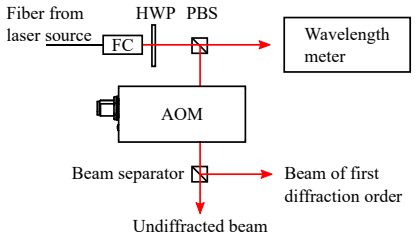
The authors present an optical element for the separation of superimposed beams which only differ in angle. The beams are angularly resolved and separated by total internal reflection at an air gap between two prisms. As a showcase application, they demonstrate the separation of superimposed beams of different diffraction orders directly behind acousto-optic modulators for an operating wavelength of 800 nm. The wavelength as well as the component size can easily be adapted to meet the requirements of a wide variety of applications. The presented optical element allows to reduce the lengths of beam paths and thus to decrease laser system size and complexity.
What carries the argument
The air gap between two prisms, where total internal reflection occurs selectively for beams above the critical angle based on their incidence angle.
If this is right
- The element separates beams that differ only by angle using total internal reflection at the air gap.
- It separates different diffraction orders from acousto-optic modulators at 800 nm.
- Wavelength and component size can be adapted for many applications.
- Beam path lengths can be reduced.
- Laser system size and complexity can be decreased.
Where Pith is reading between the lines
- The same geometry could separate other angularly close beams in setups like interferometers or multi-beam traps without extra propagation distance.
- Scaling the prisms and gap for infrared or visible wavelengths would require only matching the refractive index and critical angle condition.
- Integration into compact laser heads might eliminate separate beam dumps or long delay lines for order filtering.
Load-bearing premise
The beams must arrive with an angular difference large enough that one exceeds the critical angle for total internal reflection at the air gap while the other does not, set by the prism geometry and refractive indices.
What would settle it
A direct test would send two beams with a controlled small angular difference through the prism pair and check whether they emerge in separate paths or remain overlapped.
Figures




read the original abstract
We present an optical element for the separation of superimposed beams which only differ in angle. The beams are angularly resolved and separated by total internal reflection at an air gap between two prisms. As a showcase application, we demonstrate the separation of superimposed beams of different diffraction orders directly behind acousto-optic modulators for an operating wavelength of 800nm. The wavelength as well as the component size can easily be adapted to meet the requirements of a wide variety of applications. The presented optical element allows to reduce the lengths of beam paths and thus to decrease laser system size and complexity.
Editorial analysis
A structured set of objections, weighed in public.
Referee Report
Summary. The paper presents an optical element consisting of two prisms with an air gap that separates superimposed beams differing only in angle by exploiting total internal reflection near the critical angle at the prism-air interface. It demonstrates this principle for separating diffraction orders from an acousto-optic modulator at 800 nm and claims the design is scalable in wavelength and size to reduce beam-path lengths in laser systems.
Significance. If the separation works as described, the element provides a compact, passive means to resolve small angular differences without additional dispersive optics, which could simplify setups in laser systems. The principle follows directly from Snell's law and the definition of the critical angle, but the lack of quantitative metrics (efficiency, angular tolerance, wavelength dependence) makes it difficult to judge practical impact or advantage over existing methods.
major comments (2)
- [Abstract and demonstration section] The manuscript describes a demonstration of AOM-order separation but supplies no quantitative data, error bars, or performance metrics (e.g., measured transmission/reflection ratios, angular acceptance window, or crosstalk). This absence undermines support for the central claim of a 'highly angular resolving' separator.
- [Methods and results] No error analysis, tolerance study, or comparison to the expected critical-angle behavior (derived from the prism index and gap) is provided, leaving the load-bearing assumption that the angular separation is sufficient for one beam to TIR while the other transmits untested in the reported results.
minor comments (2)
- [Device description] Notation for the prism angles, refractive indices, and gap thickness should be defined explicitly with a diagram or equations to allow readers to reproduce the critical-angle condition.
- [Discussion] The claim that wavelength and component size 'can easily be adapted' would benefit from a brief scaling relation or example calculation.
Simulated Author's Rebuttal
We thank the referee for the detailed review and constructive comments on our manuscript. The points raised regarding the need for quantitative metrics and theoretical comparisons are valid and can be addressed through additions to the results and methods sections based on our existing experimental data and calculations. We have prepared a revised version incorporating these elements to better substantiate the claims.
read point-by-point responses
-
Referee: [Abstract and demonstration section] The manuscript describes a demonstration of AOM-order separation but supplies no quantitative data, error bars, or performance metrics (e.g., measured transmission/reflection ratios, angular acceptance window, or crosstalk). This absence undermines support for the central claim of a 'highly angular resolving' separator.
Authors: We acknowledge the absence of quantitative metrics in the original submission, which focused on demonstrating the separation principle. In the revised manuscript, we have added measured transmission and reflection ratios for the separated diffraction orders, including error bars from repeated measurements. We also include an estimate of the angular acceptance window based on the beam divergence and gap geometry, along with crosstalk levels derived from beam profile analysis. These additions provide concrete support for the angular resolution performance at 800 nm. revision: yes
-
Referee: [Methods and results] No error analysis, tolerance study, or comparison to the expected critical-angle behavior (derived from the prism index and gap) is provided, leaving the load-bearing assumption that the angular separation is sufficient for one beam to TIR while the other transmits untested in the reported results.
Authors: The referee is correct that a direct comparison to the critical-angle expectation was not explicitly shown. We have revised the methods section to include the calculation of the critical angle from the prism refractive index and air gap. Experimental results are now compared against this theoretical threshold, confirming the TIR/transmission behavior for the respective orders. A tolerance analysis addressing variations in incidence angle and wavelength has been added to the results. revision: yes
Circularity Check
No significant circularity
full rationale
The paper presents a beam separator using total internal reflection at a prism-air-gap interface to angularly resolve beams differing only by angle, as a direct application of Snell's law and the critical-angle condition. The abstract and description introduce no derivation chain, fitted parameters renamed as predictions, or self-citation load-bearing steps. The central claim is an experimental device design whose operating principle is independently verifiable from standard optics and does not reduce to its own inputs by construction.
Axiom & Free-Parameter Ledger
axioms (1)
- standard math Snell's law and conditions for total internal reflection hold for the prism and air gap interface.
Reference graph
Works this paper leans on
-
[1]
Space-borne BoseâĂŞEinstein condensation for precision interferometry,
D. Becker, M. D. Lachmann, S. T. Seidel, H. Ahlers, A. N. Din kelaker, J. Grosse, O. Hellmig, H. Müntinga, V . Schkolnik, T. Wendrich, A. Wenzlawski, B. Weps, R. Corgier, T. Franz, N. Gaaloul, W. Herr, D. Lüdtke, M. Popp, S. Amri, H. Duncker, M. Erbe, A. Kohfeldt, A. Kubelka-Lange, C. Braxmaier, E. Charron, W. Ertmer, M. Krutzik, C. Lämmerzahl, A. Peters,...
work page 2018
-
[2]
A. D. Ludlow, “An optical clock to go,” Nat. Phys. 14, 431–432 (2018)
work page 2018
-
[3]
Geodesy and metrology with a transportable optical clock,
J. Grotti, S. Koller, S. Vogt, S. Häfner, U. Sterr, C. Lisda t, H. Denker, C. Voigt, L. Timmen, A. Rolland, F. N. Baynes, H. S. Margolis, M. Zampaolo, P . Thoumany, M. Pizzocaro, B. Rauf, F. Bregolin, A. Tampellini, P . Barbieri, M. Zucco, G. A. Costanzo, C. Clivati, F. Levi, and D. Calonico , “Geodesy and metrology with a transportable optical clock,” Na...
work page 2018
-
[4]
Quantum computing with t rapped ions,
H. Häffner, C. Roos, and R. Blatt, “Quantum computing with t rapped ions,” Phys. Reports 469, 155 – 203 (2008)
work page 2008
-
[5]
Design Considerations for Acous to-Optic Devices,
E. H. Y oung and S. K. Y ao, “Design Considerations for Acous to-Optic Devices,” Proc. IEEE 69, 54–64 (1981)
work page 1981
-
[6]
Openfilters: open-source sof tware for the design, optimization, and synthesis of optical filters,
S. Larouche and L. Martinu, “Openfilters: open-source sof tware for the design, optimization, and synthesis of optical filters,” Appl. Opt. 47, C219–C230 (2008)
work page 2008
-
[7]
Ultrastable, Zerodur-based optical benches for quantum g as experiments
H. Duncker, O. Hellmig, A. Wenzlawski, A. Grote, A. J. Rafip oor, M. Rafipoor, K. Sengstock, and P . Windpassinger, “Ultrastable, Zerodur-based optical benches for quantum g as experiments.” Appl. optics 53, 4468–74 (2014)
work page 2014
-
[8]
O. Anton, K. Döringshoff, V . Schkolnik, S. Kanthak, C. Kürb is, J. Grosse, M. Elsen, A. Wenzlawski, M. Mihm, P . Windpassinger, M. Krutzik, and A. Peters, “Design of a com pact diode laser system for dual-species atom interferometry with rubidium and potassium in space,” in 2017 Conference on Lasers and Electro-Optics Pacific Rim (CLEO-PR), (2017), pp. 1–4
work page 2017
-
[9]
A com pact and robust diode laser system for atom interferometry on a sounding rocket,
V . Schkolnik, O. Hellmig, A. Wenzlawski, J. Grosse, A. Koh feldt, K. Döringshoff, A. Wicht, P . Windpassinger, K. Sengstock, C. Braxmaier, M. Krutzik, and A. Peters, “A com pact and robust diode laser system for atom interferometry on a sounding rocket,” Appl. Phys. B: Lasers Opt. 122, 217 (2016)
work page 2016
discussion (0)
Sign in with ORCID, Apple, or X to comment. Anyone can read and Pith papers without signing in.