An Accurate Fault Location Algorithm for Meshed Power Networks Utilizing Hybrid Sparse Voltage and Current Measurements
Pith reviewed 2026-05-25 13:58 UTC · model grok-4.3
The pith
Hybrid sparse voltage and current phasor measurements locate faults more accurately in meshed power networks than voltage-only or current-only methods.
A machine-rendered reading of the paper's core claim, the machinery that carries it, and where it could break.
Core claim
The authors state that an algorithm using hybrid synchronized sparse voltage and current phasor measurements determines fault locations accurately by taking the bus voltage phasor of the faulty line or a nearby line together with the branch current phasor of the adjacent line, which improves accuracy over single-measurement methods and reduces the impact of CT saturation.
What carries the argument
The hybrid measurement combination of voltage phasors at buses near the fault and current phasors on adjacent branches, applied through the known network model to solve for fault position.
If this is right
- Accuracy rises compared with voltage-only or current-only sparse methods.
- CT saturation effects are reduced.
- Performance holds across changes in fault location, resistance, and load switching.
- Results are confirmed on both a small two-area system and the IEEE 14-bus test system.
Where Pith is reading between the lines
- Existing phasor units could be combined without many new sensors to improve protection in sparse-measurement networks.
- The method might need updates if network topology changes dynamically.
- Similar hybrid data fusion could apply to other sparse-monitoring tasks such as state estimation.
Load-bearing premise
Synchronized phasor measurements exist at sparse locations near the fault and the network model and topology are known accurately enough for the hybrid equations to apply.
What would settle it
A simulation or field test showing larger location errors with the hybrid method than with the better of the two single-measurement methods under the same sparse placements would falsify the accuracy gain.
Figures
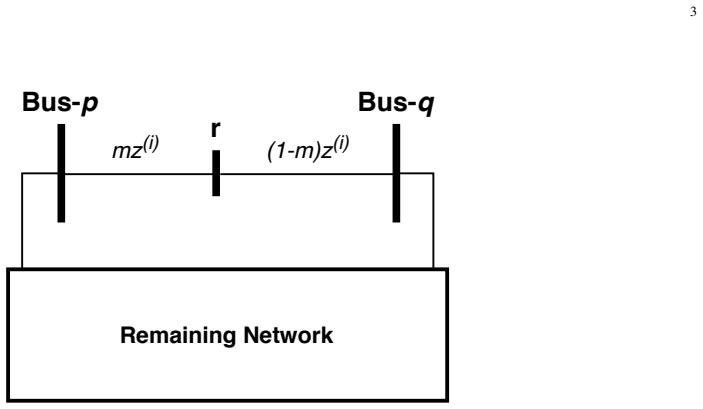
read the original abstract
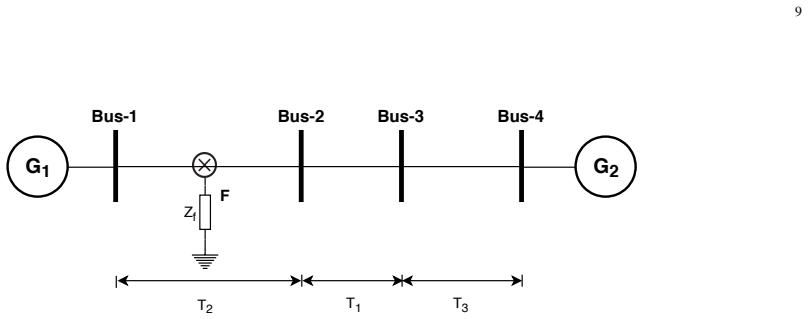
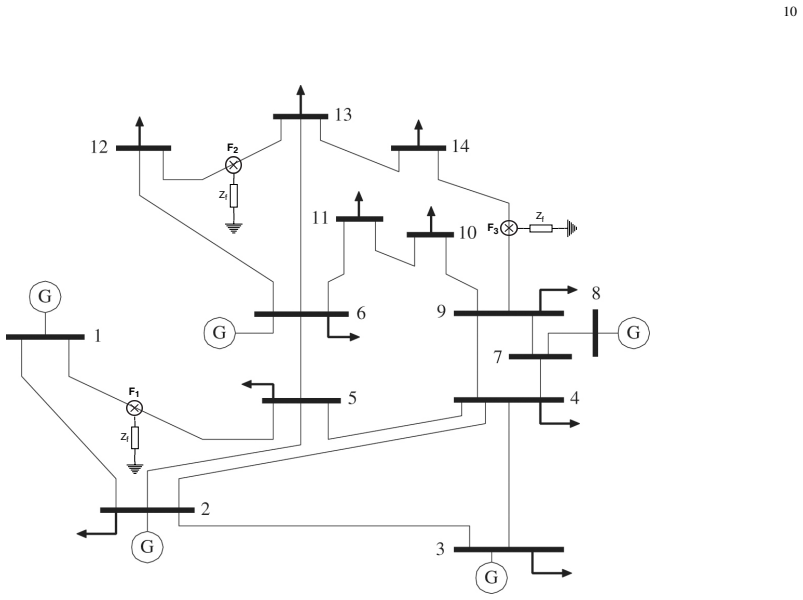
This paper proposes an accurate fault location algorithm technique based on hybrid synchronized sparse voltage and sparse current phasor measurements. The proposed algorithm addresses the performance limitation of fault location algorithms based on only synchronized sparse voltage measurements (SSVM) and on only synchronized sparse current measurements (SSCM). In the proposed method, bus voltage phasor of faulty line or close to the faulty line and branch current phasor of the adjacent line is utilized. The paper contributes to improve the accuracy of fault location and deter the effect of CT saturation by using hybrid voltage and current measurements. The proposed algorithm has been tested on four bus two area power system and IEEE 14 bus system with the typical features of an actual distribution system. The robustness of algorithm has been tested by variation in fault location, fault resistance, load switching. The simulation results demonstrate the accuracy of the proposed algorithm and ensure a reliable fault detection and location method.
Editorial analysis
A structured set of objections, weighed in public.
Referee Report
Summary. The paper proposes a fault location algorithm for meshed power networks based on hybrid synchronized sparse voltage and current phasor measurements. It claims this hybrid approach overcomes performance limitations of methods relying solely on synchronized sparse voltage measurements (SSVM) or synchronized sparse current measurements (SSCM). The method uses bus voltage phasors from the faulty line (or nearby) and branch current phasors from adjacent lines, with tests on a four-bus two-area system and IEEE 14-bus system demonstrating robustness to variations in fault location, resistance, and load switching.
Significance. If the hybrid scheme can be implemented without presupposing fault location knowledge, it would offer a practical improvement in fault location accuracy for distribution systems while reducing CT saturation effects, extending sparse measurement techniques. The simulation-based validation on standard test systems provides moderate support, but absence of quantitative error metrics or baseline comparisons limits the assessed impact.
major comments (2)
- [Abstract] Abstract: The method is described as utilizing 'bus voltage phasor of faulty line or close to the faulty line and branch current phasor of the adjacent line.' This selection presupposes knowledge of the faulted line (or its vicinity) to choose the sparse measurements, yet the fault location is the unknown the algorithm is intended to determine. In a meshed network with a fixed sparse measurement set, proximity to the actual fault cannot be guaranteed a priori, undermining the central claim that the hybrid scheme addresses the limitations of pure SSVM and SSCM.
- [Abstract] Abstract and simulation description: The paper states that 'simulation results demonstrate the accuracy' and 'robustness' but provides no specific quantitative error metrics (e.g., maximum location error in km or %), no baseline comparisons against SSVM/SSCM methods, and no full derivation details. This leaves the support for the accuracy claim moderate at best and prevents verification of the hybrid advantage.
Simulated Author's Rebuttal
We thank the referee for the detailed review and constructive comments on our manuscript. We address the major comments point by point below and propose revisions to improve clarity and support for our claims.
read point-by-point responses
-
Referee: [Abstract] Abstract: The method is described as utilizing 'bus voltage phasor of faulty line or close to the faulty line and branch current phasor of the adjacent line.' This selection presupposes knowledge of the faulted line (or its vicinity) to choose the sparse measurements, yet the fault location is the unknown the algorithm is intended to determine. In a meshed network with a fixed sparse measurement set, proximity to the actual fault cannot be guaranteed a priori, undermining the central claim that the hybrid scheme addresses the limitations of pure SSVM and SSCM.
Authors: The referee correctly identifies an ambiguity in the abstract's description. The proposed algorithm is intended to operate with a fixed, predetermined set of sparse voltage and current measurements installed throughout the meshed network. The reference to 'faulty line or close to the faulty line' indicates that the accuracy benefits from having measurements in proximity to the fault, but the algorithm does not require prior knowledge of the fault location to select or use the measurements. Instead, it processes the available hybrid measurements to solve for the fault position. We will revise the abstract to explicitly state that the measurements are from a fixed sparse set and remove any implication of fault-dependent selection. This clarification preserves the hybrid scheme's claimed advantages over pure SSVM or SSCM. revision: yes
-
Referee: [Abstract] Abstract and simulation description: The paper states that 'simulation results demonstrate the accuracy' and 'robustness' but provides no specific quantitative error metrics (e.g., maximum location error in km or %), no baseline comparisons against SSVM/SSCM methods, and no full derivation details. This leaves the support for the accuracy claim moderate at best and prevents verification of the hybrid advantage.
Authors: We agree that the abstract would benefit from including specific quantitative results to substantiate the claims of accuracy and robustness. The full manuscript presents simulation results on the four-bus two-area system and the IEEE 14-bus system, including tests under varying fault locations, resistances, and load switching. However, to strengthen the presentation, we will add explicit error metrics (such as maximum percentage errors) to the abstract and include direct comparisons with SSVM and SSCM methods in the simulation section of the revised manuscript. Regarding derivation details, the main body of the paper outlines the algorithm, but we can provide additional mathematical steps if the referee deems it necessary. revision: yes
Circularity Check
No circularity in derivation chain
full rationale
The provided abstract and description present an algorithmic technique that selects hybrid sparse voltage and current phasors near the fault to improve accuracy over pure SSVM or SSCM approaches. No equations, derivations, or self-citations are exhibited that reduce any claimed prediction or result to a fitted parameter, self-definition, or prior author result by construction. The measurement choice is stated as an input to the method rather than derived from it, and testing on IEEE systems is described as external validation. This is the common case of a self-contained algorithmic proposal with no load-bearing circular step.
Axiom & Free-Parameter Ledger
axioms (1)
- domain assumption Synchronized phasor measurements are available at sparse locations near the fault
Lean theorems connected to this paper
-
IndisputableMonolith/Foundation/RealityFromDistinction.leanreality_from_one_distinction unclear?
unclearRelation between the paper passage and the cited Recognition theorem.
The proposed algorithm addresses the performance limitation of fault location algorithms based on only synchronized sparse voltage measurements (SSVM) and on only synchronized sparse current measurements (SSCM). ... bus voltage phasor of faulty line or close to the faulty line and branch current phasor of the adjacent line
-
IndisputableMonolith/Cost/FunctionalEquation.leanwashburn_uniqueness_aczel unclear?
unclearRelation between the paper passage and the cited Recognition theorem.
Solving (12), the fault location has been derived as m = ...
What do these tags mean?
- matches
- The paper's claim is directly supported by a theorem in the formal canon.
- supports
- The theorem supports part of the paper's argument, but the paper may add assumptions or extra steps.
- extends
- The paper goes beyond the formal theorem; the theorem is a base layer rather than the whole result.
- uses
- The paper appears to rely on the theorem as machinery.
- contradicts
- The paper's claim conflicts with a theorem or certificate in the canon.
- unclear
- Pith found a possible connection, but the passage is too broad, indirect, or ambiguous to say the theorem truly supports the claim.
Reference graph
Works this paper leans on
-
[1]
Crossley PA, and Southern E, The impact of the global positioning system (GPS) on protection & control, In: Proc of 11th Int Conf on Power System ProtectionPSP , Bled,pp 15, 1998
work page 1998
-
[2]
Fardanesh B, Zelingher S, and Meliopolos, Multifunctional synchronized measurement network, IEEE Comput Appl in Power , 11(1):2630, 1998
work page 1998
-
[3]
Izykowski J, Rosolowski E, and Saha MM, Locating faults in parallel transmission lines under availability of complete measurements at one end, IEE Proc Gener Transm Distrib, 151(2):268273, 2004
work page 2004
-
[4]
Kawady T, and Stenzel J, A practical fault location approach for double circuit transmission lines using single end data, IEEE Trans on Power Deliv,18(4):11661173, 2004
work page 2004
-
[5]
Takagi T, Yamakosi Y , and Yamura M, Development of new type fault locator using the oneterminal voltage and current data, IEEE Trans on PAS, 101(8):28922898, 1981. 15 Table VII FAULT LOCATION INDEX FOR IEEE 14 B US SYSTEM Fault Type Rf (Ω) Fault location algorithm using sparse voltage measurements ( V9 & V14) Proposed Fault location algorithm (V9, I13 & ...
work page 1981
-
[6]
Zhang Q, Zhang Y , and Song W, Transmission line fault location for phase-to-earth fault using one-terminal data, IEE Proc Gener Transm Distrib, 146(2):121124, 1999
work page 1999
-
[7]
Zhang Q, Zhang Y , and Song W, Fault location of two-parallel transmission line for non-earth fault using one-terminal data, IEEE Trans on Power Deliv, 14(3):863867, 1999
work page 1999
-
[8]
Zhang Y , Zhang Q, and Song W, Transmission line fault location for double phaseto-earth fault on non-direct-ground neutral system, IEEE Trans on Power Deliv, 15(2):520524, 1999
work page 1999
-
[9]
Eriksson L, Saha MM, and Rockefeller GD, An accurate fault locator with compensation for apparent reactance in the fault resistance resulting from remote end infeed, IEEE Trans on PAS, 104(2):424–436,1985
work page 1985
-
[10]
Jiang J-A, Lin Y-H, and Yang J-Z, An adaptive PMU based fault detection/location technique for transmission lines - Part II: PMU implementation and performance evaluation, IEEE Trans on Power Deliv, 15(4):11361146, 2000
work page 2000
-
[11]
Jiang J-A, Lin Y-H, and Yang J-Z, An adaptive PMU based fault detection/location technique for transmission lines - Part I: Theory and algorithms, IEEE Trans on Power Deliv, 15(2):486493, 2000. 16
work page 2000
-
[12]
Johns AT, and Jamali S, Accurate fault location technique for power transmission lines, IEE Proc C, 137(6):395402, 1990
work page 1990
-
[13]
Kezunovic M, Mrkic J, and Perunicic B, An accurate fault location algorithm using synchronized sampling, Electr Power Syst, Res 29(3):161169, 1994
work page 1994
-
[14]
Kezunovic M, and Perunicic B, Automated transmission line fault analysis using synchronized sampling at two ends, IEEE Trans on Power Syst, 11(1):441447, 1996
work page 1996
-
[15]
Lin Y-H, Liu C-W, and Chen C-S, A new PMU-based fault detection/location technique for transmission lines with consideration of arcing fault discrimination-part I: theory and algorithms, IEEE Trans on Power Deliv, 19(4):15871593, 2004
work page 2004
-
[16]
Lin Y-H, Liu C-W, and Yu C-S, A new fault locator for three-terminal transmission linesusing two-terminal synchronized voltage and current phasors, IEEE Trans on Power Deliv, 17(2):452459, 2002
work page 2002
-
[17]
Girgis AA, Hart DG, and Peterson WL, A new fault location technique for two- and three-terminal lines, IEEE Trans on Power Deliv, 7(1):98–107, 1992
work page 1992
-
[18]
Kezunovic M, and Perunicic B, Automated transmission line fault analysis using synchronized sampling at two ends, IEEE Trans on Power Syst, 11(1):441–447, 1996
work page 1996
-
[19]
M.B. Djuri6, Z.M. Radojevi6 and V .V . Terzija, Distance Protection and Fault Location Utilizing Only Phase Current Phasors, IEEE Transactions on Power Delivery, V ol. 13, No. 4, October 1998
work page 1998
-
[20]
Brahma SM Fault location scheme for a multi-terminal transmission line using synchronized voltage measurements, IEEE Trans on Power Deliv, 20(2):1325–1331, 2005
work page 2005
-
[21]
Brahma SM, and Girgis AA, Fault location on a transmission line using synchronized voltage measurements, IEEE Trans on Power Deliv,19(4):1619–1622, 2004
work page 2004
-
[22]
Z. I, M. JF, and M. AJ, Fault location on two-terminal transmis-sion lines based on voltages, in IEE Proc Gener Transm Distrib, vol. 143, pp. 1-6, 1996
work page 1996
-
[23]
Tziouvaras DA, Roberts J, Benmouyal G, New multi-ended fault location design for two- or three-terminal lines, Proc of 7th Int Conf on Developments in Power System Protection DPSP , IEE CP476 pp 395398, 2001
work page 2001
-
[24]
Proc of CIGRE Study Committee 34 Colloquium and Meeting, Florence, paper 213,1999
Tziouvaras DA, Roberts J, Benmouyal G, New multi-ended fault location design for two- or three-terminal lines. Proc of CIGRE Study Committee 34 Colloquium and Meeting, Florence, paper 213,1999
work page 1999
-
[25]
Yuan Liao, Fault Location for Single-Circuit Line Based on Bus-Impedance Matrix Utilizing V oltage Measurements, IEEE TRANSACTIONS ON POWER DELIVERY, VOL. 23, NO. 2, APRIL 2008
work page 2008
-
[26]
A. Ali, A. Q. Khan, B. Hussain, M. T. Raza and M. Arif, ”Fault modelling and detection in power generation, transmission and distribution systems,” in IET Generation, Transmission & Distribution , vol. 9, no. 16, pp. 2782-2791, 3 12 2015
work page 2015
-
[27]
Abdul Qayyum Khan, Qudrat Ullah, Muhammad Sarwar, Sufi Tabassum Gul, Naeem Iqbal, Transmission Line Fault Detection and Identification in an Interconnected Power Network using Phasor Measurement Units, IF AC-PapersOnLine, V olume 51, Issue 24, 2018, Pages 1356-1363, ISSN 2405-8963
work page 2018
-
[28]
Y . Liao, Fault location using sparse current measurements, In NAPS 2007, Las Cruces, New Mexico, USA, September 2007
work page 2007
-
[29]
K. Takahashi, J. Fagan, and M. Chen, Formation of a sparse bus impedance matrix and its application to short circuit study, in Proc.8th PICA Conf. , Minneapolis, MN, Jun. 4–6, 1973, pp. 63–69
work page 1973
-
[30]
Murari Mohan Saha ,Jan Izykowski, and Eugeniusz Rosolowski, Fault Location on Power Networks, Springer-V erlag,London Limited 2010
work page 2010
-
[31]
JUN ZHU, Analysis of Transmission System Faults in the Phase Domain, B.S, Shanghai Jiaotong University 2004
work page 2004
discussion (0)
Sign in with ORCID, Apple, or X to comment. Anyone can read and Pith papers without signing in.