Reverse engineering neural networks from many partial recordings
Pith reviewed 2026-05-25 10:12 UTC · model grok-4.3
The pith
A neural network can be reverse-engineered from partial recordings of far fewer neurons than the total number.
A machine-rendered reading of the paper's core claim, the machinery that carries it, and where it could break.
Core claim
Reverse engineering of the nonlinear neural network is meaningfully possible if a sufficiently large number of neurons is simultaneously recorded but that this number can be considerably smaller than the number of neurons. Moreover, recording many times from small random subsets of neurons yields surprisingly good performance. Application in neuroscience suggests to approximate the I/O function of an actual neural system, we need to record from a much larger number of neurons. The kind of scaling analysis we perform here can, and arguably should be used to calibrate approaches that can dramatically scale up the size of recorded data sets in neuroscience.
What carries the argument
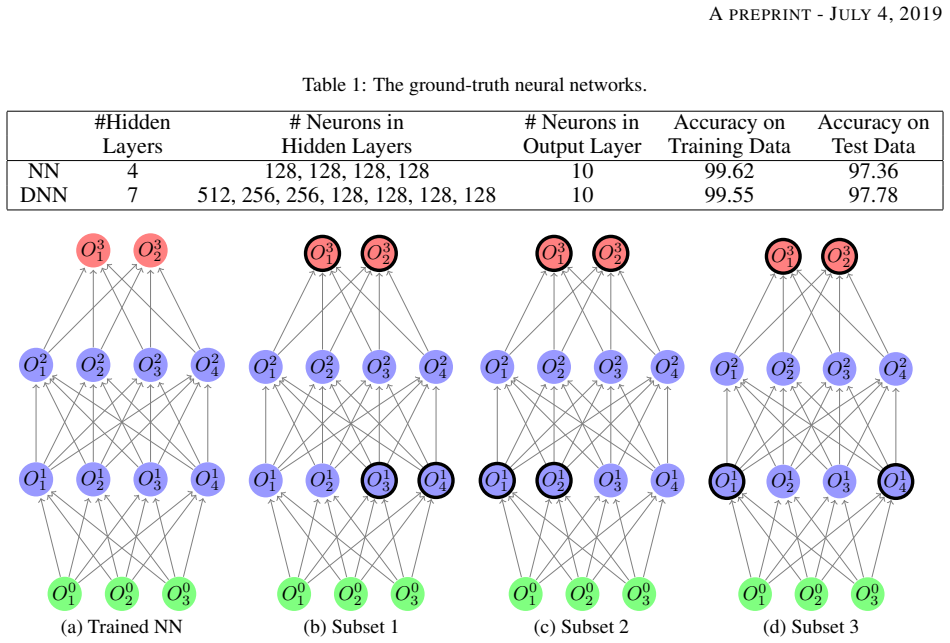
Scaling analysis of reverse-engineering quality versus the number of simultaneously recorded neurons, using an MNIST-trained artificial neural network as the test system.
If this is right
- A number of simultaneously recorded neurons considerably smaller than the total already permits meaningful recovery of the network's input-output function.
- Repeating recordings on many different small random subsets produces performance close to that of larger simultaneous recordings.
- Approximating the input-output function of a biological neural system requires recording from a much larger number of neurons than is typical today.
- Scaling analyses of this form should be used to decide how to allocate effort when designing larger-scale recording experiments.
Where Pith is reading between the lines
- Neuroscientists could design experiments that deliberately sample many overlapping small subsets rather than pursuing simultaneous coverage of the entire population.
- Optical techniques that repeatedly target chosen subsets of neurons may be sufficient for functional reconstruction if the sampling is dense enough across sessions.
- The same scaling logic could be applied to other model systems, such as recurrent networks or networks trained on different tasks, to test whether the partial-recording advantage generalizes.
Load-bearing premise
An artificial neural network trained on MNIST provides a representative test case for the challenges of reverse-engineering biological neural systems from partial recordings.
What would settle it
Applying the identical partial-recording protocol to a real neural circuit whose full connectivity and input-output behavior are independently known and finding that the recovered function deviates substantially even when many neurons are recorded.
Figures


read the original abstract
Much of neuroscience aims at reverse engineering the brain, but we only record a small number of neurons at a time. We do not currently know if reverse engineering the brain requires us to simultaneously record most neurons or if multiple recordings from smaller subsets suffice. This is made even more important by the development of novel techniques that allow recording from selected subsets of neurons, e.g. using optical techniques. To get at this question, we analyze a neural network, trained on the MNIST dataset, using only partial recordings and characterize the dependency of the quality of our reverse engineering on the number of simultaneously recorded "neurons". We find that reverse engineering of the nonlinear neural network is meaningfully possible if a sufficiently large number of neurons is simultaneously recorded but that this number can be considerably smaller than the number of neurons. Moreover, recording many times from small random subsets of neurons yields surprisingly good performance. Application in neuroscience suggests to approximate the I/O function of an actual neural system, we need to record from a much larger number of neurons. The kind of scaling analysis we perform here can, and arguably should be used to calibrate approaches that can dramatically scale up the size of recorded data sets in neuroscience.
Editorial analysis
A structured set of objections, weighed in public.
Referee Report
Summary. The manuscript analyzes reverse engineering of the input-output function of a feedforward neural network (784-256-10 architecture) trained on MNIST, using only partial recordings of its units. It reports that meaningful reverse engineering is possible when a sufficiently large but sub-total number of units is recorded simultaneously, and that repeated recordings from small random subsets can also yield good performance. The work concludes with a suggestion that similar scaling analyses should be used to calibrate the number of neurons that must be recorded in biological systems.
Significance. If the scaling relations hold beyond the specific architecture tested, the paper supplies a concrete, quantitative example of how partial-recording strategies can be evaluated, which could help experimentalists decide between simultaneous large-population recordings and repeated smaller-subset recordings when approximating neural I/O functions.
major comments (2)
- [Methods and Results (simulation setup and scaling experiments)] The load-bearing assumption that results obtained on a static, acyclic, feedforward network with MNIST inputs generalize to biological circuits is not tested. The manuscript contains no ablation or comparison network that introduces recurrence, continuous-time dynamics, or high-dimensional naturalistic inputs whose unobserved variables affect the recorded subset; without such controls the claim that 'recording many times from small random subsets yields surprisingly good performance' may be architecture-specific rather than a general property of nonlinear networks.
- [Abstract and Results] The quantitative definition of 'quality of reverse engineering' (including the precise loss or reconstruction metric, error bars, and data-exclusion criteria) is not supplied in sufficient detail to allow independent verification of the reported scaling; the abstract states the main finding but the supporting figures and tables must be checked against these omissions.
minor comments (1)
- [Abstract] The abstract would benefit from a one-sentence statement of the network architecture and the exact performance metric used.
Simulated Author's Rebuttal
We thank the referee for the constructive comments. We address each major point below and indicate the revisions we will make.
read point-by-point responses
-
Referee: [Methods and Results (simulation setup and scaling experiments)] The load-bearing assumption that results obtained on a static, acyclic, feedforward network with MNIST inputs generalize to biological circuits is not tested. The manuscript contains no ablation or comparison network that introduces recurrence, continuous-time dynamics, or high-dimensional naturalistic inputs whose unobserved variables affect the recorded subset; without such controls the claim that 'recording many times from small random subsets yields surprisingly good performance' may be architecture-specific rather than a general property of nonlinear networks.
Authors: We agree that the reported results are obtained on one specific feedforward architecture and that no ablations introducing recurrence or continuous-time dynamics were performed. The work is presented as a controlled proof-of-concept on a fully known, acyclic network to isolate the effect of partial recordings. The manuscript does not assert that the scaling relations are universal; it concludes by recommending that analogous scaling analyses be performed on biological data. We will revise the Discussion to explicitly qualify the architectural assumptions and to note that recurrence or unobserved inputs could alter the observed scaling. No new simulations will be added. revision: partial
-
Referee: [Abstract and Results] The quantitative definition of 'quality of reverse engineering' (including the precise loss or reconstruction metric, error bars, and data-exclusion criteria) is not supplied in sufficient detail to allow independent verification of the reported scaling; the abstract states the main finding but the supporting figures and tables must be checked against these omissions.
Authors: We will expand the Methods section to state the precise metric (test-set classification accuracy of the recovered network), the loss used during recovery (cross-entropy), how error bars are obtained (standard deviation across five independent random seeds), and the absence of any data-exclusion criteria. Cross-references from the Results and abstract to these details will be added so that the scaling curves can be reproduced. revision: yes
Circularity Check
No circularity; claims rest on independent simulation outcomes
full rationale
The paper's central results derive from running a trained feedforward network on MNIST inputs and measuring reconstruction quality under varying partial-recording regimes. No equation, parameter fit, or uniqueness claim reduces the reported scaling to a definition or self-citation by construction. The simulation is externally falsifiable (different architectures, inputs, or recording strategies can be substituted) and contains no load-bearing self-citations. This is the normal case of a self-contained empirical study.
Axiom & Free-Parameter Ledger
Lean theorems connected to this paper
-
IndisputableMonolith/Cost/FunctionalEquation.leanwashburn_uniqueness_aczel unclear?
unclearRelation between the paper passage and the cited Recognition theorem.
We train ANNs on the MNIST dataset... estimate the I/O function... RMSE as a function of the observed subset size
-
IndisputableMonolith/Foundation/DimensionForcing.leanalexander_duality_circle_linking unclear?
unclearRelation between the paper passage and the cited Recognition theorem.
recording many times from small random subsets of neurons yields surprisingly good performance
What do these tags mean?
- matches
- The paper's claim is directly supported by a theorem in the formal canon.
- supports
- The theorem supports part of the paper's argument, but the paper may add assumptions or extra steps.
- extends
- The paper goes beyond the formal theorem; the theorem is a base layer rather than the whole result.
- uses
- The paper appears to rely on the theorem as machinery.
- contradicts
- The paper's claim conflicts with a theorem or certificate in the canon.
- unclear
- Pith found a possible connection, but the passage is too broad, indirect, or ambiguous to say the theorem truly supports the claim.
Reference graph
Works this paper leans on
-
[1]
Spatio-temporal correlations and visual signalling in a complete neuronal population
Jonathan W Pillow, Jonathon Shlens, Liam Paninski, Alexander Sher, Alan M Litke, EJ Chichilnisky, and Eero P Simoncelli. Spatio-temporal correlations and visual signalling in a complete neuronal population. Nature, 454 (7207):995–999, 2008
work page 2008
-
[2]
Computational models in the age of large datasets
Timothy O’Leary, Alexander C Sutton, and Eve Marder. Computational models in the age of large datasets. Current opinion in neurobiology, 32:87–94, 2015
work page 2015
-
[3]
M Ballini, J Mueller, P Livi, Y Chen, U Frey, A Shadmani, IL Jones, W Gong, M Fiscella, M Radivojevic, et al. A 1024-channel cmos microelectrode-array system with 26’400 electrodes for recording and stimulation of electro-active cells in-vitro. In VLSI Circuits (VLSIC), 2013 Symposium on , pages C54–C55. IEEE, 2013
work page 2013
-
[4]
Imaging in vivo: watching the brain in action
Jason ND Kerr and Winfried Denk. Imaging in vivo: watching the brain in action. Nature Reviews Neuroscience, 9(3):195–205, 2008
work page 2008
-
[5]
Christine Grienberger and Arthur Konnerth. Imaging calcium in neurons. Neuron, 73(5):862–885, 2012
work page 2012
- [6]
-
[7]
Neural characterization in partially observed populations of spiking neurons
Jonathan W Pillow and Peter E Latham. Neural characterization in partially observed populations of spiking neurons. In NIPS, pages 1161–1168, 2007. 8 A PREPRINT - J ULY 4, 2019
work page 2007
-
[8]
Linear readout from a neural population with partial correlation data
Adrien Wohrer, Ranulfo Romo, and Christian K Machens. Linear readout from a neural population with partial correlation data. In Advances in Neural Information Processing Systems , pages 2469–2477, 2010
work page 2010
-
[9]
Inferring neural population dynamics from multiple partial recordings of the same neural circuit
Srini Turaga, Lars Buesing, Adam M Packer, Henry Dalgleish, Noah Pettit, Michael Hausser, and Jakob Macke. Inferring neural population dynamics from multiple partial recordings of the same neural circuit. In Advances in Neural Information Processing Systems, pages 539–547, 2013
work page 2013
-
[10]
Automatic discovery of cell types and microcircuitry from neural connectomics
Eric Jonas and Konrad Kording. Automatic discovery of cell types and microcircuitry from neural connectomics. ELife, 4:e04250, 2015
work page 2015
-
[11]
Could a neuroscientist understand a microprocessor? PLOS Computational Biology, 13(1):e1005268, 2017
Eric Jonas and Konrad Paul Kording. Could a neuroscientist understand a microprocessor? PLOS Computational Biology, 13(1):e1005268, 2017
work page 2017
-
[12]
Analysis of neural networks with redundancy
Yoshio Izui and Alex Pentland. Analysis of neural networks with redundancy. Neural Comput., 2(2):226–238, April 1990. ISSN 0899-7667. doi: 10.1162/neco.1990.2.2.226. URL http://dx.doi.org/10.1162/neco. 1990.2.2.226
-
[13]
Predicting parameters in deep learning
Misha Denil, Babak Shakibi, Laurent Dinh, Nando de Freitas, et al. Predicting parameters in deep learning. In Advances in Neural Information Processing Systems , pages 2148–2156, 2013
work page 2013
-
[14]
Yu Cheng, Felix X. Yu, Rogerio S. Feris, Sanjiv Kumar, Alok Choudhary, and Shi-Fu Chang. An exploration of parameter redundancy in deep networks with circulant projections. In The IEEE International Conference on Computer Vision (ICCV), December 2015
work page 2015
-
[15]
Distilling the knowledge in a neural network
Geoffrey Hinton, Oriol Vinyals, and Jeff Dean. Distilling the knowledge in a neural network. In In Deep Learning and Representation Learning Workshop, NIPS, 2015
work page 2015
-
[16]
Donald B Rubin. Inference and missing data. Biometrika, pages 581–592, 1976
work page 1976
-
[17]
Multiple imputation after 18+ years
Donald B Rubin. Multiple imputation after 18+ years. Journal of the American statistical Association , 91(434): 473–489, 1996
work page 1996
-
[18]
Spectral regularization algorithms for learning large incomplete matrices
Rahul Mazumder, Trevor Hastie, and Robert Tibshirani. Spectral regularization algorithms for learning large incomplete matrices. Journal of machine learning research, 11(Aug):2287–2322, 2010
work page 2010
-
[19]
Constraint-based causal discovery from multiple interventions over overlapping variable sets
Sofia Triantafillou and Ioannis Tsamardinos. Constraint-based causal discovery from multiple interventions over overlapping variable sets. Journal of Machine Learning Research, 16:2147–2205, 2015
work page 2015
-
[20]
Statistical matching: Theory and practice
Marcello D’Orazio, Marco Di Zio, and Mauro Scanu. Statistical matching: Theory and practice . John Wiley & Sons, 2006
work page 2006
-
[21]
Xgboost: A scalable tree boosting system
Tianqi Chen and Carlos Guestrin. Xgboost: A scalable tree boosting system. In Proceedings of the 22Nd ACM SIGKDD International Conference on Knowledge Discovery and Data Mining , pages 785–794. ACM, 2016
work page 2016
-
[22]
Statistical assessment of the stability of neural movement representations
Ian H Stevenson, Anil Cherian, Brian M London, Nicholas A Sachs, Eric Lindberg, Jacob Reimer, Marc W Slutzky, Nicholas G Hatsopoulos, Lee E Miller, and Konrad P Kording. Statistical assessment of the stability of neural movement representations. Journal of neurophysiology, 106(2):764–774, 2011. 9
work page 2011
discussion (0)
Sign in with ORCID, Apple, or X to comment. Anyone can read and Pith papers without signing in.