On induced saturation for paths
Pith reviewed 2026-05-24 22:51 UTC · model grok-4.3
The pith
P_{3n}-induced-saturated graphs exist for every positive integer n.
A machine-rendered reading of the paper's core claim, the machinery that carries it, and where it could break.
Core claim
There exists a P_{3n}-induced-saturated graph for every positive integer n. The Kneser graph K(n,2) is P_6-induced-saturated for every n≥5.
What carries the argument
Explicit constructions of graphs that contain no induced P_{3n} yet become induced-saturated under any single edge change.
If this is right
- P_k-induced-saturated graphs exist whenever k is a multiple of 3.
- For each fixed multiple of 3 there are infinitely many distinct examples.
- Kneser graphs K(n,2) supply an infinite family of P_6-induced-saturated graphs.
Where Pith is reading between the lines
- The same style of construction may extend to other arithmetic progressions of path lengths.
- Induced saturation for paths appears possible for all sufficiently large k.
- The Kneser examples suggest that strongly regular graphs could serve as witnesses for additional path lengths.
Load-bearing premise
The given constructions contain no induced copy of the target path, and every edge addition or removal creates one.
What would settle it
An explicit counterexample showing that K(5,2) contains an induced P_6, or a proof that no P_{3n}-induced-saturated graph exists for some n.
Figures


read the original abstract
For a graph $H$, a graph $G$ is $H$-induced-saturated if $G$ does not contain an induced copy of $H$, but either removing an edge from $G$ or adding a non-edge to $G$ creates an induced copy of $H$. Depending on the graph $H$, an $H$-induced-saturated graph does not necessarily exist. In fact, Martin and Smith (2012) showed that $P_4$-induced-saturated graphs do not exist, where $P_k$ denotes a path on $k$ vertices. Axenovich and Csik\'{o}s (2019) asked the existence of $P_k$-induced-saturated graphs for $k \ge 5$; it is easy to construct such graphs when $k\in\{2, 3\}$. Recently, R\"{a}ty constructed a graph that is $P_6$-induced-saturated. In this paper, we show that there exists a $P_{k}$-induced-saturated graph for infinitely many values of $k$. To be precise, we find a $P_{3n}$-induced-saturated graph for every positive integer $n$. As a consequence, for each positive integer $n$, we construct infinitely many $P_{3n}$-induced-saturated graphs. We also show that the Kneser graph $K(n,2)$ is $P_6$-induced-saturated for every $n\ge 5$.
Editorial analysis
A structured set of objections, weighed in public.
Referee Report
Summary. The paper proves existence results for induced saturation with respect to paths. It constructs, for every positive integer n, a graph G that is P_{3n}-induced-saturated (contains no induced P_{3n} but every edge addition or deletion creates one) and shows that there are in fact infinitely many such graphs for each n. Separately, it proves that the Kneser graph K(n,2) is P_6-induced-saturated for all n≥5.
Significance. The result affirmatively answers the existence question of Axenovich and Csikós for all path lengths that are multiples of 3, supplying explicit constructions rather than non-constructive arguments. The Kneser-graph family supplies an infinite concrete family of P_6-induced-saturated graphs. These are the first known constructions for any k>6 and therefore constitute a substantive contribution to the theory of induced saturation.
minor comments (3)
- §1, paragraph following the definition of induced saturation: the sentence 'Depending on the graph H, an H-induced-saturated graph does not necessarily exist' would benefit from a forward reference to the Martin-Smith non-existence result for P_4 so that readers immediately see the contrast with the positive results proved later.
- The statement that 'we construct infinitely many P_{3n}-induced-saturated graphs' for each n appears both in the abstract and in the introduction; a single consolidated statement with a precise theorem number would avoid repetition.
- Notation for the constructed graphs (presumably defined in §3 or §4) should be introduced once with a clear label so that later references to 'the graph G_n' are unambiguous.
Simulated Author's Rebuttal
We thank the referee for their positive summary of our work and for recommending minor revision. The report correctly identifies the main contributions: explicit constructions of P_{3n}-induced-saturated graphs for every n, the infinitude result for each such n, and the infinite family of Kneser graphs K(n,2) that are P_6-induced-saturated for n≥5. No specific major comments were raised in the report.
Circularity Check
No significant circularity identified
full rationale
The paper proves existence of P_{3n}-induced-saturated graphs for every n via explicit constructions, plus a direct verification that Kneser graphs K(n,2) satisfy the P_6-induced-saturation property for n≥5. These rest on case-by-case checks that the graphs contain no induced copy of the target path but every edge addition or deletion creates one. No self-definitional reductions, fitted inputs renamed as predictions, or load-bearing self-citations appear; the cited prior results (Martin-Smith, Axenovich-Csikós, Ráty) are external and non-overlapping with the present authors. The derivation chain is therefore self-contained against external benchmarks and does not reduce to its own inputs by construction.
Axiom & Free-Parameter Ledger
axioms (1)
- standard math Standard axioms and definitions of simple undirected graphs, induced subgraphs, and paths.
Reference graph
Works this paper leans on
-
[1]
M. Axenovich and M. Csik´ os. Induced saturation of graphs.Discrete Math., 342(4):1195–1212, 2019
work page 2019
-
[2]
S. Behrens, C. Erbes, M. Santana, D. Yager, and E. Yeager. Graphs with induced-saturation number zero. Electron. J. Combin., 23(1):Paper 1.54, 23, 2016
work page 2016
-
[3]
B. Ergemlidze, E. Gy˝ ori, and A. Methuku. Tur´ an number of an induced complete bipartite graph plus an odd cycle. Combin. Probab. Comput., 28(2):241–252, 2019
work page 2019
-
[4]
P. Erd˝ os, A. Hajnal, and J. W. Moon. A problem in graph theory. Amer. Math. Monthly , 71:1107– 1110, 1964
work page 1964
-
[5]
P. Erd˝ os and M. Simonovits. A limit theorem in graph theory. Studia Sci. Math. Hungar , 1:51–57, 1966
work page 1966
-
[6]
P. Erd˝ os and A. H. Stone. On the structure of linear graphs. Bull. Amer. Math. Soc. , 52:1087–1091, 1946
work page 1946
-
[7]
J. R. Faudree, R. J. Faudree, and J. R. Schmitt. A survey of minimum saturated graphs. Electron. J. Combin., 18, 2011
work page 2011
-
[8]
Z. F¨ uredi and M. Simonovits. The history of degenerate (bipartite) extremal graph problems. L. Lov´ asz, I. Z. Ruzsa, V. T. S´ os (eds) Erd˝ os Centennial. Bolyai Society Mathematical Studies., 25:169– 264, 2013. 12
work page 2013
-
[9]
P.-S. Loh, M. Tait, C. Timmons, and R. M. Zhou. Induced Tur´ an numbers. Combin. Probab. Comput., 27(2):274–288, 2018
work page 2018
-
[10]
W. Mantel. Problem 28 (Solution by H. Gouwentak, W. Mantel, J. Teixeira de Mattes, F. Schuh and W. A. Wythoff). Wiskundige Opgaven, 10:60–61, 1907
work page 1907
-
[11]
R. R. Martin and J. J. Smith. Induced saturation number. Discrete Math., 312(21):3096–3106, 2012
work page 2012
-
[12]
H. J. Pr¨ omel and A. Steger. Excluding induced subgraphs. II. Extremal graphs. Discrete Appl. Math., 44(1-3):283–294, 1993
work page 1993
-
[13]
E. R¨ aty. Induced saturation ofP6. arXiv e-prints, page arXiv:1901.09801, Jan 2019
work page internal anchor Pith review Pith/arXiv arXiv 1901
-
[14]
P. Tur´ an. On the theory of graphs. Colloquium Math., 3:19–30, 1954
work page 1954
-
[15]
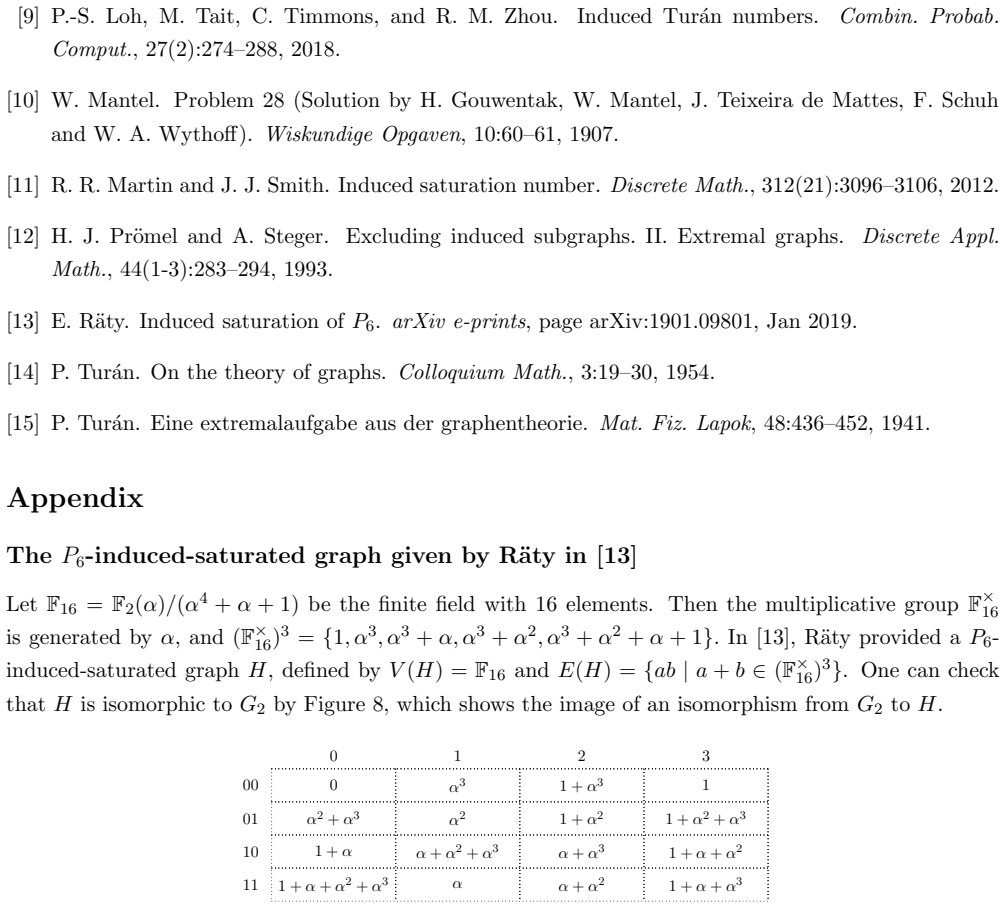
P. Tur´ an. Eine extremalaufgabe aus der graphentheorie. Mat. Fiz. Lapok, 48:436–452, 1941. Appendix The P6-induced-saturated graph given by R¨ aty in [13] Let F16 = F2(α)/(α4 +α + 1) be the finite field with 16 elements. Then the multiplicative group F× 16 is generated by α, and ( F× 16)3 ={1,α 3,α 3 +α,α 3 +α2,α 3 +α2 +α + 1}. In [13], R¨ aty provided aP6...
work page 1941
discussion (0)
Sign in with ORCID, Apple, or X to comment. Anyone can read and Pith papers without signing in.