Evolution of Incommensurate Superstructure and Electronic Structure with Pb Substitution in (Bi_(2-x)Pb_(x))Sr₂CaCu₂O_(8+δ) Superconductors
Pith reviewed 2026-05-24 22:10 UTC · model grok-4.3
The pith
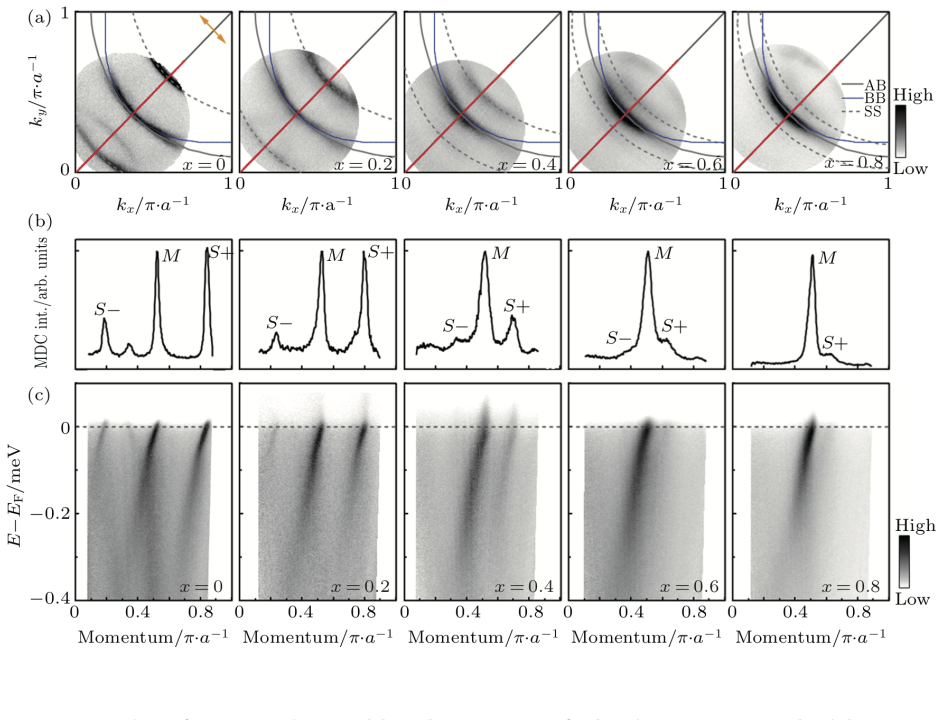
Pb substitution nearly eliminates the incommensurate superstructure in Bi2212 at x=0.8.
A machine-rendered reading of the paper's core claim, the machinery that carries it, and where it could break.
Core claim
The incommensurate modulation vector Q decreases with increasing Pb substitution while the superstructure intensity measured by ARPES drops dramatically, so that the superstructure nearly disappears at x=0.8.
What carries the argument
the incommensurate modulation vector Q tracked by TEM and photon-energy-dependent ARPES intensity
If this is right
- The superstructure can be suppressed in a controlled way by choosing the Pb level.
- At x=0.8 the superstructure is essentially removed from the Bi2212 lattice.
- ARPES intensity from the superstructure can exceed the main band at certain photon energies such as 10.897 eV.
- Photon energy selection offers an experimental knob to emphasize or suppress the superstructure signal.
Where Pith is reading between the lines
- Removing the superstructure may allow cleaner measurement of the intrinsic electronic bands without modulation-induced replicas.
- The strong photon-energy dependence hints that the superstructure involves specific out-of-plane orbital character that can be tuned by matrix-element effects.
- Similar Pb substitution strategies might be tested in other bismuth cuprates to isolate the role of the modulation in pairing.
Load-bearing premise
The changes in modulation vector and ARPES intensity are produced by the added Pb rather than by uncontrolled differences in oxygen content or crystal quality.
What would settle it
Independent determination of oxygen stoichiometry across the full substitution series, or growth of additional crystals with fixed oxygen content, to test whether Q still decreases with Pb.
Figures



read the original abstract
High-quality Bi$_{2-x}$Pb$_{x}$Sr$_2$CaCu$_2$O$_{8+\delta}$ (Bi2212) single crystals have been successfully grown by the traveling solvent floating zone technique with a wide range of Pb substitution ($x=0-0.8$). The samples are characterized by transmission electron microscope (TEM) and measured by high resolution laser-based angle-resolved photoemission spectroscopy (ARPES) with different photon energies. A systematic evolution of the electronic structure and superstructure with Pb substitution has been revealed for the first time. The superstructure shows a significant change with Pb substitution and the incommensurate modulation vector ($\textbf{Q}$) decreases with increasing Pb substitution. In the meantime, the superstructure intensity from ARPES measurements also decreases dramatically with increasing Pb concentration. The superstructure in Bi2212 can be effectively suppressed by Pb substitution and it nearly disappears with a Pb substitution of $x=0.8$. We also find that the superstructure bands in ARPES measurements depend sensitively on the photon energy of lasers used; they can become even stronger than the main band when using a laser photon energy of 10.897 eV. These results provide important information on the origin of the incommensurate superstructure and its control and suppression in bismuth-based high temperature superconductors.
Editorial analysis
A structured set of objections, weighed in public.
Referee Report
Summary. The manuscript reports successful growth of high-quality (Bi_{2-x}Pb_x)Sr_2CaCu_2O_{8+δ} single crystals (x=0–0.8) by the traveling solvent floating zone technique. TEM and high-resolution laser ARPES measurements at multiple photon energies reveal a systematic decrease in the incommensurate modulation vector Q with increasing Pb content, a dramatic reduction in ARPES superstructure intensity, and near-complete suppression of the superstructure at x=0.8. The work also notes strong photon-energy dependence of the superstructure bands in ARPES.
Significance. If the suppression of the incommensurate superstructure is shown to be due to Pb substitution independent of oxygen content, the results would provide a practical route to control and eliminate this modulation in Bi2212, enabling cleaner ARPES studies of the underlying electronic structure and new constraints on the origin of the modulation. The reported photon-energy sensitivity of the superstructure intensity would also be useful for experimental design.
major comments (1)
- [Sample preparation and characterization sections] Sample preparation and characterization sections: no measurements of oxygen stoichiometry δ (via titration, TGA, or equivalent) or a uniform post-growth annealing protocol are reported for the x=0–0.8 series. Because the modulation vector Q and superstructure intensity are known to vary sensitively with excess oxygen δ, the central claim that Pb substitution alone drives the observed suppression of Q and ARPES intensity cannot be isolated from possible systematic changes in δ.
Simulated Author's Rebuttal
We thank the referee for the positive assessment of the significance and for highlighting the need to address oxygen stoichiometry. We respond to the single major comment below.
read point-by-point responses
-
Referee: Sample preparation and characterization sections: no measurements of oxygen stoichiometry δ (via titration, TGA, or equivalent) or a uniform post-growth annealing protocol are reported for the x=0–0.8 series. Because the modulation vector Q and superstructure intensity are known to vary sensitively with excess oxygen δ, the central claim that Pb substitution alone drives the observed suppression of Q and ARPES intensity cannot be isolated from possible systematic changes in δ.
Authors: We agree that explicit measurement of δ (e.g., by titration) is absent and would strengthen isolation of the Pb effect. All crystals were grown by the same TSFZ method and received identical post-growth annealing; this protocol is now stated explicitly in a revised Sample Preparation section. We also add a paragraph in the Discussion noting that Pb substitution is known to alter oxygen uptake and that residual δ variations cannot be fully excluded without titration data. The observed monotonic trend in Q and ARPES intensity across x=0–0.8 remains consistent with Pb as the dominant control parameter, but we acknowledge the caveat. revision: partial
Circularity Check
Pure experimental report with no derivations or predictions
full rationale
This paper is an observational experimental study reporting crystal growth by TSFZ, TEM imaging, and ARPES spectra on Bi_{2-x}Pb_xSr_2CaCu_2O_{8+δ} samples for x=0-0.8. The central claims (decrease in incommensurate modulation vector Q, suppression of superstructure intensity, near disappearance at x=0.8) are stated as direct results of the measurements. No equations, ansatze, fitted parameters renamed as predictions, uniqueness theorems, or derivation steps appear in the abstract or described content. All reported trends are empirical observations without any reduction to inputs by construction, self-citation load-bearing arguments, or renaming of known results. The paper is therefore self-contained against external benchmarks with score 0.
Axiom & Free-Parameter Ledger
Reference graph
Works this paper leans on
-
[1]
Tsuei C C and Kirtley J R 2000 Rev. Mod. Phys. 72 969
work page 2000
-
[2]
Timusk T and Statt B 1999 Rep. Prog. Phys. 62 61
work page 1999
-
[3]
Damascelli A, Hussain Z and Shen Z X 2003 Rev. Mod. Phys. 75 473
work page 2003
-
[4]
Lee P A, Nagaosa N and Wen X G 2006 Rev. Mod. Phys. 78 17
work page 2006
-
[5]
Keimer B, Kivelson S A, Norman M R, Uchida S and Zaanen J 2015 Nature 518 179
work page 2015
-
[6]
Campuzano J C, Norman M R and Randeria M 2004 Physics of Superconductors (Berlin: Springer) Vol. 2 p. 167
work page 2004
-
[7]
Zhou X J, Cuk T, Devereaux T, Nagaosa N and Shen Z X 2007 Handbook of High Temperature Superconductivity: Theory and Experiment (Berlin: Springer) p. 87
work page 2007
-
[8]
Zhou X J, He S L, Liu G D, Zhao L, Yu L and Zhang W T 2018 Rep. Prog. Phys. 81 062101
work page 2018
-
[9]
Shen Z X, Dessau D S, Wells B O, King D M, Spicer W E, Arko A J, Marshall D, Lombardo L W, Kapitulnik A, Dickinson P, Doniach S, DiCarlo J, Loeser T and Park C H 1993 Phys. 12 Rev. Lett. 70 1553
work page 1993
-
[10]
Ding H, Norman M R, Campuzano J C, Randeria M, Bellman A F, Yokoya T, Takahashi T, Mochiku T and Kadowaki K 1996 Phys. Rev. B 54 9678
work page 1996
-
[11]
Hashimoto M, Nowadnick E A, He R H, Vishik I M, Moritz B, He Y, Tanaka K, Moore R G, Lu D H, Yoshida Y, Ishikado M, Sasagawa T, Fujita K, Ishida S, Uchida S, Eisaki H, Hussain Z, Devereaux T P and Shen Z X 2015 Nat. Mater. 14 37
work page 2015
-
[12]
Sun X, Zhang W T, Zhao L, Liu G D, Gu G D, Peng Q J, Wang Z M, Zhang S J, Yang F, Chen C T, Xu Z Y and Zhou X J 2018 Chin. Phys. Lett. 35 017401
work page 2018
-
[13]
Marshall D S, Dessau D S, Loeser A G, Park C H, Matsuura A Y, Eckstein J N, Bozovic I, Fournier P, Kapitulnik A, Spicer W E and Shen Z X 1996 Phys. Rev. Lett. 76 4841
work page 1996
-
[14]
Loeser A G, Shen Z X, Dessau D S, Marshall D S, Park C H, Fournier P and Kapitulnik A 1996 Science 273 325
work page 1996
-
[15]
Ding H, Yokoya T, Campuzano J C, Takahashi T, Randeria M, Norman M R, Mochiku T, Kadowaki K and Giapintzakis J 1996 Nature 382 51
work page 1996
-
[16]
Bogdanov P V, Lanzara A, Kellar S A, Zhou X J, Lu E D, Zheng W J, Gu G, Shimoyama J I, Kishio K, Ikeda H, Yoshizaki R, Hussain Z and Shen Z X 2000 Phys. Rev. Lett. 85 2581
work page 2000
-
[17]
Johnson P D, Valla T, Fedorov A V, Yusof Z, Wells B O, Li Q, Moodenbaugh A R, Gu G D, Koshizuka N, Kendziora C, Jian S and Hinks D G 2001 Phys. Rev. Lett. 87 177007
work page 2001
-
[18]
Kaminski A, Randeria M, Campuzano J C, Norman M R, Fretwell H, Mesot J, Sato T, Takahashi T and Kadowaki K 2001 Phys. Rev. Lett. 86 1070
work page 2001
-
[19]
Lanzara A, Bogdanov P V, Zhou X J, Kellar S A, Feng D L, Lu E D, Yoshida T, Eisaki H, Fujimori A, Kishio K, Shimoyama J I, Noda T, Uchida S, Hussain Z and Shen Z X 2001 Nature 412 510
work page 2001
-
[20]
Zhou X J, Yoshida T, Lanzara A, Bogdanov P V, Kellar S A, Shen K M, Yang W L, Ronning F, Sasagawa T, Kakeshita T, Noda T, Eisaki H, Uchida S, Lin C T, Zhou F, Xiong J W, Ti W X, Zhao Z X, Fujimori A, Hussain Z and Shen Z X 2003 Nature 423 398
work page 2003
-
[21]
Gromko A D, Fedorov A V, Chuang Y D, Koralek J D, Aiura Y, Yamaguchi Y, Oka K, Ando Y and Dessau D S 2003 Phys. Rev. B 68 174520
work page 2003
-
[22]
Kim T K, Kordyuk A A, Borisenko S V, Koitzsch A, Knupfer M, Berger H and Fink J 2003 Phys. Rev. Lett. 91 167002
work page 2003
-
[23]
Cuk T, Baumberger F, Lu D H, Ingle N, Zhou X J, Eisaki H, Kaneko N, Hussain Z, Devereaux 13 T P, Nagaosa N and Shen Z X 2004 Phys. Rev. Lett. 93 117003
work page 2004
-
[24]
Zhang W T, Liu G D, Zhao L, Liu H Y, Meng J Q, Dong X L, Lu W, Wen J S, Xu Z J, Gu G D, Sasagawa T, Wang G L, Zhu Y, Zhang H B, Zhou Y, Wang X Y, Zhao Z X, Chen C T, Xu Z Y and Zhou X J 2008 Phys. Rev. Lett. 100 107002
work page 2008
-
[25]
He J F, Zhang W T, Bok J M, Mou D X, Zhao L, Peng Y Y, He S L, Liu G D, Dong X L, Zhang J, Wen J S, Xu Z J, Gu G D, Wang X Y, Peng Q J, Wang Z M, Zhang S J, Yang F, Chen C T, Xu Z Y, Choi H Y, Varma C M and Zhou X J 2013 Phys. Rev. Lett. 111 107005
work page 2013
-
[26]
Bok J M, Bae J J, Choi H Y, Varma C M, Zhang W T, He J F, Zhang Y X, Yu L and Zhou X J 2016 Sci. Adv. 2 e1501329
work page 2016
-
[27]
Pan S H, O’Neal J P, Badzey R L, Chamon C, Ding H, Engelbrecht J R, Wang Z, Eisaki H, Uchida S, Guptak A K, Ng K W, Hudson E W, Lang K M and Davis J C 2001 Nature 413 282
work page 2001
-
[28]
Hoffman J E, Hudson E W, Lang K M, Madhavan V, Eisaki H, Uchida S and Davis J C 2002 Science 295 466
work page 2002
-
[29]
Kohsaka Y, Taylor C, Fujita K, Schmidt A, Lupien C, Hanaguri T, Azuma M, Takano M, Eisaki H, Takagi H, Uchida S and Davis J C 2007 Science 315 1380
work page 2007
-
[30]
Hamidian M H, Edkins S D, Joo S H, Kostin A, Eisaki H, Uchida S, Lawler M J, Kim E A, Mackenzie A P, Fujita K, Lee J and Davis J C S 2016 Nature 532 343
work page 2016
-
[31]
Fischer O, Kugler M, Maggio-Aprile I, Berthod C and Renner C 2007 Rev. Mod. Phys. 79 353
work page 2007
-
[32]
Gao Y A N, Lee P, Coppens P, Subramania M A and Sleight A W 1988 Science 241 954
work page 1988
-
[33]
Eibl O 1991 Physica C 175 419
work page 1991
-
[34]
Heinrich H, Kostorz G, Heeb B and Gauckler L J 1994 Physica C 224 133
work page 1994
-
[35]
Withers R L, Thompson J G, Wallenberg L R, Fitz Gerald J D, Anderson J S and Hyde B G 1988 J. Phys. C 21 6067
work page 1988
-
[36]
Aebi P, Osterwalder J, Schwaller P, Schlapbach L, Shimoda M, Mochiku T and Kadowaki K1994 Phys. Rev. Lett. 72 2757
-
[37]
Osterwalder J, Aebi P, Schwaller P, Schlapbach L, Shimoda M, Mochiku T and Kadowaki K 1995 Appl. Phys. A 60 247
work page 1995
-
[38]
Ding H, Bellman A F, Campuzano J C, Randeria M, Norman M R, Yokoya T, Takahashi T, KatayamaYoshida H, Mochiku T, Kadowaki K, Jennings G and Brivio G P 1996 Phys. Rev. 14 Lett. 76 1533
work page 1996
-
[39]
Fretwell H M, Kaminski A, Mesot J, Campuzano J C, Norman M R, Randeria M, Sato T, Gatt R, Takahashi T and Kadowaki K 2000 Phys. Rev. Lett. 84 4449
work page 2000
-
[40]
Chong I, Hiroi Z, Izumi M, Shimoyama J, Nakayama Y, Kishio K, Terashima T, Bando Y and Takano M 1997 Science 276 770
work page 1997
-
[41]
Fournier P, Kapitulnik A and Marshall A F 1996 Physica C 257 291
work page 1996
-
[42]
Kendziora C, Qadri S B and Skelton E 1997 Phys. Rev. B 56 14717
work page 1997
- [43]
-
[44]
Legner S, Borisenko S V, Durr C, Pichler T, Knupfer M, Golden M S, Fink J, Yang G, Abell S, Berger H, Muller R, Janowitz C and Reichardt G 2000 Phys. Rev. B 62 154
work page 2000
-
[45]
Bogdanov P V, Lanzara A, Zhou X J, Kellar S A, Feng D L, Lu E D, Eisaki H, Shimoyama J I, Kishio K, Hussain Z and Shen Z X 2001 Phys. Rev. B 64 180505
work page 2001
- [46]
-
[47]
Ziegler B, Muller B, Krapf A, Dwelk H, Janowitz C and Manzke R 2008 Phys. Rev. B 77 054520
work page 2008
-
[48]
Liu S Y, Zhang W T, Zhao L, Liu H Y, Wu Y, Liu G D, Dong X L and Zhou X J 2012 Chin. Phys. Lett. 29 087401
work page 2012
-
[49]
Zhang Y, Wang C L, Yu L, Liu G D, Liang A J, Huang J W, Nie S M, Sun X, Zhang Y X, Shen B, Liu J, Weng H M, Zhao L X, Chen G F, Jia X W, Hu C, Ding Y, Zhao W J, Gao Q, Li C, He S L, Zhao L, Zhang F F, Zhang S J, Yang F, Wang Z M, Peng Q J, Dai X, Fang Z, Xu Z Y, Chen C T and Zhou X J 2017 Nat. Commun. 8 15512
work page 2017
-
[50]
Guo C, Tian H F, Yang H X, Zhang B, Sun K, Sun X, Peng Y Y, Zhou X J and Li J Q 2017 Phys. Rev. Mater. 1 064802
work page 2017
-
[51]
Feng D L, Armitage N P, Lu D H, Damascelli A, Hu J P, Bogdanov P, Lanzara A, Ronning F, Shen K M, Eisaki H, Kim C, Shen Z X, Shimoyama J and Kishio K 2001 Phys. Rev. Lett. 86 5550
work page 2001
-
[52]
Mans A, Santoso I, Huang Y, Siu W K, Tavaddod S, Arpiainen V, Lindroos M, Berger H, Strocov V N, Shi M, Patthey L and Golden M S 2006 Phys. Rev. Lett. 96 107007
work page 2006
-
[53]
Bansil A and Lindroos M 1999 Phys. Rev. Lett. 83 5154 15
work page 1999
-
[54]
Zandbergen H W, Groen W A, Mijlhoff F C, Tendeloo G V and Amelinckx S 1988 Physica C 156 325
work page 1988
-
[55]
Gai P L and Day P 1988 Physica C 152 335
work page 1988
-
[56]
Zhang Y X, Hu C, Hu Y, Zhao L, Ding Y, Sun X, Liang A J, Zhang Y, He S L, Liu D F, Yu L, Liu G D, Dong X L, Gu G D, Chen C C, Xu Z Y and Zhou X J 2016 Sci. Bull. 61 1037
work page 2016
-
[57]
Zhong Y G, Chen Y M, Guan J Y, Zhao J, Rao Z C, Tang C Y, Liu H J, Sun Y J and Ding H 2018 Sci. China-Phys. Mech. Astron. 61 127403
work page 2018
-
[58]
Meng J Q, Liu G D, Zhang W T, Zhao L, Liu H Y, Lu W, Dong X L and Zhou X J 2009 Supercond. Sci. Technol. 22 045010
work page 2009
-
[59]
Chen Z, Peng Y Y, Wang Z, Song Y J, Meng J Q, Zhou X J and Li J Q 2013 Supercond. Sci. Technol. 26 055010
work page 2013
-
[60]
Chong I, Terashima T, Bando Y, Takano M, Matsuda Y, Nagaoka T and Kumagai K 1997 Physica C 290 57
work page 1997
-
[61]
Mao Z Q, Fan C G, Shi L, Yao Z, Yang L, Wang Y and Zhang Y H 1993 Phys. Rev. B 47 14467
work page 1993
-
[62]
Torardi C C, McCarron E M, Gai P L, Parise J B, Ghoroghchian J, Kang D B, Whangbo M H and Barry J C 1991 Physica C 176 347 16 Table 1. Nominal and measured compositions, growth condition, c-axis lattice constant and Tc(onset) of Pb-Bi2212 single crystals. Nominal composition Measured composition Growth rate (mm/hour) c (˚A) Tc(onset) (K) Bi1.9Pb 0.2Sr2CaC...
work page 1991
discussion (0)
Sign in with ORCID, Apple, or X to comment. Anyone can read and Pith papers without signing in.