A Real-Time mmWave Communication Testbed with Phase Noise Cancellation
Pith reviewed 2026-05-24 21:45 UTC · model grok-4.3
The pith
A mmWave testbed with phase noise cancellation achieves -20 dB EVM for real-time video streaming.
A machine-rendered reading of the paper's core claim, the machinery that carries it, and where it could break.
Core claim
The authors develop an easy-to-use mmWave testbed and show that their phase noise cancellation scheme, which leverages the pilot signal inserted at the transmitter, significantly reduces phase noise at the receiver in real wireless environments, allowing the testbed to achieve -20 dB EVM data transmission for real-time video streaming.
What carries the argument
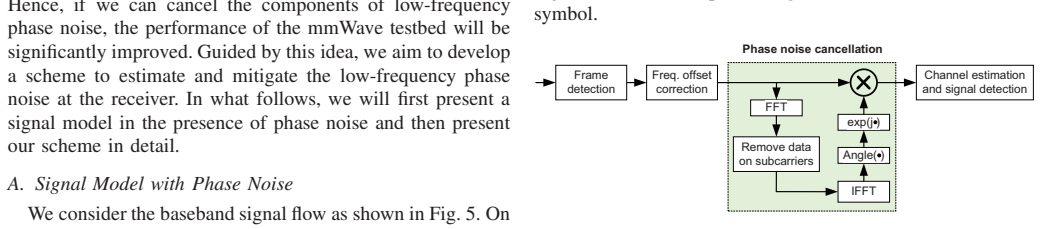
The phase noise cancellation (PNC) scheme using a transmitter pilot signal to mitigate phase noise at the receiver.
If this is right
- The testbed enables prototyping of mmWave ideas in real environments using standard components.
- Simplified IEEE 802.11 PHY can operate successfully on this mmWave hardware setup.
- Real-time video streaming becomes feasible over mmWave links with the PNC applied.
- Phase noise, a key challenge in mmWave, can be addressed without custom-designed hardware.
Where Pith is reading between the lines
- Similar pilot-based cancellation could be tested in other frequency bands or with different modulation formats.
- The testbed design might allow researchers to experiment with beamforming or multi-user scenarios in mmWave.
- Performance at higher data rates or longer distances could be explored as extensions.
Load-bearing premise
The pilot signal inserted at the transmitter allows the receiver to significantly reduce phase noise in actual wireless channels.
What would settle it
Experiments where the EVM stays above -20 dB during real-time video streaming even after applying the phase noise cancellation scheme would disprove the main result.
Figures




read the original abstract
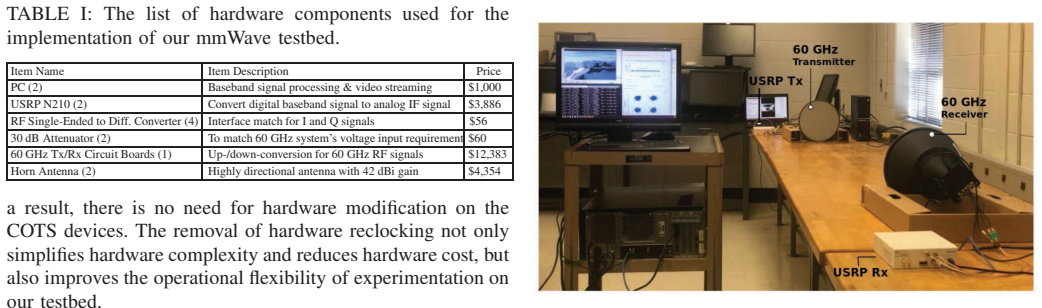
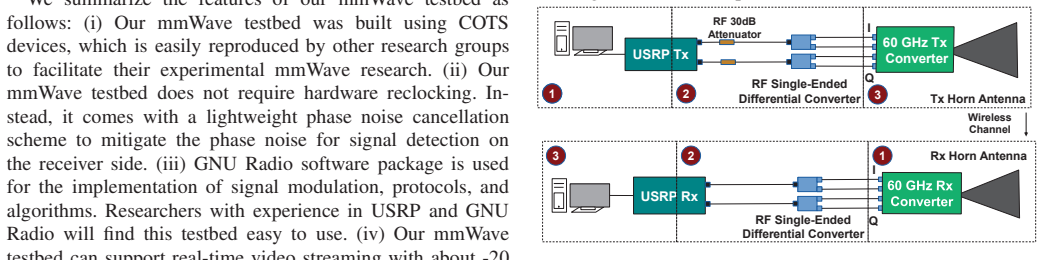
As the spectrum under 6 GHz is being depleted, pushing wireless communications onto millimeter wave (mmWave) frequencies is a trend that promises multi-Gbps data rate. mmWave is therefore considered as a key technology for 5G wireless systems and has attracted tremendous research efforts. The booming research on mmWave necessitates a reconfigurable mmWave testbed that can be used to prototype and validate new research ideas in real wireless environments. In this paper, we develop an easy-to-use mmWave testbed using commercial off-the-shelf devices (USRP and 60 GHz Tx/Rx RF frontends) and open-source software package (GNU Radio). A key component of our testbed is a phase noise cancellation (PNC) scheme, which can significantly reduce the phase noise at the receiver by leveraging the pilot signal inserted at the transmitter. We have implemented a simplified version of IEEE 802.11 PHY on this mmWave testbed. Experimental results show that, with the PNC scheme, our testbed can achieve -20 dB EVM data transmission for real-time video streaming.
Editorial analysis
A structured set of objections, weighed in public.
Referee Report
Summary. The manuscript describes the construction of a real-time mmWave testbed using USRP software-defined radios, 60 GHz Tx/Rx RF frontends, and GNU Radio, together with a pilot-based phase noise cancellation (PNC) scheme. A simplified IEEE 802.11 PHY is implemented on the platform, and experimental results are reported showing -20 dB EVM during real-time video streaming when the PNC scheme is active.
Significance. An accessible, COTS-based mmWave testbed with demonstrated real-time operation would be useful for the community if the performance attribution to PNC can be substantiated. The choice of open-source software and commercial hardware supports reproducibility, which is a positive feature of the work.
major comments (2)
- [Abstract] Abstract: The reported -20 dB EVM is stated only for the case with the PNC scheme enabled. No corresponding EVM value, phase-noise spectrum, or other metric is supplied for the identical hardware configuration with PNC disabled, so the contribution of the pilot-based cancellation to the observed performance cannot be isolated from other mmWave impairments.
- [Experimental results] Experimental results description: No error bars, number of independent trials, or quantitative isolation of phase noise from I/Q imbalance and PA nonlinearity are provided, leaving the soundness of the central performance claim difficult to verify from the given data.
minor comments (1)
- The manuscript would benefit from a link to the GNU Radio flowgraphs or a public repository to allow readers to reproduce the testbed configuration.
Simulated Author's Rebuttal
We thank the referee for the constructive comments on our manuscript. We address each major comment below and indicate the planned revisions.
read point-by-point responses
-
Referee: [Abstract] Abstract: The reported -20 dB EVM is stated only for the case with the PNC scheme enabled. No corresponding EVM value, phase-noise spectrum, or other metric is supplied for the identical hardware configuration with PNC disabled, so the contribution of the pilot-based cancellation to the observed performance cannot be isolated from other mmWave impairments.
Authors: We agree that including performance metrics without the PNC scheme would better isolate its contribution. In the revised manuscript we will update the abstract to report EVM both with and without PNC enabled and add a direct comparison (including phase-noise spectra where available) in the experimental results section. revision: yes
-
Referee: [Experimental results] Experimental results description: No error bars, number of independent trials, or quantitative isolation of phase noise from I/Q imbalance and PA nonlinearity are provided, leaving the soundness of the central performance claim difficult to verify from the given data.
Authors: We acknowledge the value of statistical details and impairment isolation. The revised experimental results section will include error bars derived from multiple independent trials and expanded discussion of how phase noise dominates the observed impairments. A fully quantitative separation from I/Q imbalance and PA nonlinearity is not feasible from the existing data set without new experiments. revision: partial
Circularity Check
Experimental testbed demonstration with no mathematical derivation chain
full rationale
The paper presents an experimental mmWave testbed implementation using COTS hardware and GNU Radio, with a pilot-based PNC scheme whose performance is measured directly via EVM in real-time video streaming. No equations, fitted parameters, or derivations are described that could reduce to self-referential inputs. The central result (-20 dB EVM) is an external hardware measurement, not a prediction derived from the scheme itself. No self-citations, ansatzes, or uniqueness claims appear in the provided text. This matches the default case of a self-contained experimental paper.
Axiom & Free-Parameter Ledger
Reference graph
Works this paper leans on
-
[1]
Inte rnet of Things (IoT): A vision, architectural elements, and future direct ions,
J. Gubbi, R. Buyya, S. Marusic, and M. Palaniswami, “Inte rnet of Things (IoT): A vision, architectural elements, and future direct ions,” Future generation computer systems , vol. 29, no. 7, pp. 1645–1660, 2013
work page 2013
-
[2]
Universal Software Radio Peripher al (USRP)
Ettus Research LLC, “Universal Software Radio Peripher al (USRP).” [Online]. Available: https://www.ettus.com/, [Accessed : 2019-01-01]
work page 2019
-
[3]
W ARP: A flexible platform for clean-slate wirele ss medium access protocol design,
A. Khattab, J. Camp, C. Hunter, P . Murphy, A. Sabharwal, a nd E. W. Knightly, “W ARP: A flexible platform for clean-slate wirele ss medium access protocol design,” ACM SIGMOBILE Mobile Computing and Communications Review, vol. 12, no. 1, pp. 56–58, 2008
work page 2008
-
[4]
X60: A programmable testbed for wideband 60 GHz WLANs with phased arrays,
S. K. Saha, Y . Ghasempour, M. K. Haider, T. Siddiqui, P . De Melo, N. Somanchi, L. Zakrajsek, A. Singh, R. Shyamsunder, O. Torr es, et al., “X60: A programmable testbed for wideband 60 GHz WLANs with phased arrays,” Elsevier Computer Communications , vol. 133, pp. 77– 88, 2019
work page 2019
-
[5]
Open Mili: A 60 GHz software radio platform with a reconfigurable phased- array antenna,
J. Zhang, X. Zhang, P . Kulkarni, and P . Ramanathan, “Open Mili: A 60 GHz software radio platform with a reconfigurable phased- array antenna,” in Proc. of ACM MobiCom , pp. 162–175, 2016
work page 2016
-
[6]
Open source SDR frontend and mea- surements for 60-GHz wireless experimentation,
P . Zetterberg and R. Fardi, “Open source SDR frontend and mea- surements for 60-GHz wireless experimentation,” IEEE Access , vol. 3, pp. 445–456, 2015
work page 2015
-
[7]
Spect rum-agile mm-wave packet radio implementation on USRPs,
J. Arnold, L. Simic, M. Petrova, and P . M¨ ah¨ onen, “Spect rum-agile mm-wave packet radio implementation on USRPs,” in Proc. of ACM W orkshop on Software Radio Implementation F orum , pp. 5–8, 2015
work page 2015
-
[8]
Demo: A real-time mmWave communication testbed
“Demo: A real-time mmWave communication testbed.” [Onl ine]. Avail- able: www.ece.louisville.edu/hzeng/mmwave.html, [Acce ssed: 2019-01- 01]
work page 2019
-
[9]
60 GHz transmitter and re ceiver de- velopment system
Pasternack Enterprises Inc., “60 GHz transmitter and re ceiver de- velopment system.” [Online]. Available: https://www.pas ternack.com, [Accessed: 2019-01-01]
work page 2019
-
[10]
60 GHz millimeterwave transmitter, 57 GHz to 64 GHz
“60 GHz millimeterwave transmitter, 57 GHz to 64 GHz.” [ Online]. Available: https://www.analog.com, [Accessed: 2019-01- 01]
work page 2019
-
[11]
Dhananjay, Iris: Mitigating phase noise in millimeter wave OFDM systems
A. Dhananjay, Iris: Mitigating phase noise in millimeter wave OFDM systems. PhD thesis, New Y ork University (NYU), 2015
work page 2015
-
[12]
Iterative c hannel estimation and phase noise compensation for sc-fde based mm wave systems,
C. Zhang, Z. Xiao, L. Su, L. Zeng, and D. Jin, “Iterative c hannel estimation and phase noise compensation for sc-fde based mm wave systems,” in Proc. of IEEE International Conference on Communication W orkshop (ICCW), pp. 2133–2138, 2015
work page 2015
discussion (0)
Sign in with ORCID, Apple, or X to comment. Anyone can read and Pith papers without signing in.