Position measurement-induced collapse states: Proposal of an experiment
Pith reviewed 2026-05-24 21:16 UTC · model grok-4.3
The pith
A modified Lloyd's mirror with two reflectors tests position measurement-induced collapse states via predicted quantum carpet patterns.
A machine-rendered reading of the paper's core claim, the machinery that carries it, and where it could break.
Core claim
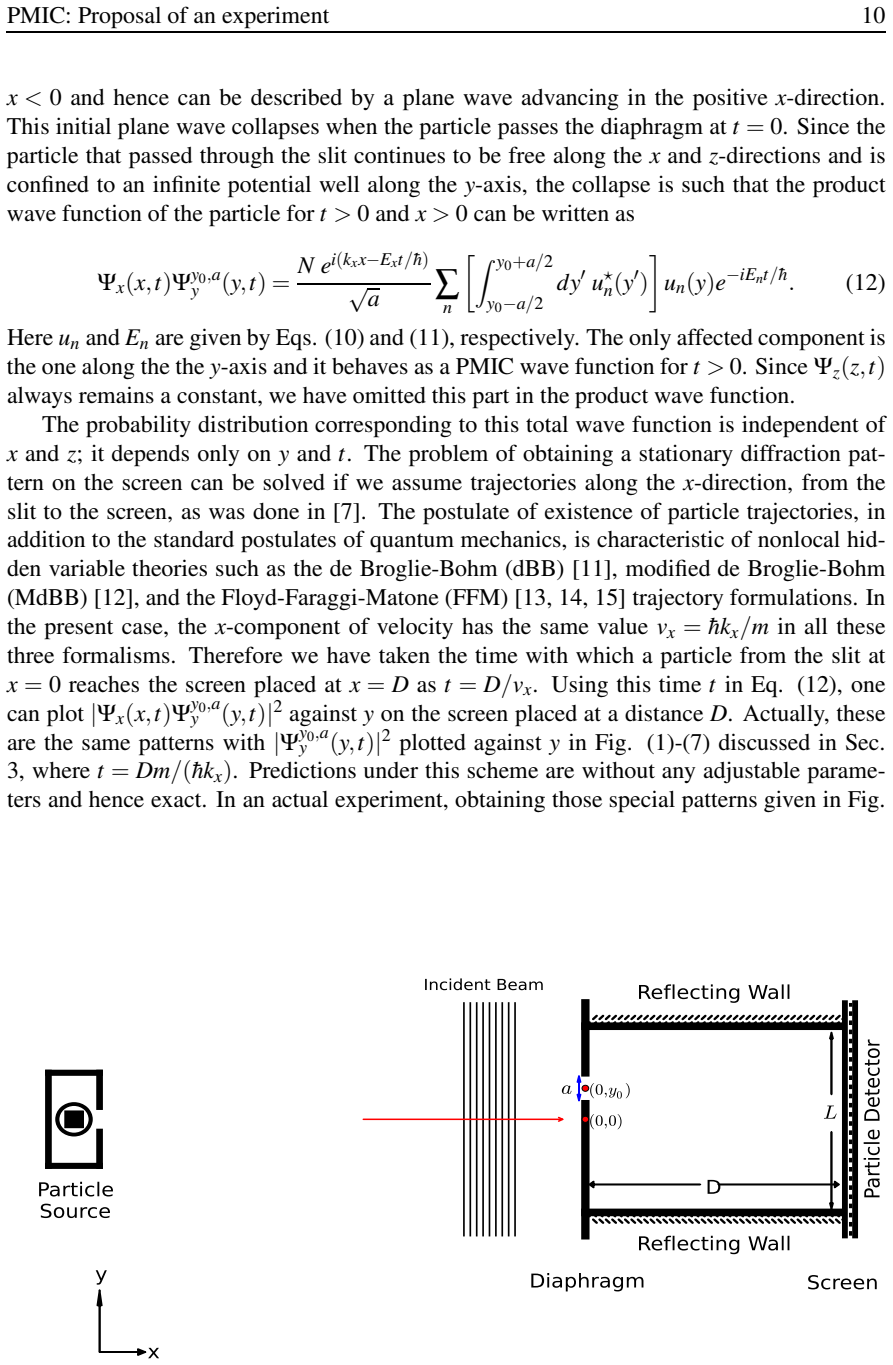
The quantum mechanical treatment of diffraction of particles, based on the standard postulates of quantum mechanics and the postulate of existence of quantum trajectories, leads to the position measurement-induced collapse (PMIC) states. An experimental set-up to test these PMIC states is proposed. The apparatus consists of a modified Lloyd's mirror in optics, with two reflectors instead of one. The diffraction patterns for this case predicted by the PMIC formalism are presented. They exhibit quantum fractal structures in space-time called quantum carpets. The PMIC formalism in this case closely follows the boundary bound diffraction analysed in a previous work. In addition to obtaining thei
What carries the argument
The modified Lloyd's mirror apparatus with two reflectors, which generates PMIC states whose diffraction patterns include quantum carpets and evolve into Fresnel and Fraunhofer forms.
If this is right
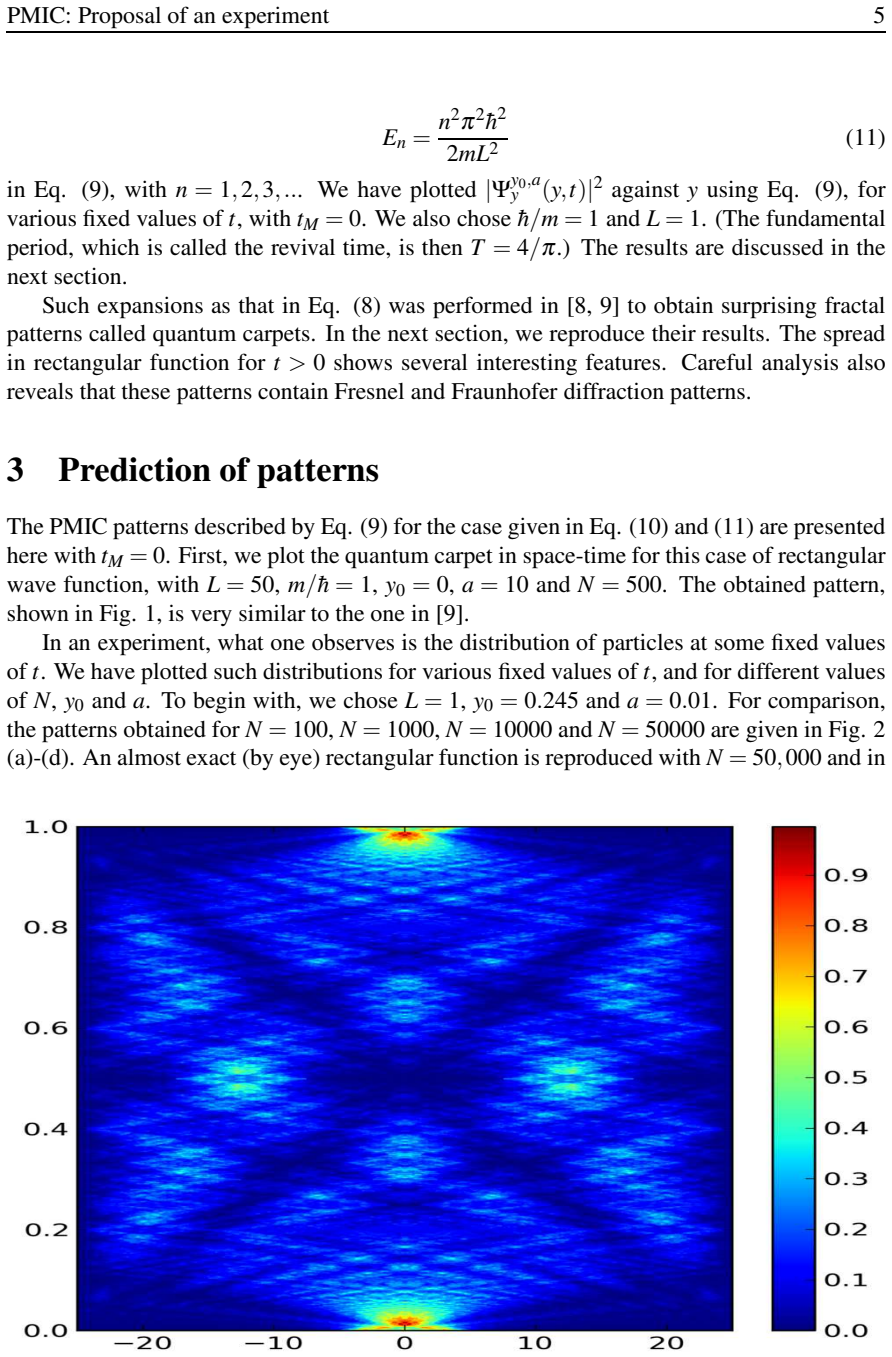
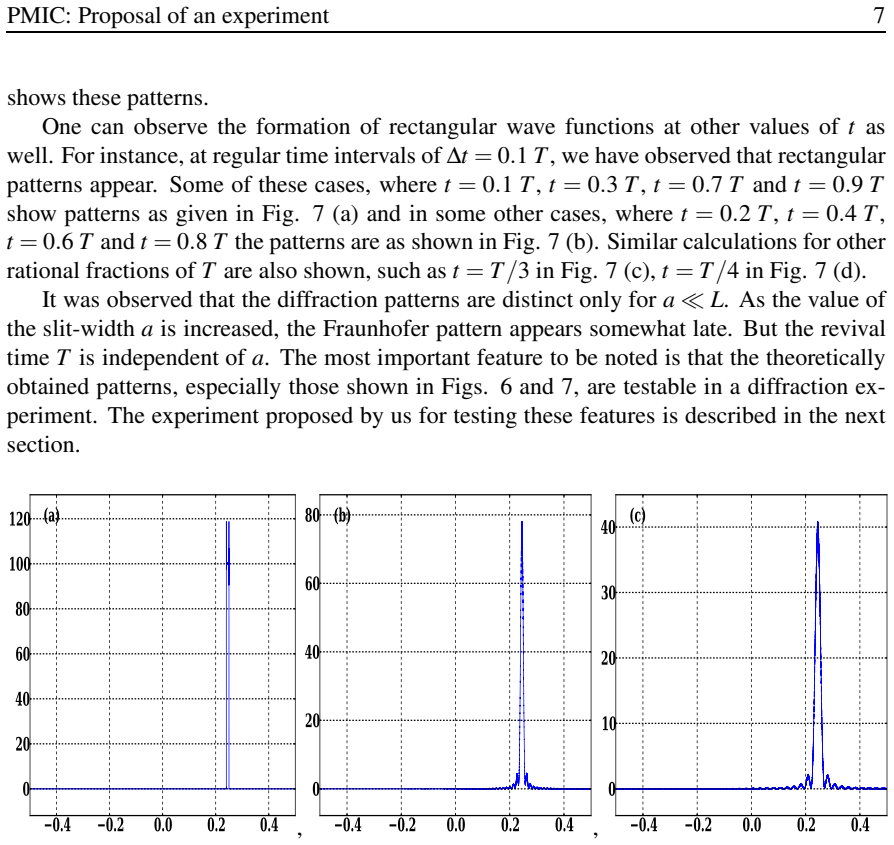
- Diffraction patterns for the two-reflector case exhibit quantum fractal structures in space-time called quantum carpets.
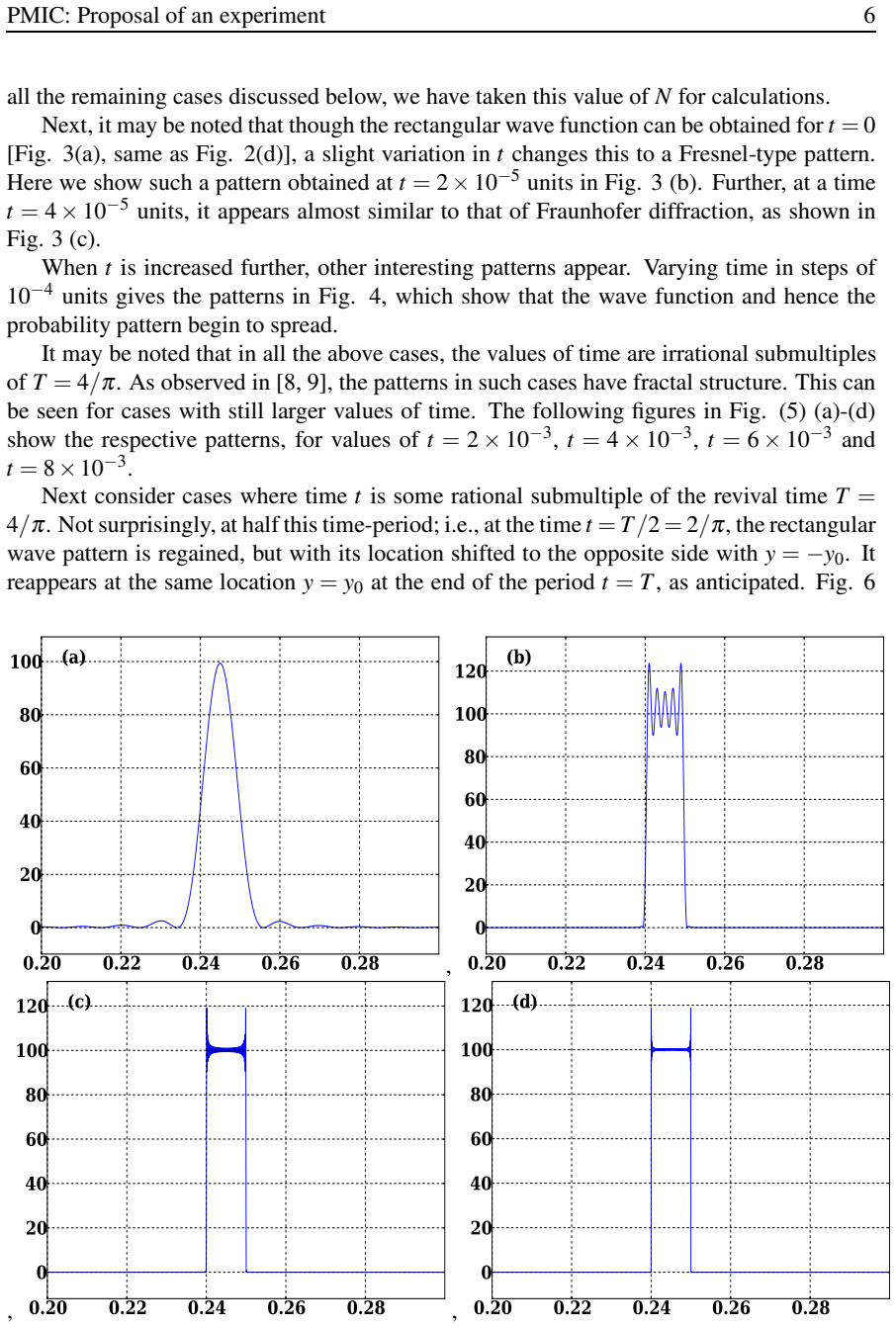
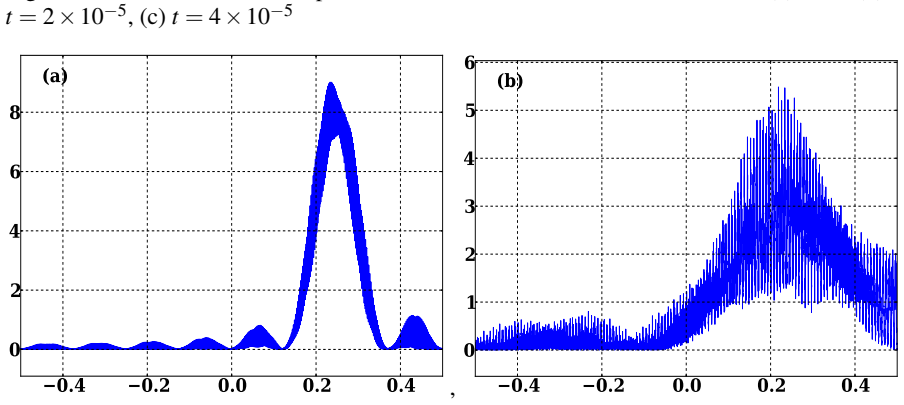
- Time evolution of the collapsed states leads to Fresnel and Fraunhofer diffraction patterns.
- The PMIC formalism closely follows boundary bound diffraction results from prior analysis while adding the time-dependent behavior.
- Verification of the predicted patterns would help understand collapse of the wave function during quantum measurements.
Where Pith is reading between the lines
- Confirmation of quantum carpets would suggest that trajectory-based features can appear in standard diffraction setups under position measurement.
- The setup could be varied by changing reflector angles or separations to map how carpet visibility depends on geometry.
- If the patterns are seen, similar collapse signatures might be sought in other interferometers that involve boundary reflections.
Load-bearing premise
The derivation assumes that quantum trajectories exist in addition to the standard postulates of quantum mechanics and that this combination produces distinct PMIC states.
What would settle it
Observation of the two-reflector Lloyd's mirror diffraction experiment that fails to show the predicted quantum carpet patterns at the calculated locations and times would falsify the PMIC formalism.
Figures
read the original abstract
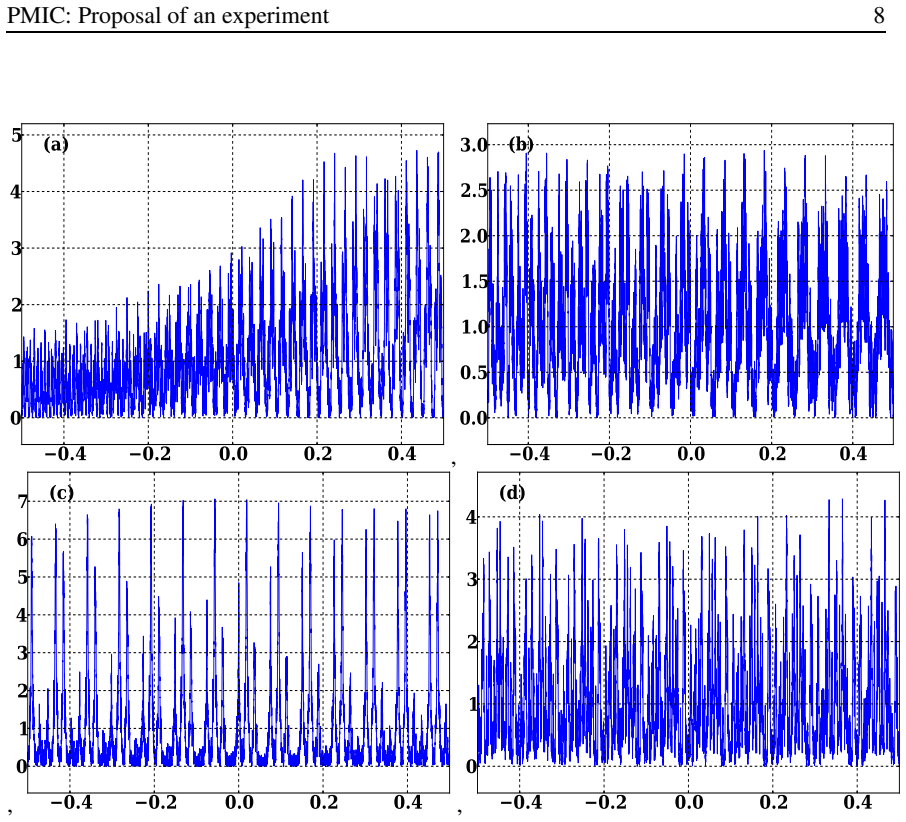
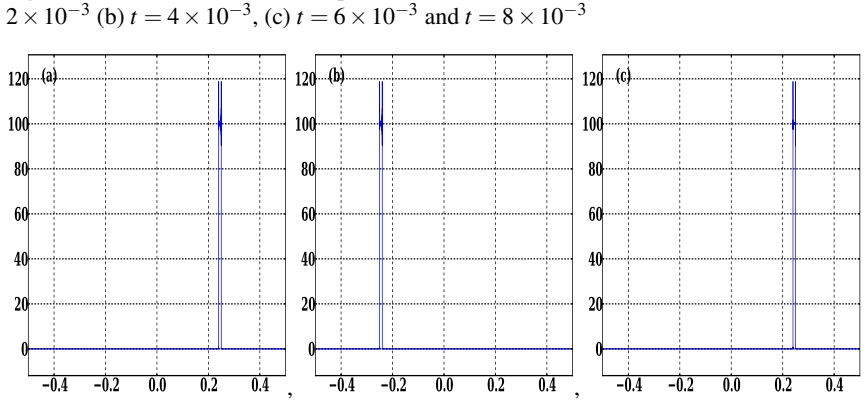
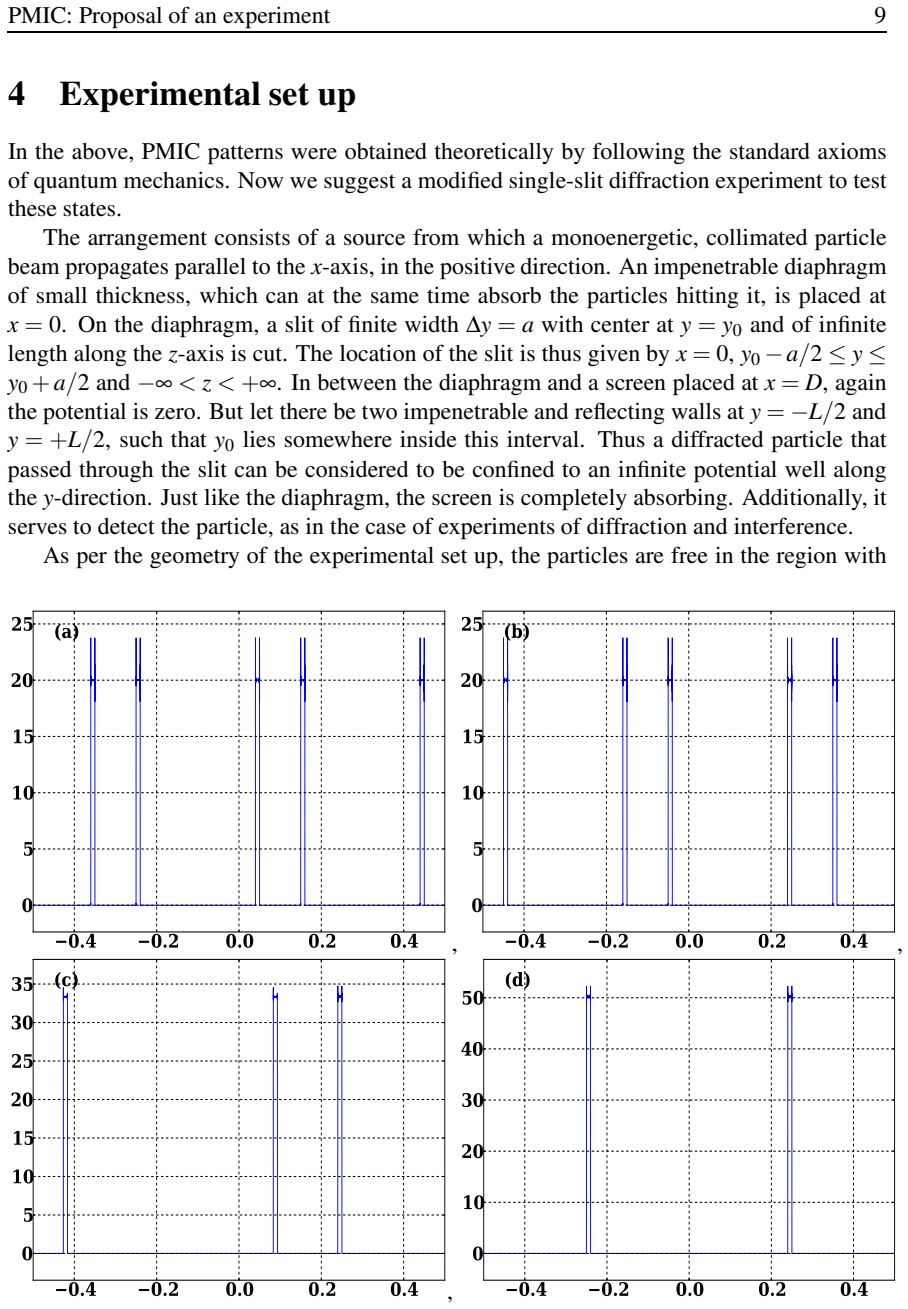
The quantum mechanical treatment of diffraction of particles, based on the standard postulates of quantum mechanics and the postulate of existence of quantum trajectories, leads to the `position measurement-induced collapse' (PMIC) states. An experimental set-up to test these PMIC states is proposed. The apparatus consists of a modified Lloyd's mirror in optics, with two reflectors instead of one. The diffraction patterns for this case predicted by the PMIC formalism are presented. They exhibit quantum fractal structures in space-time called `quantum carpets', first discovered by Berry (1996). The PMIC formalism in this case closely follows the `boundary bound diffraction' analysed in a previous work by Tounli, Alverado and Sanz (2019). In addition to obtaining their results, we have shown that the time evolution of these collapsed states also leads to Fresnel and Fraunhofer diffractions. It is anticipated that the verification of PMIC states by this experiment will help to better understand collapse of the wave function during quantum measurements.
Editorial analysis
A structured set of objections, weighed in public.
Referee Report
Summary. The manuscript proposes an experimental test of 'position measurement-induced collapse' (PMIC) states, obtained by augmenting standard quantum mechanics with a quantum-trajectories postulate. Using a modified Lloyd's mirror geometry with two reflectors, it presents predicted diffraction patterns that exhibit quantum-carpet fractal structures in space-time and shows that the time evolution of these states recovers Fresnel and Fraunhofer regimes. The PMIC treatment is stated to closely follow the boundary-bound diffraction analysis of Tounli, Alverado and Sanz (2019).
Significance. If the PMIC predictions are independently derived and the proposed apparatus can isolate the claimed signatures, the work would supply a concrete, falsifiable route to probing measurement-induced collapse via observable diffraction carpets. The explicit recovery of standard diffraction limits from the collapsed states is a clear strength of the proposal.
major comments (3)
- [Abstract / PMIC predictions section] Abstract and the section presenting the PMIC predictions: the claim that the formalism 'yields the predicted patterns and time evolution' is asserted without the explicit derivations, boundary conditions, or error analysis that would allow verification that the quantum-carpet structures follow rigorously rather than by direct transcription from the 2019 reference.
- [Discussion of relation to prior work] The paragraph stating that 'the PMIC formalism in this case closely follows the boundary-bound diffraction analysed in [Tounli et al. 2019]': because the diffraction patterns and carpets are obtained by following that prior analysis, it is unclear what new, independent predictions the present manuscript contributes beyond the experimental geometry itself.
- [Time-evolution paragraph] The claim that time evolution of the collapsed states leads to Fresnel and Fraunhofer diffraction: without the intermediate equations showing how the PMIC wave function evolves into the standard propagators, it is impossible to assess whether this recovery is a nontrivial result or an immediate consequence of the 2019 boundary conditions.
minor comments (2)
- [Abstract / Introduction] The abstract and introduction should explicitly list the new elements (if any) that go beyond the 2019 analysis rather than stating only that the formalism 'closely follows' it.
- [Figure captions] Figure captions for the predicted carpets should include the precise parameter values (slit separation, wavelength, propagation distance) used to generate each panel so that the patterns can be reproduced or compared with the 2019 results.
Simulated Author's Rebuttal
We thank the referee for the constructive comments. We address each major point below.
read point-by-point responses
-
Referee: [Abstract / PMIC predictions section] Abstract and the section presenting the PMIC predictions: the claim that the formalism 'yields the predicted patterns and time evolution' is asserted without the explicit derivations, boundary conditions, or error analysis that would allow verification that the quantum-carpet structures follow rigorously rather than by direct transcription from the 2019 reference.
Authors: We agree the manuscript would benefit from additional detail. The PMIC states and carpet patterns are derived in Tounli et al. (2019); our manuscript applies that formalism to the two-reflector geometry. In revision we will add a short summary of the boundary conditions and key derivation steps with explicit citations to the relevant equations in the 2019 reference. revision: yes
-
Referee: [Discussion of relation to prior work] The paragraph stating that 'the PMIC formalism in this case closely follows the boundary-bound diffraction analysed in [Tounli et al. 2019]': because the diffraction patterns and carpets are obtained by following that prior analysis, it is unclear what new, independent predictions the present manuscript contributes beyond the experimental geometry itself.
Authors: The new elements are the concrete two-reflector Lloyd's-mirror apparatus chosen to isolate PMIC signatures, the explicit prediction of quantum carpets for that geometry, and the demonstration that time evolution of the collapsed states recovers Fresnel and Fraunhofer regimes. These aspects are not contained in the 2019 reference. revision: no
-
Referee: [Time-evolution paragraph] The claim that time evolution of the collapsed states leads to Fresnel and Fraunhofer diffraction: without the intermediate equations showing how the PMIC wave function evolves into the standard propagators, it is impossible to assess whether this recovery is a nontrivial result or an immediate consequence of the 2019 boundary conditions.
Authors: We will insert the intermediate propagation equations showing how the PMIC wave function, after the position-measurement collapse, evolves under the standard Fresnel propagator to recover the usual diffraction limits. revision: yes
Circularity Check
No circularity; derivation applies external formalism to new setup
full rationale
The paper's central claim rests on applying the PMIC formalism (standard QM plus quantum-trajectory postulate) to a modified Lloyd's mirror, with diffraction patterns stated to closely follow the independent 2019 boundary-bound diffraction analysis by Tounli et al. (different authors). It additionally derives Fresnel/Fraunhofer patterns from time evolution of the collapsed states. No self-citation is load-bearing, no parameter is fitted then renamed as prediction, no ansatz is smuggled via self-citation, and no equation reduces to its input by construction. The quantum-carpet structures are attributed to Berry (1996) and the 2019 work as external inputs. The derivation chain is therefore self-contained against the stated postulates and external references.
Axiom & Free-Parameter Ledger
axioms (1)
- domain assumption Existence of quantum trajectories in addition to the standard postulates of quantum mechanics
Reference graph
Works this paper leans on
-
[1]
Braginsky V B and Khalili F Y 1992 Quantum Measurement (New Y ork: Cambridge University Press)
work page 1992
-
[2]
Wiseman H M and Milburn G J Quantum Measurement and Control (New Y ork: Cam- bridge University Press)
-
[3]
Lamb W E 1969 Physics Today 22 23
work page 1969
-
[4]
Marcella T V 2002 Eur. J. Phys. 23 615
work page 2002
-
[5]
Rothman T and Boughn S 2011 Eur. J. Phys. 32 107
work page 2011
- [6]
-
[7]
John M V and Mathew K 2019 Found. Phys. 49 317
work page 2019
-
[8]
Berry M V 1996 J. Phys. A: Math. Gen. 29 6617
work page 1996
-
[9]
Tounli J, Alvarado A and Sanz A S 2019 Physica Scripta 94, 035202
work page 2019
-
[10]
Cohen-Tannoudji C, Diu B and Laloe F 1977 Quantum Mechanics vol.I (Paris: Her- mann)
work page 1977
-
[11]
Thesis (University of Paris); de Broglie L 1927 J
de Broglie L 1924 Ph.D. Thesis (University of Paris); de Broglie L 1927 J. Phys. Rad., 6e serie, t. 8 225
work page 1924
-
[12]
John M V 2002 Found. Phys. Lett. 15 329
work page 2002
-
[13]
Floyd E R 1982 Phys. Rev. D 26 1339
work page 1982
-
[14]
Faraggi A and Matone M 1999 Phys. Lett. B 450 34 M.V . John,K. Mathew October 1, 2019 PMIC: Proposal of an experiment 13
work page 1999
-
[15]
Carroll R 2000 Quantum Theory, Deformation, and Integrability (Amsterdam: North Holland)
work page 2000
-
[16]
Arfken G B, Weber H J and Harris F E 2013 Mathematical Methods for Physicists , (Amsterdam: Elsevier)
work page 2013
-
[17]
Born M and Wolf E 2000 Principles of Optics (Cambridge: Cambridge University Press) M.V . John,K. Mathew October 1, 2019
work page 2000
discussion (0)
Sign in with ORCID, Apple, or X to comment. Anyone can read and Pith papers without signing in.