The Southern Wide-Field Gamma-Ray Observatory (SWGO): A Next-Generation Ground-Based Survey Instrument for VHE Gamma-Ray Astronomy
Pith reviewed 2026-05-24 19:50 UTC · model grok-4.3
The pith
SWGO will survey the southern sky in very-high-energy gamma rays with a particle-detector array built from proven technology at an estimated 54 million USD.
A machine-rendered reading of the paper's core claim, the machinery that carries it, and where it could break.
Core claim
A next-generation wide-field gamma-ray observatory in the Southern Hemisphere can be constructed using current, already-proven technology for detecting extensive air showers, delivering wide coverage of the southern sky at a construction cost of 54 million USD and five-year operations cost of 7.5 million USD, with full operations starting in 2026.
What carries the argument
The detector array of a compact inner array of particle detection units surrounded by a sparser outer array, which records extensive air showers to achieve wide-field sensitivity.
If this is right
- Wide-field coverage of a large portion of the southern sky becomes available for very-high-energy gamma-ray observations.
- Current and future northern instruments gain a southern complement for coordinated multi-messenger studies.
- Science programs on Galactic particle accelerators, the dynamic universe, and physics beyond the Standard Model receive dedicated southern-sky data.
- A US investment of 20 million USD positions American groups to lead aspects of the project.
Where Pith is reading between the lines
- Joint observations with neutrino and gravitational-wave detectors could increase the fraction of transients that receive prompt very-high-energy follow-up.
- The modular array design may allow staged deployment that reduces initial risk while still delivering early science results.
- If site selection succeeds in a high-altitude location with clear skies, the effective energy threshold could drop below current southern instruments.
Load-bearing premise
The detector can be built with already-proven technology at the stated cost without major unforeseen technical or funding problems.
What would settle it
An independent cost and performance review that shows the array cannot reach the required sensitivity or that total construction exceeds 54 million USD by more than 20 percent.
Figures


read the original abstract
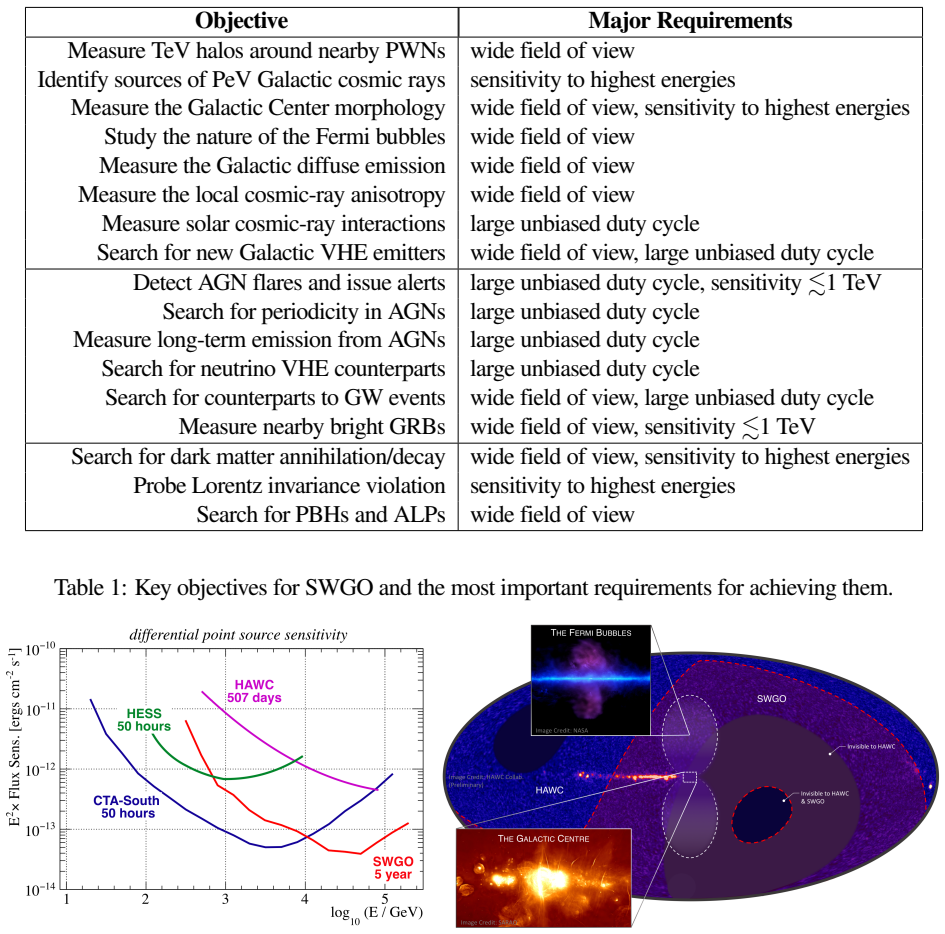
We describe plans for the development of the Southern Wide-field Gamma-ray Observatory (SWGO), a next-generation instrument with sensitivity to the very-high-energy (VHE) band to be constructed in the Southern Hemisphere. SWGO will provide wide-field coverage of a large portion of the southern sky, effectively complementing current and future instruments in the global multi-messenger effort to understand extreme astrophysical phenomena throughout the universe. A detailed description of science topics addressed by SWGO is available in the science case white paper [1]. The development of SWGO will draw on extensive experience within the community in designing, constructing, and successfully operating wide-field instruments using observations of extensive air showers. The detector will consist of a compact inner array of particle detection units surrounded by a sparser outer array. A key advantage of the design of SWGO is that it can be constructed using current, already proven technology. We estimate a construction cost of 54M USD and a cost of 7.5M USD for 5 years of operation, with an anticipated US contribution of 20M USD ensuring that the US will be a driving force for the SWGO effort. The recently formed SWGO collaboration will conduct site selection and detector optimization studies prior to construction, with full operations foreseen to begin in 2026. Throughout this document, references to science white papers submitted to the Astro2020 Decadal Survey with particular relevance to the key science goals of SWGO, which include unveiling Galactic particle accelerators [2-10], exploring the dynamic universe [11-21], and probing physics beyond the Standard Model [22-25], are highlighted in red boldface.
Editorial analysis
A structured set of objections, weighed in public.
Referee Report
Summary. The manuscript is a white paper describing plans for the Southern Wide-field Gamma-ray Observatory (SWGO), a proposed next-generation wide-field VHE gamma-ray detector array in the Southern Hemisphere. It outlines a design using proven extensive air shower technology with a compact inner array surrounded by a sparser outer array, defers the detailed science case to a companion white paper, provides community-based cost estimates (54M USD construction, 7.5M USD for 5 years operation, 20M USD anticipated US contribution), and projects full operations beginning in 2026 following site selection and optimization studies.
Significance. If realized, SWGO would fill a critical gap by providing wide-field southern-sky coverage to complement northern instruments such as HAWC and future facilities like CTA, supporting multi-messenger astrophysics. The explicit reliance on already-proven technology and community experience with similar arrays is a clear strength that lowers technical risk. The cost and timeline projections, however, are presented without supporting breakdowns or validation data.
major comments (1)
- [Abstract] Abstract: The construction cost of 54M USD, 5-year operation cost of 7.5M USD, and US contribution of 20M USD are stated as community estimates without detailed breakdowns, error bars, contingency allowances, or comparisons to analogous projects (e.g., HAWC construction costs). These figures are load-bearing for the feasibility claim and the projected 2026 start date.
minor comments (1)
- [Abstract] The manuscript appropriately references the science case to a separate white paper [1] and highlights relevant Astro2020 submissions in red boldface, but the latter formatting may not be preserved in all viewing formats.
Simulated Author's Rebuttal
We thank the referee for the positive assessment of SWGO's scientific potential and technical approach, and for the constructive feedback on the cost and timeline estimates. We address the single major comment below.
read point-by-point responses
-
Referee: [Abstract] Abstract: The construction cost of 54M USD, 5-year operation cost of 7.5M USD, and US contribution of 20M USD are stated as community estimates without detailed breakdowns, error bars, contingency allowances, or comparisons to analogous projects (e.g., HAWC construction costs). These figures are load-bearing for the feasibility claim and the projected 2026 start date.
Authors: We agree that the cost figures would benefit from additional context to support the feasibility discussion. These values are community-derived estimates informed by direct experience with HAWC and other air-shower arrays; however, as this is a high-level white paper rather than a technical design report, detailed breakdowns, contingencies, and error bars were not included. We will revise the abstract and add a short paragraph (or footnote) that (i) references HAWC construction costs for comparison, (ii) notes the absence of contingency allowances at this stage, and (iii) states that full cost-validation studies will appear in subsequent technical documents. The 2026 operations date remains a planning target contingent on site selection and funding timelines, which we will clarify. revision: yes
Circularity Check
No significant circularity; proposal with no derivations or equations
full rationale
This is an instrument proposal white paper describing plans for SWGO construction, site selection, science complementarity, and cost estimates (54M USD construction, 7.5M USD operations). No equations, parameters, predictions, or derivation chains appear anywhere in the document. Claims rest on engineering experience with proven technology and references to separate science white papers, none of which reduce to self-definition or fitted inputs by construction. The document is self-contained as a forward-looking proposal without any load-bearing mathematical steps that could exhibit circularity.
Axiom & Free-Parameter Ledger
free parameters (3)
- construction cost =
54M USD
- 5-year operation cost =
7.5M USD
- US contribution =
20M USD
axioms (2)
- domain assumption Wide-field instruments using observations of extensive air showers are effective for VHE gamma-ray detection.
- domain assumption Current proven technology is sufficient to construct SWGO at the estimated cost.
Forward citations
Cited by 1 Pith paper
-
Enhancing event reconstruction for $\gamma$-ray particle detector arrays using transformers
Transformer models applied to simulated water-Cherenkov array data improve gamma-hadron separation and reconstruction of direction, core position, and energy compared to established techniques.
Reference graph
Works this paper leans on
-
[1]
A. Albert, et al.,Science Case for a Wide Field-of-V iew V ery-High-Energy Gamma-Ray Observatory in the Southern Hemisphere, arXiv e-prints, arXiv:1902.08429 (2019),1902.08429
work page internal anchor Pith review Pith/arXiv arXiv 1902
-
[2]
H. Fleischhack, et al.,Pulsars in a Bubble? F ollowing Electron Diffusion in the Galaxy with T eV Gamma Rays, in Astro2020: Decadal Survey on Astronomy and Astrophysics, Bulletin of the AAS, Bd. 51, 311 (2019),1903.07647
work page internal anchor Pith review Pith/arXiv arXiv 2019
-
[3]
Prospects for the detection of synchrotron halos around middle-age pulsars
M. Di Mauro, S. Manconi, & F. Donato,Prospects for the detection of synchrotron halos around middle-age pulsars, in Astro2020: Decadal Survey on Astronomy and Astrophysics, Bulletin of the AAS, Bd. 51, 183 (2019),1903.05699
work page internal anchor Pith review Pith/arXiv arXiv 2019
-
[4]
J. Gelfand, et al., MeV Emission from Pulsar Wind Nebulae: Understanding Extreme P article Acceleration in Highly Relativistic Outflows, in Astro2020: Decadal Survey on Astronomy and Astrophysics, Bulletin of the AAS, Bd. 51, 513 (2019)
work page 2019
-
[5]
P . Cristofari, et al.,Where are the pevatrons?, in Astro2020: Decadal Survey on Astronomy and Astrophysics, Bulletin of the AAS, Bd. 51, 115 (2019)
work page 2019
-
[6]
J. Holder, et al., Understanding the Origin and Impact of Relativistic Cosmic P articles with V ery-High-Energy Gamma-rays, in Astro2020: Decadal Survey on Astronomy and Astrophysics, Bulletin of the AAS, Bd. 51, 267 (2019)
work page 2019
-
[7]
C. Fryer, et al.,Core-Collapse Supernovae and Multi-Messenger Astronomy, in Astro2020: Decadal Survey on Astronomy and Astrophysics, Bulletin of the AAS, Bd. 51, 122 (2019)
work page 2019
-
[8]
F. Schroeder, et al., High-Energy Galactic Cosmic Rays, in Astro2020: Decadal Survey on Astronomy and Astrophysics, Bulletin of the AAS, Bd. 51, 131 (2019)
work page 2019
-
[9]
N. Fraija, et al.,Cosmic rays in the T eV to P eV primary energy range, Astro2020: Decadal Survey on Astronomy and Astrophysics,2020, 459 (2019)
work page 2020
-
[10]
The Sun at GeV--TeV Energies: A New Laboratory for Astroparticle Physics
M. Nisa, et al., The Sun at GeV-T eV Energies: A New Laboratory for Astroparticle Physics, in Astro2020: Decadal Survey on Astronomy and Astrophysics, Bulletin of the AAS, Bd. 51, 194 (2019),1903.06349
work page internal anchor Pith review Pith/arXiv arXiv 2019
-
[11]
N. Fraija, et al., Surveying T eV gamma-ray emission from active galactic nuclei, Astro2020: Decadal Survey on Astronomy and Astrophysics,2020, 444 (2019)
work page 2020
-
[12]
H. Ji, et al., Major Scientific Challenges and Opportunities in Understanding Magnetic Recon- nection and Related Explosive Phenomena throughout the Universe, in Astro2020: Decadal Survey on Astronomy and Astrophysics, Bulletin of the AAS, Bd. 51, 5 (2019)
work page 2019
-
[13]
Multi-Physics of AGN Jets in the Multi-Messenger Era
B. Rani, et al., Multi-Physics of AGN Jets in the Multi-Messenger Era, in Astro2020: Decadal Survey on Astronomy and Astrophysics, Bulletin of the AAS, Bd. 51, 92 (2019),1903.04504
work page internal anchor Pith review Pith/arXiv arXiv 2019
-
[14]
D. Williams,Probing Extreme Environments with V ery-High-Energy Gamma Rays, in Astro2020: Decadal Survey on Astronomy and Astrophysics, Bulletin of the AAS, Bd. 51, 265 (2019) 13
work page 2019
-
[15]
A. Vieregg, et al., Astrophysics Uniquely Enabled by Observations of High-Energy Cosmic Neutrinos, in Astro2020: Decadal Survey on Astronomy and Astrophysics, Bulletin of the AAS, Bd. 51, 185 (2019)
work page 2019
-
[16]
J. V andenbroucke & M. Santander,Multi-messenger and transient astrophysics with very-high- energy gamma rays, in Astro2020: Decadal Survey on Astronomy and Astrophysics, Bulletin of the AAS, Bd. 51, 553 (2019)
work page 2019
-
[17]
M. Santander, et al.,A Unique Messenger to Probe Active Galactic Nuclei: High-Energy Neutrinos, in Astro2020: Decadal Survey on Astronomy and Astrophysics, Bulletin of the AAS, Bd. 51, 228 (2019)
work page 2019
-
[18]
F. Schussler & K. Satalecka,All-Sky time domain astrophysics with V ery High Energy Gamma rays, in Astro2020: Decadal Survey on Astronomy and Astrophysics, Bulletin of the AAS, Bd. 51, 357 (2019)
work page 2019
-
[19]
Gamma Rays and Gravitational Waves
E. Burns, et al., Gamma Rays and Gravitational W aves, in Astro2020: Decadal Survey on Astronomy and Astrophysics, Bulletin of the AAS, Bd. 51, 260 (2019),1903.04472
work page internal anchor Pith review Pith/arXiv arXiv 2019
-
[20]
Opportunities for Multimessenger Astronomy in the 2020s
E. Burns, et al.,Opportunities for Multimessenger Astronomy in the 2020s, in Astro2020: Decadal Survey on Astronomy and Astrophysics, Bulletin of the AAS, Bd. 51, 250 (2019),1903.04461
work page internal anchor Pith review Pith/arXiv arXiv 2019
-
[21]
High-Energy Astrophysics in the 2020s and Beyond
C. Reynolds, et al.,High-Energy Astrophysics in the 2020s and Beyond, in Astro2020: Decadal Survey on Astronomy and Astrophysics, Bulletin of the AAS, Bd. 51, 385 (2019),1903.07760
work page internal anchor Pith review Pith/arXiv arXiv 2019
-
[22]
A. Viana,Searching for T eV Dark Matter in the Milky W ay Galactic Center, in Astro2020: Decadal Survey on Astronomy and Astrophysics, Bulletin of the AAS, Bd. 51, 308 (2019)
work page 2019
-
[23]
A. Albert, et al.,Searching for Sources of T eV P article Dark Matter in the Southern Hemisphere, in Astro2020: Decadal Survey on Astronomy and Astrophysics, Bulletin of the AAS, Bd. 51, 202 (2019)
work page 2019
-
[24]
R. Mukherjee & A. N. Otte,Exploring Frontiers in Physics with V ery-High-Energy Gamma Rays, in Astro2020: Decadal Survey on Astronomy and Astrophysics, Bulletin of the AAS, Bd. 51, 203 (2019)
work page 2019
-
[25]
J. P . Harding, et al.,Exploring Beyond-the-Standard-Model Physics with T eV Gamma-rays, in Astro2020: Decadal Survey on Astronomy and Astrophysics, Bulletin of the AAS, Bd. 51, 272 (2019)
work page 2019
-
[26]
A. U. Abeysekara, et al. (HAWC Collaboration),Search for Gamma-Rays from the Unusually Bright GRB 130427A with the HA WC Gamma-Ray Observatory, Astrophys. J.,800, 78 (2015), 1410.1536, URL http://dx.doi.org/10.1088/0004-637X/800/2/78
work page internal anchor Pith review Pith/arXiv arXiv doi:10.1088/0004-637x/800/2/78 2015
-
[27]
A. U. Abeysekara, et al. (HAWC Collaboration),Daily Monitoring of T eV Gamma-Ray Emission from Mrk 421, Mrk 501, and the Crab Nebula with HA WC , Astrophys. J., 841, 100 (2017), 1703.06968, URL http://dx.doi.org/10.3847/1538-4357/aa729e
work page internal anchor Pith review Pith/arXiv arXiv doi:10.3847/1538-4357/aa729e 2017
-
[28]
Icecube Collaboration, et al. (including HAWC Collaboration),Multiwavelength follow-up of a rare IceCube neutrino multiplet, Astronomy & Astrophysics,607, A115 (2017),1702.06131, URL http://dx.doi.org/10.1051/0004-6361/201730620 14
work page internal anchor Pith review Pith/arXiv arXiv doi:10.1051/0004-6361/201730620 2017
-
[29]
A. U. Abeysekara, et al. (HAWC Collaboration),Search for V ery High-energy Gamma Rays from the Northern F ermi Bubble Region with HA WC, Astrophys. J.,842, 85 (2017), 1703.01344, URL http://dx.doi.org/10.3847/1538-4357/aa751a
work page internal anchor Pith review Pith/arXiv arXiv doi:10.3847/1538-4357/aa751a 2017
-
[30]
A. U. Abeysekara, et al. (including HAWC Collaboration),Observation of the Crab Nebula with the HA WC Gamma-Ray Observatory, Astrophys. J.,843, 39 (2017), 1701.01778, URL http://dx.doi.org/10.3847/1538-4357/aa7555
work page internal anchor Pith review Pith/arXiv arXiv doi:10.3847/1538-4357/aa7555 2017
-
[31]
A. U. Abeysekara, et al. (HAWC Collaboration), The 2HWC HA WC Observa- tory Gamma-Ray Catalog , Astrophys. J., 843, 40 (2017), 1702.02992, URL http://dx.doi.org/10.3847/1538-4357/aa7556
work page internal anchor Pith review Pith/arXiv arXiv doi:10.3847/1538-4357/aa7556 2017
-
[32]
R. Alfaro, et al. (HAWC Collaboration), Search for V ery-high-energy Emission from Gamma-Ray Bursts Using the First 18 Months of Data from the HA WC Gamma-Ray Observatory , Astrophys. J., 843, 88 (2017), 1705.01551, URL http://dx.doi.org/10.3847/1538-4357/aa756f
work page internal anchor Pith review Pith/arXiv arXiv doi:10.3847/1538-4357/aa756f 2017
-
[33]
A. U. Abeysekara, et al. (HAWC Collaboration), The HA WC Real-time Flare Monitor for Rapid Detection of Transient Events, Astrophys. J., 843, 116 (2017), 1704.07411, URL http://dx.doi.org/10.3847/1538-4357/aa789f
work page internal anchor Pith review Pith/arXiv arXiv doi:10.3847/1538-4357/aa789f 2017
-
[34]
B. P . Abbott, et al. (including HAWC Collaboration), Multi-messenger Observations of a Binary Neutron Star Merger , Astrophys. J. Lett., 848, L12 (2017), 1710.05833, URL http://dx.doi.org/10.3847/2041-8213/aa91c9
work page internal anchor Pith review Pith/arXiv arXiv doi:10.3847/2041-8213/aa91c9 2017
-
[35]
A. U. Abeysekara, et al. (HAWC Collaboration),Extended gamma-ray sources around pulsars constrain the origin of the positron flux at Earth, Science,358, 911 (2017),1711.06223, URL http://dx.doi.org/10.1126/science.aan4880
work page internal anchor Pith review Pith/arXiv arXiv doi:10.1126/science.aan4880 2017
-
[36]
Dark Matter Limits From Dwarf Spheroidal Galaxies with The HAWC Gamma-Ray Observatory
A. Albert, et al. (HAWC Collaboration),Dark Matter Limits from Dwarf Spheroidal Galaxies with the HA WC Gamma-Ray Observatory, Astrophys. J.,853, 154 (2018),1706.01277, URL http://dx.doi.org/10.3847/1538-4357/aaa6d8
work page internal anchor Pith review Pith/arXiv arXiv doi:10.3847/1538-4357/aaa6d8 2018
-
[37]
A. U. Abeysekara, et al. (HAWC Collaboration), A search for dark matter in the Galactic halo with HA WC, J. Cosmol. Astropart. Phys., 2018, 049 (2018), 1710.10288, URL http://dx.doi.org/10.1088/1475-7516/2018/02/049
work page internal anchor Pith review Pith/arXiv arXiv doi:10.1088/1475-7516/2018/02/049 2018
-
[38]
A. Albert, et al. (HAWC Collaboration), Search for dark matter gamma-ray emis- sion from the Andromeda Galaxy with the High-Altitude W ater Cherenkov Ob- servatory, J. Cosmol. Astropart. Phys., 2018, 043 (2018), 1804.00628, URL http://dx.doi.org/10.1088/1475-7516/2018/06/043
work page internal anchor Pith review Pith/arXiv arXiv doi:10.1088/1475-7516/2018/06/043 2018
-
[39]
IceCube Collaboration, et al. (including HAWC Collaboration),Multimessenger observations of a flaring blazar coincident with high-energy neutrino IceCube-170922A, Science,361, eaat1378 (2018),1807.08816, URL http://dx.doi.org/10.1126/science.aat1378
-
[40]
A. Albert, et al. (HAWC Collaboration),Constraints on spin-dependent dark matter scattering with long-lived mediators from T eV observations of the Sun with HA WC, Phys. Rev. D,98, 123012 (2018),1808.05624, URL http://dx.doi.org/10.1103/PhysRevD.98.123012 15
work page internal anchor Pith review Pith/arXiv arXiv doi:10.1103/physrevd.98.123012 2018
-
[41]
A. U. Abeysekara, et al. (HAWC Collaboration), V ery-high-energy particle accelera- tion powered by the jets of the microquasar SS 433 , Nature, 562, 82 (2018), URL http://dx.doi.org/10.1038/s41586-018-0565-5
-
[42]
HAWC Collaboration, et al.,Measurement of the Crab Nebula at the Highest Energies with HA WC, arXiv e-prints (accepted for pub. in Astrophys. J.), arXiv:1905.12518 (2019),1905.12518
-
[43]
X. Bai, et al.,The Large High Altitude Air Shower Observatory (LHAASO) Science White P aper, arXiv e-prints, arXiv:1905.02773 (2019),1905.02773
-
[44]
R. Mirzoyan,First time detection of a GRB at sub-T eV energies; MAGIC detects the GRB 190114C, The Astronomer’s Telegram,12390(2019)
work page 2019
-
[45]
Cherenkov Telescope Array Consortium, et al.,Science with the Cherenkov T elescope Array, World Scientific Publishing Co. Pte. Ltd. (2019), URLhttp://dx.doi.org/10.1142/10986
-
[46]
Using HAWC to Discover Invisible Pulsars
T. Linden, et al.,Using HA WC to discover invisible pulsars, Phys. Rev. D, 96, 103016 (2017), 1703.09704, URL http://dx.doi.org/10.1103/PhysRevD.96.103016
work page internal anchor Pith review Pith/arXiv arXiv doi:10.1103/physrevd.96.103016 2017
-
[47]
Observation of an anomalous positron abundance in the cosmic radiation
O. Adriani, et al.,An anomalous positron abundance in cosmic rays with energies 1.5-100GeV, Na- ture,458, 607 (2009),0810.4995, URLhttp://dx.doi.org/10.1038/nature07942
work page internal anchor Pith review Pith/arXiv arXiv doi:10.1038/nature07942 2009
-
[48]
HESS Collaboration, et al.,Acceleration of petaelectronvolt protons in the Galactic Centre, Nature, 531, 476 (2016),1603.07730, URL http://dx.doi.org/10.1038/nature17147
work page internal anchor Pith review Pith/arXiv arXiv doi:10.1038/nature17147 2016
-
[49]
The Spectrum and Morphology of the Fermi Bubbles
M. Ackermann, et al.,The Spectrum and Morphology of the F ermi Bubbles, Astrophys. J.,793, 64 (2014),1407.7905, URL http://dx.doi.org/10.1088/0004-637X/793/1/64
work page internal anchor Pith review Pith/arXiv arXiv doi:10.1088/0004-637x/793/1/64 2014
-
[50]
L. Y ang & S. Razzaque,Constraints on very high energy gamma-ray emission from the F ermi bubbles with future ground-based experiments, Phys. Rev. D,99, 083007 (2019),1811.10970, URL http://dx.doi.org/10.1103/PhysRevD.99.083007
work page internal anchor Pith review Pith/arXiv arXiv doi:10.1103/physrevd.99.083007 2019
-
[51]
F. Acero, et al., Development of the Model of Galactic Interstellar Emission for Standard P oint-source Analysis of F ermi Large Area T elescope Data, Astrophys. J. Suppl.,223, 26 (2016), 1602.07246, URL http://dx.doi.org/10.3847/0067-0049/223/2/26
work page internal anchor Pith review Pith/arXiv arXiv doi:10.3847/0067-0049/223/2/26 2016
-
[52]
A. U. Abeysekara, et al. (including HAWC Collaboration),All-sky Measurement of the Anisotropy of Cosmic Rays at 10 T eV and Mapping of the Local Interstellar Magnetic Field, Astrophys. J.,871, 96 (2019),1812.05682, URL http://dx.doi.org/10.3847/1538-4357/aaf5cc
work page internal anchor Pith review Pith/arXiv arXiv doi:10.3847/1538-4357/aaf5cc 2019
-
[53]
D. Seckel, T. Stanev, & T. K. Gaisser,Signatures of Cosmic-Ray Interactions on the Solar Surface, Astrophys. J.,382, 652 (1991), URLhttp://dx.doi.org/10.1086/170753
-
[54]
A. A. Abdo, et al., F ermi Large Area T elescope Observations of T wo Gamma-Ray Emission Components from the Quiescent Sun , Astrophys. J., 734, 116 (2011), 1104.2093, URL http://dx.doi.org/10.1088/0004-637X/734/2/116
work page internal anchor Pith review Pith/arXiv arXiv doi:10.1088/0004-637x/734/2/116 2011
-
[55]
K. C. Y . Ng, et al., First observation of time variation in the solar-disk gamma- ray flux with F ermi , Phys. Rev. D, 94, 023004 (2016), 1508.06276, URL http://dx.doi.org/10.1103/PhysRevD.94.023004 16
work page internal anchor Pith review Pith/arXiv arXiv doi:10.1103/physrevd.94.023004 2016
-
[56]
TeV Solar Gamma Rays From Cosmic-Ray Interactions
B. Zhou, et al.,T eV solar gamma rays from cosmic-ray interactions, Phys. Rev. D,96, 023015 (2017),1612.02420, URL http://dx.doi.org/10.1103/PhysRevD.96.023015
work page internal anchor Pith review Pith/arXiv arXiv doi:10.1103/physrevd.96.023015 2017
-
[57]
Evidence for a New Component of High-Energy Solar Gamma-Ray Production
T. Linden, et al., Evidence for a New Component of High-Energy Solar Gamma- Ray Production , Phys. Rev. Lett.., 121, 131103 (2018), 1803.05436, URL http://dx.doi.org/10.1103/PhysRevLett.121.131103
work page internal anchor Pith review Pith/arXiv arXiv doi:10.1103/physrevlett.121.131103 2018
-
[58]
Unexpected Dip in the Solar Gamma-Ray Spectrum
Q.-W. Tang, et al.,Unexpected dip in the solar gamma-ray spectrum, Phys. Rev. D,98, 063019 (2018),1804.06846, URL http://dx.doi.org/10.1103/PhysRevD.98.063019
work page internal anchor Pith review Pith/arXiv arXiv doi:10.1103/physrevd.98.063019 2018
-
[59]
High Energy Neutrino Production by Cosmic Ray Interactions in the Sun
G. Ingelman & M. Thunman, High energy neutrino production by cosmic ray in- teractions in the Sun , Phys. Rev. D, 54, 4385 (1996), hep-ph/9604288, URL http://dx.doi.org/10.1103/PhysRevD.54.4385
work page internal anchor Pith review Pith/arXiv arXiv doi:10.1103/physrevd.54.4385 1996
-
[60]
K. C. Y . Ng, et al., Solar atmospheric neutrinos: A new neutrino floor for dark matter searches , Phys. Rev. D, 96, 103006 (2017), 1703.10280, URL http: //dx.doi.org/10.1103/PhysRevD.96.103006
work page internal anchor Pith review Pith/arXiv arXiv doi:10.1103/physrevd.96.103006 2017
-
[61]
C. A. Arg¨uelles, et al.,Solar atmospheric neutrinos and the sensitivity floor for solar dark matter annihilation searches, J. Cosmol. Astropart. Phys., 2017, 024 (2017), 1703.07798, URL http://dx.doi.org/10.1088/1475-7516/2017/07/024
work page internal anchor Pith review Pith/arXiv arXiv doi:10.1088/1475-7516/2017/07/024 2017
-
[62]
Neutrinos from cosmic ray interactions in the Sun
J. Edsj¨o, et al.,Neutrinos from cosmic ray interactions in the Sun, J. Cosmol. Astropart. Phys.,2017, 033 (2017), 1704.02892, URL http://dx.doi.org/10.1088/1475-7516/2017/ 06/033
work page internal anchor Pith review Pith/arXiv arXiv doi:10.1088/1475-7516/2017/ 2017
-
[63]
S. In, M. Jeong, & IceCube Collaboration, Solar atmospheric neutrino search with IceCube, International Cosmic Ray Conference,301, 965 (2017)
work page 2017
-
[64]
Probe of the Solar Magnetic Field Using the "Cosmic-Ray Shadow" of the Sun
M. Amenomori, et al., Probe of the Solar Magnetic Field Using the “Cosmic-Ray Shadow” of the Sun , Phys. Rev. Lett.., 111, 011101 (2013), 1306.3009, URL http://dx.doi.org/10.1103/PhysRevLett.111.011101
work page internal anchor Pith review Pith/arXiv arXiv doi:10.1103/physrevlett.111.011101 2013
-
[65]
Evaluation of the Interplanetary Magnetic Field Strength Using the Cosmic-Ray Shadow of the Sun
M. Amenomori, et al., Evaluation of the Interplanetary Magnetic Field Strength Using the Cosmic-Ray Shadow of the Sun, Phys. Rev. Lett.., 120, 031101 (2018), 1801.06942, URL http://dx.doi.org/10.1103/PhysRevLett.120.031101
work page internal anchor Pith review Pith/arXiv arXiv doi:10.1103/physrevlett.120.031101 2018
- [66]
-
[67]
An Exceptional VHE Gamma-Ray Flare of PKS 2155-304
F. Aharonian, et al., An Exceptional V ery High Energy Gamma-Ray Flare of PKS 2155-304, Astrophys. J. Lett.,664, L71 (2007),0706.0797, URL http://dx.doi.org/10.1086/ 520635
work page internal anchor Pith review Pith/arXiv arXiv 2007
-
[68]
Study of 23 day periodicity of Blazar Mkn501 in 1997
S. Osone, Study of 23 day periodicity of Blazar Mkn501 in 1997 , Astroparticle Physics, 26, 209 (2006), astro-ph/0506328, URL http://dx.doi.org/10.1016/j. astropartphys.2006.06.004 17
work page internal anchor Pith review Pith/arXiv arXiv doi:10.1016/j 1997
-
[69]
Long-term optical polarization variability and multiwavelength analysis of Blazar Mrk 421
N. Fraija, et al., Long-term Optical P olarization V ariability and Multiwavelength Anal- ysis of Blazar Mrk 421 , Astrophys. J. Suppl., 232, 7 (2017), 1707.05624, URL http://dx.doi.org/10.3847/1538-4365/aa82cc
work page internal anchor Pith review Pith/arXiv arXiv doi:10.3847/1538-4365/aa82cc 2017
-
[70]
F. M. Rieger & K. Mannheim, The P eriodical V ariability and the Central Black Hole System in Mkn 501, in L. O. Takalo & E. V altaoja (Hg.),High Energy Blazar Astronomy, Bd. 299 von Astronomical Society of the P acific Conference Series, 83 (2003)
work page 2003
-
[71]
G. Bonnoli, et al.,An emerging population of BL Lacs with extreme properties: towards a class of EBL and cosmic magnetic field probes?, MNRAS, 451, 611 (2015), 1501.01974, URL http://dx.doi.org/10.1093/mnras/stv953
work page internal anchor Pith review Pith/arXiv arXiv doi:10.1093/mnras/stv953 2015
-
[72]
C. D. Dermer, et al., Time Delay of Cascade Radiation for T eV Blazars and the Measurement of the Intergalactic Magnetic Field , Astrophys. J., 733, L21 (2011), 1011.6660, URL http://dx.doi.org/10.1088/2041-8205/733/2/L21
work page internal anchor Pith review Pith/arXiv arXiv doi:10.1088/2041-8205/733/2/l21 2011
-
[73]
Blazars as Ultra-High-Energy Cosmic-Ray Sources: Implications for TeV Gamma-Ray Observations
K. Murase, et al., Blazars as Ultra-high-energy Cosmic-ray Sources: Implications for T eV Gamma-Ray Observations , Astrophys. J., 749, 63 (2012), 1107.5576, URL http://dx.doi.org/10.1088/0004-637X/749/1/63
work page internal anchor Pith review Pith/arXiv arXiv doi:10.1088/0004-637x/749/1/63 2012
-
[74]
Search for Spatial Extension in High-Latitude Sources Detected by the Fermi Large Area Telescope
M. Ackermann, et al., The Search for Spatial Extension in High-latitude Sources Detected by the F ermi Large Area T elescope, Astrophys. J. Suppl., 237, 32 (2018), 1804.08035, URL http://dx.doi.org/10.3847/1538-4365/aacdf7
work page internal anchor Pith review Pith/arXiv arXiv doi:10.3847/1538-4365/aacdf7 2018
-
[75]
R. J. Gould & G. Schr´eder, Opacity of the Universe to High-Energy Photons, Phys. Rev. Lett.., 16, 252 (1966), URLhttp://dx.doi.org/10.1103/PhysRevLett.16.252
-
[76]
Pierre Auger Collaboration, et al., Correlation of the Highest-Energy Cosmic Rays with Nearby Extragalactic Objects , Science, 318, 938 (2007), 0711.2256, URL http://dx.doi.org/10.1126/science.1151124
work page internal anchor Pith review Pith/arXiv arXiv doi:10.1126/science.1151124 2007
-
[77]
Neutrino, $\gamma$-ray and cosmic ray fluxes from the core of the closest radio galaxies
N. Fraija & A. Marinelli, Neutrino, γ-Ray, and Cosmic-Ray Fluxes from the Core of the Closest Radio Galaxies , Astrophys. J., 830, 81 (2016), 1607.04633, URL http://dx.doi.org/10.3847/0004-637X/830/2/81
work page internal anchor Pith review Pith/arXiv arXiv doi:10.3847/0004-637x/830/2/81 2016
-
[78]
IceCube Collaboration, et al., Neutrino emission from the direction of the blazar TXS 0506+056 prior to the IceCube-170922A alert, Science,361, 147 (2018),1807.08794, URL http://dx.doi.org/10.1126/science.aat2890
work page internal anchor Pith review Pith/arXiv arXiv doi:10.1126/science.aat2890 2018
-
[79]
FRBCAT: The Fast Radio Burst Catalogue
E. Petroff, et al.,FRBCAT: The F ast Radio Burst Catalogue, P ASA,33, e045 (2016),1601.03547, URL http://dx.doi.org/10.1017/pasa.2016.35
work page internal anchor Pith review Pith/arXiv arXiv doi:10.1017/pasa.2016.35 2016
-
[80]
M. W. E. Smith, et al., The Astrophysical Multimessenger Observatory Network (AMON), Astroparticle Physics,45, 56 (2013),1211.5602, URL http://dx.doi.org/10.1016/ j.astropartphys.2013.03.003
work page internal anchor Pith review Pith/arXiv arXiv 2013
discussion (0)
Sign in with ORCID, Apple, or X to comment. Anyone can read and Pith papers without signing in.