Engineering Music to Slow Breathing and Invite Relaxed Physiology
Pith reviewed 2026-05-24 18:43 UTC · model grok-4.3
The pith
Interactive music whose loudness shifts follow a user's breathing slows that breathing and reduces arousal markers even while the user focuses on another task.
A machine-rendered reading of the paper's core claim, the machinery that carries it, and where it could break.
Core claim
Each of the three interactive music designs slowed breathing rates, the Personalized Tempo design produced the largest and most significant reduction, and the breathing changes were accompanied by reductions in electrodermal activity, heart rate, and slow cortical potentials, indicating a shift toward a more calmed physiological state.
What carries the argument
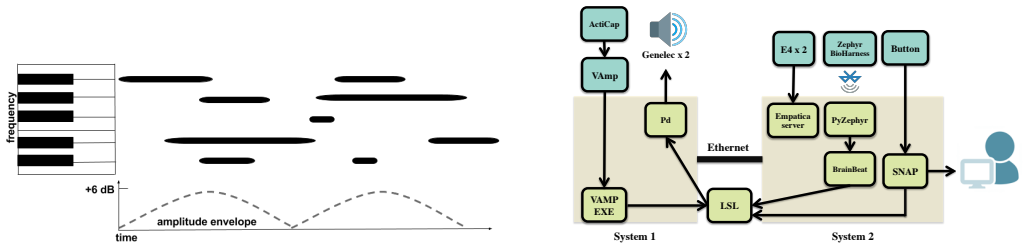
The three amplitude-modulation designs—Fixed Tempo at six beats per minute, Personalized Tempo fixed at 75 percent of each individual's baseline breathing rate, and Personalized Envelope that matches breathing in real time—that control the loudness shifts in the generated ambient music.
If this is right
- The Personalized Tempo design outperforms the non-personalized Fixed Tempo design in slowing breathing.
- Reductions in peripheral and cortical arousal markers occur together with the breathing slowdown.
- Interactive biometric music can produce these effects without requiring users to focus on breathing or listening.
- Such systems may therefore affect physiology more strongly than traditional recorded music.
Where Pith is reading between the lines
- The same real-time modulation principle could be applied to other target rhythms such as heart-rate variability.
- Repeated exposure might produce lasting changes in breathing habits even after the music is removed.
- Integration into consumer devices could allow on-demand physiological regulation during daily activities.
Load-bearing premise
The measured drops in breathing rate and arousal markers are caused by the music designs themselves rather than by the demands of the attention task, participant expectations, or artifacts in the recording equipment.
What would settle it
A control condition in which the same participants perform the identical attention task with either no music or non-adaptive recorded music produces no comparable reductions in breathing rate or in the electrodermal, heart-rate, and EEG arousal markers.
Figures


read the original abstract
We engineered an interactive music system that influences a user's breathing rate to induce a relaxation response. This system generates ambient music containing periodic shifts in loudness that are determined by the user's own breathing patterns. We evaluated the efficacy of this music intervention for participants who were engaged in an attention-demanding task, and thus explicitly not focusing on their breathing or on listening to the music. We measured breathing patterns in addition to multiple peripheral and cortical indicators of physiological arousal while users experienced three different interaction designs: (1) a "Fixed Tempo" amplitude modulation rate at six beats per minute; (2) a "Personalized Tempo" modulation rate fixed at 75\% of each individual's breathing rate baseline, and (3) a "Personalized Envelope" design in which the amplitude modulation matches each individual's breathing pattern in real-time. Our results revealed that each interactive music design slowed down breathing rates, with the "Personalized Tempo" design having the largest effect, one that was more significant than the non-personalized design. The physiological arousal indicators (electrodermal activity, heart rate, and slow cortical potentials measured in EEG) showed concomitant reductions, suggesting that slowing users' breathing rates shifted them towards a more calmed state. These results suggest that interactive music incorporating biometric data may have greater effects on physiology than traditional recorded music.
Editorial analysis
A structured set of objections, weighed in public.
Referee Report
Summary. The manuscript presents an interactive music system that uses real-time biometric data (breathing patterns) to modulate ambient music amplitude, with the goal of slowing users' breathing rates and reducing physiological arousal during an attention-demanding task. Three designs are compared: Fixed Tempo (6 bpm modulation), Personalized Tempo (75% of baseline breathing rate), and Personalized Envelope (real-time matching of breathing). Physiological measures include breathing rate, electrodermal activity, heart rate, and EEG slow cortical potentials. Results show breathing slowing across conditions (largest for Personalized Tempo) with concomitant arousal reductions, leading to the suggestion that biometric interactive music may have greater physiological effects than traditional recorded music.
Significance. If the reported directional effects and ranking among interactive designs are robust, the work contributes to HCI and biofeedback research by demonstrating how music personalization can influence physiology without explicit user focus. The multi-measure approach (peripheral and cortical) strengthens internal validity for the relaxation claim. The absence of a non-interactive baseline, however, means the comparative advantage over traditional music remains an untested extrapolation rather than a within-experiment finding.
major comments (2)
- [Abstract] Abstract: The concluding claim that 'interactive music incorporating biometric data may have greater effects on physiology than traditional recorded music' is load-bearing for the paper's broader implication but rests on an untested extrapolation. The experiment includes only three interactive/personalized conditions with no non-interactive recorded-music arm or no-music baseline, so differential efficacy is not directly compared.
- [Abstract] Abstract (and Methods/Results sections): No sample size, statistical tests, effect sizes, exclusion criteria, or power analysis are reported, despite directional effects and a comparative ranking among conditions being central to the efficacy claims. This prevents assessment of whether the 'more significant' effect for Personalized Tempo is reliable or clinically meaningful.
Simulated Author's Rebuttal
We thank the referee for these focused comments on the abstract. We agree that the extrapolation regarding traditional recorded music requires revision and that key methodological details should be summarized in the abstract for transparency.
read point-by-point responses
-
Referee: [Abstract] Abstract: The concluding claim that 'interactive music incorporating biometric data may have greater effects on physiology than traditional recorded music' is load-bearing for the paper's broader implication but rests on an untested extrapolation. The experiment includes only three interactive/personalized conditions with no non-interactive recorded-music arm or no-music baseline, so differential efficacy is not directly compared.
Authors: We agree the claim is an extrapolation, as the study compared only the three interactive designs without a non-interactive baseline arm. We will revise the abstract to remove this sentence and focus the concluding statement on the relative effects observed among the tested interactive conditions. revision: yes
-
Referee: [Abstract] Abstract (and Methods/Results sections): No sample size, statistical tests, effect sizes, exclusion criteria, or power analysis are reported, despite directional effects and a comparative ranking among conditions being central to the efficacy claims. This prevents assessment of whether the 'more significant' effect for Personalized Tempo is reliable or clinically meaningful.
Authors: We acknowledge the abstract omits these details. The full manuscript reports sample size, statistical tests (including comparisons among conditions), and exclusion criteria in Methods/Results, but we will add a concise summary of N, key tests, effect sizes, and exclusion criteria to the abstract. A post-hoc power analysis will also be included if feasible from the existing data. revision: yes
Circularity Check
No circularity: purely empirical study with no derivations or self-referential fits
full rationale
The paper reports a user study measuring physiological responses across three interactive music conditions. No equations, fitted parameters, predictions, or first-principles derivations appear in the abstract or described methods; all claims rest on direct experimental contrasts among the tested conditions. The suggestion that interactive biometric music may outperform traditional recorded music is an untested extrapolation rather than a result that reduces to its own inputs by construction. No self-citations, ansatzes, or uniqueness theorems are invoked to support core results. This is a standard empirical design whose central claims can be evaluated against the reported data without circular reduction.
Axiom & Free-Parameter Ledger
axioms (2)
- domain assumption Periodic auditory amplitude changes can entrain or slow human breathing rate
- domain assumption Reductions in electrodermal activity, heart rate, and slow cortical potentials indicate lowered physiological arousal
Lean theorems connected to this paper
-
IndisputableMonolith/Cost/FunctionalEquation.leanwashburn_uniqueness_aczel unclear?
unclearRelation between the paper passage and the cited Recognition theorem.
We evaluated the efficacy of this music intervention... three different interaction designs: (1) a 'Fixed Tempo' amplitude modulation rate at six beats per minute; (2) a 'Personalized Tempo' modulation rate fixed at 75% of each individual's breathing rate baseline, and (3) a 'Personalized Envelope' design...
-
IndisputableMonolith/Foundation/RealityFromDistinction.leanreality_from_one_distinction unclear?
unclearRelation between the paper passage and the cited Recognition theorem.
Our results revealed that each interactive music design slowed down breathing rates... concomitant reductions, suggesting that slowing users' breathing rates shifted them towards a more calmed state.
What do these tags mean?
- matches
- The paper's claim is directly supported by a theorem in the formal canon.
- supports
- The theorem supports part of the paper's argument, but the paper may add assumptions or extra steps.
- extends
- The paper goes beyond the formal theorem; the theorem is a base layer rather than the whole result.
- uses
- The paper appears to rely on the theorem as machinery.
- contradicts
- The paper's claim conflicts with a theorem or certificate in the canon.
- unclear
- Pith found a possible connection, but the passage is too broad, indirect, or ambiguous to say the theorem truly supports the claim.
Reference graph
Works this paper leans on
-
[1]
L. B. Meyer, Emotion and meaning in music . U. of Chicago P., 1956
work page 1956
-
[2]
Directing physiology and mood through music: Validation of an affective music player,
M. D. van der Zwaag, J. H. Janssen, and J. H. Westerink, “Directing physiology and mood through music: Validation of an affective music player,” TAC, vol. 4, no. 1, pp. 57–68, 2012
work page 2012
-
[3]
Breathe with the ocean: a system for relaxation using audio, haptic and visual stimuli,
E. O. Dijk and A. Weffers, “Breathe with the ocean: a system for relaxation using audio, haptic and visual stimuli,” in EuroHaptics, 2011
work page 2011
-
[4]
Emotional responses to music: The need to consider underlying mechanisms,
P. N. Juslin and D. V ¨astfj¨all, “Emotional responses to music: The need to consider underlying mechanisms,” Behav. and brain sciences , vol. 31, no. 5, pp. 559–575, 2008
work page 2008
-
[5]
Music structure and emotional response: Some empirical findings,
J. A. Sloboda, “Music structure and emotional response: Some empirical findings,” Psychology of music , vol. 19, no. 2, pp. 110–120, 1991
work page 1991
-
[6]
Musically informed sonification for self-directed chronic pain physical rehabili- tation,
J. Newbold, N. Berthouze, N. Gold, and A. Williams, “Musically informed sonification for self-directed chronic pain physical rehabili- tation,” 2015
work page 2015
-
[7]
Temporal control of movements in sensorimotor synchronization,
G. Aschersleben, “Temporal control of movements in sensorimotor synchronization,” Brain and cognition , vol. 48, no. 1, pp. 66–79, 2002
work page 2002
-
[8]
Sensorimotor synchronization: a review of the tapping literature,
B. H. Repp, “Sensorimotor synchronization: a review of the tapping literature,” Psychonomic bul. & rev. , vol. 12, no. 6, 2005
work page 2005
-
[9]
Using music as a signal for biofeedback,
I. Bergstrom, S. Seinfeld, J. Arroyo-Palacios, M. Slater, and M. V . Sanchez-Vives, “Using music as a signal for biofeedback,” International J. of Psychophysiology , vol. 93, no. 1, pp. 140–149, 2014
work page 2014
-
[10]
Emotions evoked by the sound of music: characterization, classification, and measurement
M. Zentner, D. Grandjean, and K. R. Scherer, “Emotions evoked by the sound of music: characterization, classification, and measurement.” Emotion, vol. 8, no. 4, p. 494, 2008
work page 2008
-
[11]
Emotion in motion: A study of music and affective response,
J. Jaimovich, N. Coghlan, and R. B. Knapp, “Emotion in motion: A study of music and affective response,” in International Symposium on Computer Music Modeling and Retrieval . Springer, 2012, pp. 19–43
work page 2012
-
[12]
D. Sammler, M. Grigutsch, T. Fritz, and S. Koelsch, “Music and emotion: electrophysiological correlates of the processing of pleasant and unpleasant music.” Psychophysiology, vol. 44, no. 2, 2007
work page 2007
-
[13]
The rewarding aspects of music listening are related to degree of emotional arousal
V . N. Salimpoor, M. Benovoy, G. Longo, J. R. Cooperstock, and R. J. Zatorre, “The rewarding aspects of music listening are related to degree of emotional arousal.” PloS one , vol. 4, no. 10, p. e7487, jan 2009
work page 2009
-
[14]
Catch your breath-musical biofeed- back for breathing regulation,
D. Siwiak, J. Berger, and Y . Yang, “Catch your breath-musical biofeed- back for breathing regulation,” in Audio Eng. Society Conv. , 2009
work page 2009
-
[15]
Unwind: a musical biofeedback for relaxation assistance,
B. Yu, M. Funk, J. Hu, and L. Feijs, “Unwind: a musical biofeedback for relaxation assistance,” Behav. & Info. Tech. , vol. 37, no. 8, 2018
work page 2018
-
[16]
Interactively mediating experiences of mindfulness meditation,
J. Vidyarthi and B. E. Riecke, “Interactively mediating experiences of mindfulness meditation,” International J. of Human-Computer Studies , vol. 72, no. 8, pp. 674–688, 2014
work page 2014
-
[17]
S. L. Robb, “Music assisted progressive muscle relaxation, progressive muscle relaxation, music listening, and silence: A comparison of relax- ation techniques,” J. of Music Therapy , vol. 37, no. 1, pp. 2–21, 2000
work page 2000
-
[18]
L. Bernardi, C. Porta, and P. Sleight, “Cardiovascular, cerebrovascular, & respiratory changes induced by different types of music in musicians & non-musicians: the importance of silence,” Heart, vol. 92, no. 4, 2006
work page 2006
-
[19]
Music-based respiratory biofeedback in visually-demanding tasks
R. Bhandari, A. Parnandi, E. Shipp, B. Ahmed, and R. Gutierrez-Osuna, “Music-based respiratory biofeedback in visually-demanding tasks.” in NIME, 2015, pp. 78–82
work page 2015
-
[20]
Peripheral paced respiration: influencing user physiology during information work,
N. Moraveji, B. Olson, T. Nguyen, M. Saadat, Y . Khalighi, R. Pea, and J. Heer, “Peripheral paced respiration: influencing user physiology during information work,” in ACM symp. on UI sw. & tech. , 2011
work page 2011
-
[21]
Central signals of perceived exertion during dynamic exercise
R. J. Robertson, “Central signals of perceived exertion during dynamic exercise.” Medicine & Science in Sports & Exercise , vol. 14, no. 5, 1982
work page 1982
-
[22]
Endocrinology of the stress response,
E. Charmandari, C. Tsigos, and G. Chrousos, “Endocrinology of the stress response,” Annu. Rev. Physiol. , vol. 67, pp. 259–284, 2005
work page 2005
-
[23]
Specific respiratory patterns distinguish among human basic emotions,
S. Bloch, M. Lemeignan, and N. Aguilera-T, “Specific respiratory patterns distinguish among human basic emotions,” International J. of Psychophysiology, vol. 11, no. 2, pp. 141–154, 1991
work page 1991
-
[24]
R. P. Brown and P. L. Gerbarg, “Sudarshan kriya yogic breathing in the treatment of stress, anxiety, and depression: part ineurophysiologic model,” J. of Alternative & Complementary Medicine , vol. 11, no. 1, pp. 189–201, 2005
work page 2005
-
[25]
——, “Sudarshan kriya yogic breathing in the treatment of stress, anxiety, and depression: part iiclinical applications and guidelines,” J. of Alternative & Complementary Medicine , vol. 11, no. 4, 2005
work page 2005
-
[26]
Effect of controlled deep breathing on psychomotor & higher mental functions in normal individuals
S. Soni, L. N. Joshi, and A. Datta, “Effect of controlled deep breathing on psychomotor & higher mental functions in normal individuals.” 2015
work page 2015
-
[27]
Respiratory feedback in the generation of emotion,
P. Philippot, G. Chapelle, and S. Blairy, “Respiratory feedback in the generation of emotion,” Cognition & Emotion , vol. 16, no. 5, 2002
work page 2002
-
[28]
E. F. Bryant, The yoga sutras of Patanjali: A new edition, translation, and commentary . North Point Press, 2015
work page 2015
-
[29]
Mindfulness-based interventions in context: past, present, and future,
J. Kabat-Zinn, “Mindfulness-based interventions in context: past, present, and future,” Clinical psychology: Science and practice , vol. 10, no. 2, pp. 144–156, 2003
work page 2003
-
[30]
Mindless comput- ing: designing technologies to subtly influence behavior,
A. T. Adams, J. Costa, M. F. Jung, and T. Choudhury, “Mindless comput- ing: designing technologies to subtly influence behavior,” in Proceedings of the 2015 ACM International Joint Conference on Pervasive and Ubiquitous Computing . ACM, 2015, pp. 719–730
work page 2015
-
[31]
The influence of implicit and explicit biofeedback in first- person shooter games,
K. Kuikkaniemi, T. Laitinen, M. Turpeinen, T. Saari, I. Kosunen, and N. Ravaja, “The influence of implicit and explicit biofeedback in first- person shooter games,” in CHI. ACM, 2010, pp. 859–868
work page 2010
-
[32]
Brightbeat: Effortlessly influencing breathing for cultivating calmness and focus,
A. Ghandeharioun and R. Picard, “Brightbeat: Effortlessly influencing breathing for cultivating calmness and focus,” in Proceedings of the 2017 CHI Conference Extended Abstracts on Human Factors in Computing Systems. ACM, 2017, pp. 1624–1631
work page 2017
-
[33]
Pure data: another integrated computer music environment,
M. Puckette et al. , “Pure data: another integrated computer music environment,” Proceedings of the second intercollege computer music concerts, pp. 37–41, 1996
work page 1996
-
[34]
P. M. Lehrer, E. Vaschillo, and B. Vaschillo, “Resonant frequency biofeedback training to increase cardiac variability: Rationale and man- ual for training,” Applied psychophysiology and biofeedback , vol. 25, no. 3, pp. 177–191, 2000
work page 2000
-
[35]
Contingent negative variation (CNV) and psychological processes in man,
J. J. Tecce, “Contingent negative variation (CNV) and psychological processes in man,” Psychological Bul., vol. 77, no. 2, pp. 73–108, 1972
work page 1972
-
[36]
C. Kothe, “Lab streaming layer (lsl),” accessed: 2017-10-01
work page 2017
-
[37]
A. Delorme and S. Makeig, “Eeglab: an open source toolbox for analysis of single-trial eeg dynamics including independent component analysis,” J. of neuroscience methods , vol. 134, no. 1, pp. 9–21, 2004
work page 2004
-
[38]
Differential Go/NoGo Activity in Both Contingent Negative Variation and Spectral Power,
I. Funderud, M. Lindgren, M. Løvstad, T. Endestad, B. V oytek, R. T. Knight, and A. K. Solbakk, “Differential Go/NoGo Activity in Both Contingent Negative Variation and Spectral Power,” PLoS ONE , vol. 7, no. 10, 2012
work page 2012
-
[39]
A real-time qrs detection algorithm,
J. Pan and W. J. Tompkins, “A real-time qrs detection algorithm,” IEEE Trans. Biomed. Eng , vol. 32, no. 3, pp. 230–236, 1985
work page 1985
-
[40]
Python package for heart rate variability analysis,
“Python package for heart rate variability analysis,” https://github.com/ rhenanbartels/hrv, accessed: 2019-04-01
work page 2019
-
[41]
Some implementations of the boxplot,
M. Frigge, D. C. Hoaglin, and B. Iglewicz, “Some implementations of the boxplot,” The American Statistician , vol. 43, no. 1, pp. 50–54, 1989
work page 1989
-
[42]
Breathing-control lowers blood pressure,
E. Grossman, A. Grossman, M. Schein, R. Zimlichman, and B. Gavish, “Breathing-control lowers blood pressure,” J. of human hypertension , vol. 15, no. 4, p. 263, 2001
work page 2001
-
[43]
A sigh following sustained attention and mental stress: effects on respiratory variability,
E. Vlemincx, I. Van Diest, and O. Van den Bergh, “A sigh following sustained attention and mental stress: effects on respiratory variability,” Physiology & behavior , vol. 107, no. 1, pp. 1–6, 2012
work page 2012
-
[44]
Sigh rate and respiratory variability during mental load and sustained attention,
E. Vlemincx, J. Taelman, S. De Peuter, I. Van Diest, and O. Van Den Bergh, “Sigh rate and respiratory variability during mental load and sustained attention,” Psychophysiology, vol. 48, no. 1, 2011
work page 2011
-
[45]
Take a deep breath: the relief effect of spontaneous and instructed sighs,
E. Vlemincx, J. Taelman, I. Van Diest, and O. Van den Bergh, “Take a deep breath: the relief effect of spontaneous and instructed sighs,” Physiology & behavior , vol. 101, no. 1, pp. 67–73, 2010
work page 2010
-
[46]
M. Wysocki, C. Cracco, A. Teixeira, A. Mercat, J.-L. Diehl, Y . Lefort, J.-P. Derenne, and T. Similowski, “Reduced breathing variability as a predictor of unsuccessful patient separation from mechanical ventila- tion,” Critical care medicine , vol. 34, no. 8, pp. 2076–2083, 2006
work page 2076
-
[47]
Impact of ventilatory modes on the breathing variability in mechanically ventilated infants,
F. Baudin, H.-T. Wu, A. Bordessoule, J. Beck, P. Jouvet, M. G. Frasch, and G. Emeriaud, “Impact of ventilatory modes on the breathing variability in mechanically ventilated infants,” Frontiers in pediatrics , vol. 2, p. 132, 2014
work page 2014
-
[48]
Boucsein, Electrodermal activity
W. Boucsein, Electrodermal activity. Springer Sci. & Bus. Media, 2012
work page 2012
-
[49]
The relationship between quantified eeg and skin conductance level,
C. Lim, R. Barry, E. Gordon, A. Sawant, C. Rennie, and C. Yiannikas, “The relationship between quantified eeg and skin conductance level,” International J. of Psychophysiology, vol. 21, no. 2, pp. 151 – 162, 1996
work page 1996
-
[50]
Effects of reduction in arousal level caused by long-lasting task on cnv,
S. Higuchi, S. Watanuki, and A. Yasukouchi, “Effects of reduction in arousal level caused by long-lasting task on cnv,” Applied Human Science, vol. 16, no. 1, pp. 29–34, 1997
work page 1997
-
[51]
Y . Nagai, L. H. Goldstein, H. D. Critchley, and P. B. Fenwick, “Influence of sympathetic autonomic arousal on cortical arousal: implications for a therapeutic behavioural intervention in epilepsy,” Epilepsy research , vol. 58, no. 2-3, pp. 185–193, 2004
work page 2004
-
[52]
Effect of respiration in heart rate variability (hrv) analysis,
B. Aysin and E. Aysin, “Effect of respiration in heart rate variability (hrv) analysis,” in EMBC. IEEE, 2006, pp. 1776–1779
work page 2006
-
[53]
Multiple arousal theory and daily-life electrodermal activity asymmetry,
R. W. Picard, S. Fedor, and Y . Ayzenberg, “Multiple arousal theory and daily-life electrodermal activity asymmetry,” Emotion Rev., vol. 8, no. 1, pp. 62–75, 2016
work page 2016
discussion (0)
Sign in with ORCID, Apple, or X to comment. Anyone can read and Pith papers without signing in.