Word-representability of Toeplitz graphs
Pith reviewed 2026-05-24 18:19 UTC · model grok-4.3
The pith
Toeplitz graphs defined by constant diagonal patterns are word-representable for several general classes, with constructions for non-representable cases and infinite examples.
A machine-rendered reading of the paper's core claim, the machinery that carries it, and where it could break.
Core claim
Word-representable Toeplitz graphs exist in several general classes where explicit words can be built to satisfy the alternation condition exactly on the edges determined by the constant diagonal patterns; non-word-representable Toeplitz graphs can be constructed similarly, and infinite word-representable Riordan graphs are introduced with examples.
What carries the argument
The definition of word-representability via alternation of letters in a word matching the edges of the graph, applied to the Toeplitz structure of Riordan graphs of Appell type.
Load-bearing premise
The constant-diagonal patterns allow explicit word constructions that realize the exact alternation condition without internal contradictions in the periodic adjacency.
What would settle it
Finding a Toeplitz graph in one of the general classes claimed to be word-representable for which no such alternating word exists, or showing that a constructed non-representable example actually admits one.
Figures
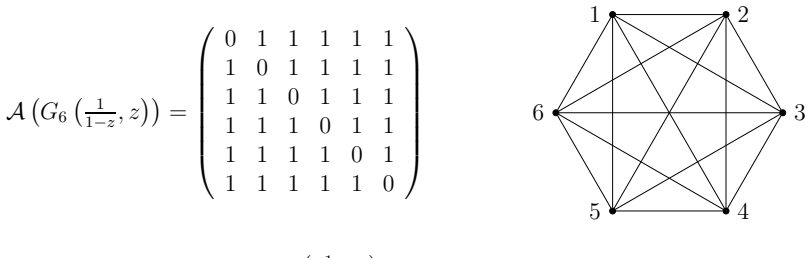
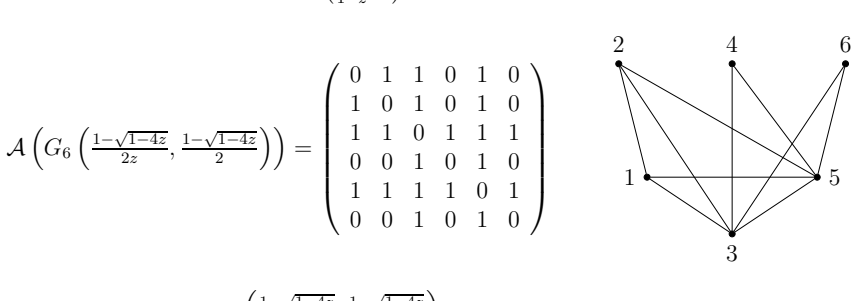
read the original abstract
Distinct letters $x$ and $y$ alternate in a word $w$ if after deleting in $w$ all letters but the copies of $x$ and $y$ we either obtain a word of the form $xyxy\cdots$ (of even or odd length) or a word of the form $yxyx\cdots$ (of even or odd length). A graph $G=(V,E)$ is word-representable if there exists a word $w$ over the alphabet $V$ such that letters $x$ and $y$ alternate in $w$ if and only if $xy$ is an edge in $E$. In this paper we initiate the study of word-representable Toeplitz graphs, which are Riordan graphs of the Appell type. We prove that several general classes of Toeplitz graphs are word-representable, and we also provide a way to construct non-word-representable Toeplitz graphs. Our work not only merges the theories of Riordan matrices and word-representable graphs via the notion of a Riordan graph, but also it provides the first systematic study of word-representability of graphs defined via patterns in adjacency matrices. Moreover, our paper introduces the notion of an infinite word-representable Riordan graph and gives several general examples of such graphs. It is the first time in the literature when the word-representability of infinite graphs is discussed.
Editorial analysis
A structured set of objections, weighed in public.
Referee Report
Summary. The paper initiates the study of word-representability for Toeplitz graphs (Riordan graphs of Appell type). It proves word-representability for several general classes via explicit constructions realizing the required alternation condition exactly on the constant diagonals, provides a separate construction for non-word-representable Toeplitz graphs, and introduces infinite word-representable Riordan graphs with general examples.
Significance. If the constructions hold, this merges the theories of Riordan matrices and word-representable graphs and provides the first systematic study of word-representability for graphs defined via adjacency matrix patterns. The explicit constructions for the classes and the extension to infinite graphs are strengths. The stress-test concern about compatibility of the alternation condition with the Toeplitz constant-diagonal pattern does not land on the manuscript; the definitions are standard and no internal inconsistency is apparent.
minor comments (2)
- The abstract states that 'several general classes' are shown to be word-representable but does not name them; adding a brief enumeration or reference to the relevant theorem numbers would improve clarity for readers.
- Notation for the infinite case (e.g., how alternation is defined for infinite words) should be introduced explicitly in the main text rather than left implicit from the finite case.
Simulated Author's Rebuttal
We thank the referee for the positive summary, significance assessment, and recommendation of minor revision. No specific major comments were provided in the report.
Circularity Check
No significant circularity
full rationale
The paper's claims rest on explicit combinatorial constructions that realize the alternation condition for word-representability on the constant-diagonal patterns of Toeplitz/Riordan graphs of Appell type, together with separate constructions for non-representable examples and infinite cases. These are direct proofs from the standard definitions of alternation and the matrix patterns; no equations reduce a claimed result to a fitted parameter or self-referential definition, and no load-bearing step is justified solely by a self-citation chain. The derivation is therefore self-contained.
Axiom & Free-Parameter Ledger
axioms (1)
- domain assumption Standard definitions of word-representability via alternation and of Toeplitz graphs as Riordan graphs of Appell type are assumed to hold without additional constraints.
Reference graph
Works this paper leans on
- [1]
-
[2]
E. J. L. Bell. Word-graph theory. PhD thesis, Lancaster Univer sity, 2011
work page 2011
-
[3]
I. M. Bomze, M. Budinich, P. M. Pardalos, M. Pelillo. “The maximum cliq ue problem”, Handbook of Combinatorial Optimization, 4, Kluwer Academic Publishe rs (1999) 1–74
work page 1999
-
[4]
R. L. Brooks. On colouring the nodes of a network. Proc. Cambridge Philos. Soc. 37 (1941) 194–197
work page 1941
- [5]
- [6]
-
[7]
A. Collins, S. Kitaev, V. Lozin. New results on word-representab le graphs, Discrete Appl. Math. 216P1 (2017) 136–141. 16
work page 2017
-
[8]
S. H. Ghorban, Toeplitz graph decomposition , Transactions on Combinatorics 1(4) (2012), 35–41
work page 2012
-
[9]
M. Glen. Software to work with word-representable graphs. Av ailable at https://personal.cis.strath.ac.uk/sergey.kitaev/word-representable-graphs.html
- [10]
-
[11]
M. Halld´ orsson, S. Kitaev, A. Pyatkin. Semi-transitive orienta tions and word- representable graphs. Discr. Appl. Math. 201 (2016) 164–171
work page 2016
-
[12]
Kitaev (2017) A Comprehensive introduction to the theory o f word-representable graphs
S. Kitaev (2017) A Comprehensive introduction to the theory o f word-representable graphs. In: ´E. Charlier, J. Leroy, M. Rigo (eds), Developments in Language The ory. DLT 2017. Lecture Notes Comp. Sci. 10396, Springer, 36–67
work page 2017
- [13]
- [14]
- [15]
-
[16]
M. Koebe. On a new class of intersection graphs. In Jaroslav Ne ˘ set˘ ril and Miroslav Fiedler, editors, Fourth Czechoslovakian Symposium on Combinator ics, Graphs and Complexity (Prachatice, 1990), volume 51 of Ann. Discrete Math., p ages 141–143. North-Holland, Amsterdam, 1992
work page 1990
- [17]
-
[18]
S. Seif. The Perkins Semigroup has Co-NP-complete term-equiv alence problem. Int. J. Alg. Comp. (IJAC) 15(2) (2005) 317–326. 17
work page 2005
discussion (0)
Sign in with ORCID, Apple, or X to comment. Anyone can read and Pith papers without signing in.