Reverse-order law for core inverse of tensors
Pith reviewed 2026-05-24 18:00 UTC · model grok-4.3
The pith
Sufficient and necessary conditions are established for the reverse-order law of the core inverse of tensors under the Einstein product.
A machine-rendered reading of the paper's core claim, the machinery that carries it, and where it could break.
Core claim
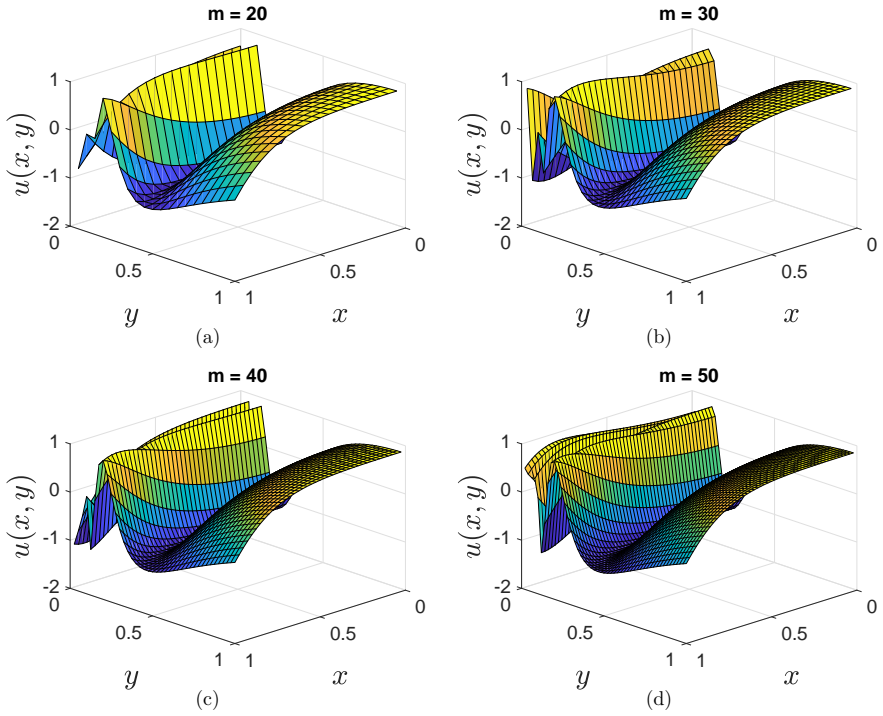
The notion of the core inverse of tensors with the Einstein product was introduced very recently. Sufficient and necessary conditions for the reverse-order law of this inverse are established. New results related to the mixed-type reverse-order law for core inverse are presented. Core inverse solutions of multilinear systems of tensors via the Einstein product are discussed, and the approach is demonstrated for solving the Poisson problem in the multilinear system framework.
What carries the argument
The core inverse of a tensor with respect to the Einstein product, together with the rank and range conditions that make the reverse-order law (A * B)^# = B^# * A^# hold.
If this is right
- The reverse-order law holds exactly when the identified sufficient and necessary conditions on the tensors are met.
- Mixed-type reverse-order laws hold under the additional relations derived in the paper.
- Multilinear tensor systems possess core-inverse solutions whenever the core inverse exists.
- The Poisson equation admits an explicit solution when recast as a multilinear system and solved via the core inverse.
Where Pith is reading between the lines
- The conditions may guide the design of algorithms that compute core inverses for large tensor arrays without forming the full product first.
- Similar rank-based criteria could be tested for other generalized inverses of tensors under the same product.
- The multilinear Poisson example suggests the method may apply to other linear PDEs discretized on tensor grids.
- Numerical stability of the resulting solutions could be checked on low-order test tensors that meet the conditions.
Load-bearing premise
The core inverse of each tensor in the statements is assumed to exist.
What would settle it
A concrete pair of tensors A and B satisfying the stated rank and range conditions for which (A * B)^# does not equal B^# * A^#.
Figures
read the original abstract
The notion of the core inverse of tensors with the Einstein product was introduced, very recently. This paper we establish some sufficient and necessary conditions for reverse-order law of this inverse. Further, we present new results related to the mixed-type reverse-order law for core inverse. In addition to these, we discuss core inverse solutions of multilinear systems of tensors via the Einstein product. The prowess of the inverse is demonstrated for solving the Poisson problem in the multilinear system framework.
Editorial analysis
A structured set of objections, weighed in public.
Referee Report
Summary. The paper builds on the recently introduced core inverse for tensors under the Einstein product. It derives sufficient and necessary conditions for the reverse-order law ((AB)^# = B^# A^#) to hold, presents results on mixed-type variants of this law, and shows how the core inverse yields solutions to multilinear tensor systems, with a demonstration on the Poisson problem.
Significance. If the derivations hold, the work extends matrix core-inverse theory to the tensor setting with the Einstein product, supplying explicit conditions under which the reverse-order law applies and a concrete method for solving multilinear systems. This could be useful for structured tensor computations in applications such as discretized PDEs.
major comments (2)
- [Abstract, §1] Abstract and §1: All stated sufficient/necessary conditions for the reverse-order law and the mixed-type variants, as well as the core-inverse solution method for multilinear systems, are conditional on the core inverse existing for the tensors involved. No new existence criteria or independent verification of existence within the Einstein-product framework are supplied; the results therefore inherit the standing assumption from the cited prior reference without additional analysis.
- [Application section (Poisson problem)] The demonstration for the Poisson problem is presented as an application of the core-inverse solution method, but because existence is not re-derived or guaranteed inside the manuscript, the numerical example only illustrates the method where the imported existence criterion already holds.
Simulated Author's Rebuttal
We thank the referee for the careful reading and constructive comments on our manuscript. We respond to each major comment below.
read point-by-point responses
-
Referee: [Abstract, §1] Abstract and §1: All stated sufficient/necessary conditions for the reverse-order law and the mixed-type variants, as well as the core-inverse solution method for multilinear systems, are conditional on the core inverse existing for the tensors involved. No new existence criteria or independent verification of existence within the Einstein-product framework are supplied; the results therefore inherit the standing assumption from the cited prior reference without additional analysis.
Authors: We agree that all results are conditional on the existence of the core inverses, as established in the cited prior reference introducing the core inverse for tensors under the Einstein product. The manuscript's focus is the derivation of necessary and sufficient conditions for the reverse-order law (and mixed-type variants) assuming existence, together with the application to multilinear systems; new existence criteria lie outside the stated scope. In the revised version we will explicitly restate the standing existence assumption in the abstract and §1 to make the conditional nature of the results fully transparent. revision: partial
-
Referee: [Application section (Poisson problem)] The demonstration for the Poisson problem is presented as an application of the core-inverse solution method, but because existence is not re-derived or guaranteed inside the manuscript, the numerical example only illustrates the method where the imported existence criterion already holds.
Authors: The Poisson-problem example is intended solely as an illustration of how the core-inverse solution method applies to a concrete multilinear system once the existence conditions from the prior reference are met. We will add a clarifying sentence in the application section noting that the numerical demonstration assumes the relevant core inverses exist according to the imported criterion. revision: yes
Circularity Check
No significant circularity; conditions derived independently under existence prerequisite
full rationale
The paper assumes the core inverse exists (as introduced in cited prior work) and derives sufficient/necessary conditions for reverse-order laws plus applications to multilinear systems. These are presented as mathematical results without any quoted reduction of the claimed laws to fitted parameters, self-definitions, or load-bearing self-citations that force the outcomes by construction. The existence assumption is a standard prerequisite rather than a circular step within this manuscript's derivations.
Axiom & Free-Parameter Ledger
axioms (2)
- domain assumption The core inverse of a tensor (as defined in the cited recent work) exists for the tensors under consideration.
- standard math The Einstein product obeys the usual associativity and distributivity rules needed for inverse manipulations.
Reference graph
Works this paper leans on
-
[1]
D. T. Barwick and J. D. Gilbert. Generalizations of the reverse or der law with related results. Linear Algebra and Appl. , 8:345–349, 1974
work page 1974
-
[2]
T. S. Baskett and I. J. Katz. Theorems on products of EPr matrices. Linear Algebra and Appl. , 2:87–103, 1969
work page 1969
- [3]
-
[4]
R. Behera and D. Mishra. Further results on generalized inverse s of tensors via the Einstein product. Linear Multilinear Algebra , 65(8):1662–1682, 2017
work page 2017
-
[5]
R. Behera, A. K. Nandi, and J. K. Sahoo. Further results on the drazin inverse of even order tensors. arXiv preprint arXiv:1904.10783 , 2019
work page internal anchor Pith review arXiv 1904
-
[6]
M. Brazell, N. Li, C. Navasca, and C. Tamon. Solving multilinear syst ems via tensor inversion. SIAM J. Matrix Anal. Appl. , 34(2):542–570, 2013
work page 2013
-
[7]
C. Cao, X. Zhang, and X. Tang. Reverse order law of group inver ses of products of two matrices. Appl. Math. Comput. , 158(2):489–495, 2004
work page 2004
-
[8]
L. De Lathauwer, B. De Moor, and J. Vandewalle. A multilinear singu lar value decomposition. SIAM J. Matrix Anal. Appl. , 21(4):1253–1278, 2000
work page 2000
-
[9]
V. de Silva and L.-H. Lim. Tensor rank and the ill-posedness of the b est low-rank approximation problem. SIAM J. Matrix Anal. Appl. , 30(3):1084–1127, 2008
work page 2008
-
[10]
C. Y. Deng. Reverse order law for the group inverses. J. Math. Anal. Appl. , 382(2):663–671, 2011
work page 2011
- [11]
-
[12]
T. N. E. Greville. Note on the generalized inverse of a matrix prod uct. SIAM Rev. , 9:249, 1966
work page 1966
-
[13]
M. Ishteva, P.-A. Absil, S. Van Huffel, and L. De Lathauwer. Bes t low multilinear rank approximation of higher-order tensors, based on the Riemannian trust-region s cheme. SIAM J. Matrix Anal. Appl. , 32(1):115–135, 2011
work page 2011
- [14]
- [15]
-
[16]
T. G. Kolda and B. W. Bader. Tensor decompositions and applicat ions. SIAM Rev. , 51(3):455–500, 2009. 23
work page 2009
-
[17]
J. B. Kruskal. Three-way arrays: rank and uniqueness of trilin ear decompositions, with application to arithmetic complexity and statistics. Linear Algebra and Appl. , 18(2):95–138, 1977
work page 1977
-
[18]
W. Lai, D. Rubin, and E. Krempl. Introduction to Continuum Mechanics . Butterworth Heinemann, Oxford, 2009
work page 2009
-
[19]
M. Liang and B. Zheng. Gradient-based iterative algorithms for solving sylvester tensor equations and the associated tensor nearness problems. arXiv preprint arXiv:1811.10378 , 2018
work page internal anchor Pith review Pith/arXiv arXiv 2018
-
[20]
M. Liang and B. Zheng. Further results on Moore-Penrose inve rses of tensors with application to tensor nearness problems. Comput. Math. Appl. , 77(5):1282–1293, 2019
work page 2019
- [21]
-
[22]
D. Mishra and K. Panigrahy. Reverse-order law of tensors rev isited. arXiv preprint arXiv: 1809.07017 , 2018
-
[23]
K. Panigrahy, R. Behera, and D. Mishra. Reverse-order law fo r the moore–penrose inverses of tensors. Linear Multilinear Algebra , pages 1–19, 2018
work page 2018
-
[24]
K. Panigrahy and D. Mishra. Reverse-order law for weighted mo ore–penrose inverse of tensors. arXiv preprint arXiv:1901.01527, 2019
-
[26]
J. K. Sahoo, R. Behera, P. S. Stanimirovic, V. N. Katsikis, and H . Ma. Core and core-ep inverses of tensors. arXiv preprint arXiv:1905.07874 , 2019
work page internal anchor Pith review arXiv 1905
-
[27]
X. Shi, Y. Wei, and S. Ling. Backward error and perturbation bo unds for high order Sylvester tensor equation. Linear Multilinear Algebra , 61(10):1436–1446, 2013
work page 2013
-
[28]
N. D. Sidiropoulos, L. De Lathauwer, X. Fu, K. Huang, E. E. Pap alexakis, and C. Faloutsos. Tensor decomposition for signal processing and machine learning. IEEE Trans. Signal Process. , 65(13):3551– 3582, 2017
work page 2017
-
[29]
P. Stanimirovic, M. Ciric, V. Katsikis, C. Li, and H. Ma. Outer and ( b,c) inverses of tensors. Linear Multilinear Algebra, pages 1–32, 2018
work page 2018
-
[30]
L. Sun, B. Zheng, C. Bu, and Y. Wei. Moore-Penrose inverse of tensors via Einstein product. Linear Multilinear Algebra, 64(4):686–698, 2016
work page 2016
-
[31]
L. Sun, B. Zheng, Y. Wei, and C. Bu. Generalized inverses of ten sors via a general product of tensors. Front. Math. China , 13(4):893–911, 2018
work page 2018
- [32]
discussion (0)
Sign in with ORCID, Apple, or X to comment. Anyone can read and Pith papers without signing in.