Development and Applicability of Online Passivity Enforced Wide-Band Multi-Port Equivalents For Hybrid Transient Simulation
Pith reviewed 2026-05-24 20:29 UTC · model grok-4.3
The pith
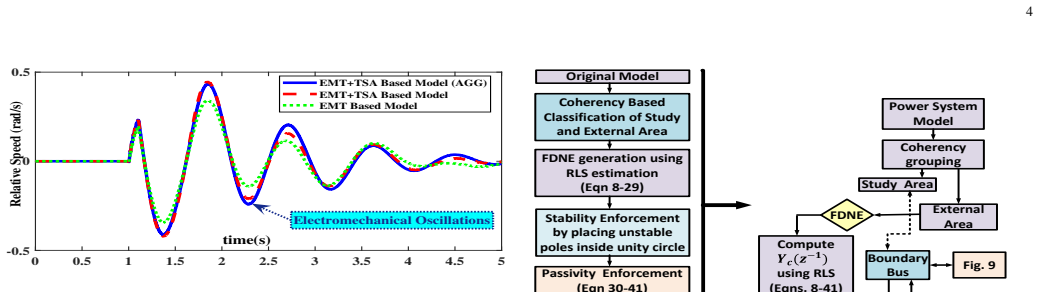
An online recursive least squares algorithm with passivity enforcement identifies multi-port frequency dependent network equivalents directly from data.
A machine-rendered reading of the paper's core claim, the machinery that carries it, and where it could break.
Core claim
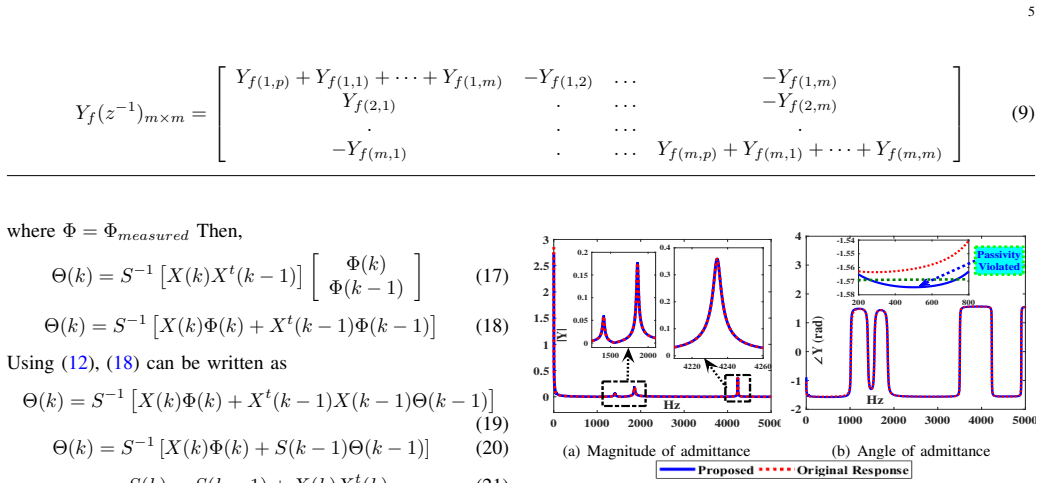
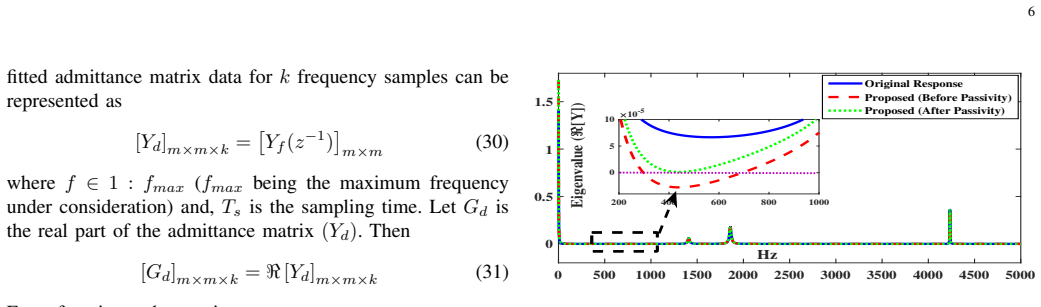
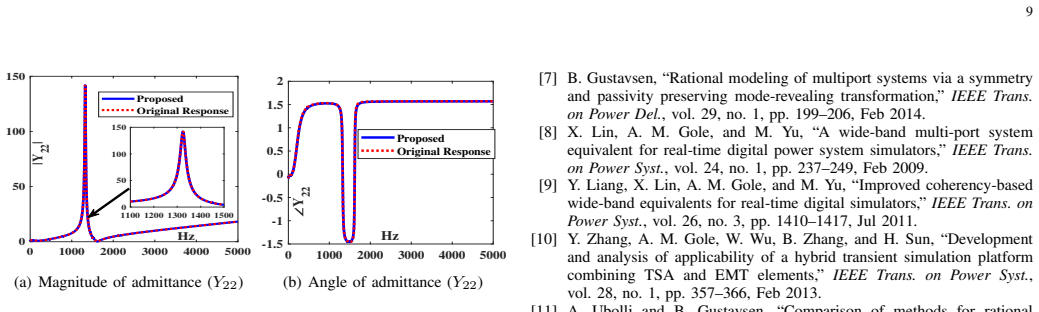
The proposed architecture identifies the FDNE even with unknown network parameters in the frequency range of interest, and yet can be implemented directly due to discrete formulation while maintaining desired accuracy, stability, and passivity conditions.
What carries the argument
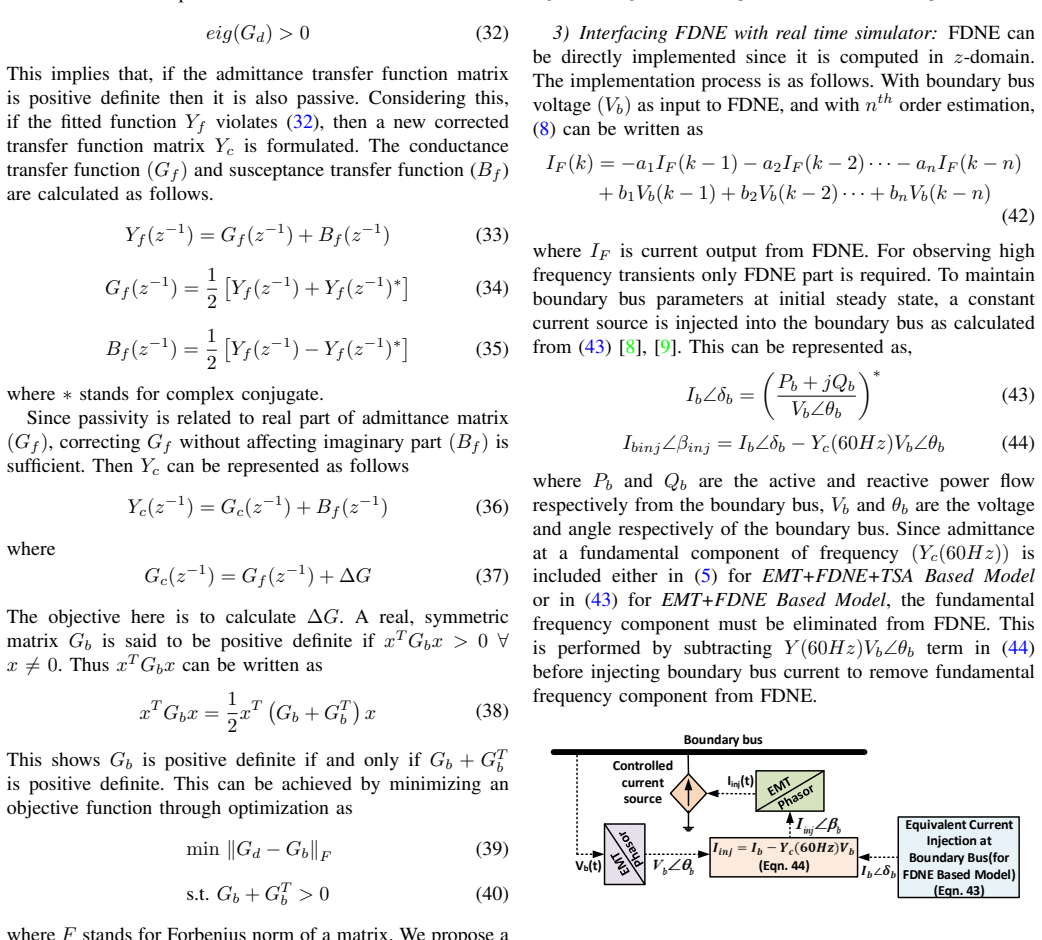
Passivity-enforced online recursive least squares identification algorithm that extracts the input admittance matrix in z-domain
If this is right
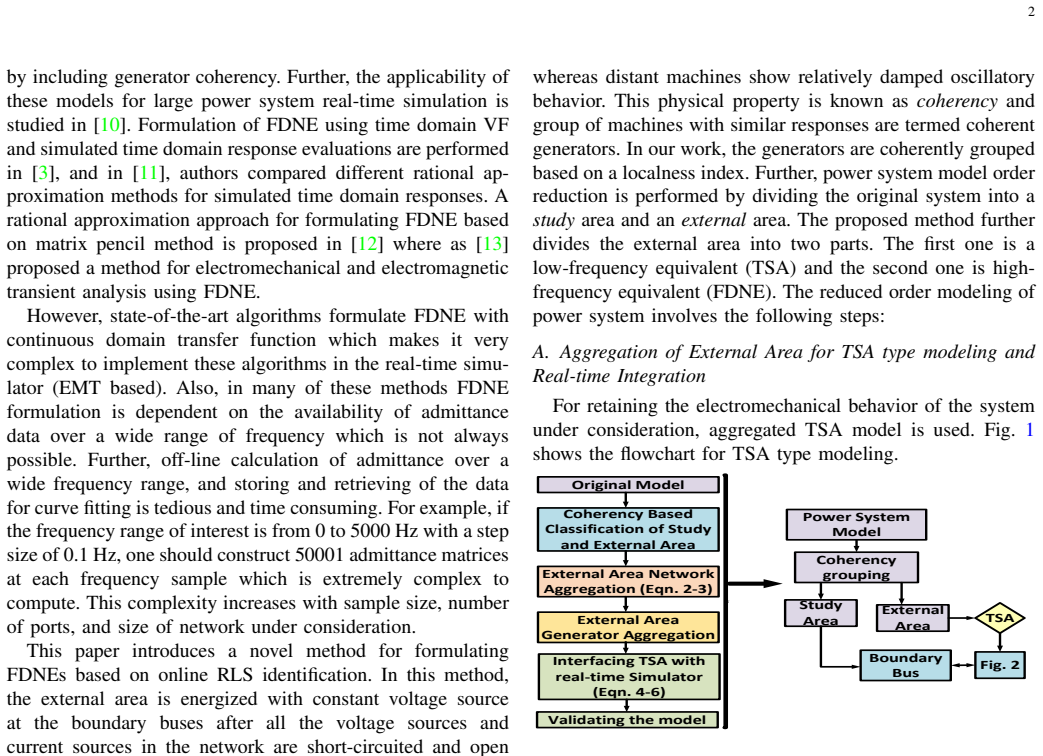
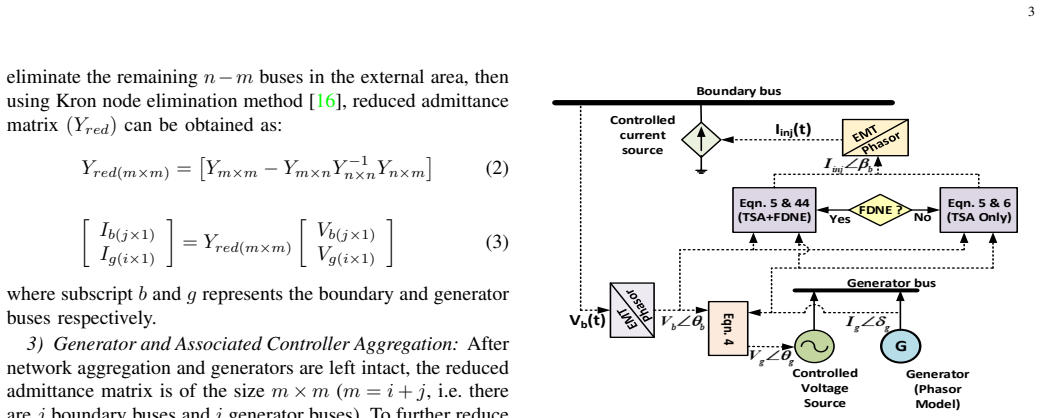
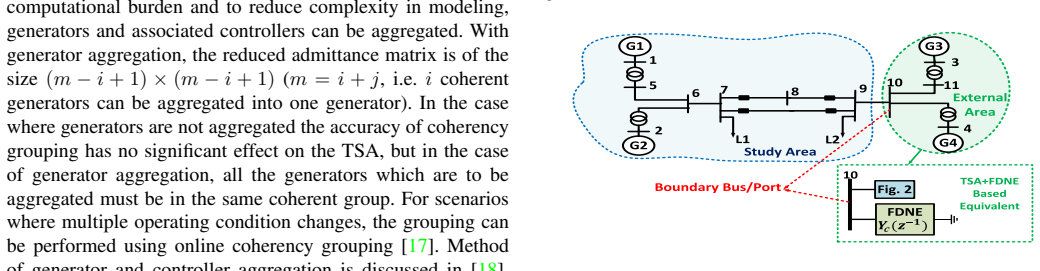
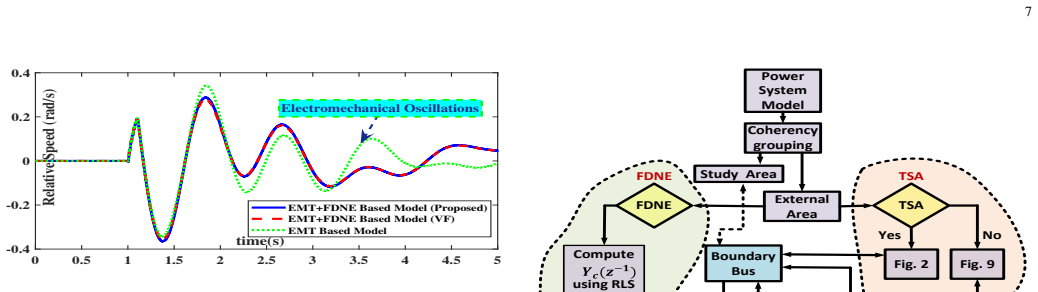
- The identified FDNEs integrate directly into real-time hybrid models that combine transient stability analysis with electromagnetic transient detail.
- Single-port and multi-port equivalents are produced by the same discrete-time identification process.
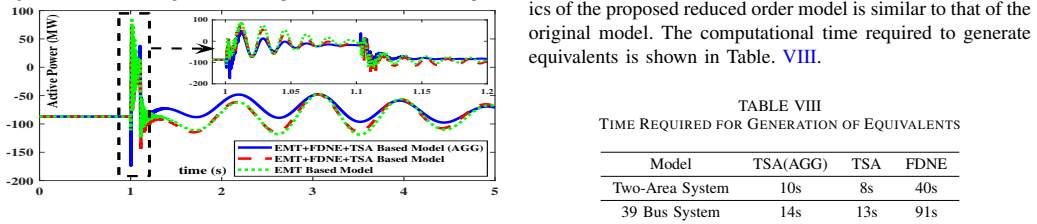
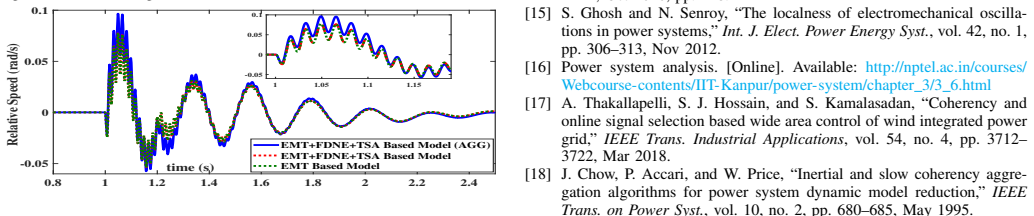
- The method applies to standard test cases including two-area, IEEE 39-bus, and IEEE 68-bus power system models while preserving accuracy and stability.
Where Pith is reading between the lines
- Online identification could support adaptive FDNE updates when network topology or loading changes during operation.
- The z-domain discrete formulation may reduce interface overhead when coupling with existing digital real-time simulators.
- Extending the passivity enforcement step to include measurement noise bounds could widen the range of practical field data that can be used.
Load-bearing premise
An online recursive least squares identification algorithm, once passivity is enforced, will produce an admittance matrix whose accuracy and stability hold for the full frequency range of interest without requiring prior knowledge of network parameters.
What would settle it
A simulation in which the identified FDNE is driven at a frequency or operating point outside the identification window and exhibits instability or loss of passivity.
Figures

read the original abstract
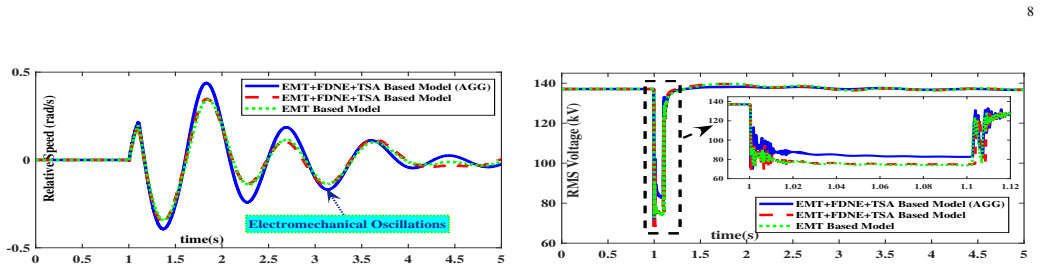
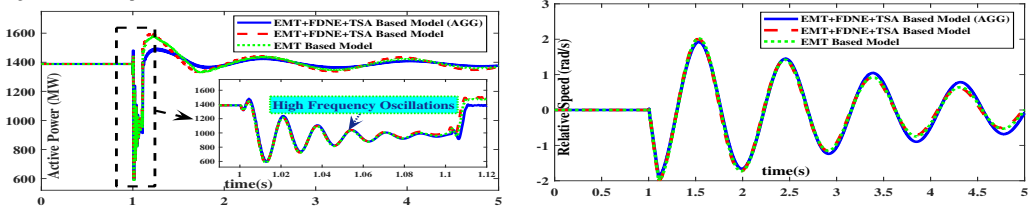
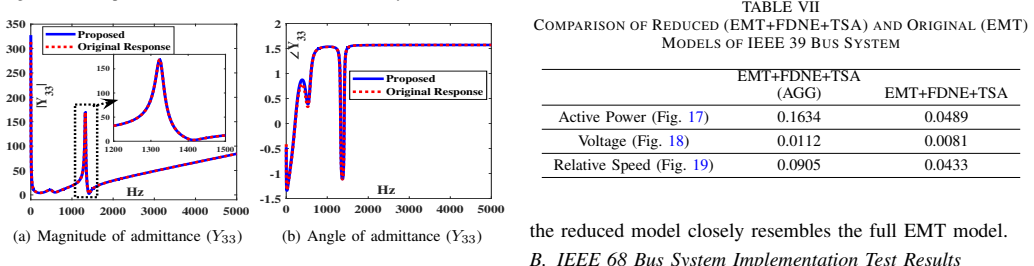
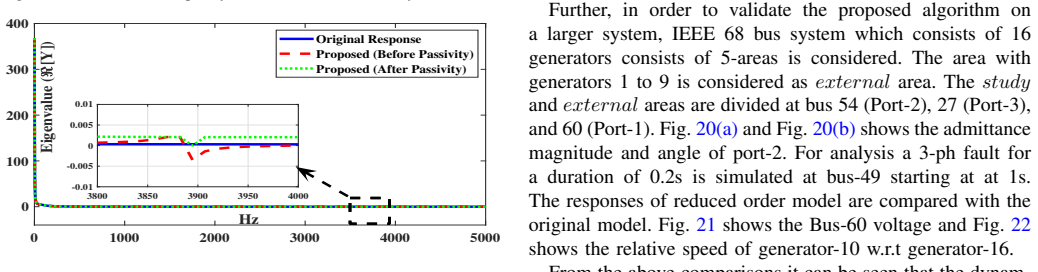
This paper presents a method for developing single and multi-port frequency dependent network equivalent (FDNE) based on a passivity enforced online recursive least squares identification algorithm, which identifies the input admittance matrix in z-domain. Furthermore, with the proposed architecture, a real-time hybrid model of the reduced power system is developed that integrate transient stability analysis and FDNE. Main advantages of the proposed architecture are, it identifies the FDNE even with unknown network parameters in the frequency range of interest, and yet can be implemented directly due to discrete formulation while maintaining desired accuracy, stability, and passivity conditions. The accuracy and characteristics of the proposed method are verified by implementing on two-area, IEEE 39 and 68 bus power system models.
Editorial analysis
A structured set of objections, weighed in public.
Referee Report
Summary. The manuscript presents a method for developing single- and multi-port frequency-dependent network equivalents (FDNE) via a passivity-enforced online recursive least-squares identification algorithm that identifies the input admittance matrix directly in the z-domain. It further describes a real-time hybrid model integrating transient stability analysis with the FDNE for reduced-order power-system representations. The central claims are that the approach identifies the FDNE even when network parameters are unknown within the frequency range of interest, can be implemented directly due to its discrete formulation, and maintains accuracy, stability, and passivity; verification is stated on two-area, IEEE 39-bus, and 68-bus models.
Significance. If substantiated, the work would offer a practical route to online FDNE construction for hybrid EMT-TSA simulators without requiring full network parameter knowledge, leveraging the discrete z-domain form for direct embedding. The emphasis on passivity enforcement and real-time applicability addresses a recognized need in large-scale power-system transient studies. However, the significance is limited by the absence of quantitative error metrics or excitation analysis, which are necessary to confirm that the fitted models remain accurate and passive over the full band of interest.
major comments (2)
- [Abstract] Abstract: the verification on IEEE 39- and 68-bus models is asserted without any quantitative error metrics, baseline comparisons against existing FDNE methods, or discussion of how the passivity-enforcement step modifies the underlying RLS fit; this information is load-bearing for the accuracy and stability claims.
- [Method] Method (RLS identification and passivity step): the claim that the z-domain RLS fit followed by passivity projection yields an admittance matrix whose accuracy and stability hold across the entire frequency range of interest, even with unknown parameters, lacks supporting analysis of persistent excitation or extrapolation error; power-system transients supply limited spectral content, so high-frequency poles and inter-port couplings may remain under-determined.
minor comments (1)
- [Abstract] Abstract: grammatical error in 'a real-time hybrid model ... is developed that integrate transient stability analysis' (should be 'integrates').
Simulated Author's Rebuttal
We thank the referee for the constructive feedback. We respond to each major comment below and indicate the revisions that will be incorporated.
read point-by-point responses
-
Referee: [Abstract] Abstract: the verification on IEEE 39- and 68-bus models is asserted without any quantitative error metrics, baseline comparisons against existing FDNE methods, or discussion of how the passivity-enforcement step modifies the underlying RLS fit; this information is load-bearing for the accuracy and stability claims.
Authors: We agree that the abstract would benefit from quantitative support. In the revised manuscript we will update the abstract to report specific error metrics (maximum relative error in admittance magnitude and phase over the frequency band) for the IEEE 39-bus and 68-bus cases, add a concise baseline comparison statement, and include a brief clause noting that passivity enforcement is performed via a minimal projection that preserves the accuracy of the underlying RLS fit. revision: yes
-
Referee: [Method] Method (RLS identification and passivity step): the claim that the z-domain RLS fit followed by passivity projection yields an admittance matrix whose accuracy and stability hold across the entire frequency range of interest, even with unknown parameters, lacks supporting analysis of persistent excitation or extrapolation error; power-system transients supply limited spectral content, so high-frequency poles and inter-port couplings may remain under-determined.
Authors: The manuscript currently supports the claims through time-domain verification on the cited benchmark systems. We acknowledge that an explicit discussion of persistent excitation and extrapolation behavior would strengthen the presentation. In the revision we will expand the method section with an analysis of the spectral content present in the transients used for identification and will demonstrate, via additional results from the test cases, that the online RLS-plus-projection procedure maintains accuracy and passivity across the band of interest. We maintain that the empirical evidence already indicates the approach is robust even when network parameters are unknown, but agree to add the requested supporting discussion. revision: partial
Circularity Check
No significant circularity; method is explicit data-driven identification with external verification
full rationale
The paper proposes an algorithmic procedure for constructing FDNEs via online RLS identification of the z-domain admittance matrix followed by passivity enforcement, then verifies performance on standard IEEE test systems (two-area, 39-bus, 68-bus). No derivation chain asserts first-principles predictions or uniqueness results that reduce to fitted parameters or self-citations by construction. Accuracy and stability claims rest on simulation outcomes against known network models rather than internal redefinition of inputs as outputs.
Axiom & Free-Parameter Ledger
Reference graph
Works this paper leans on
-
[1]
P. Sorensen and A. D. Hansen and P. Christensen and M. Mieritz and J. Bech and B. Bak-Jensen and H. Nielsen, Simulation and verification of transient events in large wind power installations . Ris National Laboratory, Rosklide, 2003
work page 2003
-
[2]
S. Abourida and J. Belanger and V . J. Marandi, Real-Time Power System Simulation: EMT vs. Phasor . OPAL-RT Technologies: White Paper: opWP150620-sa-revA, 2016
work page 2016
-
[3]
Multiport frequency-dependent network equivalencing based on simulated time-domain responses,
A. Ubolli and B. Gustavsen, “Multiport frequency-dependent network equivalencing based on simulated time-domain responses,” IEEE Trans. on Power Del., vol. 27, no. 2, pp. 648–657, Apr 2012
work page 2012
-
[4]
J. H. Chow, Power system coherency and model reduction . New York, NY , USA: Springer, 2013
work page 2013
-
[5]
Applications of real-time simulation technologies in power and energy systems,
X. Guillaud et al. , “Applications of real-time simulation technologies in power and energy systems,” IEEE Power Energy Technol. Syst. J. , vol. 2, no. 3, pp. 103–115, Sep 2015
work page 2015
-
[6]
B. Gustavsen and C. Heitz, “Fast realization of the modal vector fitting method for rational modeling with an accurate representation of small eigenvalues,” IEEE Trans. on Power Del., vol. 24, no. 3, pp. 1396–1405, Jul 2009
work page 2009
-
[7]
B. Gustavsen, “Rational modeling of multiport systems via a symmetry and passivity preserving mode-revealing transformation,” IEEE Trans. on Power Del., vol. 29, no. 1, pp. 199–206, Feb 2014
work page 2014
-
[8]
A wide-band multi-port system equivalent for real-time digital power system simulators,
X. Lin, A. M. Gole, and M. Yu, “A wide-band multi-port system equivalent for real-time digital power system simulators,” IEEE Trans. on Power Syst., vol. 24, no. 1, pp. 237–249, Feb 2009
work page 2009
-
[9]
Improved coherency-based wide-band equivalents for real-time digital simulators,
Y . Liang, X. Lin, A. M. Gole, and M. Yu, “Improved coherency-based wide-band equivalents for real-time digital simulators,” IEEE Trans. on Power Syst., vol. 26, no. 3, pp. 1410–1417, Jul 2011
work page 2011
-
[10]
Y . Zhang, A. M. Gole, W. Wu, B. Zhang, and H. Sun, “Development and analysis of applicability of a hybrid transient simulation platform combining TSA and EMT elements,” IEEE Trans. on Power Syst. , vol. 28, no. 1, pp. 357–366, Feb 2013
work page 2013
-
[11]
A. Ubolli and B. Gustavsen, “Comparison of methods for rational approximation of simulated time-domain responses: ARMA, ZD-VF, and TD-VF,” IEEE Trans. on Power Del. , vol. 26, no. 1, pp. 279–288, Jan 2011
work page 2011
-
[12]
Multiport frequency-dependent network equivalent using a modified matrix pencil method,
K. Sheshyekani and B. Tabei, “Multiport frequency-dependent network equivalent using a modified matrix pencil method,” IEEE Trans. on Power Del., vol. 29, no. 5, pp. 2340–2348, Oct 2014
work page 2014
-
[13]
X. Zhang, A. J. Flueck, and S. Abhyankar, “Implicitly coupled elec- tromechanical and electromagnetic transient analysis using a frequency- dependent network equivalent,” IEEE Trans. on Power Del. , vol. 32, no. 3, pp. 1262–1269, Jun 2017
work page 2017
-
[14]
Real-time reduced order model based adaptive pitch controller for grid connected wind turbines,
A. Thakallapelli, S. Ghosh, and S. Kamalasadan, “Real-time reduced order model based adaptive pitch controller for grid connected wind turbines,” in Proc. Industry Applications Society Annual Meeting (IAS), IEEE, Oct 2016, pp. 1–8
work page 2016
-
[15]
The localness of electromechanical oscilla- tions in power systems,
S. Ghosh and N. Senroy, “The localness of electromechanical oscilla- tions in power systems,” Int. J. Elect. Power Energy Syst., vol. 42, no. 1, pp. 306–313, Nov 2012
work page 2012
- [16]
-
[17]
Coherency and online signal selection based wide area control of wind integrated power grid,
A. Thakallapelli, S. J. Hossain, and S. Kamalasadan, “Coherency and online signal selection based wide area control of wind integrated power grid,” IEEE Trans. Industrial Applications , vol. 54, no. 4, pp. 3712– 3722, Mar 2018
work page 2018
-
[18]
Inertial and slow coherency aggre- gation algorithms for power system dynamic model reduction,
J. Chow, P. Accari, and W. Price, “Inertial and slow coherency aggre- gation algorithms for power system dynamic model reduction,” IEEE Trans. on Power Syst. , vol. 10, no. 2, pp. 680–685, May 1995
work page 1995
-
[19]
Stojkovic , Computer aided design in power engineering-application of software tools
Z. Stojkovic , Computer aided design in power engineering-application of software tools . Springer, 2012
work page 2012
-
[20]
Real-time frequency based reduced order modeling of large power grid,
A. Thakallapelli, S. Ghosh, and S. Kamalasadan, “Real-time frequency based reduced order modeling of large power grid,” in Proc. Power and Energy Society General Meeting, IEEE , Jul 2016, pp. 1–5
work page 2016
-
[21]
Coherency based online wide area control of renewable energy integrated power grid,
A. Thakallapelli, S. J. Hossain, and S. Kamalasadan, “Coherency based online wide area control of renewable energy integrated power grid,” in Proc. PEDES, IEEE , Dec 2016, pp. 1–6
work page 2016
-
[22]
K. J. Astrom and B. Wittenmark, Adaptive control. Addison-Wesley Publishing Company, 1995
work page 1995
-
[23]
Graph implementations for nonsmooth convex programs,
M. Grant and S. Boyd, “Graph implementations for nonsmooth convex programs,” in in Recent Advances in Learning and Control , New York: Springer, 2008, pp. 95–110
work page 2008
-
[24]
Report: 39-bus system (new england reduced model),
I. Hiskens, “Report: 39-bus system (new england reduced model),” IEEE PES Task Force on Benchmark Syst. for Stability Controls, 2013
work page 2013
-
[25]
A. K. Singh and B. C. Pal, Report on the 68-bus, 16-machine, 5-area system. IEEE PES Task Force on Benchmark Systems for Stability Controls, Ver. 3.3, 2013. A. Thakallapelli (S’14) received his B.Tech degree in Electrical Engineering from Acharya Nagarjuna University in 2010 and the M.Tech degree in Elec- trical Engineering from the Veermata Jijabai Tech-...
work page 2013
discussion (0)
Sign in with ORCID, Apple, or X to comment. Anyone can read and Pith papers without signing in.