Effective team onboarding in Agile software development: techniques and goals
Pith reviewed 2026-05-24 17:08 UTC · model grok-4.3
The pith
Agile teams use both formal and informal techniques to onboard new members, with some contributing highly to specific goals.
A machine-rendered reading of the paper's core claim, the machinery that carries it, and where it could break.
Core claim
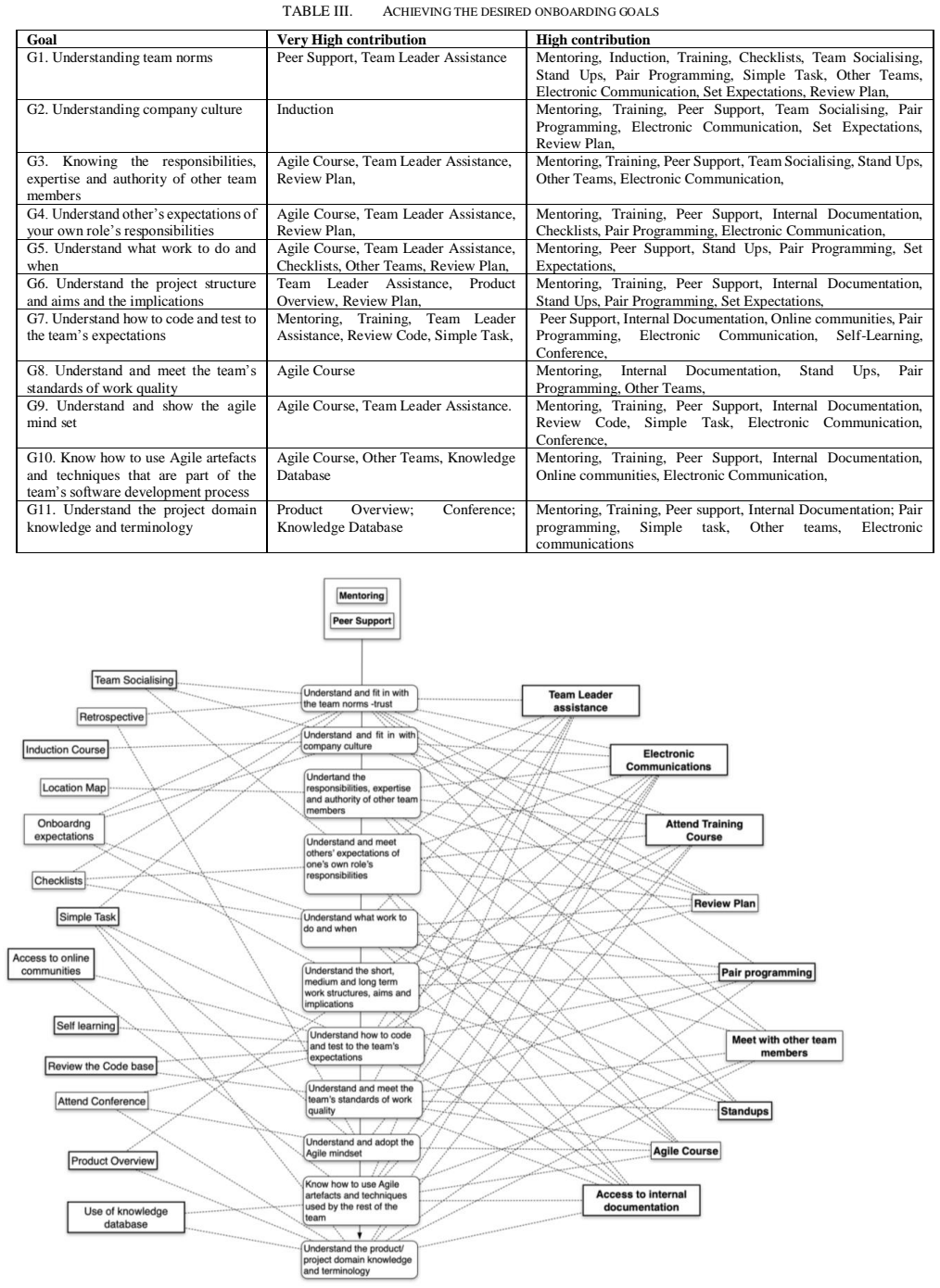
Our study reveals that a broad range of team onboarding techniques, both formal and informal, are used in practice. It also shows that particular techniques have high contributions to a given goal or set of goals. In presenting a set of onboarding goals to consider and an evidence-based mechanism for selecting techniques to achieve the desired goals it is expected that this study will contribute to better-informed onboarding design and planning.
What carries the argument
Repertory grid instrument that rates the contribution of each identified onboarding technique to the set of goals synthesized from the literature.
If this is right
- Teams can choose onboarding techniques according to the specific goals they want to prioritize.
- Onboarding programs can be planned with an explicit link between activities and desired outcomes.
- Practitioner awareness increases of the range of options available for supporting new team members.
- Organizations gain a concrete way to evaluate and adjust their current onboarding activities.
Where Pith is reading between the lines
- The same mapping approach could be tested in non-Agile development settings to check whether the technique-goal links differ.
- Longitudinal tracking of new hires after applying the mapped techniques would show whether the reported contributions translate into measurable integration speed.
- Remote or hybrid Agile teams might require adjustments to the identified techniques, which the current data does not address.
Load-bearing premise
The eleven participants from eight organizations supply a sufficient basis for identifying common techniques and their goal contributions across Agile teams in general.
What would settle it
A larger interview or observation study across additional organizations that finds the reported high-contribution technique-to-goal mappings do not hold or that different techniques dominate.
Figures

read the original abstract
Context: It is not uncommon for a new team member to join an existing Agile software development team, even after development has started. This new team member faces a number of challenges before they are integrated into the team and can contribute productively to team progress. Ideally, each newcomer should be supported in this transition through an effective team onboarding program, although prior evidence suggests that this is challenging for many organisations. Objective: We seek to understand how Agile teams address the challenge of team onboarding in order to inform future onboarding design. Method: We conducted an interview survey of eleven participants from eight organisations to investigate what onboarding activities are common across Agile software development teams. We also identify common goals of onboarding from a synthesis of literature. A repertory grid instrument is used to map the contributions of onboarding techniques to onboarding goals. Results: Our study reveals that a broad range of team onboarding techniques, both formal and informal, are used in practice. It also shows that particular techniques that have high contributions to a given goal or set of goals. Conclusions: In presenting a set of onboarding goals to consider and an evidence-based mechanism for selecting techniques to achieve the desired goals it is expected that this study will contribute to better-informed onboarding design and planning. An increase in practitioner awareness of the options for supporting new team members is also an expected outcome.
Editorial analysis
A structured set of objections, weighed in public.
Referee Report
Summary. The paper reports results from an interview survey of 11 participants across 8 organizations on onboarding practices in Agile software development teams. It synthesizes a set of common onboarding goals from the literature and employs a repertory grid instrument to map the contributions of observed formal and informal onboarding techniques to those goals. The central claim is that a broad range of techniques are used in practice and that particular techniques show high contributions to specific goals or goal sets, thereby offering an evidence-based mechanism to guide onboarding design.
Significance. If the technique-to-goal mappings hold, the work supplies practitioners with a structured, goal-oriented approach to selecting onboarding activities, which could improve new-member integration in Agile teams. The combination of empirical interview data with literature-derived goals and the repertory-grid mapping method constitutes a concrete contribution to the software engineering onboarding literature.
major comments (2)
- [Method] Method section and abstract: the claim that the study reveals techniques 'common across Agile software development teams' and identifies techniques with 'high contributions' to goals rests on interviews with only 11 participants from 8 organizations. No description is given of the sampling strategy, organization diversity (size, domain, Agile maturity), theoretical saturation, or cross-validation, so the generalizability asserted in the results and conclusions cannot be evaluated from the reported evidence.
- [Results] Results section: the repertory-grid mappings that identify techniques with 'high contributions' to given goals are presented without reporting the number of participants supporting each mapping, inter-rater agreement, or any sensitivity analysis; this leaves the strength and robustness of the contribution rankings unclear and load-bearing for the paper's prescriptive recommendation.
minor comments (1)
- [Abstract] The abstract states that 'particular techniques that have high contributions' but does not specify how many techniques or goals were examined; adding a brief count or table reference would improve clarity.
Simulated Author's Rebuttal
We thank the referee for these constructive comments on the scope and reporting of our qualitative study. We address each major point below, indicating revisions where the manuscript will be updated to better reflect the exploratory nature of the work and to strengthen the presentation of the mappings.
read point-by-point responses
-
Referee: [Method] Method section and abstract: the claim that the study reveals techniques 'common across Agile software development teams' and identifies techniques with 'high contributions' to goals rests on interviews with only 11 participants from 8 organizations. No description is given of the sampling strategy, organization diversity (size, domain, Agile maturity), theoretical saturation, or cross-validation, so the generalizability asserted in the results and conclusions cannot be evaluated from the reported evidence.
Authors: We agree that the sample is small and that the manuscript does not detail the sampling approach or organizational characteristics. This was an exploratory interview survey intended to surface techniques and goal mappings observed in practice rather than to support statistical generalization. We will revise the method section to describe recruitment (convenience sampling via professional networks) and available details on the eight organizations. We will also add an explicit limitations subsection noting the absence of theoretical saturation claims and the limited diversity, and we will adjust wording in the abstract, results, and conclusions from 'common across' to 'observed in our sample of' to avoid overstatement. revision: yes
-
Referee: [Results] Results section: the repertory-grid mappings that identify techniques with 'high contributions' to given goals are presented without reporting the number of participants supporting each mapping, inter-rater agreement, or any sensitivity analysis; this leaves the strength and robustness of the contribution rankings unclear and load-bearing for the paper's prescriptive recommendation.
Authors: The mappings were aggregated from the 11 individual repertory grids. We will revise the results section to include, for each technique-goal pair, the count of participants whose grids indicated a high contribution, thereby making the support for each ranking transparent. Formal inter-rater agreement statistics are not applicable because the grids were elicited directly from participants using the standard repertory-grid procedure; the research team performed the subsequent synthesis. We will add a brief note on this point and a short discussion of robustness based on the observed consistency across grids. No formal sensitivity analysis was conducted, but the added counts will allow readers to assess the strength of the evidence themselves. revision: partial
Circularity Check
No significant circularity in derivation chain
full rationale
The paper derives its findings on onboarding techniques and goal contributions directly from primary data collected via interviews with 11 participants and a literature synthesis for goals, with a repertory grid used only to organize the mapping. No mathematical derivations, fitted parameters, self-definitional loops, or load-bearing self-citations exist that would reduce any claim to its own inputs by construction. The central results are grounded in the empirical sample and external sources rather than being tautological, so the derivation chain is self-contained.
Axiom & Free-Parameter Ledger
axioms (1)
- domain assumption Goals synthesized from existing literature accurately capture the intended outcomes of team onboarding in Agile settings.
Reference graph
Works this paper leans on
-
[1]
J. Jeremiah, Survey: is agile the new norm?, retrieved from http://techbeacon.com/survey-agile-new-norm, May, 2018
work page 2018
-
[2]
Organizational socialization: The effective onboarding of new employees
T. N. Bauer and B. Erdogan, “Organizational socialization: The effective onboarding of new employees ”. I n APA Handbook of I/O Psychology, S. Zedeck, S. Aguinis, W. Cascio, M. Gelfand, K. Leung, S. Parker, and J. Zhou , Eds. New York: American Psychological Association (APA), 2011, pp. 51–64. doi:10.1037/12171-002
-
[3]
J. D. Kammeyer-Mueller and C. R. Wanberg, “ Unwrapping the organizational entry process: disentangling multiple antecedents and their pathways to adjustment”, Journal of Applied Psychology, vol. 88 no. 5, 2003, pp. 779-794
work page 2003
-
[4]
A brief introduction to personal construct theory
G. A. Kelly, “A brief introduction to personal construct theory ”. Connstruttivismi, vol. 4, 2017, pp. 3–25
work page 2017
-
[5]
Personality characteristics in an XP team: a repertory grid study
S. Young, H. M. E dwards, S. McDonald and J. B. Thompson, “Personality characteristics in an XP team: a repertory grid study ”, SIGSOFT software Engineering, vol. 30 no. 4, 2005, pp. 1-7
work page 2005
-
[6]
The repertory grid technique: its place in empirical software engineering research
H. M. Edwards, S. McDonald and S.M. Young, “The repertory grid technique: its place in empirical software engineering research ”, Information and Software Technology, vol. 51, 2009, pp. 785-798
work page 2009
-
[7]
Learning to be a programmer in a complex organization: a case study
M. Johnson and M. Senges, “Learning to be a programmer in a complex organization: a case study”, Journal of Workplace Learning, vol. 22 no. 3, pp. 180-194, 2010
work page 2010
-
[8]
Novice software developers, all over again
A. Begel and B. Simon, “Novice software developers, all over again”, ICER '08: Proceedings of the Fourth Interna tional Workshop on Computing Education Research, pp. 3-14, 2008
work page 2008
-
[9]
Not seen and not heard: onboarding challenges in newly virtual teams
A. Begel and L. He mphill, “Not seen and not heard: onboarding challenges in newly virtual teams”. Microsoft Technical Report, 2011
work page 2011
-
[10]
Proactive socialization and behavioral self-management
M. A. Saka and E. B. Ashforth, “Proactive socialization and behavioral self-management”, Journal of Vocational Behavior, vol. 48, 1996, pp. 201-323
work page 1996
-
[11]
Proactive personality and job performance: A social capital perspective
J. A. Thompson, “Proactive personality and job performance: A social capital perspective”, Journal of Applied Psychology, vol. 90, 2005, pp. 1011-1017
work page 2005
-
[12]
T. N. Bauer, T. Bodner, B. Erdogan, D. M. Truxillo, and J. S. Tucker, “Newcomer adjustment during organizational socialization: A meta - analytic review of antecedents, outcomes, and methods ”, Journal of Applied Psychology, vol. 92 no. 3, 2007, pp. 707-721
work page 2007
-
[13]
D. Chan, and S. Neal, “Interindividual differences in intraindividual changes in proactivity during organizational entry: a latent growth modeling approach to understanding newcomer adaptation”, Journal of Applied Psychology, vol. 85 no. 2, 2000, pp. 190-210
work page 2000
-
[14]
Newcomer integration and learning in technical support communities for open software
V. Singh, “Newcomer integration and learning in technical support communities for open software”, 17th Intl. Conf. on Supporting Group Work, 2012, pp. 65-74
work page 2012
-
[15]
Mentoring trajectories in an evolving agile workplace
S. Kumar, C. Wallace, and M. Young, “Mentoring trajectories in an evolving agile workplace”, IEEE International Conference on Software Engineering Companion, 2016, pp. 142-151
work page 2016
-
[16]
Work experience and organizational socialization: a longitudinal examination
C. L. Adkins, Previous “Work experience and organizational socialization: a longitudinal examination”, The Academy of Management Journal, vol. 38 no. 3, 1995, pp. 839-862
work page 1995
-
[17]
Organizational socialization tactics and newcomer proactive behaviors: An integrative study
J. A. Gruman, A. M. Saks and D. I. Zweig, “Organizational socialization tactics and newcomer proactive behaviors: An integrative study”, Journal of Vocational Behavior, vol. 69, 2006, pp. 90-104
work page 2006
-
[18]
J. Fereday and E . Muir-Cochrane. “Demonstrating R igor Using Thematic Analysis: A Hybrid Approach of Inductive and Deductive Coding and Theme Development.” International Journal of Qualitative Methods, 2006, pp. 80–92
work page 2006
-
[19]
M. Stein, and L. Christiansen, Successful Onboarding: A Strategy to Unlock Hidden Value Within Your Organization, New York: McGraw Hill/ Kaiser Associates, Inc, 2010
work page 2010
-
[20]
K. L. Pike “New employee onboarding programs and person- organization fit: an examination of socialization tactics”, New Employee Onboarding Programs, 2014, pp. 1-15
work page 2014
-
[21]
C. Jensen, S. King, and V. Kuechler, “Joining free/open source software communities: an analysis of newbies' first interactions on project mailing lists”, System Sciences (HICSS), vol. 1 no. 1, 2011
work page 2011
-
[22]
Recommending mentors to software project newcomers
I. Steinmacher, S. I. Wiese, and M. A. Gerosa, “Recommending mentors to software project newcomers ”, Workshop on Recommendation Systems for Soft. Eng, 2012, pp. 63-67
work page 2012
-
[23]
The hard life of open source software project newcomers
I. Steinmacher, I. S. Wiese, T. Conte, M. A. Gerosa, and D. Redmiles, “The hard life of open source software project newcomers”, International Workshop on Cooperative and Human Aspects of Software Engineering, 2014, pp. 72-78
work page 2014
-
[24]
G. Symon, and C. Cassell, Qualitative Organizational Research: Core Methods and Current Challenges , London: SAGE Publications Ltd , 2012
work page 2012
-
[25]
A social capital theory of career success
M. L. Seibert, S. E., Kraimer, and R. C. Liden, “A social capital theory of career success ”, Academy of Management Journal, vol. 44, 2001, pp. 219-237
work page 2001
-
[26]
Barriers faced by newcomers to open source projects: a systematic review
I. Steinmacher, I., M. A. Sliva, and M. A. Gerosa, “Barriers faced by newcomers to open source projects: a systematic review”, Open Source Software: Mobile Open Source Technologies, 2014, pp. 153- 163
work page 2014
-
[27]
Struggles of new college graduates in their first software development job
A. Begel and B. Simon, “Struggles of new college graduates in their first software development job”, Technical Symposium on Computer Science Education, 2008, pp. 226-230
work page 2008
-
[28]
G. V. Krogh, S. Spaeth and K. R. Lakhani, ). Community, joining, and specialization in open source software innovation: a case study ”, Research Policy, vol. 32 no. 7, 2003, pp. 1217-1241
work page 2003
-
[29]
Beyond pretty pictures: examining the benefits of code visualization for open source newcomers
Y. Park and C. Jensen, “Beyond pretty pictures: examining the benefits of code visualization for open source newcomers”, 5th Intl. Workshop on Visualizing Software for Understanding and Analysis, 2009, pp. 3- 10
work page 2009
-
[30]
Hipikat: a project memory for software development
D. Cubranic, G. C. Murphy and K. S. Booth, “Hipikat: a project memory for software development ”, IEEE Transactions on Software Engineering, 31(6), 2005, pp. 446-465
work page 2005
-
[31]
Measuring agile capabilities in the supply chain
R. I. Hoek, A. Harrison and M. Christopher, “Measuring agile capabilities in the supply chain”, International Journal of Operations & Production Management, vol. 12 no. 1/2, 2001, pp. 126-148
work page 2001
-
[32]
J. Shore and S. Warden, The Art of Agile Development, New York: O'Reilly Media, 2010
work page 2010
-
[33]
A. Rüping, Agile Documentation: A Pattern Guide to Producing Lightweight Documents for Software Projects , West Sussex: John Wiley & Sons Ltd, 2003
work page 2003
-
[34]
Using domain knowledge in software development environments
K. M. Oliveira, A. . Rocha, G. H. Travassos and C.S. Menezes, “Using domain knowledge in software development environments”, in Learning Software Organizations: Methodology and Applications, G. Ruhe and F. Bomarius, Eds. Berlin Heidelberg: Springer-Verlag, 1999
work page 1999
-
[35]
I. Valiela, Doing Science: Design, Analysis, and Communication of Scientific Research, New York: Oxford University Press, Inc, 2001
work page 2001
-
[36]
An inventory of personal constructs for risk researchers
T. Moynihan, “An inventory of personal constructs for risk researchers”, Journal of information Technology, 1996, pp. 359-371
work page 1996
-
[37]
Onboarding in open source projects
F. Fagerholm, A. S. Guinea, J. Borenstein and J. Münch, “Onboarding in open source projects ”. IEEE Software, vol. 31 no. 6, 2014, pp. 54- 61
work page 2014
-
[38]
The role of mentoring and project characteristics for onboarding in open source software projects
F. Fagerholm, A. S. Guinea, J. Borenstein, J. Münch and J. Borenstein, “The role of mentoring and project characteristics for onboarding in open source software projects”. In Proceedings of the 8th ACM/IEEE international symposium on empirical software engineering and measurement, 2014, pp. 55-64
work page 2014
discussion (0)
Sign in with ORCID, Apple, or X to comment. Anyone can read and Pith papers without signing in.