pith. sign in

arxiv: 1907.11171 · v1 · pith:7QJIEJF4new · submitted 2019-07-25 · 🌌 astro-ph.IM · hep-ex

Astro2020 APC White Paper: The MegaMapper: a z > 2 spectroscopic instrument for the study of Inflation and Dark Energy

Pith reviewed 2026-05-24 15:52 UTC · model grok-4.3

classification 🌌 astro-ph.IM hep-ex
keywords MegaMapperspectroscopic surveyinflation parametersdark energyhigh-redshift galaxiesLSST target selectionDESI spectrographsbaryon acoustic oscillations
0
0 comments X

The pith

MegaMapper proposes coupling a 6.5-m Magellan telescope with DESI spectrographs to measure inflation parameters and dark energy from galaxy redshifts at 2<z<5.

A machine-rendered reading of the paper's core claim, the machinery that carries it, and where it could break.

The paper advances a concept for a ground-based spectroscopic survey instrument called MegaMapper that targets galaxies at redshifts between 2 and 5. It relies on pairing an existing 6.5-meter telescope at Las Campanas Observatory with DESI spectrographs to reach a multiplexing level of 20,000. Target selection would draw from LSST imaging. The resulting redshift catalog is intended to constrain early-universe inflation models and the properties of dark energy through large-scale structure statistics at previously inaccessible epochs.

Core claim

MegaMapper is a proposed instrument that would obtain spectra of galaxies at 2 < z < 5 using a 6.5-m Magellan telescope coupled to DESI spectrographs for a multiplexing factor of 20,000, sited at Las Campanas Observatory to exploit LSST imaging for target selection and thereby measure parameters of inflation and dark energy.

What carries the argument

Coupling of DESI spectrographs to the Magellan 6.5-m telescope to deliver 20,000-fiber multiplexing over the required field while maintaining throughput and resolution for the 2<z<5 redshift range.

If this is right

  • The survey would deliver redshifts for millions of galaxies at 2<z<5, enabling measurements of the baryon acoustic oscillation scale and redshift-space distortions at early times.
  • These data would tighten constraints on the primordial power spectrum and thereby discriminate among inflation models.
  • Combined with LSST photometry, the instrument would allow efficient selection of emission-line galaxies and Lyman-break galaxies across the full southern sky accessible from Las Campanas.
  • The high multiplexing would reduce the time required to complete a volume-limited sample compared with existing facilities.

Where Pith is reading between the lines

These are editorial extensions of the paper, not claims the author makes directly.

  • If the instrument meets its multiplexing goal, it could serve as a pathfinder for even larger multiplexed systems on future extremely large telescopes.
  • The same dataset would also yield measurements of the growth rate of structure at z>2, providing an independent test of general relativity on cosmological scales.
  • Synergies with CMB experiments could cross-calibrate the amplitude of fluctuations between the early and late universe.

Load-bearing premise

The DESI spectrographs can be successfully coupled to the Magellan telescope while preserving the throughput, spectral resolution, and field of view needed for the stated multiplexing and redshift coverage.

What would settle it

An optical ray-trace or throughput calculation that shows the proposed coupling cannot simultaneously achieve the required field of view, resolution, and light-gathering efficiency for 20,000 fibers at z>2.

Figures

Figures reproduced from arXiv: 1907.11171 by Adam D. Myers, Adam S. Bolton, Alex G. Kim, Alexie Leauthaud, Andreu Font-Ribera, Anthony L. Piro, Anthony R. Pullen, Arjun Dey, Ashley J. Ross, Charles Baltay, Christophe Magneville, Christopher Bebek, Christopher J. Miller, Christophe Yeche, Claire Poppett, David Brooks, David J. Schlegel, David Rabinowitz, Dennis Zaritsky, Dionysios Karagiannis, Dragan Huterer, Dustin Lang, Elizabeth Buckley-Geer, Emmanuel Schaan, Eric V. Linder, Gaston Gutierrez, Greg Aldering, Greg Tarle, Guillermo Blanc, Hans-Walter Rix, Hee-Jong Seo, Henry Heetderks, Ian Thompson, Jason X. Prochaska, Jean-Paul Kneib, Jeffrey A. Newman, Jeffrey Crane, John Moustakas, John Mulchaey, Joseph Silber, Joshua D. Simon, Julien Guy, Juna A. Kollmeier, Lado Samushia, Leopoldo Infante, Luzius Kronig, Marcelle Soares-Santos, Mario Mateo, Martin White, Matthew Johns, Michael J. Wilson, Michael L. Lampton, Michael Schubnell, Michele Liguori, Mohamed Bouri, Monica Valluri, Nathalie Palanque-Delabrouille, Nick Konidaris, Nikhil Padmanabhan, Ofer Lahav, Patrick Jelinsky, Patrick McDonald, Paul Martini, Peter Doel, Peter E. Nugent, Risa H. Wechsler, Robert Besuner, Segev Benzvi, Simone Ferraro, Solange Ramirez, Stephen A. Shectman, Stephen Bailey, Stephen M. Kent, Uros Seljak, Xiaohui Fan, Zachary Slepian, Zheng Cai.

Figure 1
Figure 1. Figure 1: Number of galaxy redshifts as a function of time for the largest cosmology surveys. [PITH_FULL_IMAGE:figures/full_fig_p004_1.png] view at source ↗
Figure 2
Figure 2. Figure 2: Rendering of the Magellan-style telescope with the secondary mirror and 7-element [PITH_FULL_IMAGE:figures/full_fig_p008_2.png] view at source ↗
Figure 3
Figure 3. Figure 3: The optical systems on the Magellan telescope. [PITH_FULL_IMAGE:figures/full_fig_p009_3.png] view at source ↗
Figure 4
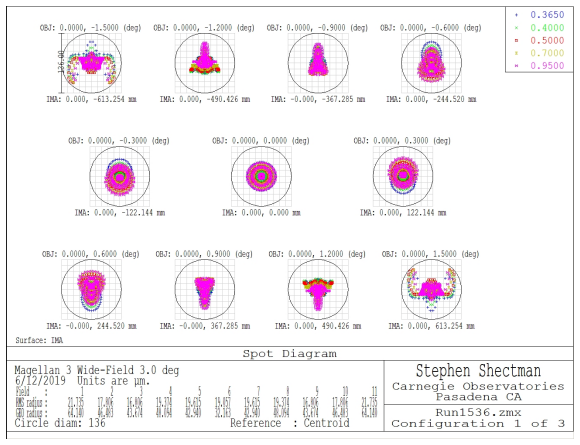
Figure 4. Figure 4: Spot diagram for the telescope and corrector optics. [PITH_FULL_IMAGE:figures/full_fig_p010_4.png] view at source ↗
Figure 5
Figure 5. Figure 5: Optical model of the DESI and SDSS-V spectrographs, which are identical systems aside [PITH_FULL_IMAGE:figures/full_fig_p011_5.png] view at source ↗
read the original abstract

MegaMapper is a proposed ground-based experiment to measure Inflation parameters and Dark Energy from galaxy redshifts at 2<z<5. A 6.5-m Magellan telescope will be coupled with DESI spectrographs to achieve multiplexing of 20,000. MegaMapper would be located at Las Campanas Observatory to fully access LSST imaging for target selection.

Editorial analysis

A structured set of objections, weighed in public.

Desk editor's note, referee report, simulated authors' rebuttal, and a circularity audit. Tearing a paper down is the easy half of reading it; the pith above is the substance, this is the friction.

Referee Report

1 major / 0 minor

Summary. The manuscript is an Astro2020 APC White Paper proposing the MegaMapper instrument: a 6.5-m Magellan telescope at Las Campanas Observatory coupled to DESI spectrographs to deliver 20,000 multiplexing for galaxy redshift surveys at 2 < z < 5, using LSST imaging for target selection, with the goal of constraining Inflation parameters and Dark Energy.

Significance. If the instrument concept can be realized with the stated multiplexing, throughput, and resolution, the resulting high-redshift spectroscopic sample would provide distinctive constraints on early-universe physics and dark-energy evolution that complement existing and planned lower-redshift surveys.

major comments (1)
  1. [Abstract] Abstract: The central claim that DESI spectrographs can be coupled to the Magellan telescope while preserving the throughput, spectral resolution, and field-of-view needed for 20,000 multiplexing (and thus the forecasted Inflation and Dark Energy constraints) is stated at the conceptual level only; no throughput budget, fiber-injection efficiency calculation, or resolution-preservation estimate is supplied, which directly bears on whether the science reach is achievable.

Simulated Author's Rebuttal

1 responses · 0 unresolved

We thank the referee for their constructive review of our Astro2020 APC White Paper. We address the single major comment below.

read point-by-point responses
  1. Referee: [Abstract] Abstract: The central claim that DESI spectrographs can be coupled to the Magellan telescope while preserving the throughput, spectral resolution, and field-of-view needed for 20,000 multiplexing (and thus the forecasted Inflation and Dark Energy constraints) is stated at the conceptual level only; no throughput budget, fiber-injection efficiency calculation, or resolution-preservation estimate is supplied, which directly bears on whether the science reach is achievable.

    Authors: We agree that the abstract and manuscript present the coupling of DESI spectrographs to the Magellan telescope at a conceptual level without supplying quantitative throughput budgets, fiber-injection efficiencies, or resolution-preservation estimates. This level of detail is typical for Astro2020 APC White Papers, whose primary purpose is to outline scientific motivation and high-level instrument concepts rather than full engineering analyses. We will revise the manuscript to add a short paragraph (or subsection) summarizing the expected performance based on DESI's demonstrated throughput and resolution, together with references to existing fiber-coupling studies for similar systems, to strengthen the justification for the claimed multiplexing and science reach. revision: yes

Circularity Check

0 steps flagged

No circularity: white paper is conceptual instrument proposal with no derivations or equations

full rationale

The document is an Astro2020 APC white paper outlining a proposed instrument (MegaMapper) for future observations. It contains no equations, model derivations, fitted parameters, predictions from first principles, or self-citation chains that could reduce to inputs by construction. The content is forward-looking design description relying on coupling existing DESI hardware to a Magellan telescope, presented at the conceptual level without quantitative budgets or reductions that match any enumerated circularity pattern. This is self-contained as a proposal against external benchmarks like LSST imaging and DESI performance data.

Axiom & Free-Parameter Ledger

1 free parameters · 2 axioms · 0 invented entities

The proposal rests on design parameters and external survey assumptions without independent verification in this document.

free parameters (1)
  • multiplexing factor = 20000
    The value of 20,000 is stated as the target capability without derivation from first principles or data in the abstract.
axioms (2)
  • domain assumption LSST imaging will be available and sufficient for target selection at the required depth and area
    The abstract explicitly states that the instrument would fully access LSST imaging for target selection.
  • domain assumption DESI spectrographs can be coupled to the 6.5-m Magellan telescope while preserving required performance
    The central instrument concept in the abstract depends on this coupling being feasible.

pith-pipeline@v0.9.0 · 5949 in / 1433 out tokens · 23875 ms · 2026-05-24T15:52:01.300534+00:00 · methodology

discussion (0)

Sign in with ORCID, Apple, or X to comment. Anyone can read and Pith papers without signing in.

Forward citations

Cited by 2 Pith papers

Reviewed papers in the Pith corpus that reference this work. Sorted by Pith novelty score.

  1. New Isocurvature Constraints from JWST UV Luminosity Function

    astro-ph.CO 2026-05 unverdicted novelty 6.0

    First UVLF-based constraints on model-agnostic isocurvature power spectra for CDM, baryon, neutrino, and dark radiation modes yield consistent 95% credible envelopes over k ~ 0.5-10 Mpc^{-1}.

  2. From Large Telescopes to the MUltiplexed Survey Telescope (MUST)

    astro-ph.IM 2026-05 unverdicted novelty 4.0

    MUST is a new 6.5 m telescope designed to deliver simultaneous optical spectra for over 20,000 targets across a 5 deg² field, enabling the largest 3D spectroscopic map of the Universe with redshifts for more than 100 ...

Reference graph

Works this paper leans on

21 extracted references · 21 canonical work pages · cited by 2 Pith papers · 18 internal anchors

  1. [1]

    Primordial Non-Gaussianity

    P. D. Meerburg et al., “Primordial Non-Gaussianity,” arXiv:1903.04409 [astro-ph.CO]

  2. [2]

    Testing Inflation with Large Scale Structure: Connecting Hopes with Reality

    M. Alvarez et al., “Testing Inflation with Large Scale Structure: Connecting Hopes with Reality,” arXiv:1412.4671 [astro-ph.CO]

  3. [3]

    Planck 2018 results. IX. Constraints on primordial non-Gaussianity

    Planck Collaboration, Y . Akramiet al., “Planck 2018 results. IX. Constraints on primordial non-Gaussianity,” arXiv:1905.05697 [astro-ph.CO]

  4. [4]

    Dark Energy and Modified Gravity

    A. Slosar et al., “Dark Energy and Modified Gravity,” arXiv:1903.12016 [astro-ph.CO]

  5. [5]

    Inflation and Dark Energy from spectroscopy at $z > 2$

    S. Ferraro et al., “Inflation and Dark Energy from spectroscopy at z > 2,” arXiv:1903.09208 [astro-ph.CO]

  6. [6]

    Scratches from the Past: Inflationary Archaeology through Features in the Power Spectrum of Primordial Fluctuations

    A. Slosar et al., “Scratches from the Past: Inflationary Archaeology through Features in the Power Spectrum of Primordial Fluctuations,” arXiv:1903.09883 [astro-ph.CO]

  7. [7]

    Inflationary Freedom and Cosmological Neutrino Constraints

    R. de Putter, E. V . Linder, and A. Mishra, “Inflationary Freedom and Cosmological Neutrino Constraints,” Phys. Rev. D89 no. 10, (2014) 103502, arXiv:1401.7022 [astro-ph.CO]

  8. [8]

    J., & White, M

    M. J. Wilson and M. White, “Cosmology with dropout selection: Straw-man surveys and CMB lensing,” arXiv:1904.13378 [astro-ph.CO]

  9. [9]

    FOBOS: A Next-Generation Spectroscopic Facility at the W. M. Keck Observatory

    K. Bundy, K. Westfall, N. MacDonald, R. Kupke, M. Savage, C. Poppett, A. Alabi, G. Becker, J. Burchett, P. Capak, A. Coil, M. Cooper, D. Cowley, W. Deich, D. Dillon, J. Edelstein, P. Guhathakurta, J. Hennawi, M. Kassis, K. G. Lee, D. Masters, T. Miller, J. Newman, J. O’Meara, J. X. Prochaska, M. Rau, J. Rhodes, R. M. Rich, C. Rockosi, A. Romanowsky, C. Sc...

  10. [10]

    The Maunakea Spectroscopic Explorer

    J. Marshall, J. Bullock, A. Burgasser, K. Chambers, D. DePoy, A. Dey, N. Flagey, A. Hill, L. Hillenbrand, D. Huber, T. Li, S. Juneau, M. Kaplinghat, M. Mateo, A. McConnachie, J. Newman, A. Petric, D. Schlegel, A. Sheinis, Y . Shen, D. Simons, M. Strauss, K. Szeto, K.-V . Tran, C. Y`eche, and the MSE Science Team, “The Maunakea Spectroscopic Explorer,” arX...

  11. [11]

    SpecTel: A 10-12 meter class Spectroscopic Survey Telescope

    R. Ellis, K. Dawson, J. Bland-Hawthorn, R. Bacon, A. Bolton, M. Bremer, J. Brinchmann, K. Bundy, C. Conroy, B. Delabre, A. Dey, A. Drlica-Wagner, J. Greene, L. Guzzo, J. Johnson, A. Leauthaud, K.-G. Lee, L. Pasquini, L. Pentericci, J. Richard, H.-W. Rix, C. Rockosi, D. Schlegel, A. Slosar, M. Strauss, M. Takada, E. Tolstoy, and D. Watson, “SpecTel: A 10-1...

  12. [12]

    Report on LSST Next-generation Instrumentation Workshop, April 11, 12 2019

    C. W. Stubbs and K. Heitmann, “Report on LSST Next-generation Instrumentation Workshop, April 11, 12 2019,”arXiv e-prints (May, 2019) arXiv:1905.04669, arXiv:1905.04669 [astro-ph.IM]

  13. [13]

    Wide-field Multi-object Spectroscopy to Enhance Dark Energy Science from LSST

    LSST Dark Energy Science Collaboration, R. Mandelbaum et al., “Wide-field Multi-object Spectroscopy to Enhance Dark Energy Science from LSST,” arXiv:1903.09323 [astro-ph.CO]

  14. [14]

    Deep Multi-object Spectroscopy to Enhance Dark Energy Science from LSST

    LSST Dark Energy Science Collaboration, J. A. Newman et al., “Deep Multi-object Spectroscopy to Enhance Dark Energy Science from LSST,” arXiv:1903.09325 [astro-ph.CO]

  15. [15]

    Dark Matter Science in the Era of LSST

    K. Bechtol et al., “Dark Matter Science in the Era of LSST,” arXiv:1903.04425 [astro-ph.CO]

  16. [16]

    Probing the Fundamental Nature of Dark Matter with the Large Synoptic Survey Telescope

    LSST Dark Matter Group Collaboration, A. Drlica-Wagner et al., “Probing the Fundamental Nature of Dark Matter with the Large Synoptic Survey Telescope,” arXiv:1902.01055 [astro-ph.CO]

  17. [17]

    The DESI Experiment Part II: Instrument Design

    DESI Collaboration, A. Aghamousa, J. Aguilar, S. Ahlen, S. Alam, L. E. Allen, C. Allende Prieto, J. Annis, S. Bailey, and C. Balland, “The DESI Experiment Part II: Instrument Design,” arXiv e-prints (Oct, 2016) arXiv:1611.00037, arXiv:1611.00037 [astro-ph.IM]

  18. [18]

    Spectro-Perfectionism: An Algorithmic Framework for Photon Noise-Limited Extraction of Optical Fiber Spectroscopy,

    A. S. Bolton and D. J. Schlegel, “Spectro-Perfectionism: An Algorithmic Framework for Photon Noise-Limited Extraction of Optical Fiber Spectroscopy,” PASP 122 no. 888, (Feb,

  19. [19]

    248, arXiv:0911.2689 [astro-ph.IM]

  20. [20]

    Cosmic Visions Dark Energy: Small Projects Portfolio,

    K. Dawson, J. Frieman, K. Heitmann, B. Jain, S. Kahn, R. Mandelbaum, S. Perlmutter, and A. Slosar, “Cosmic Visions Dark Energy: Small Projects Portfolio,” arXiv e-prints (Feb,

  21. [21]

    arXiv:1802.07216, arXiv:1802.07216 [astro-ph.CO] . 14