Recognition: 2 theorem links
· Lean TheoremNew Isocurvature Constraints from JWST UV Luminosity Function
Pith reviewed 2026-05-13 01:13 UTC · model grok-4.3
The pith
JWST ultraviolet luminosity functions yield new upper limits on primordial isocurvature perturbations that are insensitive to spectral assumptions.
A machine-rendered reading of the paper's core claim, the machinery that carries it, and where it could break.
Core claim
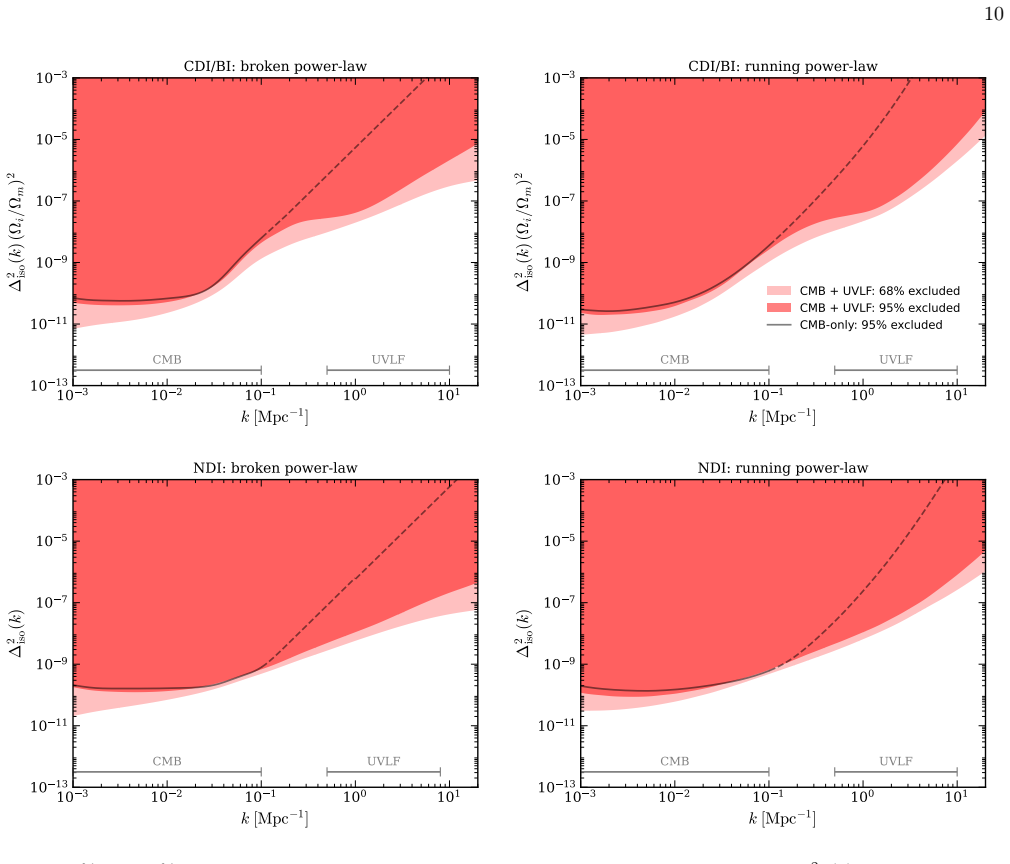
We constrain uncorrelated primordial isocurvature perturbations using a combination of large- and small-scale cosmological probes, with the small-scale data provided by the ultraviolet luminosity function. We consider several isocurvature modes and model the isocurvature power spectrum using broken and running power laws without fixing the spectral index. Our analysis combines CMB, BAO, and SNIa data with UVLF measurements from HST and JWST that probe matter fluctuations over k ~ 0.5-10 Mpc^{-1} at 4 ≲ z ≲ 13. We construct 68% and 95% credible envelopes in k-space for the allowed isocurvature power and find good agreement between the envelopes for the 95% envelope across a wide range of k, 0
What carries the argument
The ultraviolet luminosity function from HST and JWST, acting as a direct tracer of linear matter fluctuations on intermediate scales to set bounds on isocurvature power spectra parameterized agnostically.
If this is right
- Isocurvature power is limited by 68% and 95% credible envelopes over k ~ 0.5-10 Mpc^{-1} for CDM, baryon, neutrino density, velocity, and dark radiation modes.
- The 95% credible envelope shows consistency across scales regardless of whether a broken or running power-law form is assumed.
- These represent the first UVLF-based constraints on model-agnostic isocurvature perturbations.
- Large-scale probes (CMB, BAO, supernovae) are supplemented by the continuous intermediate-scale coverage from the UVLF.
Where Pith is reading between the lines
- If the UVLF-to-fluctuation link holds, tighter future JWST observations could further narrow the allowed parameter space for multi-field inflation scenarios.
- The method opens a path for other high-redshift galaxy surveys to provide independent checks on early-universe perturbation spectra.
- Improved modeling of high-redshift galaxy formation could either strengthen these bounds or reveal where astrophysical effects begin to dominate.
Load-bearing premise
That the observed ultraviolet luminosity function at redshifts 4 to 13 directly traces linear matter fluctuations on scales of 0.5 to 10 inverse megaparsecs without dominant contamination from redshift-dependent astrophysical effects like dust, feedback, or changes in star-formation efficiency.
What would settle it
An independent measurement or simulation demonstrating that astrophysical processes, rather than primordial density fluctuations, primarily determine the shape and evolution of the UV luminosity function in the range 4 ≤ z ≤ 13 would invalidate the isocurvature bounds derived here.
Figures


read the original abstract
We constrain uncorrelated primordial isocurvature perturbations using a combination of large- and small-scale cosmological probes, with the small-scale data provided by the ultraviolet luminosity function (UVLF) -- a measure of number density of galaxies as a function of UV brightness. We consider several isocurvature modes, including cold dark matter, baryon, neutrino density, neutrino velocity, and dark radiation perturbations. The isocurvature power spectrum is modeled using two independent parameterizations: a broken power law and a running power law, without fixing the spectral index a priori. Our analysis combines large-scale data from the Cosmic Microwave Background (CMB), baryon acoustic oscillations, and Type Ia supernovae with small-scale constraints from UVLF measurements obtained by \textit{HST} and \textit{JWST}. The UVLF probes matter fluctuations over a continuous range of intermediate scales, $k \sim 0.5$--$10~\mathrm{Mpc}^{-1}$ over a wide range of redshift $4\lesssim z \lesssim 13$, providing a direct handle on structure formation in a regime where constraints on the scale dependence of isocurvature perturbations remain comparatively limited. Our result represents the first UVLF-based constraint on model-agnostic isocurvature perturbations carried by various components. We construct $68\%$ and $95\%$ credible envelopes in $k$-space for the allowed isocurvature power and find good agreement between the envelopes for the $95\%$ envelope across a wide range of scales, indicating that our constraints are mostly insensitive to the assumed power-law form.
Editorial analysis
A structured set of objections, weighed in public.
Referee Report
Summary. The manuscript claims to constrain uncorrelated primordial isocurvature perturbations (CDM, baryon, neutrino density, neutrino velocity, and dark radiation modes) by combining CMB, BAO, and SNIa data with UV luminosity function measurements from HST and JWST spanning 4 ≤ z ≤ 13. The isocurvature power spectrum is modeled via two independent parameterizations (broken power law and running power law) without fixing the spectral index a priori; 68% and 95% credible envelopes are constructed in k-space (k ∼ 0.5–10 Mpc^{-1}), with the result that the 95% envelopes agree across a wide range of scales, indicating insensitivity to the assumed functional form. This is presented as the first UVLF-based constraint on model-agnostic isocurvature perturbations.
Significance. If the UVLF-to-matter mapping holds without dominant unmodeled astrophysical contamination, the work would be significant as the first application of JWST UVLF data to place model-agnostic bounds on isocurvature on intermediate scales where CMB constraints weaken. The continuous redshift coverage and direct structure-formation probe could tighten limits on early-universe scenarios and motivate further small-scale tests.
major comments (2)
- [§3] §3 (UVLF modeling and likelihood construction): The central claim that UVLF measurements directly trace linear matter fluctuations on k ∼ 0.5–10 Mpc^{-1} rests on the assumption that galaxy number density follows the halo mass function without dominant scale- or redshift-dependent biases from dust, feedback, or star-formation efficiency. No details are provided on the galaxy-formation model employed, the form of the covariance matrix, or any marginalization over astrophysical nuisance parameters; this omission is load-bearing for the reported credible envelopes.
- [§4.1] §4.1 (parameterization and envelope construction): The power-law amplitudes and indices are fitted simultaneously to the combined UVLF + CMB + BAO + SNIa dataset under each parameterization. While the manuscript reports agreement between the resulting 95% envelopes, no quantitative metric of agreement (e.g., overlap integral or maximum deviation) or external validation against an independent small-scale probe is given, weakening the insensitivity conclusion.
minor comments (3)
- [Abstract, §2] The abstract and §2 would benefit from explicit citation of prior isocurvature constraints from CMB, Lyman-α, or 21-cm data to contextualize the new UVLF lever arm.
- [§4.2] Notation for the k-space credible envelopes (e.g., how the 68% vs. 95% bands are defined from the posterior) is introduced without an equation; adding a brief definition would improve clarity.
- [Figures 4–6] Figure captions for the envelope plots should state the exact redshift and magnitude ranges of the UVLF data points used in each bin.
Simulated Author's Rebuttal
We thank the referee for their careful reading of the manuscript and for the constructive comments, which have helped us strengthen the presentation of our results. We address each major comment point by point below and have revised the manuscript accordingly.
read point-by-point responses
-
Referee: [§3] §3 (UVLF modeling and likelihood construction): The central claim that UVLF measurements directly trace linear matter fluctuations on k ∼ 0.5–10 Mpc^{-1} rests on the assumption that galaxy number density follows the halo mass function without dominant scale- or redshift-dependent biases from dust, feedback, or star-formation efficiency. No details are provided on the galaxy-formation model employed, the form of the covariance matrix, or any marginalization over astrophysical nuisance parameters; this omission is load-bearing for the reported credible envelopes.
Authors: We agree that a more explicit description of the UVLF modeling is necessary to support the robustness of the reported constraints. In the revised manuscript we have expanded §3 with a dedicated subsection detailing the galaxy-formation model: the UVLF is connected to the halo mass function via abundance matching with a redshift-dependent star-formation efficiency that includes both a normalization and a power-law slope, together with a simple dust-attenuation prescription. The covariance matrix is now fully specified, combining Poisson shot noise, cosmic variance, and systematic uncertainties from the HST and JWST datasets. We also marginalize over the astrophysical nuisance parameters (star-formation efficiency normalization and slope, dust optical depth) with Gaussian priors informed by lower-redshift calibrations. These additions ensure that the 68 % and 95 % credible envelopes incorporate the dominant astrophysical uncertainties. revision: yes
-
Referee: [§4.1] §4.1 (parameterization and envelope construction): The power-law amplitudes and indices are fitted simultaneously to the combined UVLF + CMB + BAO + SNIa dataset under each parameterization. While the manuscript reports agreement between the resulting 95% envelopes, no quantitative metric of agreement (e.g., overlap integral or maximum deviation) or external validation against an independent small-scale probe is given, weakening the insensitivity conclusion.
Authors: We thank the referee for this suggestion. In the revised manuscript we have added a quantitative comparison of the two 95 % credible envelopes: we report both the integrated overlap fraction (defined as the ratio of the area where the envelopes coincide to the total area spanned by either envelope) and the maximum relative deviation across the k-range 0.5–10 Mpc^{-1}. These metrics confirm that the envelopes agree to within ∼10 % over most of the interval, reinforcing the claim of insensitivity to functional form. While an external cross-check with an independent small-scale probe (e.g., Lyman-α forest) lies outside the scope of the present analysis, we have added a brief discussion in the conclusions outlining how such a comparison could be performed in future work. revision: yes
Circularity Check
No significant circularity in derivation chain
full rationale
The paper performs a standard Bayesian fit of isocurvature power-spectrum parameters (amplitudes and indices under broken-power-law and running-power-law forms) to the joint posterior from CMB+BAO+SNIa plus UVLF data. The reported 68% and 95% credible envelopes in k-space and their agreement across the two parameterizations constitute a consistency check on the functional form, not a quantity that is forced by construction from the inputs. The UVLF is introduced as an independent small-scale probe under an explicit (and debatable) astrophysical mapping assumption; that assumption is not derived from the fit itself. No self-citations, self-definitional relations, or renamings of known results appear as load-bearing steps in the provided text. The central claim therefore retains independent content from the data.
Axiom & Free-Parameter Ledger
free parameters (2)
- isocurvature amplitude per mode
- spectral index or break scale
axioms (2)
- domain assumption Standard flat Lambda-CDM background cosmology governs the evolution between recombination and the observed redshifts.
- domain assumption UVLF measurements at 4 less than or equal to z less than or equal to 13 faithfully trace linear matter density fluctuations on the quoted k-range.
Lean theorems connected to this paper
-
IndisputableMonolith/Foundation/RealityFromDistinction.leanreality_from_one_distinction unclearWe construct 68% and 95% credible envelopes in k-space for the allowed isocurvature power... using two independent parameterizations: a broken power law and a running power law
-
IndisputableMonolith/Cost/FunctionalEquation.leanwashburn_uniqueness_aczel unclearThe UVLF probes matter fluctuations over a continuous range of intermediate scales, k ∼ 0.5–10 Mpc^{-1}
Reference graph
Works this paper leans on
-
[1]
Primordial Adiabatic and Isocurvature Perturbations 3 2.2
Theory and Parameterization 3 2.1. Primordial Adiabatic and Isocurvature Perturbations 3 2.2. Broken Power-Law Isocurvature Spectrum 4 2.3. Running Isocurvature Spectrum 4 2.4. Isocurvature Modes: CDI, BI, NDI, NVI and DRDI 5
-
[2]
Datasets and Analysis Pipeline 6 3.1. Cosmological Datasets 6 3.2. Sampler and Pipeline 6 3.3. Cosmology and Sampling 7
-
[3]
Reconstruction of Isocurvature Spectral Envelopes 8 4.2
Results 8 4.1. Reconstruction of Isocurvature Spectral Envelopes 8 4.2. Constraints on Isocurvature Spectra 9 ∗ rco@iu.edu † saictade@iu.edu (for correspondence)
-
[4]
Discussion 13 Acknowledgement 14 A. UVLF Pipeline 14 B. Isocurvature Spectrum Reconstruction 16
-
[5]
Broken Power-Law Parameterization 16
-
[6]
Running Parameterization 18 References 18
-
[7]
INTRODUCTION The remarkable success of theΛCDM framework rests on a simple and powerful assumption: the primordial fluc- tuations that seeded cosmic structure were predominantly adiabatic. Measurements of the Cosmic Microwave Back- ground (CMB) temperature and polarization anisotropies, together with large-scale structure observations, have con- firmed th...
work page internal anchor Pith review Pith/arXiv arXiv 2026
-
[8]
THEOR Y AND P ARAMETERIZA TION 2.1. Primordial Adiabatic and Isocurvature Perturbations In the presence of multiple light degrees of freedom during inflation, the primordial perturbations may con- tain both adiabatic and isocurvature components. The adiabatic mode corresponds to fluctuations in the total energy density with fixed relative composition, suc...
-
[9]
DA T ASETS AND ANAL YSIS PIPELINE 3.1. Cosmological Datasets Our constraints on primordial isocurvature modes com- bine information from multiple cosmological probes that span a broad range of physical scales. We incorporate the following datasets with updated/recent likelihoods in most cases: a. CMB Anisotropies and Lensing.For the primary CMB anisotropi...
work page 2018
-
[10]
RESUL TS We now present the results on the upper limits for the various isocurvature modes, constrained jointly by the CMB+BAO+SNe+UVLF likelihoods. 4.1. Reconstruction of Isocurvature Spectral Envelopes For the broken power-law parameterization, rather than presenting constraints onAiso(kc)for each assumed break scale kc, we summarize the results directl...
-
[11]
DISCUSSION In this work, we have derived new constraints on pri- mordial isocurvature perturbations by combining large- scale cosmological probes with small-scale structure infor- mation from the ultraviolet luminosity function of high- redshift galaxies. By jointly analyzing CMB, BAO, and Type Ia supernova data with recentHSTandJWST UVLF measurements, we...
-
[12]
Broken Power-Law Parameterization For the broken power-law analysis, the break scalekc is treated as a fixed hyperparameter during each MCMC run. Thus, for each fixed value ofkc, the MCMC samples are drawn from the conditional posterior p(Θ|D, k c),(B.1) where D denotes the combined dataset/likelihood andΘ denotes the full set of sampled parameters, inclu...
-
[13]
Planck 2018 results. VI. Cosmological parameters
Running Parameterization For comparison, the running isocurvature parameteri- zation is reconstructed in a similar manner to the broken power-law case, but without introducing a break scale. The spectrum is specified by an amplitude, a spectral in- dex, and a running. In our sampling strategy, we sample the amplitudes at two anchor scalesk1,2 together wit...
work page internal anchor Pith review Pith/arXiv arXiv 2018
-
[14]
D. Seckel and M. S. Turner,Isothermal Density Perturbations in an Axion Dominated Inflationary Universe,Phys. Rev. D32(1985) 3178
work page 1985
-
[15]
K. Enqvist and M. S. Sloth,Adiabatic CMB perturbations in pre - big bang string cosmology,Nucl. Phys. B626(2002) 395–409, [hep-ph/0109214]
- [16]
-
[17]
T. Moroi and T. Takahashi,Effects of cosmological moduli fields on cosmic microwave background,Phys. Lett. B522(2001) 215–221, [hep-ph/0110096]
-
[18]
D. Polarski and A. A. Starobinsky,Isocurvature perturbations in multiple inflationary models,Phys. Rev. D50(1994) 6123–6129, [astro-ph/9404061]
- [19]
- [20]
-
[21]
S. Kasuya and M. Kawasaki,Axion isocurvature fluctuations with extremely blue spectrum,Phys.Rev. D80(2009) 023516, [0904.3800]
- [22]
- [23]
-
[24]
J. Enander, A. Pargner and T. Schwetz,Axion minicluster power spectrum and mass function,JCAP12 (2017) 038, [1708.04466]
-
[25]
K. Freese and M. W. Winkler,Dark matter and gravitational waves from a dark big bang,Phys. Rev. D 107(2023) 083522, [2302.11579]. 19
- [26]
-
[27]
N. Afshordi, P. McDonald and D. N. Spergel,Primordial black holes as dark matter: The Power spectrum and evaporation of early structures,Astrophys. J. Lett.594 (2003) L71–L74, [astro-ph/0302035]
- [28]
- [29]
- [30]
-
[31]
HERAcollaboration, Z. Abdurashidova et al.,Improved Constraints on the 21 cm EoR Power Spectrum and the X-Ray Heating of the IGM with HERA Phase I Observations,Astrophys. J.945(2023) 124, [2210.04912]
-
[32]
J. de Kruijf, E. Vanzan, K. K. Boddy, A. Raccanelli and N. Bartolo,Searching for blue-tilted power spectra in the dark ages,Phys. Rev. D111(2025) 063507, [2408.04991]
-
[33]
M. Pavičević, V. Iršič, M. Viel, J. S. Bolton, M. G. Haehnelt, S. Martin-Alvarez et al.,Constraints on Primordial Magnetic Fields from the Lyman-alpha Forest, Phys. Rev. Lett.135(2025) 071001, [2501.06299]
-
[34]
O. Garcia-Gallego, V. Iršič, M. Viel, M. G. Haehnelt and J. S. Bolton,Post-inflationary axion constraints from the Lyman-alpha forest,arxiv(3, 2026) , [2603.04401]
-
[35]
J. Urrutia, J. Ellis, M. Fairbairn and V. Vaskonen, Starlight from JWST: Implications for star formation and dark matter models,Astron. Astrophys.702(2025) A109, [2504.20043]
-
[36]
M. Gorghetto, S. Trifinopoulos and G. Valogiannis, Large-Scale Structure Probes of the Post-Inflationary Axiverse,arxiv(11, 2025) , [2511.04734]
- [37]
- [38]
- [39]
- [40]
-
[41]
L. Pagano, J. M. Delouis, S. Mottet, J. L. Puget and L. Vibert,Reionization optical depth determination from Planck HFI data with ten percent accuracy,Astron. Astrophys.635(2020) A99, [1908.09856]. [33]Planckcollaboration, N. Aghanim et al.,Planck 2018 results. III. High Frequency Instrument data processing and frequency maps,Astron. Astrophys.641(2020) A...
-
[42]
G. Efstathiou and S. Gratton,A Detailed Description of the CamSpec Likelihood Pipeline and a Reanalysis of the Planck High Frequency Maps,Open J. Astrophys.4 (2021) 8, [1910.00483]
-
[43]
E. Rosenberg, S. Gratton and G. Efstathiou,CMB power spectra and cosmological parameters from Planck PR4 with CamSpec,Mon. Not. Roy. Astron. Soc.517(2022) 4620–4636, [2205.10869]
-
[44]
J. Carron, M. Mirmelstein and A. Lewis,CMB lensing from Planck PR4 maps,JCAP09(2022) 039, [2206.07773]. [37]ACTcollaboration, F. J. Qu et al.,The Atacama Cosmology Telescope: A Measurement of the DR6 CMB Lensing Power Spectrum and Its Implications for Structure Growth,Astrophys. J.962(2024) 112, [2304.05202]. [38]ACTcollaboration, M. S. Madhavacheril et a...
- [45]
- [46]
-
[47]
DESIcollaboration, A. G. Adame et al.,DESI 2024 VI: cosmological constraints from the measurements of baryon acoustic oscillations,JCAP02(2025) 021, [ 2404.03002]. [42]Pan-STARRS1collaboration, D. M. Scolnic et al.,The Complete Light-curve Sample of Spectroscopically Confirmed SNe Ia from Pan-STARRS1 and Cosmological Constraints from the Combined Pantheon...
work page internal anchor Pith review Pith/arXiv arXiv 2024
- [48]
-
[49]
P. A. Oesch, R. J. Bouwens, G. D. Illingworth, I. Labbé and M. Stefanon,The dearth of z∼ 10 galaxies in all hst legacy fields-the rapid evolution of the galaxy population in the first 500 myr*,The Astrophysical Journal855 (mar, 2018) 105
work page 2018
-
[50]
R. J. Bouwens, P. A. Oesch, M. Stefanon, G. Illingworth, I. Labbé, N. Reddy et al.,New determinations of the uv luminosity functions from z∼9 to 2 show a remarkable consistency with halo growth and a constant star formation efficiency,The Astronomical Journal162(jul,
- [51]
- [52]
-
[53]
Cobaya: Code for Bayesian Analysis of hierarchical physical models
J. Torrado and A. Lewis,Cobaya: Code for Bayesian Analysis of hierarchical physical models,JCAP05(2021) 057, [2005.05290]
work page internal anchor Pith review arXiv 2021
-
[54]
T. Brinckmann and J. Lesgourgues,MontePython 3: Boosted MCMC sampler and other features,Physics of the Dark Universe24(2019) 100260
work page 2019
-
[55]
A. Lewis,GetDist: a Python package for analysing Monte Carlo samples,Journal of Cosmology and Astroparticle Physics2025(Aug., 2025) 025
work page 2025
-
[56]
D. Blas, J. Lesgourgues and T. Tram,The Cosmic Linear Anisotropy Solving System (CLASS) II: Approximation schemes,JCAP07(2011) 034, [1104.2933]
work page internal anchor Pith review arXiv 2011
- [57]
- [58]
- [59]
-
[60]
J. Chluba and D. Grin,CMB spectral distortions from small-scale isocurvature fluctuations,Monthly Notices of the Royal Astronomical Society434(jul, 2013) 1619–1635, [1304.4596]
-
[61]
I. Esteban, A. H. G. Peter and S. Y. Kim,Milky Way satellite velocities reveal the dark matter power spectrum at small scales,Phys. Rev. D110(2024) 123013, [2306.04674]
-
[62]
D. J. H. Chung, M. Münchmeyer and S. C. Tadepalli, Search for isocurvature with large-scale structure: A forecast for Euclid and MegaMapper using EFTofLSS, Phys. Rev. D108(2023) 103542, [2306.09456]. [58]Euclidcollaboration, F. Finelli et al.,Euclid preparation: Expected constraints on initial conditions, 2507.15819
- [63]
-
[64]
T. Sekiguchi, H. Tashiro, J. Silk and N. Sugiyama, Cosmological signatures of tilted isocurvature perturbations: reionization and 21cm fluctuations,JCAP 03(2014) 001, [1311.3294]
-
[65]
Y. Takeuchi and S. Chongchitnan,Constraining isocurvature perturbations with the 21 cm emission from minihaloes,Mon. Not. Roy. Astron. Soc.439(2014) 1125–1135, [1311.2585]
- [66]
-
[67]
P. G. Pérez-González, G. Östlin, L. Costantin, J. Melinder, S. L. Finkelstein, R. S. Somerville et al., The rise of the galactic empire: Ultraviolet luminosity functions at z∼17 and z∼25 estimated with the midis+ngdeep ultra-deep jwst/nircam data set,The Astrophysical Journal991(sep, 2025) 179
work page 2025
-
[68]
M. Castellano et al.,Pushing JWST to the extremes: Search and scrutiny of bright galaxy candidates at z≃ 15–30,Astron. Astrophys.704(2025) A158, [2504.05893]
-
[69]
R. C. Kennicutt, Jr.,Star formation in galaxies along the Hubble sequence,Ann. Rev. Astron. Astrophys.36(1998) 189–231, [astro-ph/9807187]
work page internal anchor Pith review Pith/arXiv arXiv 1998
-
[70]
Madau,Cosmic star formation history,AIP Conf
P. Madau,Cosmic star formation history,AIP Conf. Proc.393(1997) 481, [astro-ph/9612157]
- [71]
-
[72]
A. S. Eddington,On a Formula for Correcting Statistics for the Effects of a known Probable Error of Observation, Monthly Notices of the Royal Astronomical Society73 (Mar., 1913) 359–360
work page 1913
discussion (0)
Sign in with ORCID, Apple, or X to comment. Anyone can read and Pith papers without signing in.