Optimal error estimates of the penalty finite element method for the unsteady Navier-Stokes equations with nonsmooth initial data
Pith reviewed 2026-05-24 12:29 UTC · model grok-4.3
The pith
The penalty finite element method for the unsteady Navier-Stokes equations delivers optimal L2 error estimates for velocity and pressure with nonsmooth initial data.
A machine-rendered reading of the paper's core claim, the machinery that carries it, and where it could break.
Core claim
Optimal L² error estimates for the semidiscrete as well as the fully discrete approximations of the velocity and of the pressure are derived for the penalized unsteady Navier-Stokes equations with nonsmooth initial data under realistically assumed conditions on the data.
What carries the argument
The inverse of the penalized Stokes operator exploited in combination with negative norm estimates and time weighted estimates.
If this is right
- Semidiscrete finite element approximations achieve optimal L2 convergence rates.
- Fully discrete approximations with backward Euler time stepping also attain optimal rates.
- Error estimates cover both velocity and pressure variables.
- The method handles nonsmooth initial data without requiring regularization.
Where Pith is reading between the lines
- The error analysis techniques could apply to three-dimensional problems or other penalty parameters.
- Similar approaches might improve estimates for related evolutionary equations with low-regularity data.
- Practical simulations could verify the rates for various mesh sizes and time steps.
Load-bearing premise
The initial data and forcing satisfy conditions allowing the inverse of the penalized Stokes operator and associated estimates to produce optimal convergence rates.
What would settle it
Numerical computation of the L2 errors for the velocity approximation on successively refined meshes with nonsmooth initial data that fails to show the predicted optimal order of convergence.
Figures
read the original abstract
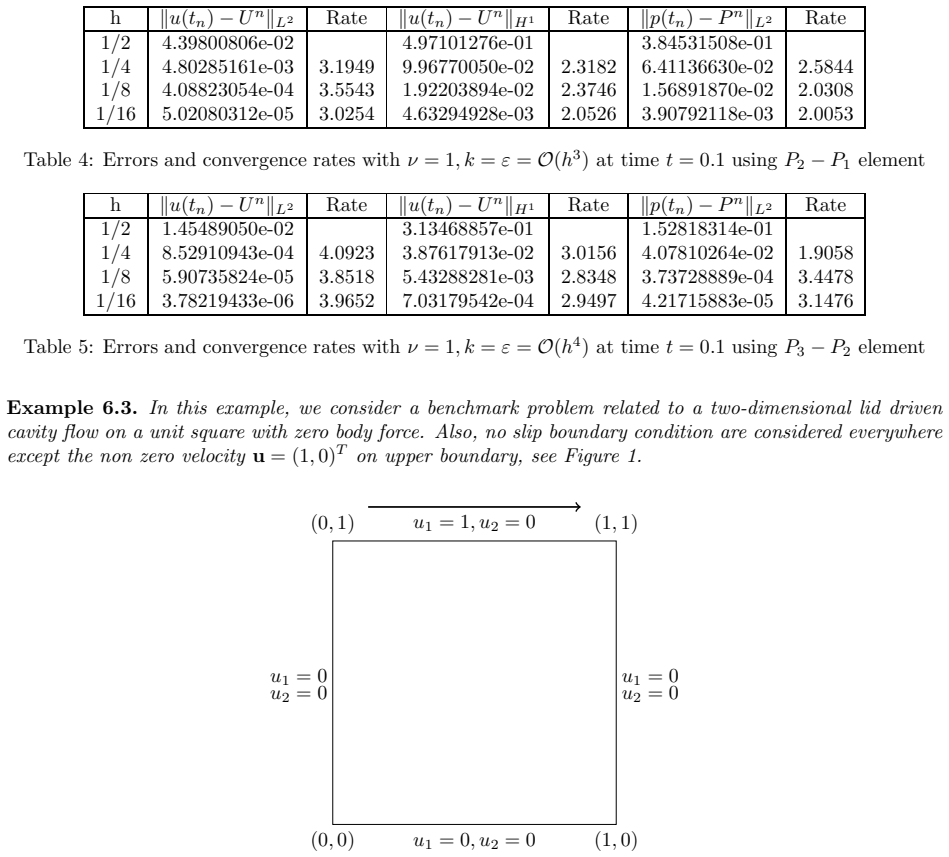
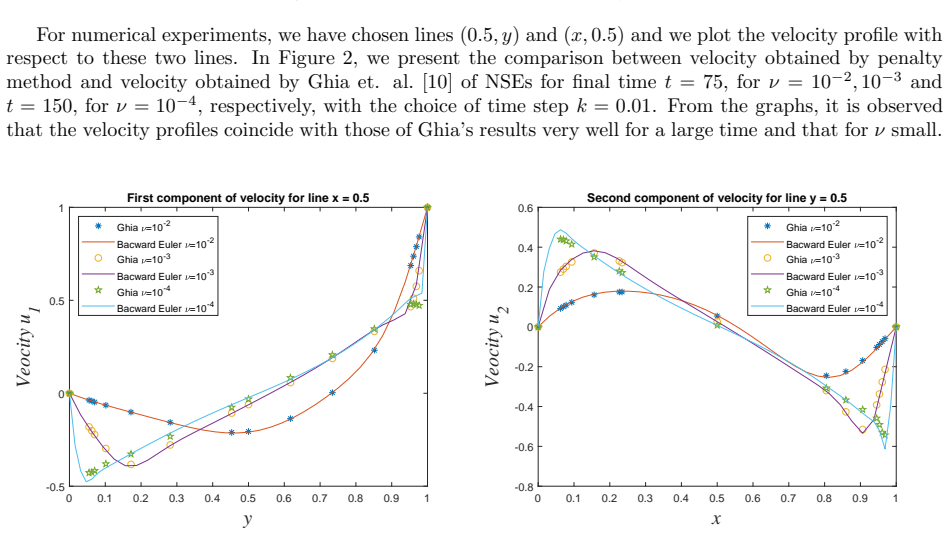
In this paper, both semidiscrete and fully discrete finite element methods are analyzed for the penalized two-dimensional unsteady Navier-Stokes equations with nonsmooth initial data. First order backward Euler method is applied for the time discretization, whereas conforming finite element method is used for the spatial discretization. Optimal $L^2$ error estimates for the semidiscrete as well as the fully discrete approximations of the velocity and of the pressure are derived for realistically assumed conditions on the data. The main ingredient in the proof is the appropriate exploitation of the inverse of the penalized Stokes operator, negative norm estimates and time weighted estimates. Numerical examples are discussed at the end which conform our theoretical results.
Editorial analysis
A structured set of objections, weighed in public.
Referee Report
Summary. The manuscript analyzes the penalty formulation of the two-dimensional unsteady Navier-Stokes equations with nonsmooth initial data. Both semidiscrete (conforming FEM in space) and fully discrete (backward Euler in time) approximations are considered. Optimal L² error estimates are derived for the velocity and pressure under realistically assumed data conditions, with the proofs relying on the inverse of the penalized Stokes operator, negative-norm estimates, and time-weighted estimates. Numerical examples are presented to support the analysis.
Significance. If the error estimates hold, the work is significant for providing optimal rates in a low-regularity setting that arises in many applications. The exploitation of standard tools (inverse penalized Stokes operator, negative norms, time weights) to recover optimality without artificial smoothing is a methodological strength, and the numerical confirmation adds practical value. This contributes to the literature on finite-element methods for Navier-Stokes under limited data regularity.
minor comments (1)
- [Abstract] Abstract: the sentence 'Numerical examples are discussed at the end which conform our theoretical results' contains a typographical error; 'conform' should be 'confirm'.
Simulated Author's Rebuttal
We thank the referee for the careful reading of our manuscript and the positive assessment. The referee's summary correctly reflects the main contributions regarding optimal L² error estimates for the penalty FEM applied to the 2D unsteady Navier-Stokes equations with nonsmooth initial data, using the inverse of the penalized Stokes operator, negative-norm estimates, and time-weighted estimates. We are pleased that the work is viewed as significant for low-regularity settings and that the numerical examples are appreciated. No major comments were raised in the report.
Circularity Check
No significant circularity
full rationale
The paper derives optimal L2 error estimates for the semidiscrete and fully discrete penalty FEM approximations of the unsteady Navier-Stokes equations via standard analytic tools: the inverse of the penalized Stokes operator, negative-norm estimates, and time-weighted estimates applied to the penalty formulation, backward-Euler discretization, and conforming FEM. These steps rely on operator properties and approximation theory under stated data assumptions rather than any fitted parameters renamed as predictions, self-definitional loops, or load-bearing self-citations. The central claims are independent mathematical proofs and do not reduce to their own inputs by construction.
Axiom & Free-Parameter Ledger
axioms (1)
- domain assumption Realistically assumed conditions on the data allow negative-norm and time-weighted estimates to produce optimal rates
Lean theorems connected to this paper
-
IndisputableMonolith/Cost/FunctionalEquation.leanwashburn_uniqueness_aczel unclear?
unclearRelation between the paper passage and the cited Recognition theorem.
Optimal L² error estimates … main ingredient … inverse of the penalized Stokes operator, negative norm estimates and time weighted estimates.
-
IndisputableMonolith/Foundation/RealityFromDistinction.leanreality_from_one_distinction unclear?
unclearRelation between the paper passage and the cited Recognition theorem.
penalty method … aε(v,w) = a(v,w) + (1/ε)(∇·v,∇·w)
What do these tags mean?
- matches
- The paper's claim is directly supported by a theorem in the formal canon.
- supports
- The theorem supports part of the paper's argument, but the paper may add assumptions or extra steps.
- extends
- The paper goes beyond the formal theorem; the theorem is a base layer rather than the whole result.
- uses
- The paper appears to rely on the theorem as machinery.
- contradicts
- The paper's claim conflicts with a theorem or certificate in the canon.
- unclear
- Pith found a possible connection, but the passage is too broad, indirect, or ambiguous to say the theorem truly supports the claim.
Reference graph
Works this paper leans on
-
[1]
An, R. Iteration penalty method for the incompressible Navier-St okes equations with variable density based on the artificial compressible method , Adv. Comput. Math. 46 (2020), 1-29
work page 2020
-
[2]
An, R., Li, Y. Two-level penalty finite element methods for the Navier-Sto kes equations with nonlinear slip boundary conditions , Inter. J. Numer. Anal. Model. 11 (2014), 608-623
work page 2014
-
[3]
Two-level iteration penalty methods for the incompressibl e flows , Appl
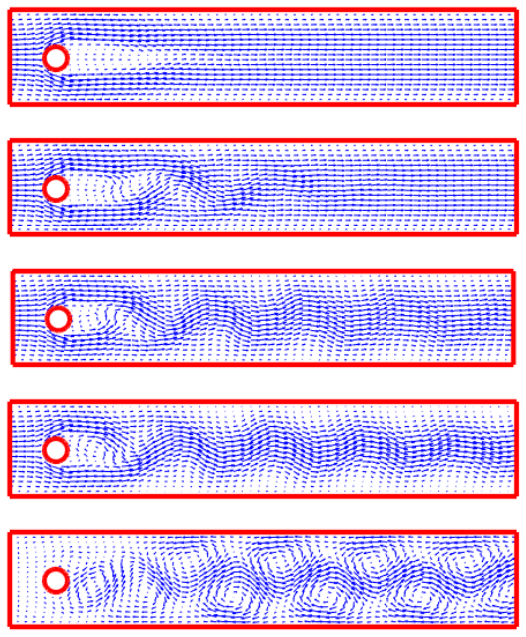
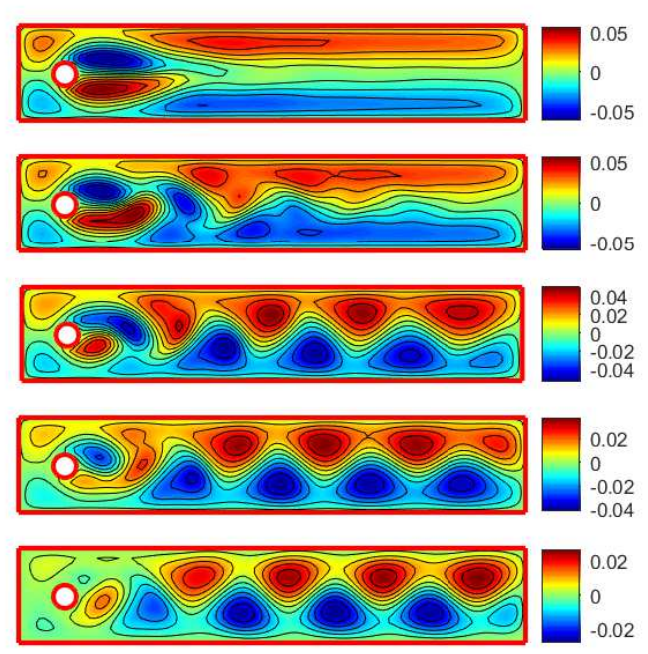
An, R., Shi, F. Two-level iteration penalty methods for the incompressibl e flows , Appl. Math. Model. 39 (2015), 630-641. 26 Figure 4: Velocity field for Example 6.4 for T = 4, 5, 6, 7, 8
work page 2015
-
[4]
Attractors for the penalized Navier-Stokes equations , SIAM J
Brefort, B., Ghidaglia, J.M., Temam, R. Attractors for the penalized Navier-Stokes equations , SIAM J. Math. Anal. 19 (1988), 1-21
work page 1988
-
[5]
Linear finite element methods for planar linear elasticity , Math
Brenner, S.C., Sung, L.Y. Linear finite element methods for planar linear elasticity , Math. Comput. 59 (1992), 321–338
work page 1992
-
[6]
Variational methods for the solution of problems of equilib rium and vibrations , Bull
Courant, R. Variational methods for the solution of problems of equilib rium and vibrations , Bull. Amer. Math. Soc. 49 (1943), 1-23
work page 1943
-
[7]
Dai, X., Tang, P., Wu, M. Analysis of an iterative penalty method for Navier-Stokes e quations with nonlinear slip boundary conditions , Int. J. Numer. Meth. Fluids 72 (2013), 403-413
work page 2013
-
[8]
de Frutos, J., Garcia-Archilla, Novo, J. Fully Discrete Approximations to the Time-Dependent Navier–Stokes Equations with a Projection Method in Time an d Grad-Div Stabilization , J. Sci. Comput. 80 (2019), 1330-1368
work page 2019
-
[9]
Goswami, D., Dam´ azio, P.D.A two-grid finite element method for time-dependent incompr essible Navier- Stokes equations with non-smooth initial data , Numer. Math. Theor. Meth. Appl. 8 (2015), 549-580
work page 2015
-
[10]
High-Re solutions for incompressible flow using the Navier- Stokes equations and a multigrid method
Ghia, U., Ghia, K.N., Shin, C.T. High-Re solutions for incompressible flow using the Navier- Stokes equations and a multigrid method. J. Comput. Phys. 48 (1982), 387-411
work page 1982
-
[11]
Finite element approximation of the Navier-Stokes equatio ns, Lecture Notes in Mathematics, 749
Girault,V., Raviart, P.A. Finite element approximation of the Navier-Stokes equatio ns, Lecture Notes in Mathematics, 749. Springer-Verlag, Berlin-New York, 1980. vii+2 00 pp
work page 1980
-
[12]
New development in freefem++ , J
Hecht, F. New development in freefem++ , J. Numer. Math. 20 (2012), 251-265
work page 2012
-
[13]
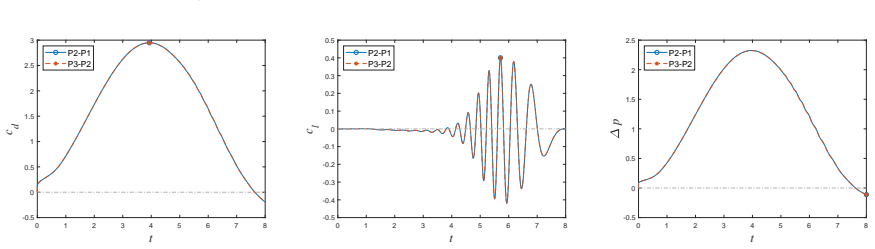
He, Y. Optimal error estimate of the penalty finite element method f or the time-dependent Navier-Stokes equations, Math. Comp. 74 (2005), 1201-1216. 27 Figure 5: Stream function for Example 6.4 for T = 4, 5, 6, 7, 8. 0 1 2 3 4 5 6 7 8 t -0.5 0 0.5 1 1.5 2 2.5 3 cd P2-P1 P3-P2 0 1 2 3 4 5 6 7 8 t -0.5 -0.4 -0.3 -0.2 -0.1 0 0.1 0.2 0.3 0.4 0.5 cl P2-P1 P3-P...
work page 2005
-
[14]
Huang, P. Iterative methods in penalty finite element discretization s for the steady Navier-Stokes equa- tions, Numer. Methods Partial Differential Eq. 30 (2014), 74-94
work page 2014
-
[15]
Huang, P., He, Y., Feng, X. Convergence and stability of two-level penalty mixed finite element method for stationary Navier-Stokes equations , Front. Math. China 8 (2013), 837-854
work page 2013
-
[16]
He, Y., Li, J. A penalty finite element method based on the Euler implicit/e xplicit scheme for the time- dependent Navier-Stokes equations , J. Comput. Appl. Math. 235 (2010), 708-725
work page 2010
-
[17]
Two-level penalized finite element methods for the stationa ry Navier-Stokes equations, Inter
He, Y., Li, J., Yang, X. Two-level penalized finite element methods for the stationa ry Navier-Stokes equations, Inter. J. Inform. and Sys. Sci. 2 (2006), 131-143
work page 2006
-
[18]
Heywood, J. G., Rannacher, R. Finite element approximation of the nonstationary Navier- Stokes prob- lem I: Regularity of solutions and second-order error estim ates for spatial discretization, SIAM J. Numer. Anal. 19 (1982), 275-311. 28
work page 1982
-
[19]
Heywood, J. G., Rannacher, R. Finite element approximation of the nonstationary Navier- Stokes prob- lem: I. Error analysis for second-order time discretizatio n, SIAM J. Numer. Anal. 27 (1990), 353-384
work page 1990
-
[20]
Hausenblas, E., Randrianasolo, T.A. Time-discretization of stochastic 2-D Navier-Stokes equa tions with a penalty-projection method , Numer. Math. 143 (2019), 339-378
work page 2019
-
[21]
Reference values for drag and lift of a two-dimensional time -dependent flow around a cylinder , Int
John, V. Reference values for drag and lift of a two-dimensional time -dependent flow around a cylinder , Int. J. Numer. Methods Fluids 44 (2004), 777-788
work page 2004
-
[22]
Li, Y., An, R. Penalty finite element method for Navier-Stokes equations w ith nonlinear slip boundary conditions, Inter. J. Numer. Meth. Fluids 69 (2012), 550-566
work page 2012
-
[23]
Li, Y., An, R. Two-level iteration penalty methods for the Navier-Stokes equations with friction boundary conditions, Abstr. Appl. Anal. 2013 (2013), 1-17
work page 2013
-
[24]
Lu, X., Lin, P. Error estimate of the P1 nonconforming finite element method for the penalized unste ady Navier-Stokes equations , Numer. Math. 115 (2010), 261-287
work page 2010
-
[25]
A penalty-FEM for Navier-Stokes type variational inequali ty with nonlinear damping term , Numer
Qiu, H., Zhang, Y., Mei, L., Xue, C. A penalty-FEM for Navier-Stokes type variational inequali ty with nonlinear damping term , Numer. Methods Partial Differential Eq. 33 (2017), 918-940
work page 2017
-
[26]
Shen, J. Long time stability and convergence for fully discrete nonl inear Galerkin methods , Applicable Analysis 38 (1990), 201-229
work page 1990
-
[27]
On error estimates of the projection method for Navier-Stok es equations, SIAM J
Shen, J. On error estimates of the projection method for Navier-Stok es equations, SIAM J. Numer. Anal. 29 (1992), 57-77
work page 1992
-
[28]
Shen, J. On error estimates of some higher order projection and penal ty-projection methods for Navier–Stokes equations , Numer. Math. 62 (1992), 49-73
work page 1992
-
[29]
On error estimates of the penalty method for unsteady Navier -Stokes equations, SIAM J
Shen, J. On error estimates of the penalty method for unsteady Navier -Stokes equations, SIAM J. Numer. Anal. 32 (1995), 386-403
work page 1995
-
[30]
Une m´ ethode d’approximation de la solution des ´ equations de Navier-Stokes , Bull
Temam, R. Une m´ ethode d’approximation de la solution des ´ equations de Navier-Stokes , Bull. Soc. Math. France 96 (1968), 115-152
work page 1968
-
[31]
Navier-Stokes equations, theory and numerical analysis , Third Edition
Temam, R. Navier-Stokes equations, theory and numerical analysis , Third Edition. Studies in Mathe- matics and its Application 2, North-Holland Publishing Co., Amsterdam, 1984. xii+526 pp
work page 1984
-
[32]
Penalty method for the stationary Navier-Stokes problems u nder the slip boundary condition , J
Zhou, G., Kashiwabara, T., Oikawa, I. Penalty method for the stationary Navier-Stokes problems u nder the slip boundary condition , J. Sci. Comput. 68 (2016), 339-374. Appendix Proof of the Lemma 2.5: Proof. Choose φ = uε in (2.3) and use the Cauchy-Schwarz inequality and the Poincar´ e ine quality with Lemma 2.3 ( ∥uε∥2 ≤ 1 λ1 ∥∇ uε∥2 ≤ c2 0 λ1 ∥A 1 2 ε ...
work page 2016
discussion (0)
Sign in with ORCID, Apple, or X to comment. Anyone can read and Pith papers without signing in.