Practical exposure correction via compensation
Pith reviewed 2026-05-24 09:56 UTC · model grok-4.3
The pith
A new exposure corrector adapts to unknown scenes using compensation and an adversarial function.
A machine-rendered reading of the paper's core claim, the machinery that carries it, and where it could break.
Core claim
The authors establish a practical exposure corrector (PEC) built on an exposure-sensitive compensation model that supplies an intuitive modeling perspective and an exposure adversarial function that catalyzes scene-adaptive compensation, realized through a stable iterative shrinkage scheme that avoids the complex inferences of earlier approaches.
What carries the argument
Exposure-sensitive compensation model paired with an exposure adversarial function, realized via an iterative shrinkage scheme.
If this is right
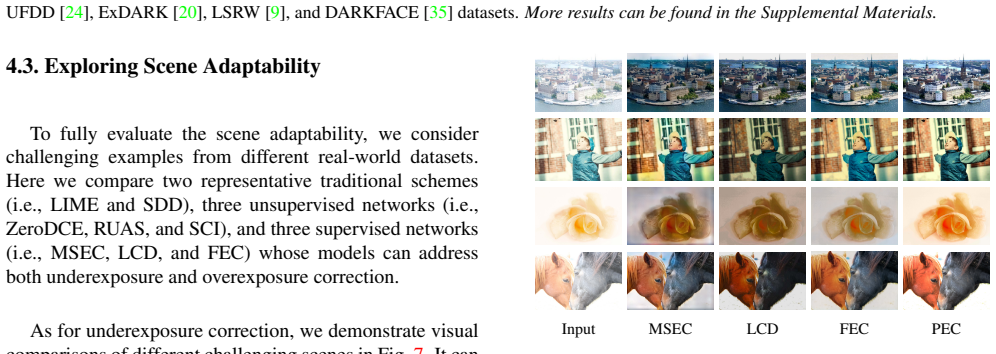
- The model adapts to unknown environments on eight challenging datasets.
- Processing requires only 0.0009 seconds for a 2K image on a GeForce RTX 2080Ti GPU.
- The approach improves results on downstream vision tasks.
- The iterative shrinkage scheme sidesteps complex computational flows of prior methods.
Where Pith is reading between the lines
- Real-time deployment becomes feasible on resource-constrained devices because of the reported speed.
- The compensation perspective may extend to related low-level tasks such as tone mapping or contrast enhancement.
- Reduced dependence on large paired training sets could follow if the adversarial function generalizes across domains.
Load-bearing premise
The exposure-sensitive compensation model plus the exposure adversarial function together provide sufficient expressive power and scene adaptability for arbitrary unknown environments.
What would settle it
A new test set of images with lighting conditions absent from the eight evaluated datasets on which the model produces visibly incorrect exposure levels or requires more than 0.001 seconds per 2K image on an RTX 2080Ti GPU.
Figures








read the original abstract
In computer vision, correcting the exposure level is a fundamental task for enhancing the visual quality of observations with inappropriate lightness. However, existing methodologies tend to be impractical because they lack adaptability to unknown scenes due to restricted modeling patterns and struggle to achieve satisfactory efficiency due to complex computational flows. To tackle these challenges, we establish a new practical exposure corrector (PEC) that excels in both quality and efficiency. Specifically, to overcome the limited expressive power of existing modeling patterns, we build a general model with exposure-sensitive compensation to provide an intuitive modeling perspective. We also design a simple but effective exposure adversarial function to catalyze scene-adaptive compensation. Building on the aforementioned key concepts, we develop a stable and robust iterative shrinkage scheme, avoiding the complex inferences encountered in existing studies. Extensive experimental evaluations across eight challenging datasets showcase the strong adaptability of the developed model to unknown environments. The model offers impressive processing speed, requiring only 0.0009 s to handle a 2K image on a device equipped with a GeForce RTX 2080Ti GPU. Experimental analysis of different downstream vision tasks further verifies the flexibility of the model. The code is available at https://rsliu.tech/PEC.
Editorial analysis
A structured set of objections, weighed in public.
Referee Report
Summary. The paper proposes a Practical Exposure Corrector (PEC) that combines an exposure-sensitive compensation model with an exposure adversarial function inside a stable iterative shrinkage scheme. It claims this yields higher quality and efficiency than prior methods while providing strong adaptability to unknown scenes, supported by experiments on eight datasets, a reported runtime of 0.0009 s per 2K image on an RTX 2080Ti, and improved performance on downstream vision tasks. Code is released.
Significance. If the central claims hold, the work would supply a practical, fast exposure-correction module with better scene generalization than existing restricted modeling patterns, directly benefiting real-world pipelines and downstream tasks. The public code release is a clear strength for reproducibility.
major comments (2)
- [Abstract] Abstract (paragraph 3): the claim that the exposure adversarial function plus compensation model together 'provide sufficient expressive power and scene adaptability for arbitrary unknown environments' is load-bearing for the generalization result, yet the manuscript supplies neither a theoretical coverage bound on the adversarial term nor an ablation that isolates its contribution from the compensation model alone.
- [§4] §4 (experimental section): the reported gains across eight datasets are presented without error bars, statistical significance tests, or cross-dataset failure-case analysis, making it impossible to verify whether the adaptability claim is robust or limited to patterns seen in training.
minor comments (2)
- [Abstract] The efficiency number 0.0009 s is given without a corresponding table that directly compares wall-clock time and memory against the cited baselines under identical hardware and image sizes.
- [Method] Notation for the iterative shrinkage scheme is introduced without an explicit convergence criterion or stopping condition, which should be stated for reproducibility.
Simulated Author's Rebuttal
We thank the referee for the constructive feedback on our manuscript. We address each major comment below and indicate planned revisions where appropriate.
read point-by-point responses
-
Referee: [Abstract] Abstract (paragraph 3): the claim that the exposure adversarial function plus compensation model together 'provide sufficient expressive power and scene adaptability for arbitrary unknown environments' is load-bearing for the generalization result, yet the manuscript supplies neither a theoretical coverage bound on the adversarial term nor an ablation that isolates its contribution from the compensation model alone.
Authors: The manuscript does not include a theoretical coverage bound on the adversarial term or an ablation isolating its contribution from the compensation model. We will add an ablation study in the revised version to quantify the incremental benefit of the adversarial function. A formal theoretical bound is not provided, as the work focuses on a practical, empirical solution validated across diverse datasets rather than theoretical guarantees; we will clarify this distinction in the text. revision: partial
-
Referee: [§4] §4 (experimental section): the reported gains across eight datasets are presented without error bars, statistical significance tests, or cross-dataset failure-case analysis, making it impossible to verify whether the adaptability claim is robust or limited to patterns seen in training.
Authors: We agree that the experimental results would be strengthened by error bars, statistical significance tests, and failure-case analysis. In the revision we will report error bars on quantitative metrics, include statistical tests for the reported gains, and add a cross-dataset analysis of challenging or failure cases to better substantiate the adaptability claims. revision: yes
Circularity Check
No circularity detected; derivation relies on novel model components without reduction to fitted inputs or self-citations.
full rationale
The provided abstract and context describe a new exposure-sensitive compensation model, exposure adversarial function, and iterative shrinkage scheme as the core contributions. No equations are presented that equate a claimed prediction or result to its own inputs by construction. No self-citations are invoked as load-bearing for uniqueness theorems or ansatzes. The central claim of adaptability to unknown environments is presented as an empirical outcome from evaluations on eight datasets rather than a mathematical reduction. This satisfies the criteria for a self-contained derivation with independent content, warranting a score of 0.
Axiom & Free-Parameter Ledger
Forward citations
Cited by 1 Pith paper
-
ZeroIDIR: Zero-Reference Illumination Degradation Image Restoration with Perturbed Consistency Diffusion Models
ZeroIDIR restores illumination-degraded images via adaptive gamma correction followed by perturbed consistency diffusion, trained solely on degraded images without references.
Reference graph
Works this paper leans on
-
[1]
Learning multi-scale photo expo- sure correction
Mahmoud Afifi, Konstantinos G Derpanis, Bjorn Ommer, and Michael S Brown. Learning multi-scale photo expo- sure correction. In Proceedings of the IEEE/CVF Conference on Computer Vision and Pattern Recognition , pages 9157– 9167, 2021. 1, 2, 3, 4, 5
work page 2021
-
[2]
A joint intrinsic-extrinsic prior model for retinex
Bolun Cai, Xianming Xu, Kailing Guo, Kui Jia, Bin Hu, and Dacheng Tao. A joint intrinsic-extrinsic prior model for retinex. In Proceedings of the IEEE/CVF International Con- ference on Computer Vision, 2017. 2, 6
work page 2017
-
[3]
Learning a deep single image contrast enhancer from multi-exposure images
Jianrui Cai, Shuhang Gu, and Lei Zhang. Learning a deep single image contrast enhancer from multi-exposure images. IEEE Transactions on Image Processing, PP(99):1–1, 2018. 1, 7
work page 2018
-
[4]
Multitask aet with orthogonal tangent regularity for dark object detection
Ziteng Cui, Guo-Jun Qi, Lin Gu, Shaodi You, Zenghui Zhang, and Tatsuya Harada. Multitask aet with orthogonal tangent regularity for dark object detection. In Proceedings of the IEEE/CVF International Conference on Computer Vi- sion, pages 2553–2562, 2021. 8
work page 2021
-
[5]
Xueyang Fu, Yinghao Liao, Delu Zeng, Yue Huang, Xiao- Ping Zhang, and Xinghao Ding. A probabilistic method for image enhancement with simultaneous illumination and re- flectance estimation. IEEE Transactions on Image Process- ing, 24(12):4965–4977, 2015. 6
work page 2015
-
[6]
A weighted variational model for simultane- ous reflectance and illumination estimation
Xueyang Fu, Delu Zeng, Yue Huang, Xiao-Ping Zhang, and Xinghao Ding. A weighted variational model for simultane- ous reflectance and illumination estimation. In Proceedings of the IEEE/CVF Conference on Computer Vision and Pat- tern Recognition, 2016. 2, 6
work page 2016
-
[7]
Zero-reference deep curve estimation for low-light image enhancement
Chunle Guo, Chongyi Li, Jichang Guo, Chen Change Loy, Junhui Hou, Sam Kwong, and Runmin Cong. Zero-reference deep curve estimation for low-light image enhancement. In Proceedings of the IEEE/CVF Conference on Computer Vi- sion and Pattern Recognition, pages 1780–1789, 2020. 1, 2, 4, 5
work page 2020
-
[8]
Lime: Low-light im- age enhancement via illumination map estimation
Xiaojie Guo, Yu Li, and Haibin Ling. Lime: Low-light im- age enhancement via illumination map estimation. IEEE Transactions on Image Processing, 26(2):982–993, 2017. 2, 6
work page 2017
-
[9]
R2rnet: Low-light image enhancement via real-low to real-normal network
Jiang Hai, Zhu Xuan, Ren Yang, Yutong Hao, Fengzhu Zou, Fang Lin, and Songchen Han. R2rnet: Low-light image enhancement via real-low to real-normal network. arXiv preprint arXiv:2106.14501, 2021. 1, 7
-
[10]
Low-light image enhancement with semi-decoupled decom- position
Shijie Hao, Xu Han, Yanrong Guo, Xin Xu, and Meng Wang. Low-light image enhancement with semi-decoupled decom- position. IEEE transactions on multimedia , 22(12):3025– 3038, 2020. 2, 6
work page 2020
-
[11]
Exposure normalization and compensation for multiple-exposure correction
Jie Huang, Yajing Liu, Xueyang Fu, Man Zhou, Yang Wang, Feng Zhao, and Zhiwei Xiong. Exposure normalization and compensation for multiple-exposure correction. In Proceed- ings of the IEEE/CVF Conference on Computer Vision and Pattern Recognition, pages 6043–6052, 2022. 1, 2, 3
work page 2022
-
[12]
Deep fourier-based exposure correction network with spatial- frequency interaction
Jie Huang, Yajing Liu, Feng Zhao, Keyu Yan, Jinghao Zhang, Yukun Huang, Man Zhou, and Zhiwei Xiong. Deep fourier-based exposure correction network with spatial- frequency interaction. In European Conference on Computer Vision, 2022. 2, 5
work page 2022
-
[13]
Exposure-consistency representation learning for exposure correction
Jie Huang, Man Zhou, Yajing Liu, Mingde Yao, Feng Zhao, and Zhiwei Xiong. Exposure-consistency representation learning for exposure correction. In Proceedings of the 30th ACM International Conference on Multimedia, pages 6309– 6317, 2022. 1, 2
work page 2022
-
[14]
Edwin H Land and John J McCann. Lightness and retinex theory. Journal of the Optical Society of America, 1971. 2
work page 1971
-
[15]
Gps- glass: Learning nighttime semantic segmentation using day- time video and gps data
Hongjae Lee, Changwoo Han, and Seung-Won Jung. Gps- glass: Learning nighttime semantic segmentation using day- time video and gps data. arXiv preprint arXiv:2207.13297,
-
[16]
Zero-shot day-night domain adaptation with a physics prior
Attila Lengyel, Sourav Garg, Michael Milford, and Jan C van Gemert. Zero-shot day-night domain adaptation with a physics prior. In Proceedings of the IEEE/CVF International Conference on Computer Vision, pages 4399–4409, 2021. 8
work page 2021
-
[17]
Structure-revealing low-light image en- hancement via robust retinex model
Mading Li, Jiaying Liu, Wenhan Yang, Xiaoyan Sun, and Zongming Guo. Structure-revealing low-light image en- hancement via robust retinex model. IEEE Transactions on Image Processing, 27(6):2828–2841, 2018. 2, 6
work page 2018
-
[18]
Recurrent exposure generation for low-light face detection
Jinxiu Liang, Jingwen Wang, Yuhui Quan, Tianyi Chen, Ji- aying Liu, Haibin Ling, and Yong Xu. Recurrent exposure generation for low-light face detection. IEEE Transactions on Multimedia, 24:1609–1621, 2021. 8
work page 2021
-
[19]
Risheng Liu, Long Ma, Jiaao Zhang, Xin Fan, and Zhongx- uan Luo. Retinex-inspired unrolling with cooperative prior architecture search for low-light image enhancement. InPro- ceedings of the IEEE/CVF Conference on Computer Vision and Pattern Recognition, pages 10561–10570, 2021. 2, 5
work page 2021
-
[20]
Getting to know low- light images with the exclusively dark dataset
Yuen Peng Loh and Chee Seng Chan. Getting to know low- light images with the exclusively dark dataset. Computer Vision and Image Understanding, 178:30–42, 2019. 7
work page 2019
-
[21]
Perceptual quality assessment for multi-exposure image fusion
Kede Ma, Kai Zeng, and Zhou Wang. Perceptual quality assessment for multi-exposure image fusion. IEEE Transac- tions on Image Processing, 24(11):3345–3356, 2015. 6
work page 2015
-
[22]
Toward fast, flexible, and robust low-light image enhancement
Long Ma, Tengyu Ma, Risheng Liu, Xin Fan, and Zhongx- uan Luo. Toward fast, flexible, and robust low-light image enhancement. In Proceedings of the IEEE/CVF Conference on Computer Vision and Pattern Recognition , pages 5637– 5646, 2022. 1, 2, 4, 5, 7
work page 2022
-
[23]
Mak- ing a ”completely blind” image quality analyzer
Anish Mittal, Rajiv Soundararajan, and Alan C Bovik. Mak- ing a ”completely blind” image quality analyzer. IEEE Sig- nal Processing Letters, 20(3):209–212, 2012. 5
work page 2012
-
[24]
Pushing the limits of unconstrained face de- tection: a challenge dataset and baseline results
Hajime Nada, Vishwanath A Sindagi, He Zhang, and Vishal M Patel. Pushing the limits of unconstrained face de- tection: a challenge dataset and baseline results. In IEEE In- ternational Conference on Biometrics Theory, Applications and Systems. IEEE, 2018. 1, 7
work page 2018
-
[25]
Lr3m: Robust low-light enhancement via low-rank regularized retinex model
Xutong Ren, Wenhan Yang, Wen-Huang Cheng, and Jiay- ing Liu. Lr3m: Robust low-light enhancement via low-rank regularized retinex model. IEEE Transactions on Image Pro- cessing, 29:5862–5876, 2020. 6
work page 2020
-
[26]
Acdc: The adverse conditions dataset with correspondences for se- mantic driving scene understanding
Christos Sakaridis, Dengxin Dai, and Luc Van Gool. Acdc: The adverse conditions dataset with correspondences for se- mantic driving scene understanding. In Proceedings of the IEEE/CVF International Conference on Computer Vision , pages 10765–10775, 2021. 7
work page 2021
-
[27]
A mathematical theory of communi- cation
Claude E Shannon. A mathematical theory of communi- cation. The Bell system technical journal , 27(3):379–423,
-
[28]
Local color distributions prior for image enhancement
Haoyuan Wang, Ke Xu, and Rynson WH Lau. Local color distributions prior for image enhancement. In European Conference on Computer Vision , pages 343–359, 2022. 4, 5
work page 2022
-
[29]
Nat- uralness preserved enhancement algorithm for non-uniform illumination images
Shuhang Wang, Jin Zheng, Hai-Miao Hu, and Bo Li. Nat- uralness preserved enhancement algorithm for non-uniform illumination images. IEEE Transactions on Image Process- ing, 22(9):3538–3548, 2013. 5, 6
work page 2013
-
[30]
Unsupervised face detection in the dark
Wenjing Wang, Xinhao Wang, Wenhan Yang, and Jiaying Liu. Unsupervised face detection in the dark. IEEE Trans- actions on Pattern Analysis and Machine Intelligence, 2022. 8
work page 2022
-
[31]
Uretinex-net: Retinex-based deep unfolding network for low-light image enhancement
Wenhui Wu, Jian Weng, Pingping Zhang, Xu Wang, Wenhan Yang, and Jianmin Jiang. Uretinex-net: Retinex-based deep unfolding network for low-light image enhancement. InPro- ceedings of the IEEE/CVF Conference on Computer Vision and Pattern Recognition, pages 5901–5910, 2022. 2, 5
work page 2022
-
[32]
Xinyi Wu, Zhenyao Wu, Lili Ju, and Song Wang. A one- stage domain adaptation network with image alignment for unsupervised nighttime semantic segmentation. IEEE Trans- actions on Pattern Analysis and Machine Intelligence, 2021. 8
work page 2021
-
[33]
Star: A struc- ture and texture aware retinex model
Jun Xu, Yingkun Hou, Dongwei Ren, Li Liu, Fan Zhu, Mengyang Yu, Haoqian Wang, and Ling Shao. Star: A struc- ture and texture aware retinex model. IEEE Transactions on Image Processing, 29:5022–5037, 2020. 6
work page 2020
-
[34]
Structure extrac- tion from texture via relative total variation
Li Xu, Qiong Yan, Yang Xia, and Jiaya Jia. Structure extrac- tion from texture via relative total variation. ACM Transac- tions on Graphics, 2012. 2
work page 2012
-
[35]
Advancing image understanding in poor visibility environments: A collective benchmark study
Wenhan Yang, Ye Yuan, Wenqi Ren, Jiaying Liu, Wal- ter J Scheirer, Zhangyang Wang, Taiheng Zhang, Qiaoy- ong Zhong, Di Xie, Shiliang Pu, et al. Advancing image understanding in poor visibility environments: A collective benchmark study. IEEE Transactions on Image Processing, 29:5737–5752, 2020. 7
work page 2020
-
[36]
The unreasonable effectiveness of deep features as a perceptual metric
Richard Zhang, Phillip Isola, Alexei A Efros, Eli Shecht- man, and Oliver Wang. The unreasonable effectiveness of deep features as a perceptual metric. In Proceedings of the IEEE Conference on Computer Vision and Pattern Recogni- tion, pages 586–595, 2018. 5
work page 2018
-
[37]
Kindling the darkness: A practical low-light image enhancer
Yonghua Zhang, Jiawan Zhang, and Xiaojie Guo. Kindling the darkness: A practical low-light image enhancer. In ACM Multimedia, 2019. 2, 5
work page 2019
-
[38]
Adaptive unfolding total variation network for low-light image en- hancement
Chuanjun Zheng, Daming Shi, and Wentian Shi. Adaptive unfolding total variation network for low-light image en- hancement. In Proceedings of the IEEE/CVF International Conference on Computer Vision, pages 4439–4448, 2021. 2, 5
work page 2021
discussion (0)
Sign in with ORCID, Apple, or X to comment. Anyone can read and Pith papers without signing in.