A Heavy-Load-Enhanced and Changeable-Periodicity-Perceived Workload Prediction Network
Pith reviewed 2026-05-24 07:21 UTC · model grok-4.3
The pith
PePNet achieves 21 percent higher accuracy on heavy workloads by automatically detecting changeable periodicity and iteratively fixing the weakest predictions.
A machine-rendered reading of the paper's core claim, the machinery that carries it, and where it could break.
Core claim
PePNet fuses periodic information adaptively for periodicity-changeable time series through its Periodicity-Perceived Mechanism and uses an Achilles' Heel Loss Function to iteratively optimize the most under-fitting parts of each prediction sequence, yielding an average 11.8 percent improvement in overall workload prediction accuracy and 21.0 percent improvement for heavy workloads compared with state-of-the-art methods on real-world datasets.
What carries the argument
The Periodicity-Perceived Mechanism that automatically detects periodicity length from the input sequence and fuses the corresponding periodic information adaptively, together with the Achilles' Heel Loss Function that iteratively optimizes the most under-fitting segments of the prediction sequence.
If this is right
- Heavy-load prediction errors decrease, lowering the chance of service level agreement violations in cloud systems.
- Workload forecasting becomes feasible for time series whose periodicity length changes without requiring separate models or manual retuning.
- Training focuses computational effort on the rare high-load segments that matter most for reliability.
- The same architecture can be applied to other imbalanced periodic forecasting tasks where overall accuracy masks critical tail errors.
Where Pith is reading between the lines
- The approach may transfer to domains such as network traffic or power-grid load where bursty high-value events coincide with drifting periodic structure.
- Combining the loss function with other sequence models could further isolate whether the gains come mainly from the periodicity module or the loss design.
- Controlled experiments that inject known periodicity shifts into real traces would isolate how much of the reported gain depends on accurate length detection.
Load-bearing premise
The Periodicity-Perceived Mechanism can reliably infer and fuse the correct current periodicity length from the input sequence even when periodicity is not stationary.
What would settle it
Measure whether the mechanism's detected periodicity lengths match ground-truth changing periods on a controlled synthetic dataset and whether accuracy gains disappear when the mechanism is replaced by a fixed-periodicity baseline.
Figures


read the original abstract
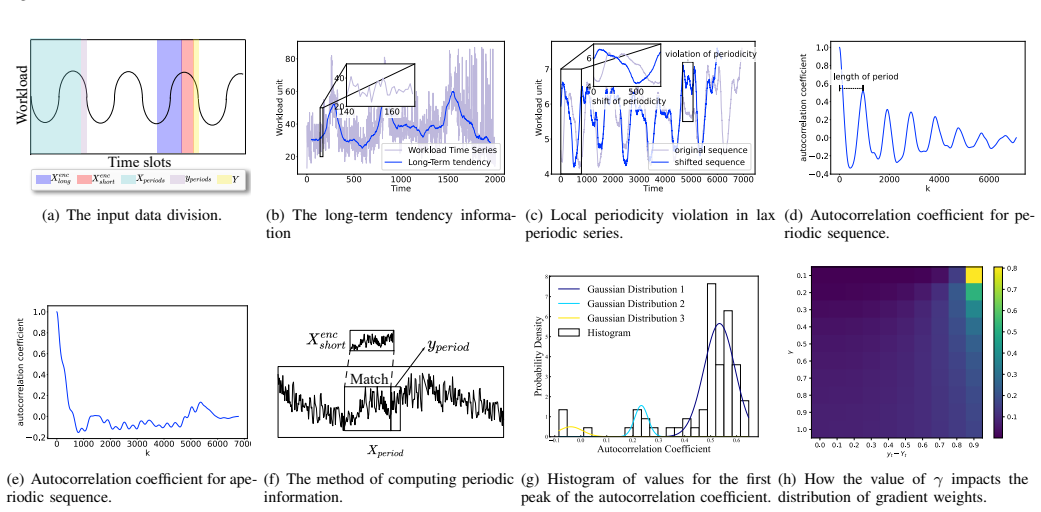
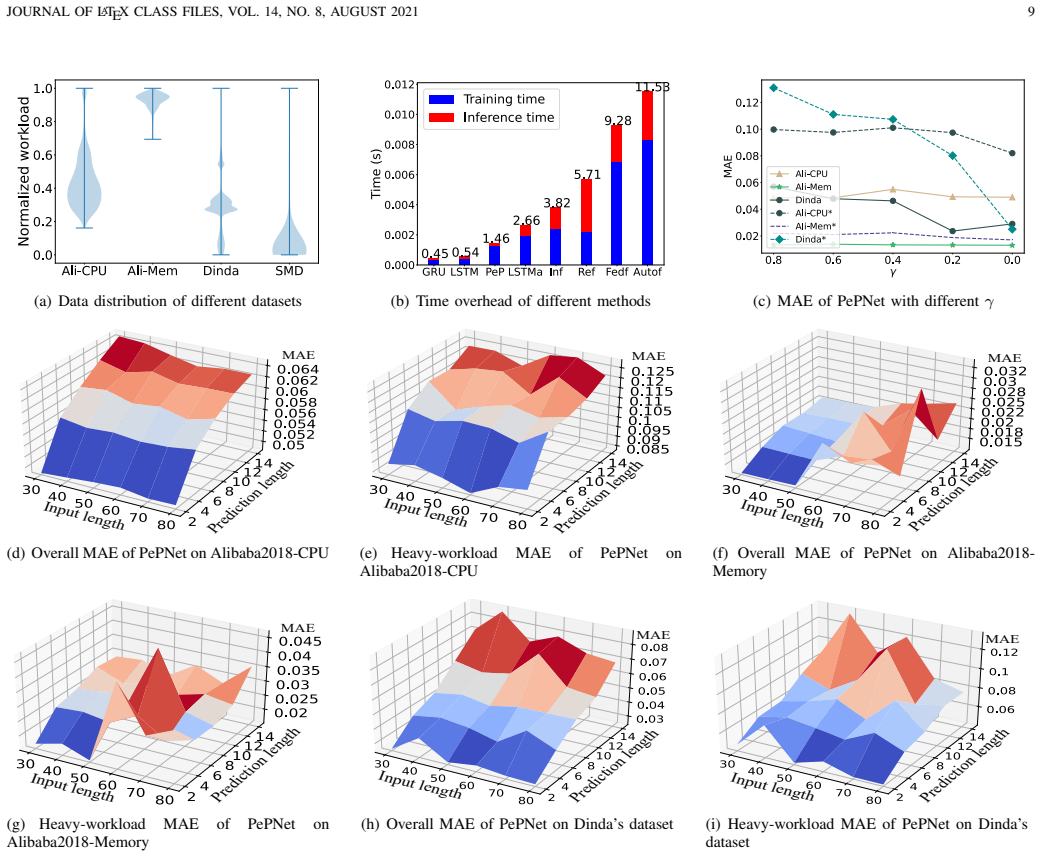
Cloud providers can greatly benefit from accurate workload prediction. However, the workload of cloud servers is highly variable, with occasional workload bursts, which makes workload prediction challenging. The time series forecasting methods relying on periodicity information, often assume fixed and known periodicity length, which does not align with the periodicity-changeable nature of cloud service workloads. Although many state-of-the-art time-series forecasting methods do not rely on periodicity information and achieve high overall accuracy, they are vulnerable to data imbalance between heavy workloads and regular workloads. As a result, their prediction accuracy on rare heavy workloads is limited. Unfortunately, heavyload-prediction accuracy is more important than overall one, as errors in heavyload prediction are more likely to cause Service Level Agreement violations than errors in normal-load prediction. Thus, we propose a changeable-periodicity-perceived workload prediction network (PePNet) to fuse periodic information adaptively for periodicity-changeable time series and improve rare heavy workload prediction accuracy. It has two distinctive characteristics: (i) A Periodicity-Perceived Mechanism to detect the periodicity length automatically and fuses periodic information adaptively, which is suitable for periodicity-changeable time series, and (ii) An Achilles' Heel Loss Function that is used to iteratively optimize the most under-fitting part in predicting sequence for each step, thus evidently improving the prediction accuracy of heavy load. Extensive experiments conducted on real-world datasets demonstrate that PePNet improves accuracy for overall workload by 11.8% averagely, compared with state-of-the-art methods. Especially, PePNet improves accuracy for heavy workload by 21.0% averagely.
Editorial analysis
A structured set of objections, weighed in public.
Referee Report
Summary. The paper proposes PePNet, a neural network for cloud workload forecasting that incorporates a Periodicity-Perceived Mechanism to automatically detect and adaptively fuse periodicity information in changeable-periodicity series, together with an Achilles' Heel Loss that iteratively focuses optimization on the most under-fitting segments of each prediction sequence. The central empirical claim is that these components yield average accuracy gains of 11.8% overall and 21.0% on heavy-load subsets relative to state-of-the-art baselines across real-world datasets.
Significance. If the Periodicity-Perceived Mechanism can be shown to correctly identify and fuse the current periodicity length under non-stationary drifts without additional distributional assumptions, and if the Achilles' Heel Loss demonstrably improves tail accuracy without degrading overall performance, the work would address a practically important gap between periodicity-aware forecasters (which assume fixed periods) and general time-series models (which underperform on rare heavy loads). The reported heavy-load gains would be directly relevant to SLA-sensitive cloud provisioning.
major comments (2)
- Abstract, characteristic (i): the assertion that the Periodicity-Perceived Mechanism 'detect[s] the periodicity length automatically and fuses periodic information adaptively' for 'periodicity-changeable time series' without requiring stationarity or extra assumptions is load-bearing for the 21% heavy-load claim, yet the description supplies neither the detection algorithm, the fusion equations, nor any ablation or failure-mode analysis when periodicity length switches mid-sequence. Without such evidence the reported improvement cannot be attributed to this component rather than to the loss or to dataset-specific tuning.
- Abstract: the headline percentages (11.8% overall, 21.0% heavy load) are stated without reference to any baseline methods, error metric, number of runs, or statistical significance test. Because the soundness of these numbers is the primary empirical support for both novel components, the absence of protocol details makes it impossible to assess whether the gains are reproducible or arise from post-hoc selection.
minor comments (1)
- The abstract refers to 'real-world datasets' but does not name them or indicate their periodicity characteristics; adding this information would allow readers to judge the scope of the changeable-periodicity claim.
Simulated Author's Rebuttal
We thank the referee for the constructive feedback. We address each major comment below, clarifying details from the full manuscript and proposing targeted revisions to the abstract for improved clarity and reproducibility.
read point-by-point responses
-
Referee: [—] Abstract, characteristic (i): the assertion that the Periodicity-Perceived Mechanism 'detect[s] the periodicity length automatically and fuses periodic information adaptively' for 'periodicity-changeable time series' without requiring stationarity or extra assumptions is load-bearing for the 21% heavy-load claim, yet the description supplies neither the detection algorithm, the fusion equations, nor any ablation or failure-mode analysis when periodicity length switches mid-sequence. Without such evidence the reported improvement cannot be attributed to this component rather than to the loss or to dataset-specific tuning.
Authors: The full manuscript provides the detection algorithm and adaptive fusion equations in Section 3.2, along with ablation studies in Section 4.3 that isolate the mechanism's contribution by showing degraded performance (especially on heavy loads) when it is removed. The design explicitly handles non-stationary periodicity changes via per-window adaptation without fixed assumptions. We agree the abstract is overly concise and will revise it to briefly reference the algorithm and point to these sections; we will also add a short failure-mode discussion for mid-sequence switches if the referee considers it essential. revision: yes
-
Referee: [—] Abstract: the headline percentages (11.8% overall, 21.0% heavy load) are stated without reference to any baseline methods, error metric, number of runs, or statistical significance test. Because the soundness of these numbers is the primary empirical support for both novel components, the absence of protocol details makes it impossible to assess whether the gains are reproducible or arise from post-hoc selection.
Authors: Sections 4.1 and 4.2 of the manuscript detail the experimental protocol, including the specific state-of-the-art baselines, error metrics (MAE/RMSE), number of runs, and statistical significance testing. The abstract reports average improvements across datasets. We will revise the abstract to explicitly name the baselines, metrics, and note that results are averaged over multiple runs with significance tests, thereby making the headline figures self-contained. revision: yes
Circularity Check
No circularity; model design and empirical validation are independent
full rationale
The paper proposes PePNet as a neural architecture incorporating a Periodicity-Perceived Mechanism and Achilles' Heel Loss, validated via experiments on real-world datasets. No equations, derivations, or self-citations are shown that reduce any claimed prediction or mechanism to its inputs by construction (e.g., no fitted parameter renamed as prediction, no self-definitional periodicity detection, no load-bearing uniqueness theorem from prior author work). The 21% heavy-load gain is presented as an experimental outcome, not a tautology. This matches the common case of a self-contained empirical proposal with score 0.
Axiom & Free-Parameter Ledger
Reference graph
Works this paper leans on
-
[1]
Runtime resource management with workload prediction,
M. Niknafs, I. Ukhov, P. Eles, and Z. Peng, “Runtime resource management with workload prediction,” in Annual Design Automation Conference 2019, DAC 2019 , 2019, pp. 1–6
work page 2019
-
[2]
Era: A framework for economic resource allocation for the cloud,
M. Babaioff, Y . Mansour, N. Nisan, G. Noti, C. Curino, N. Ganapathy, I. Menache, O. Reingold, M. Tennenholtz, and E. Timnat, “Era: A framework for economic resource allocation for the cloud,” in Interna- tional Conference on World Wide Web Companion, WWW 2017 , 2017, p. 635–642
work page 2017
-
[3]
Machine learning based workload pre- diction in cloud computing,
J. Gao, H. Wang, and H. Shen, “Machine learning based workload pre- diction in cloud computing,” in International Conference on Computer Communications and Networks, ICCCN 2020 , 2020, pp. 1–9
work page 2020
-
[4]
Toward better service performance management via workload prediction,
H. Moussa, I. Yen, F. B. Bastani, Y . Dong, and W. He, “Toward better service performance management via workload prediction,” in Services Computing - SCC 2019 , ser. Lecture Notes in Computer Science, vol. 11515, 2019, pp. 92–106
work page 2019
-
[5]
Z. Chen, J. Hu, G. Min, A. Y . Zomaya, and T. A. El-Ghazawi, “Towards accurate prediction for high-dimensional and highly-variable cloud workloads with deep learning,” IEEE Trans. Parallel Distributed Syst., vol. 31, no. 4, pp. 923–934, 2020
work page 2020
-
[6]
H. Aragon, S. Braganza, E. Boza, J. Parrales, and C. Abad, “Workload characterization of a software-as-a-service web application implemented with a microservices architecture,” in Companion Proceedings of The 2019 World Wide Web Conference, WWW 2019 , 2019, p. 746–750
work page 2019
-
[7]
Workload prediction using ARIMA model and its impact on cloud applications’ qos,
R. N. Calheiros, E. Masoumi, R. Ranjan, and R. Buyya, “Workload prediction using ARIMA model and its impact on cloud applications’ qos,” IEEE Trans. Cloud Comput. , vol. 3, no. 4, pp. 449–458, 2015
work page 2015
-
[8]
Y . Jiang, M. Shahrad, D. Wentzlaff, D. H. K. Tsang, and C. Joe-Wong, “Burstable instances for clouds: Performance modeling, equilibrium analysis, and revenue maximization,” IEEE/ACM Trans. Netw., vol. 28, no. 6, pp. 2489–2502, 2020
work page 2020
-
[9]
Modeling extreme events in time series prediction,
D. Ding, M. Zhang, X. Pan, M. Yang, and X. He, “Modeling extreme events in time series prediction,” in ACM SIGKDD International Con- ference on Knowledge Discovery & Data Mining, KDD 2019 , 2019, pp. 1114–1122. JOURNAL OF LATEX CLASS FILES, VOL. 14, NO. 8, AUGUST 2021 12
work page 2019
-
[10]
Y . Zhu, W. Zhang, Y . Chen, and H. Gao, “A novel approach to workload prediction using attention-based LSTM encoder-decoder network in cloud environment,” EURASIP J. Wirel. Commun. Netw., vol. 2019, pp. 1–18, 2019
work page 2019
-
[11]
Informer: Beyond efficient transformer for long sequence time-series forecasting,
H. Zhou, S. Zhang, J. Peng, S. Zhang, J. Li, H. Xiong, and W. Zhang, “Informer: Beyond efficient transformer for long sequence time-series forecasting,” in Conference on Artificial Intelligence, AAAI 2021 , 2021, pp. 11 106–11 115
work page 2021
-
[12]
The statistical properties of host load,
P. A. Dinda, “The statistical properties of host load,” Sci. Program. , vol. 7, no. 3-4, pp. 211–229, 1999
work page 1999
-
[13]
Attention based spatial- temporal graph convolutional networks for traffic flow forecasting,
S. Guo, Y . Lin, N. Feng, C. Song, and H. Wan, “Attention based spatial- temporal graph convolutional networks for traffic flow forecasting,” in Conference on Artificial Intelligence, AAAI 2019 , 2019, pp. 922–929
work page 2019
-
[14]
Gated residual recurrent graph neural networks for traffic prediction,
C. Chen, K. Li, S. G. Teo, X. Zou, K. Wang, J. Wang, and Z. Zeng, “Gated residual recurrent graph neural networks for traffic prediction,” in Conference on Artificial Intelligence, AAAI 2019 , 2019, pp. 485–492
work page 2019
-
[15]
LC-RNN: A deep learning model for traffic speed prediction,
Z. Lv, J. Xu, K. Zheng, H. Yin, P. Zhao, and X. Zhou, “LC-RNN: A deep learning model for traffic speed prediction,” in Proceedings of International Joint Conference on Artificial Intelligence, IJCAI 2018 , 2018, pp. 3470–3476
work page 2018
-
[16]
Revisiting spatial- temporal similarity: A deep learning framework for traffic prediction,
H. Yao, X. Tang, H. Wei, G. Zheng, and Z. Li, “Revisiting spatial- temporal similarity: A deep learning framework for traffic prediction,” in Conference on Artificial Intelligence, AAAI 2019 , 2019, pp. 5668– 5675
work page 2019
-
[17]
Modeling extreme events in time series prediction,
D. Ding, M. Zhang, X. Pan, M. Yang, and X. He, “Modeling extreme events in time series prediction,” in Proceedings of the 25th ACM SIGKDD International Conference on Knowledge Discovery & Data Mining, 2019, pp. 1114–1122
work page 2019
-
[18]
Learning Phrase Representations using RNN Encoder-Decoder for Statistical Machine Translation
K. Cho, B. Van Merri ¨enboer, C. Gulcehre, D. Bahdanau, F. Bougares, H. Schwenk, and Y . Bengio, “Learning phrase representations using rnn encoder-decoder for statistical machine translation,” arXiv preprint arXiv:1406.1078, 2014
work page internal anchor Pith review Pith/arXiv arXiv 2014
-
[19]
A. Vaswani, N. Shazeer, N. Parmar, J. Uszkoreit, L. Jones, A. N. Gomez, Ł. Kaiser, and I. Polosukhin, “Attention is all you need,” Advances in neural information processing systems , vol. 30, 2017
work page 2017
-
[20]
S. Hochreiter and J. Schmidhuber, “Long short-term memory,” Neural Computation, vol. 9, no. 8, pp. 1735–1780, 1997
work page 1997
-
[21]
A. Vaswani, N. Shazeer, N. Parmar, J. Uszkoreit, L. Jones, A. N. Gomez, L. u. Kaiser, and I. Polosukhin, “Attention is all you need,” in Advances in Neural Information Processing Systems, NeurIPS 2017, vol. 30, 2017
work page 2017
-
[22]
Stacked convo- lutional auto-encoders for hierarchical feature extraction,
J. Masci, U. Meier, D. Cires ¸an, and J. Schmidhuber, “Stacked convo- lutional auto-encoders for hierarchical feature extraction,” in Artificial Neural Networks and Machine Learning, ICANN 2011. Springer Berlin Heidelberg, 2011, pp. 52–59
work page 2011
-
[23]
Autoformer: Decomposition transformers with auto-correlation for long-term series forecasting,
H. Wu, J. Xu, J. Wang, and M. Long, “Autoformer: Decomposition transformers with auto-correlation for long-term series forecasting,” in Advances in Neural Information Processing Systems, NeurIPS 2021 , vol. 34, 2021, pp. 22 419–22 430
work page 2021
-
[24]
Reformer: The efficient trans- former,
N. Kitaev, L. Kaiser, and A. Levskaya, “Reformer: The efficient trans- former,” inInternational Conference on Learning Representations, ICLR 2020, 2020
work page 2020
-
[25]
Fedformer: Frequency enhanced decomposed transformer for long-term series fore- casting,
T. Zhou, Z. Ma, Q. Wen, X. Wang, L. Sun, and R. Jin, “Fedformer: Frequency enhanced decomposed transformer for long-term series fore- casting,” in International Conference on Machine Learning, ICML 2022, vol. 162, 2022, pp. 27 268–27 286
work page 2022
-
[26]
Robust anomaly detection for multivariate time series through stochastic recurrent neural network,
Y . Su, Y . Zhao, C. Niu, R. Liu, W. Sun, and D. Pei, “Robust anomaly detection for multivariate time series through stochastic recurrent neural network,” in ACM SIGKDD international conference on knowledge discovery & data mining, KDD 2019 , 2019, pp. 2828–2837
work page 2019
-
[27]
Characterization and prediction of deep learning workloads in large-scale GPU datacenters,
Q. Hu, P. Sun, S. Yan, Y . Wen, and T. Zhang, “Characterization and prediction of deep learning workloads in large-scale GPU datacenters,” in The International Conference for High Performance Computing, Networking, Storage and Analysis, SC ’21 , 2021, pp. 104:1–104:15
work page 2021
-
[28]
A meta reinforcement learning approach for predictive autoscaling in the cloud,
S. Xue, C. Qu, X. Shi, C. Liao, S. Zhu, X. Tan, L. Ma, S. Wang, S. Wang, Y . Hu et al. , “A meta reinforcement learning approach for predictive autoscaling in the cloud,” in ACM SIGKDD Conference on Knowledge Discovery and Data Mining, KDD 2022 , 2022, pp. 4290– 4299
work page 2022
-
[29]
CAFE: adaptive VDI workload prediction with multi-grained features,
Y . Zhang, W. Fan, X. Wu, H. Chen, B. Li, and M. Zhang, “CAFE: adaptive VDI workload prediction with multi-grained features,” in Artificial Intelligence, AAAI 2019 , 2019, pp. 5821–5828
work page 2019
-
[30]
Deep learning for hdd health assessment: An application based on lstm,
A. De Santo, A. Galli, M. Gravina, V . Moscato, and G. Sperl `ı, “Deep learning for hdd health assessment: An application based on lstm,” IEEE Transactions on Computers, vol. 71, no. 1, pp. 69–80, 2020
work page 2020
-
[31]
Query-based workload forecasting for self-driving database management systems,
L. Ma, D. Van Aken, A. Hefny, G. Mezerhane, A. Pavlo, and G. J. Gordon, “Query-based workload forecasting for self-driving database management systems,” in Proceedings of the 2018 International Con- ference on Management of Data , 2018, pp. 631–645
work page 2018
-
[32]
Graph deep factors for forecasting with applications to cloud resource alloca- tion,
H. Chen, R. A. Rossi, K. Mahadik, S. Kim, and H. Eldardiry, “Graph deep factors for forecasting with applications to cloud resource alloca- tion,” in ACM SIGKDD Conference on Knowledge Discovery & Data Mining, KDD 2021 , 2021, pp. 106–116
work page 2021
-
[33]
Intelligent virtual machine provisioning in cloud computing,
C. Luo, B. Qiao, X. Chen, P. Zhao, R. Yao, H. Zhang, W. Wu, A. Zhou, and Q. Lin, “Intelligent virtual machine provisioning in cloud computing,” in International Joint Conference on Artificial Intelligence, IJCAI 2020, 2020, pp. 1495–1502
work page 2020
-
[34]
Simplets: An efficient and universal model selection framework for time series forecasting,
Y . Yao, D. Li, H. Jie, H. Jie, T. Li, J. Chen, J. Wang, F. Li, and Y . Gao, “Simplets: An efficient and universal model selection framework for time series forecasting,” Proceedings of the VLDB Endowment , vol. 16, no. 12, pp. 3741–3753, 2023
work page 2023
-
[35]
Thermal status and workload prediction using support vector regression,
M. Stockman, M. Awad, H. Akkary, and R. Khanna, “Thermal status and workload prediction using support vector regression,” in International Conference on Energy Aware Computing , 2012, pp. 1–5
work page 2012
-
[36]
TASM: technocrat ARIMA and SVR model for workload prediction of web applications in cloud,
P. Singh, P. Gupta, and K. Jyoti, “TASM: technocrat ARIMA and SVR model for workload prediction of web applications in cloud,” Clust. Comput., vol. 22, no. 2, pp. 619–633, 2019
work page 2019
-
[37]
Workload prediction for cloud cluster using a recurrent neural network,
W. Zhang, B. Li, D. Zhao, F. Gong, and Q. Lu, “Workload prediction for cloud cluster using a recurrent neural network,” in International Conference on Identification, Information and Knowledge in the Internet of Things (IIKI) , 2016, pp. 104–109
work page 2016
-
[38]
J. Kumar, R. Goomer, and A. K. Singh, “Long short term memory recurrent neural network (lstm-rnn) based workload forecasting model for cloud datacenters,” Procedia Computer Science , vol. 125, pp. 676– 682, 2018
work page 2018
-
[39]
A. Bauer, M. Z ¨ufle, N. Herbst, S. Kounev, and V . Curtef, “Telescope: An automatic feature extraction and transformation approach for time series forecasting on a level-playing field,” in 2020 IEEE 36th International Conference on Data Engineering (ICDE) , 2020, pp. 1902–1905
work page 2020
-
[40]
Geoman: Multi- level attention networks for geo-sensory time series prediction
Y . Liang, S. Ke, J. Zhang, X. Yi, and Y . Zheng, “Geoman: Multi- level attention networks for geo-sensory time series prediction.” in International conference on international joint conferences on artificial intelligence, IJCAI 2018 , 2018, pp. 3428–3434
work page 2018
-
[41]
Modeling the stock relation with graph network for overnight stock movement predic- tion,
W. Li, R. Bao, K. Harimoto, D. Chen, J. Xu, and Q. Su, “Modeling the stock relation with graph network for overnight stock movement predic- tion,” in International conference on international joint conferences on artificial intelligence, IJCAI 2021 , 2021, pp. 4541–4547
work page 2021
-
[42]
Enhancenet: Plugin neural networks for enhancing correlated time series forecasting,
R.-G. Cirstea, T. Kieu, C. Guo, B. Yang, and S. J. Pan, “Enhancenet: Plugin neural networks for enhancing correlated time series forecasting,” in 2021 IEEE 37th International Conference on Data Engineering (ICDE), 2021, pp. 1739–1750
work page 2021
-
[43]
Metro: a generic graph neural network framework for multivariate time series forecasting,
Y . Cui, K. Zheng, D. Cui, J. Xie, L. Deng, F. Huang, and X. Zhou, “Metro: a generic graph neural network framework for multivariate time series forecasting,” Proceedings of the VLDB Endowment, vol. 15, no. 2, pp. 224–236, 2021
work page 2021
-
[44]
Autocts: Automated correlated time series forecasting,
X. Wu, D. Zhang, C. Guo, C. He, B. Yang, and C. S. Jensen, “Autocts: Automated correlated time series forecasting,” Proceedings of the VLDB Endowment, vol. 15, no. 4, pp. 971–983, 2021
work page 2021
-
[45]
Training robust deep models for time-series domain: Novel algorithms and theoretical analysis,
T. Belkhouja, Y . Yan, and J. R. Doppa, “Training robust deep models for time-series domain: Novel algorithms and theoretical analysis,” in Proceedings of the AAAI Conference on Artificial Intelligence , vol. 36, no. 6, 2022, pp. 6055–6063
work page 2022
-
[46]
Data-gru: Dual-attention time-aware gated recurrent unit for irregular multivariate time series,
Q. Tan, M. Ye, B. Yang, S. Liu, A. J. Ma, T. C.-F. Yip, G. L.-H. Wong, and P. Yuen, “Data-gru: Dual-attention time-aware gated recurrent unit for irregular multivariate time series,” in Proceedings of the AAAI Conference on Artificial Intelligence, vol. 34, no. 01, 2020, pp. 930–937
work page 2020
-
[47]
Tapnet: Multivariate time series classification with attentional prototypical network,
X. Zhang, Y . Gao, J. Lin, and C.-T. Lu, “Tapnet: Multivariate time series classification with attentional prototypical network,” in Proceedings of the AAAI Conference on Artificial Intelligence , vol. 34, no. 04, 2020, pp. 6845–6852
work page 2020
-
[48]
X. Tang, H. Yao, Y . Sun, C. Aggarwal, P. Mitra, and S. Wang, “Joint modeling of local and global temporal dynamics for multivariate time series forecasting with missing values,” in Proceedings of the AAAI Conference on Artificial Intelligence , vol. 34, no. 04, 2020, pp. 5956– 5963
work page 2020
-
[49]
E2gan: End-to-end generative adversarial network for multivariate time series imputation,
Y . Luo, Y . Zhang, X. Cai, and X. Yuan, “E2gan: End-to-end generative adversarial network for multivariate time series imputation,” in Proceed- ings of the 28th international joint conference on artificial intelligence . AAAI Press, 2019, pp. 3094–3100
work page 2019
discussion (0)
Sign in with ORCID, Apple, or X to comment. Anyone can read and Pith papers without signing in.