Exceptionally Slow, Long Range, and Non-Gaussian Critical Fluctuations Dominate the Charge Density Wave Transition
Pith reviewed 2026-05-24 07:23 UTC · model grok-4.3
The pith
Resistance noise measurements show that critical fluctuations of the pinned CDW order parameter in (TaSe4)2I survive the thermodynamic limit and dominate low-frequency noise with slow, non-Gaussian statistics.
A machine-rendered reading of the paper's core claim, the machinery that carries it, and where it could break.
Core claim
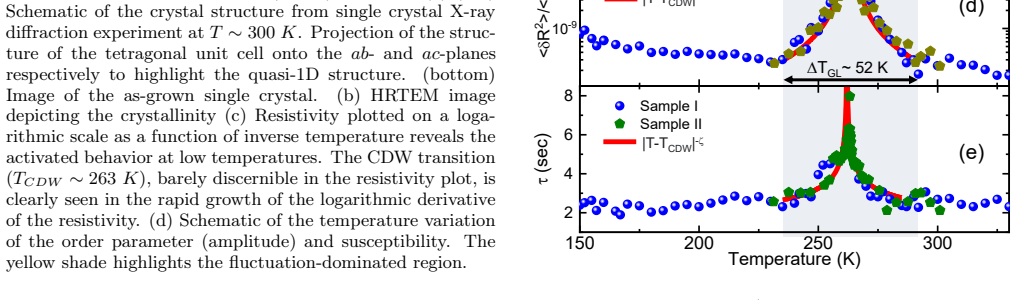
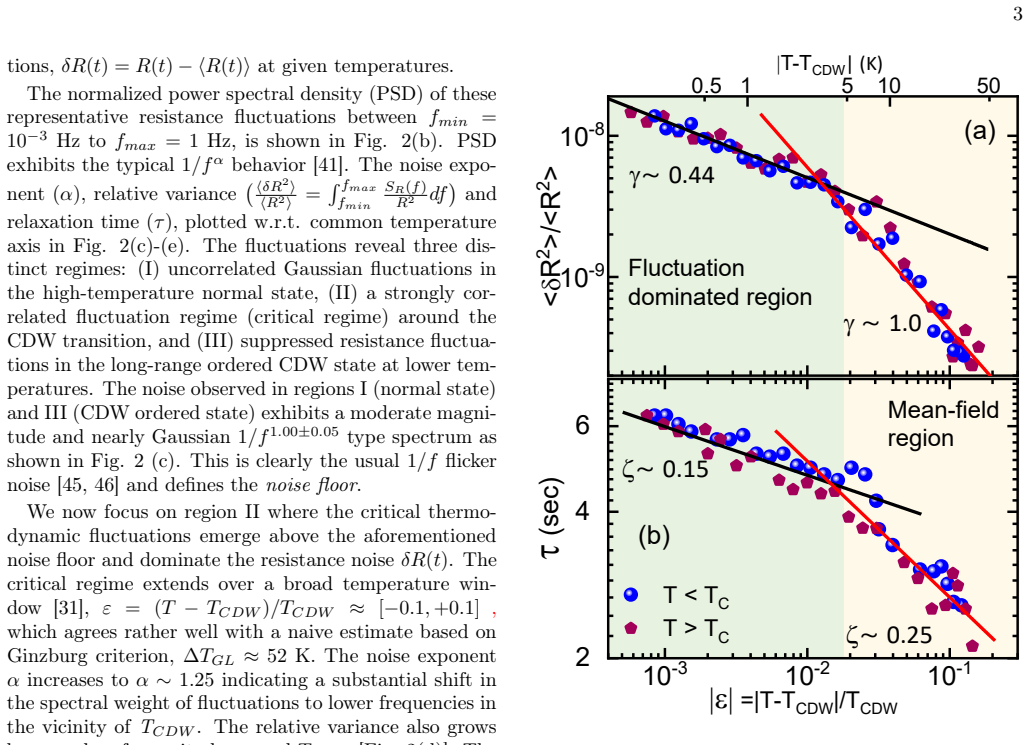
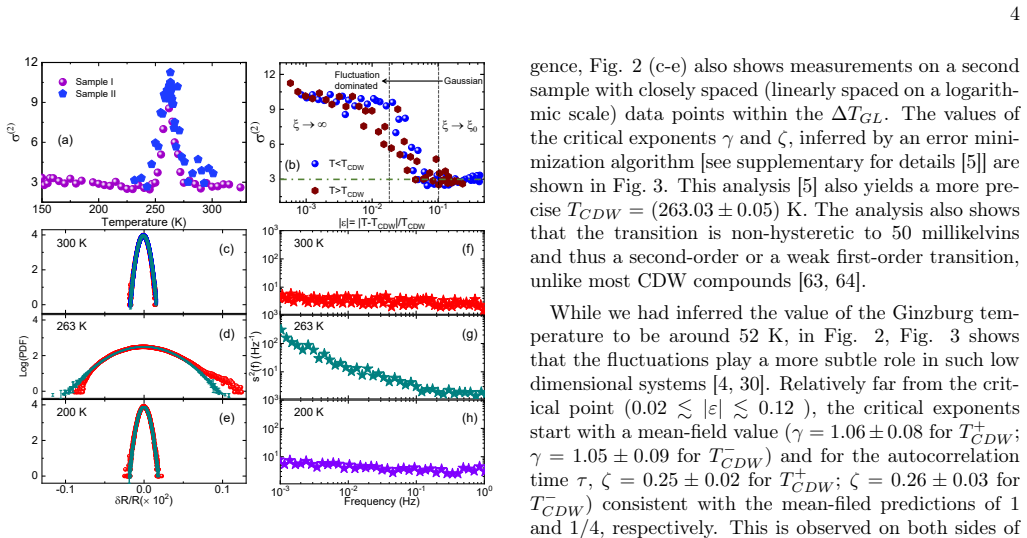
Critical fluctuations of the pinned CDW order parameter near the transition can be inferred from resistance noise on account of their coupling to dissipative normal carriers. These fluctuations are slow enough to survive the thermodynamic limit and dominate the low-frequency resistance noise. The noise variance and relaxation time show rapid growth within ε ≈ ±0.1. Below |ε| ≲ 0.02 a crossover occurs to a fluctuation-dominated regime with anomalously low critical exponents, and the distribution of fluctuations becomes skewed and strongly non-Gaussian because the diverging coherence volume becomes comparable to the macroscopic sample size.
What carries the argument
Resistance noise generated by the coupling of pinned CDW order-parameter fluctuations to dissipative normal carriers, used to extract critical exponents and relaxation times.
If this is right
- Noise variance and relaxation time exhibit rapid growth (critical opalescence and critical slowing down) inside ε ≈ ±0.1.
- Critical exponents can be extracted quantitatively from the temperature dependence of the resistance noise.
- A crossover from mean-field to fluctuation-dominated regime occurs below |ε| ≲ 0.02, accompanied by anomalously low exponent values.
- The fluctuation distribution becomes skewed and strongly non-Gaussian once the coherence volume approaches sample size.
- The quasi-one-dimensional character enlarges the temperature range over which these large critical fluctuations are observable.
Where Pith is reading between the lines
- Similar resistance-noise signatures of slow, non-Gaussian fluctuations are likely to appear in other quasi-one-dimensional CDW materials whose coherence volumes are comparably large.
- Macroscopic transport quantities in the critical window may retain sensitivity to sample-specific fluctuation details rather than obeying strict self-averaging.
- The wide critical region could alter the expected temperature dependence of other transport and thermodynamic observables that are usually treated within mean-field theory.
Load-bearing premise
Resistance noise can be quantitatively inverted to extract the critical exponents and relaxation times of the CDW order-parameter fluctuations through its coupling to normal carriers.
What would settle it
A direct probe such as x-ray photon correlation spectroscopy or time-resolved scattering that measures the CDW order-parameter autocorrelation and finds relaxation times or statistics inconsistent with those extracted from the resistance noise inside the stated temperature windows.
Figures
read the original abstract
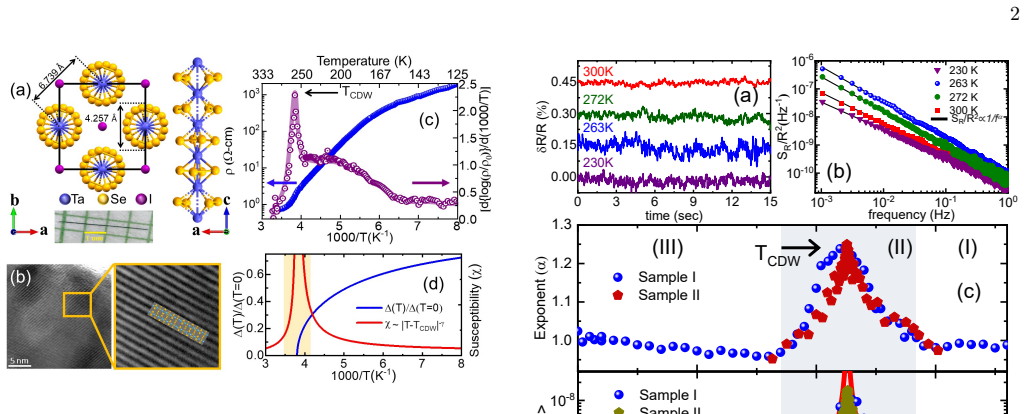
$(TaSe_4)_2I$ is a well-studied quasi-one-dimensional compound long-known to have a charge-density wave (CDW) transition around 263 K. We argue that the critical fluctuations of the pinned CDW order parameter near the transition can be inferred from the resistance noise on account of their coupling to the dissipative normal carriers. Remarkably, the critical fluctuations of the CDW order parameter are slow enough to survive the thermodynamic limit and dominate the low-frequency resistance noise. The noise variance and relaxation time show rapid growth (critical opalescence and critical slowing down) within a temperature window of $ \varepsilon \approx \pm 0.1$, where $\varepsilon$ is the reduced temperature. This is very wide but consistent with the Ginzburg criterion. We further show that this resistance noise can be quantitatively used to extract the associated critical exponents. Below $|\varepsilon | \lesssim 0.02$, we observe a crossover from mean-field to a fluctuation-dominated regime with the critical exponents taking anomalously low values. The distribution of fluctuations in the critical transition region is skewed and strongly non-Gaussian. This non-Gaussianity is interpreted as the breakdown of the validity of the central limit theorem as the diverging coherence volume becomes comparable to the macroscopic sample size. The large magnitude critical fluctuations observed over an extended temperature range, as well as the crossover from the mean-field to the fluctuation-dominated regime highlight the role of the quasi-one dimensional character in controlling the phase transition.
Editorial analysis
A structured set of objections, weighed in public.
Referee Report
Summary. The manuscript claims that in the quasi-1D CDW compound (TaSe₄)₂I, resistance noise measurements near the 263 K transition allow inference of the critical fluctuations of the pinned CDW order parameter via their coupling to dissipative normal carriers. These fluctuations are slow enough to dominate low-frequency noise in the thermodynamic limit, exhibit rapid growth in variance and relaxation time (critical opalescence and slowing down) within |ε| ≈ ±0.1, permit quantitative extraction of critical exponents, show a crossover below |ε| ≲ 0.02 to a fluctuation-dominated regime with anomalously low exponents, and display skewed non-Gaussian distributions interpreted as the coherence volume becoming comparable to the macroscopic sample size, underscoring the role of quasi-1D character.
Significance. If the noise-to-order-parameter mapping is validated, the results would demonstrate an unusually wide critical region in a CDW system consistent with the Ginzburg criterion, direct access to non-mean-field exponents, and observation of non-Gaussian fluctuations arising from finite-size effects on the coherence volume. This could establish resistance noise as a probe for critical dynamics in quasi-1D systems and highlight how dimensionality controls the extent of critical fluctuations.
major comments (2)
- [Abstract] Abstract (opening argument) and the central claim: the quantitative inversion of resistance noise δR(ω) to extract CDW order-parameter relaxation time τ(ε), variance, exponents, and the crossover at |ε| ≲ 0.02 assumes a direct proportionality δR ∝ δψ (or simple functional) mediated by normal carriers, but no microscopic derivation of the transfer function, calibration against independent probes (X-ray, Raman), or demonstration that other 1/f sources are negligible is provided; this mapping is load-bearing for all exponent values and the non-Gaussian interpretation.
- [Abstract] Abstract: no error bars, explicit fitting procedure, or definition of the critical window are described for the reported rapid growth of noise variance and relaxation time or the exponent extraction; without these, it is unclear whether the crossover and anomalously low exponents are robust or sensitive to post-hoc choices in data analysis.
minor comments (1)
- [Abstract] The abstract would benefit from a brief statement of sample dimensions or estimated coherence volume to support the claim that the coherence volume becomes comparable to the macroscopic sample size below |ε| ≲ 0.02.
Simulated Author's Rebuttal
We thank the referee for their thorough review and constructive criticism. We address each major comment below and outline the revisions we will make.
read point-by-point responses
-
Referee: [Abstract] Abstract (opening argument) and the central claim: the quantitative inversion of resistance noise δR(ω) to extract CDW order-parameter relaxation time τ(ε), variance, exponents, and the crossover at |ε| ≲ 0.02 assumes a direct proportionality δR ∝ δψ (or simple functional) mediated by normal carriers, but no microscopic derivation of the transfer function, calibration against independent probes (X-ray, Raman), or demonstration that other 1/f sources are negligible is provided; this mapping is load-bearing for all exponent values and the non-Gaussian interpretation.
Authors: We acknowledge that the manuscript does not contain a first-principles microscopic derivation of the precise transfer function relating δR to δψ. The assumed linear coupling is motivated by the physical expectation that CDW order-parameter fluctuations modulate the density or scattering of normal carriers in this quasi-1D system, an approach used in prior noise studies of CDW materials. We will add an expanded discussion section that (i) states the functional form explicitly, (ii) cites supporting transport and Raman literature on (TaSe₄)₂I, and (iii) quantifies why other 1/f mechanisms are sub-dominant in the reported temperature window by showing their weaker temperature dependence. Direct calibration against X-ray or Raman is not feasible within the present experiment because those probes access different wave-vector and time scales; however, the extracted critical window |ε| ≲ 0.1 coincides with the region of enhanced fluctuations reported by independent diffraction studies on the same compound. These additions will be made in the revised manuscript. revision: partial
-
Referee: [Abstract] Abstract: no error bars, explicit fitting procedure, or definition of the critical window are described for the reported rapid growth of noise variance and relaxation time or the exponent extraction; without these, it is unclear whether the crossover and anomalously low exponents are robust or sensitive to post-hoc choices in data analysis.
Authors: We agree that the abstract (and, by extension, the main text) should make the analysis pipeline fully transparent. In the revised version we will (i) report error bars on all extracted quantities (variance, τ, and exponents) obtained from the noise spectra, (ii) describe the precise fitting protocol, including the functional form used for the power spectral density and the frequency range over which τ is extracted, and (iii) define the critical window explicitly as the interval |ε| < 0.1 where the noise variance rises by more than an order of magnitude above the background. We will also include a supplementary figure showing the sensitivity of the reported crossover at |ε| ≲ 0.02 and the low exponents to the choice of fitting window and background subtraction. These changes will allow readers to assess robustness directly. revision: yes
Circularity Check
No significant circularity; claims rest on experimental observations
full rationale
The paper reports direct measurements of resistance noise near the CDW transition in (TaSe4)2I and interprets the observed rapid growth in variance and relaxation time, crossover in exponents, and non-Gaussian distributions as signatures of critical fluctuations. These are presented as empirical findings within stated temperature windows (ε ≈ ±0.1 and |ε| ≲ 0.02), with the coupling to normal carriers invoked as an interpretive argument rather than a closed mathematical derivation. No equations, self-citations, or fitting procedures are shown that reduce any reported exponent or distribution back to the input data by construction, and the central results do not rely on uniqueness theorems or ansatzes imported from prior author work.
Axiom & Free-Parameter Ledger
axioms (1)
- domain assumption Resistance noise directly and quantitatively reflects the critical fluctuations of the pinned CDW order parameter via coupling to dissipative normal carriers.
Lean theorems connected to this paper
-
IndisputableMonolith/Cost/FunctionalEquation.leanwashburn_uniqueness_aczel unclear?
unclearRelation between the paper passage and the cited Recognition theorem.
the normalized variance ⟨δR²⟩/⟨R²⟩ ∝ |T−TCDW|^{-γ} with a mean-field value of γ=1... τ∼|ε|^{-ζ} where ζ=1/4 from mean-field
-
IndisputableMonolith/Foundation/DimensionForcing.leanalexander_duality_circle_linking unclear?
unclearRelation between the paper passage and the cited Recognition theorem.
Ginzburg criterion ΔTGL≈52 K... crossover from mean-field to fluctuation-dominated regime
What do these tags mean?
- matches
- The paper's claim is directly supported by a theorem in the formal canon.
- supports
- The theorem supports part of the paper's argument, but the paper may add assumptions or extra steps.
- extends
- The paper goes beyond the formal theorem; the theorem is a base layer rather than the whole result.
- uses
- The paper appears to rely on the theorem as machinery.
- contradicts
- The paper's claim conflicts with a theorem or certificate in the canon.
- unclear
- Pith found a possible connection, but the passage is too broad, indirect, or ambiguous to say the theorem truly supports the claim.
Reference graph
Works this paper leans on
-
[1]
P. Gressier, A. Meerschaut, L. Guemas, J. Rouxel, and P. Monceau, Characterization of the new se- ries of quasi one-dimensional compounds (MX 4)nY (M Nb,Ta;X S,Se;Y Br,I), Journal of Solid State Chemistry 51, 141 (1984)
work page 1984
-
[2]
G. M. Sheldrick, A short history of shelx, Acta Crystallo- graphica Section A: Foundations of Crystallography64, 112 (2008). 0 2 4 60 1 2 3 4Log (P) dR2(W2) 0 2 4 60 1 2 3 4Log (P) dR2(W2) 0 2 4 6 0 1 2 3 4Log (P) dR2(W2) 0 2 4 60 1 2 3 4Log (P) dR2(W2) (a) 300 K 262 K (c) 0 2 4 60 1 2 3 4Log (P) dR2(W2) 0 2 4 60 1 2 3 4Log (P) dR2(W2) 150 K200 K 255 K 28...
work page 2008
-
[3]
O. V. Dolomanov, L. J. Bourhis, R. J. Gildea, J. A. K. Howard, and H. Puschmann, Olex2: a complete struc- ture solution, refinement and analysis program, Journal of applied crystallography42, 339 (2009)
work page 2009
-
[4]
A. Ghosh, S. Kar, A. Bid, and A. Raychaudhuri, A set- up for measurement of low frequency conductance fluc- tuation (noise) using digital signal processing techniques, arXiv preprint cond-mat/0402130 (2004)
work page internal anchor Pith review Pith/arXiv arXiv 2004
-
[5]
Kogan, Electronic noise and fluctuations in solids (Cambridge University Press, England, 1996)
S. Kogan, Electronic noise and fluctuations in solids (Cambridge University Press, England, 1996)
work page 1996
-
[6]
S. Kar, A. K. Raychaudhuri, A. Ghosh, H. v. Löhneysen, and G. Weiss, Observation of non-gaussian conductance fluctuations at low temperatures in si:p(b) at the metal- insulator transition, Phys. Rev. Lett.91, 216603 (2003)
work page 2003
-
[7]
R. Koushik, S. Kumar, K. R. Amin, M. Mondal, J. Je- sudasan, A. Bid, P. Raychaudhuri, and A. Ghosh, Cor- related conductance fluctuations close to the berezinskii- kosterlitz-thoulesstransitioninultrathinnbnfilms,Phys. Rev. Lett.111, 197001 (2013)
work page 2013
-
[8]
U.Chandni, A.Ghosh, H.S.Vijaya,andS.Mohan,Criti- cality of tuning in athermal phase transitions, Phys. Rev. Lett. 102, 025701 (2009)
work page 2009
- [9]
-
[10]
S. Chatterjee, R. S. Bisht, V. R. Reddy, and A. K. Raychaudhuri, Emergence of large thermal noise close to a temperature-driven metal-insulator transition, Phys. 18 Rev. B104, 155101 (2021)
work page 2021
-
[11]
L. X. Yang, G. Rohde, K. Hanff, A. Stange, R. Xiong, J. Shi, M. Bauer, and K. Rossnagel, Bypassing the struc- tural bottleneck in the ultrafast melting of electronic or- der, Phys. Rev. Lett.125, 266402 (2020)
work page 2020
-
[12]
A. Tomeljak, H. Schäfer, D. Städter, M. Beyer, K. Biljakovic, and J. Demsar, Dynamics of photoin- duced charge-density-wave to metal phase transition in K0.3MoO3, Phys. Rev. Lett.102, 066404 (2009)
work page 2009
-
[13]
L. Perfetti, P. A. Loukakos, M. Lisowski, U. Bovensiepen, H. Berger, S. Biermann, P. S. Cornaglia, A. Georges, and M. Wolf, Time evolution of the electronic structure of 1T (TaS2) through the insulator-metal transition, Phys. Rev. Lett.97, 067402 (2006)
work page 2006
-
[14]
A. Zong, P. E. Dolgirev, A. Kogar, E. Ergeçen, M. B. Yilmaz, Y.-Q. Bie, T. Rohwer, I.-C. Tung, J. Straqua- dine, X. Wang, Y. Yang, X. Shen, R. Li, J. Yang, S.Park, M.C.Hoffmann, B.K.Ofori-Okai, M.E.Kozina, H. Wen, X. Wang, I. R. Fisher, P. Jarillo-Herrero, and N. Gedik, Dynamical slowing-down in an ultrafast pho- toinduced phase transition, Phys. Rev. Let...
work page 2019
-
[15]
F. Schmitt, P. S. Kirchmann, U. Bovensiepen, R. G. Moore, L. Rettig, M. Krenz, J.-H. Chu, N. Ru, L. Per- fetti, D. Lu, et al., Transient electronic structure and melting of a charge density wave in TbTe3, Science321, 1649 (2008)
work page 2008
- [16]
-
[17]
Hooge, 1/f noise sources, IEEE Transactions on Elec- tron Devices41, 1926 (1994)
F. Hooge, 1/f noise sources, IEEE Transactions on Elec- tron Devices41, 1926 (1994)
work page 1926
-
[18]
F. N. Hooge, T. G. M. Kleinpenning, and L. K. J. Van- damme, Experimental studies on 1/f noise, Reports on Progress in Physics44, 479 (1981)
work page 1981
-
[19]
M. B. Weissman,1 f noise and other slow, nonexponential kinetics in condensed matter, Rev. Mod. Phys.60, 537 (1988)
work page 1988
-
[20]
Gruner,Density waves in solids(CRC press, 2018)
G. Gruner,Density waves in solids(CRC press, 2018)
work page 2018
-
[21]
G. T. Seidler and S. A. Solin, Non-gaussian 1/f noise: Experimental optimization and separation of high-order amplitude and phase correlations, Phys. Rev. B53, 9753 (1996)
work page 1996
discussion (0)
Sign in with ORCID, Apple, or X to comment. Anyone can read and Pith papers without signing in.