Fate of Bosonic Topological Edge Modes in the Presence of Many-Body Interactions
Pith reviewed 2026-05-24 07:12 UTC · model grok-4.3
The pith
Bosonic topological edge modes persist in the presence of full many-body interactions in a ladder quantum paramagnet.
A machine-rendered reading of the paper's core claim, the machinery that carries it, and where it could break.
Core claim
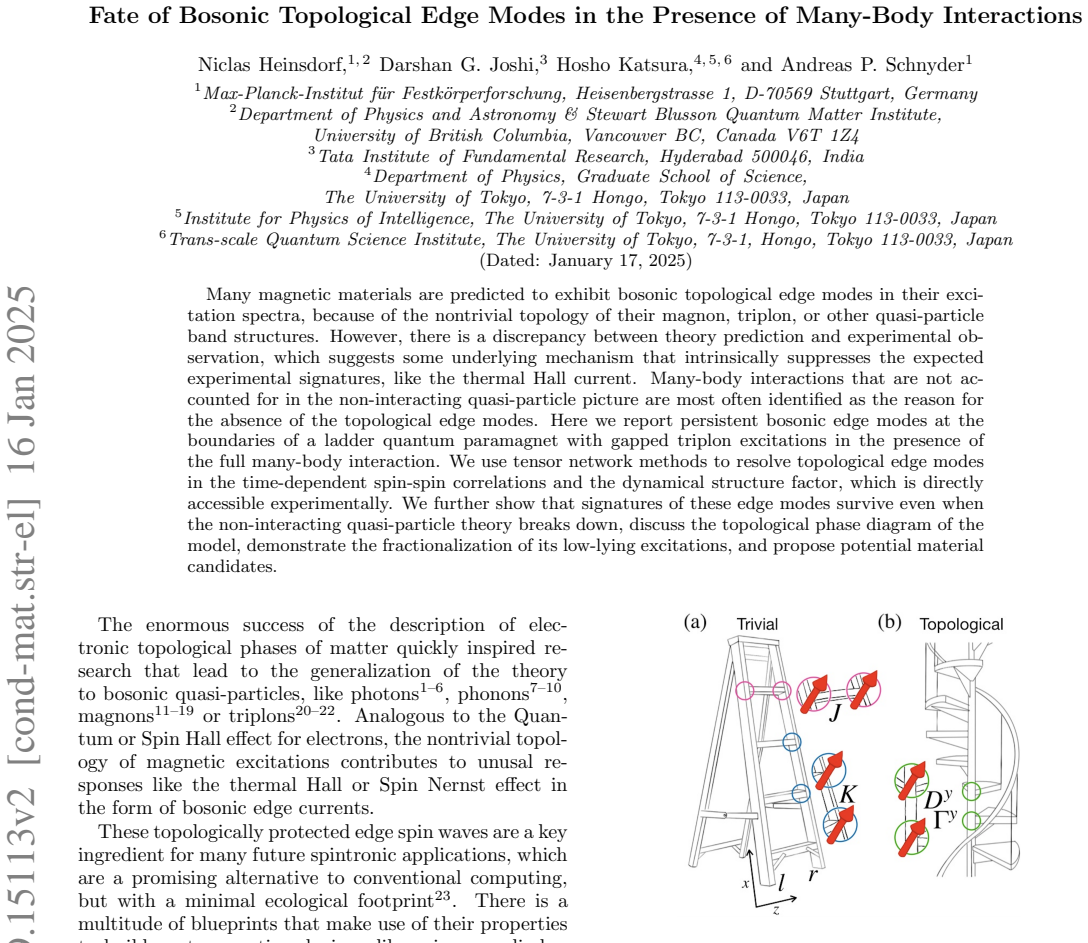
Persistent bosonic edge modes are found at the boundaries of the ladder quantum paramagnet even with the full many-body interaction. These are resolved in the time-dependent spin-spin correlations and the dynamical structure factor, which is experimentally accessible. Signatures survive when the non-interacting quasi-particle theory breaks down, the topological phase diagram is discussed, low-lying excitations fractionalize, and material candidates are proposed.
What carries the argument
Tensor network methods that resolve topological edge modes in the dynamical structure factor of the interacting model.
If this is right
- Edge mode signatures remain detectable in the dynamical structure factor even beyond the non-interacting approximation.
- The model has a topological phase diagram with persistent modes.
- Low-lying excitations exhibit fractionalization.
- Potential material candidates are identified for experimental study.
Where Pith is reading between the lines
- If the ladder model is representative, similar persistence may occur in other bosonic topological systems.
- Experimental focus should shift to other possible suppression mechanisms for the observed discrepancy.
- Direct measurement of the dynamical structure factor in candidate materials could confirm the modes.
Load-bearing premise
The chosen ladder quantum paramagnet Hamiltonian is representative of the class of materials with predicted bosonic topological edge modes, and the tensor network calculations accurately reflect the interacting physics.
What would settle it
An experimental measurement on a matching material candidate showing no edge mode signatures in the dynamical structure factor would falsify the persistence of the modes.
Figures


read the original abstract
Many magnetic materials are predicted to exhibit bosonic topological edge modes in their excitation spectra, because of the nontrivial topology of their magnon, triplon, or other quasi-particle band structures. However, there is a discrepancy between theory prediction and experimental observation, which suggests some underlying mechanism that intrinsically suppresses the expected experimental signatures, like the thermal Hall current. Many-body interactions that are not accounted for in the non-interacting quasi-particle picture are most often identified as the reason for the absence of the topological edge modes. Here we report persistent bosonic edge modes at the boundaries of a ladder quantum paramagnet with gapped triplon excitations in the presence of the full many-body interaction. We use tensor network methods to resolve topological edge modes in the time-dependent spin-spin correlations and the dynamical structure factor, which is directly accessible experimentally. We further show that signatures of these edge modes survive even when the non-interacting quasi-particle theory breaks down, discuss the topological phase diagram of the model, demonstrate the fractionalization of its low-lying excitations, and propose potential material candidates.
Editorial analysis
A structured set of objections, weighed in public.
Referee Report
Summary. The manuscript studies a ladder quantum paramagnet with gapped triplon excitations and claims that bosonic topological edge modes persist at the boundaries even after including the full many-body interactions. Tensor-network simulations are used to resolve these modes in time-dependent spin-spin correlations and the dynamical structure factor; the work also maps the topological phase diagram, demonstrates fractionalization of low-lying excitations, and proposes material candidates.
Significance. If the central numerical claim is robust, the result would indicate that many-body interactions need not destroy bosonic edge modes, thereby addressing the long-standing theory-experiment discrepancy in candidate magnetic materials and providing a concrete microscopic example where the non-interacting quasi-particle picture fails yet topology survives.
major comments (1)
- [Numerical Methods / Results] Numerical Methods / Results sections: No bond-dimension convergence data, truncation-error estimates, or finite-size scaling for the edge-mode signatures in the dynamical structure factor or time-dependent correlations are reported. Because the central claim—that modes remain visible once the quasi-particle description breaks down—rests entirely on these tensor-network observables, the absence of such checks leaves open the possibility that finite-bond artifacts produce spurious localization.
minor comments (1)
- [Abstract] The abstract refers to 'the full many-body interaction' without specifying the interaction terms retained in the Hamiltonian; a brief statement of the model (e.g., which exchange or anisotropy terms are kept) would improve clarity.
Simulated Author's Rebuttal
We thank the referee for their careful reading and constructive comments. We fully agree that additional numerical convergence checks are needed to support the central claims and will incorporate them in the revised manuscript.
read point-by-point responses
-
Referee: [Numerical Methods / Results] Numerical Methods / Results sections: No bond-dimension convergence data, truncation-error estimates, or finite-size scaling for the edge-mode signatures in the dynamical structure factor or time-dependent correlations are reported. Because the central claim—that modes remain visible once the quasi-particle description breaks down—rests entirely on these tensor-network observables, the absence of such checks leaves open the possibility that finite-bond artifacts produce spurious localization.
Authors: We agree that the absence of explicit convergence data weakens the presentation of the central numerical claim. In the revised manuscript we will add a dedicated subsection (and supplementary figures) reporting bond-dimension convergence for both the time-dependent spin correlations and the dynamical structure factor. We will show that the localized edge-mode signatures remain stable for bond dimensions D = 128, 256 and 512, with truncation errors below 10^{-9}, and that the peak positions and weights exhibit only minor changes when the ladder length is increased from 20 to 40 rungs. These checks confirm that the reported edge modes are not finite-bond artifacts. revision: yes
Circularity Check
No circularity: results from direct tensor-network simulation on concrete Hamiltonian
full rationale
The paper reports numerical findings from tensor-network computations of time-dependent correlations and dynamical structure factor on a specific ladder quantum paramagnet Hamiltonian. The central claim of persistent edge modes is obtained by direct simulation rather than any analytic derivation that reduces to fitted inputs, self-definitions, or self-citation chains. No load-bearing step equates a prediction to its own construction by the paper's equations. The topological phase diagram and fractionalization statements are likewise numerical outputs. This is the most common honest non-finding for simulation-based work.
Axiom & Free-Parameter Ledger
axioms (1)
- domain assumption The ladder quantum paramagnet with gapped triplon excitations and the specific interactions studied is representative of materials where bosonic topological edge modes are predicted.
Reference graph
Works this paper leans on
-
[1]
Observation of the spin hall effect of light via weak measurements
Onur Hosten and Paul Kwiat. Observation of the spin hall effect of light via weak measurements. Science , 319(5864):787--790, 2008
work page 2008
-
[2]
Observation of unidirectional backscattering-immune topological electromagnetic states
Zheng Wang, Yidong Chong, John D Joannopoulos, and Marin Solja c i \'c . Observation of unidirectional backscattering-immune topological electromagnetic states. Nature , 461(7265):772--775, 2009
work page 2009
-
[3]
Philippe Ben-Abdallah. Photon thermal hall effect. Physical Review Letters , 116(8):084301, 2016
work page 2016
-
[4]
Frederick Duncan Michael Haldane and Srinivas Raghu. Possible realization of directional optical waveguides in photonic crystals with broken time-reversal symmetry. Physical Review Letters , 100(1):013904, 2008
work page 2008
-
[5]
Analogs of quantum-hall-effect edge states in photonic crystals
Srinivas Raghu and Frederick Duncan Michael Haldane. Analogs of quantum-hall-effect edge states in photonic crystals. Physical Review A , 78(3):033834, 2008
work page 2008
-
[6]
Masaru Onoda, Shuichi Murakami, and Naoto Nagaosa. Hall effect of light. Physical review letters , 93(8):083901, 2004
work page 2004
-
[7]
Phenomenological evidence for the phonon hall effect
C Strohm, GLJA Rikken, and P Wyder. Phenomenological evidence for the phonon hall effect. Physical Review Letters , 95(15):155901, 2005
work page 2005
-
[8]
Anomalous hall effect for the phonon heat conductivity in paramagnetic dielectrics
Yu Kagan and LA Maksimov. Anomalous hall effect for the phonon heat conductivity in paramagnetic dielectrics. Physical Review Letters , 100(14):145902, 2008
work page 2008
-
[9]
Thermal hall effect in a phonon-glass ba 3 cusb 2 o 9
Kaori Sugii, Masaaki Shimozawa, Daiki Watanabe, Yoshitaka Suzuki, Mario Halim, Motoi Kimata, Yosuke Matsumoto, Satoru Nakatsuji, and Minoru Yamashita. Thermal hall effect in a phonon-glass ba 3 cusb 2 o 9. Physical Review Letters , 118(14):145902, 2017
work page 2017
-
[10]
Theory of the phonon hall effect in paramagnetic dielectrics
L Sheng, DN Sheng, and CS Ting. Theory of the phonon hall effect in paramagnetic dielectrics. Physical Review Letters , 96(15):155901, 2006
work page 2006
-
[11]
Hosho Katsura, Naoto Nagaosa, and Patrick A. Lee. Theory of the thermal hall effect in quantum magnets. Phys. Rev. Lett. , 104:066403, Feb 2010
work page 2010
-
[12]
Three-dimensional topological magnon systems
Hiroki Kondo, Yutaka Akagi, and Hosho Katsura. Three-dimensional topological magnon systems. Physical Review B , 100(14):144401, 2019
work page 2019
-
[13]
Dirac surface states in magnonic analogs of topological crystalline insulators
Hiroki Kondo and Yutaka Akagi. Dirac surface states in magnonic analogs of topological crystalline insulators. Physical Review Letters , 127(17):177201, 2021
work page 2021
-
[14]
Rotational motion of magnons and the thermal hall effect
Ryo Matsumoto and Shuichi Murakami. Rotational motion of magnons and the thermal hall effect. Physical Review B , 84(18):184406, 2011
work page 2011
-
[15]
Hall effect of spin waves in frustrated magnets
Satoshi Fujimoto. Hall effect of spin waves in frustrated magnets. Physical Review Letters , 103(4):047203, 2009
work page 2009
-
[16]
Chiral spin-wave edge modes in dipolar magnetic thin films
Ryuichi Shindou, Jun-ichiro Ohe, Ryo Matsumoto, Shuichi Murakami, and Eiji Saitoh. Chiral spin-wave edge modes in dipolar magnetic thin films. Physical Review B , 87(17):174402, 2013
work page 2013
-
[17]
Topological chiral magnonic edge mode in a magnonic crystal
Ryuichi Shindou, Ryo Matsumoto, Shuichi Murakami, and Jun-ichiro Ohe. Topological chiral magnonic edge mode in a magnonic crystal. Physical Review B , 87(17):174427, 2013
work page 2013
-
[18]
Realization of the haldane-kane-mele model in a system of localized spins
Se Kwon Kim, H \'e ctor Ochoa, Ricardo Zarzuela, and Yaroslav Tserkovnyak. Realization of the haldane-kane-mele model in a system of localized spins. Physical Review Letters , 117(22):227201, 2016
work page 2016
-
[19]
Darshan G. Joshi. Topological excitations in the ferromagnetic kitaev-heisenberg model. Phys. Rev. B , 98:060405, Aug 2018
work page 2018
-
[20]
Hall effect of triplons in a dimerized quantum magnet
Judit Romh \'a nyi, Karlo Penc, and Ramachandran Ganesh. Hall effect of triplons in a dimerized quantum magnet. Nature communications , 6(1):6805, 2015
work page 2015
-
[21]
Topological quantum paramagnet in a quantum spin ladder
Darshan G Joshi and Andreas P Schnyder. Topological quantum paramagnet in a quantum spin ladder. Physical Review B , 96(22):220405, 2017
work page 2017
-
[22]
Darshan G. Joshi and Andreas P. Schnyder. z _ 2 topological quantum paramagnet on a honeycomb bilayer. Phys. Rev. B , 100:020407, Jul 2019
work page 2019
-
[23]
Andrii V Chumak, Vitaliy I Vasyuchka, Alexander A Serga, and Burkard Hillebrands. Magnon spintronics. Nature physics , 11(6):453--461, 2015
work page 2015
-
[24]
Topological insulators and semimetals in classical magnetic systems
Z-X Li, Yunshan Cao, and Peng Yan. Topological insulators and semimetals in classical magnetic systems. Physics Reports , 915:1--64, 2021
work page 2021
-
[25]
Theoretical prediction of a rotating magnon wave packet in ferromagnets
Ryo Matsumoto and Shuichi Murakami. Theoretical prediction of a rotating magnon wave packet in ferromagnets. Physical Review Letters , 106(19):197202, 2011
work page 2011
-
[26]
Topological magnonics: A paradigm for spin-wave manipulation and device design
XS Wang, HW Zhang, and XR Wang. Topological magnonics: A paradigm for spin-wave manipulation and device design. Physical Review Applied , 9(2):024029, 2018
work page 2018
-
[27]
Topological magnons in cri3 monolayers: an itinerant fermion description
Ant \'o nio T Costa, Daniel Louren c o R Santos, Nuno MR Peres, and Joaqu \' n Fern \'a ndez-Rossier. Topological magnons in cri3 monolayers: an itinerant fermion description. 2D Materials , 7(4):045031, 2020
work page 2020
-
[28]
Topological weyl magnons and thermal hall effect in layered honeycomb ferromagnets
Shuyi Li and Andriy H Nevidomskyy. Topological weyl magnons and thermal hall effect in layered honeycomb ferromagnets. Physical Review B , 104(10):104419, 2021
work page 2021
-
[29]
Kyusung Hwang, Nandini Trivedi, and Mohit Randeria. Topological magnons with nodal-line and triple-point degeneracies: implications for thermal hall effect in pyrochlore iridates. Physical Review Letters , 125(4):047203, 2020
work page 2020
-
[30]
Magnon thermal hall effect in kagome antiferromagnets with dzyaloshinskii-moriya interactions
Pontus Laurell and Gregory A Fiete. Magnon thermal hall effect in kagome antiferromagnets with dzyaloshinskii-moriya interactions. Physical Review B , 98(9):094419, 2018
work page 2018
-
[31]
Magnon hall effect and topology in kagome lattices: A theoretical investigation
Alexander Mook, J \"u rgen Henk, and Ingrid Mertig. Magnon hall effect and topology in kagome lattices: A theoretical investigation. Physical Review B , 89(13):134409, 2014
work page 2014
-
[32]
SA Owerre. Topological honeycomb magnon hall effect: A calculation of thermal hall conductivity of magnetic spin excitations. Journal of Applied Physics , 120(4), 2016
work page 2016
-
[33]
Spin chirality and hall-like transport phenomena of spin excitations
Jung Hoon Han and Hyunyong Lee. Spin chirality and hall-like transport phenomena of spin excitations. Journal of the Physical Society of Japan , 86(1):011007, 2017
work page 2017
-
[34]
Weyl magnons in breathing pyrochlore antiferromagnets
Fei-Ye Li, Yao-Dong Li, Yong Baek Kim, Leon Balents, Yue Yu, and Gang Chen. Weyl magnons in breathing pyrochlore antiferromagnets. Nature communications , 7(1):12691, 2016
work page 2016
-
[35]
Fengfeng Zhu, Lichuan Zhang, Xiao Wang, Flaviano Jos \'e Dos Santos, Junda Song, Thomas Mueller, Karin Schmalzl, Wolfgang F Schmidt, Alexandre Ivanov, Jitae T Park, et al. Topological magnon insulators in two-dimensional van der waals ferromagnets crsite3 and crgete3: Toward intrinsic gap-tunability. Science advances , 7(37):eabi7532, 2021
work page 2021
-
[36]
Anomalous thermal hall effect in an insulating van der waals magnet
Heda Zhang, Chunqiang Xu, Caitlin Carnahan, Milos Sretenovic, Nishchay Suri, Di Xiao, and Xianglin Ke. Anomalous thermal hall effect in an insulating van der waals magnet. Physical Review Letters , 127(24):247202, 2021
work page 2021
-
[37]
Topological triplon modes and bound states in a shastry--sutherland magnet
Paul A McClarty, F Kr \"u ger, Tatiana Guidi, SF Parker, Keith Refson, AW Parker, Dharmalingam Prabhakaran, and Radu Coldea. Topological triplon modes and bound states in a shastry--sutherland magnet. Nature Physics , 13(8):736--741, 2017
work page 2017
-
[38]
Planar thermal hall effect of topological bosons in the kitaev magnet -rucl3
Peter Czajka, Tong Gao, Max Hirschberger, Paula Lampen-Kelley, Arnab Banerjee, Nicholas Quirk, David G Mandrus, Stephen E Nagler, and N Phuan Ong. Planar thermal hall effect of topological bosons in the kitaev magnet -rucl3. Nature Materials , 22(1):36--41, 2023
work page 2023
-
[39]
Thermal hall effect of spin excitations in a kagome magnet
Max Hirschberger, Robin Chisnell, Young S Lee, and Nai Phuan Ong. Thermal hall effect of spin excitations in a kagome magnet. Physical Review Letters , 115(10):106603, 2015
work page 2015
-
[40]
Observation of the magnon hall effect
Y Onose, T Ideue, H Katsura, Y Shiomi, N Nagaosa, and Y Tokura. Observation of the magnon hall effect. Science , 329(5989):297--299, 2010
work page 2010
-
[41]
Intrinsic suppression of the topological thermal hall effect in an exactly solvable quantum magnet
S Suetsugu, T Yokoi, K Totsuka, T Ono, I Tanaka, S Kasahara, Y Kasahara, Z Chengchao, H Kageyama, and Y Matsuda. Intrinsic suppression of the topological thermal hall effect in an exactly solvable quantum magnet. Physical Review B , 105(2):024415, 2022
work page 2022
-
[42]
Thermal hall effect of topological triplons in srcu2 (bo3) 2
Luke Pritchard Cairns, J-Ph Reid, Robin Perry, Dharmalingam Prabhakaran, and Andrew Huxley. Thermal hall effect of topological triplons in srcu2 (bo3) 2. In Proceedings of the International Conference on Strongly Correlated Electron Systems (SCES2019) , page 011089, 2020
work page 2020
-
[43]
Colloquium: Spontaneous magnon decays
ME Zhitomirsky and AL Chernyshev. Colloquium: Spontaneous magnon decays. Reviews of Modern Physics , 85(1):219, 2013
work page 2013
-
[44]
Damped topological magnons in the kagome-lattice ferromagnets
AL Chernyshev and PA Maksimov. Damped topological magnons in the kagome-lattice ferromagnets. Physical Review Letters , 117(18):187203, 2016
work page 2016
-
[45]
Breakdown of chiral edge modes in topological magnon insulators
Jonas Habel, Alexander Mook, Josef Willsher, and Johannes Knolle. Breakdown of chiral edge modes in topological magnon insulators. arXiv preprint arXiv:2308.03168 , 2023
-
[46]
Fragility of z 2 topological invariant characterizing triplet excitations in a bilayer kagome magnet
Andreas Thomasen, Karlo Penc, Nic Shannon, and Judit Romh \'a nyi. Fragility of z 2 topological invariant characterizing triplet excitations in a bilayer kagome magnet. Physical Review B , 104(10):104412, 2021
work page 2021
-
[47]
Pershoguba, Saikat Banerjee, J
Sergey S. Pershoguba, Saikat Banerjee, J. C. Lashley, Jihwey Park, Hans gren, Gabriel Aeppli, and Alexander V. Balatsky. Dirac magnons in honeycomb ferromagnets. Phys. Rev. X , 8:011010, Jan 2018
work page 2018
-
[48]
Breakdown of magnons in a strongly spin-orbital coupled magnet
Stephen M Winter, Kira Riedl, Pavel A Maksimov, Alexander L Chernyshev, Andreas Honecker, and Roser Valent \' . Breakdown of magnons in a strongly spin-orbital coupled magnet. Nature communications , 8(1):1152, 2017
work page 2017
-
[49]
Interacting topological dirac magnons
Hao Sun, Dhiman Bhowmick, Bo Yang, and Pinaki Sengupta. Interacting topological dirac magnons. Phys. Rev. B , 107:134426, Apr 2023
work page 2023
-
[50]
P. A. McClarty, X.-Y. Dong, M. Gohlke, J. G. Rau, F. Pollmann, R. Moessner, and K. Penc. Topological magnons in kitaev magnets at high fields. Phys. Rev. B , 98:060404, Aug 2018
work page 2018
-
[51]
Spectral and thermodynamic properties of a strong-leg quantum spin ladder
D Schmidiger, Pierre Bouillot, S M \"u hlbauer, S Gvasaliya, Corinna Kollath, Thierry Giamarchi, and A Zheludev. Spectral and thermodynamic properties of a strong-leg quantum spin ladder. Physical review letters , 108(16):167201, 2012
work page 2012
-
[52]
Surprises on the way from one-to two-dimensional quantum magnets: The ladder materials
Elbio Dagotto and TM Rice. Surprises on the way from one-to two-dimensional quantum magnets: The ladder materials. Science , 271(5249):618--623, 1996
work page 1996
-
[53]
Subir Sachdev and RN Bhatt. Bond-operator representation of quantum spins: Mean-field theory of frustrated quantum heisenberg antiferromagnets. Physical Review B , 41(13):9323, 1990
work page 1990
-
[54]
Darshan G. Joshi, Kris Coester, Kai P. Schmidt, and Matthias Vojta. Nonlinear bond-operator theory and 1/d expansion for coupled-dimer magnets. i. paramagnetic phase. Phys. Rev. B , 91:094404, Mar 2015
work page 2015
-
[55]
Darshan G. Joshi and Matthias Vojta. Nonlinear bond-operator theory and 1/d expansion for coupled-dimer magnets. ii. antiferromagnetic phase and quantum phase transition. Phys. Rev. B , 91:094405, Mar 2015
work page 2015
-
[56]
F Duncan M Haldane. Model for a quantum hall effect without landau levels: Condensed-matter realization of the" parity anomaly". Physical Review Letters , 61(18):2015, 1988
work page 2015
-
[57]
C. L. Kane and E. J. Mele. Quantum spin hall effect in graphene. Phys. Rev. Lett. , 95:226801, Nov 2005
work page 2005
-
[58]
Liang Fu, C. L. Kane, and E. J. Mele. Topological insulators in three dimensions. Phys. Rev. Lett. , 98:106803, Mar 2007
work page 2007
-
[59]
B. Andrei Bernevig, Taylor L. Hughes, and Shou-Cheng Zhang. Quantum spin hall effect and topological phase transition in hgte quantum wells. Science , 314(5806):1757--1761, 2006
work page 2006
-
[60]
Z 2 topological invariant for magnon spin hall systems
Hiroki Kondo, Yutaka Akagi, and Hosho Katsura. Z 2 topological invariant for magnon spin hall systems. Physical Review B , 99(4):041110, 2019
work page 2019
-
[61]
Olivier Mentr \'e , El Mostafa Ketatni, Marie Colmont, Marielle Huve, Francis Abraham, and Vaclav Petricek. Structural features of the modulated bicu2 (p1-x v x) o6 solid solution; 4-d treatment of x= 0.87 compound and magnetic spin-gap to gapless transition in new cu2+ two-leg ladder systems. Journal of the American Chemical Society , 128(33):10857--10867, 2006
work page 2006
-
[62]
Exchange integrals of vanadates as revealed by magnetic-susceptibility measurements of nav 2 o 5
Fr \'e d \'e ric Mila, Patrice Millet, and Jacques Bonvoisin. Exchange integrals of vanadates as revealed by magnetic-susceptibility measurements of nav 2 o 5. Physical Review B , 54(17):11925, 1996
work page 1996
-
[63]
Masahiko Isobe and Yutaka Ueda. Magnetic susceptibility of quasi-one-dimensional compound '-n a v 2 o 5--possible spin-peierls compound with high critical temperature of 34 k--. Journal of the Physical Society of Japan , 65(5):1178--1181, 1996
work page 1996
-
[64]
Absence of superconductivity in the doped antiferromagnetic spin-ladder compound (la, sr) cuo2
Z Hiroi and M Takano. Absence of superconductivity in the doped antiferromagnetic spin-ladder compound (la, sr) cuo2. 5. Nature , 377(6544):41--43, 1995
work page 1995
-
[65]
Yoshimitsu Kohama, Shuang Wang, Atsuko Uchida, Krunoslav Prsa, Sergei Zvyagin, Yuri Skourski, Ross D McDonald, Luis Balicas, Henrik M Ronnow, Christian R \"u egg, et al. Anisotropic cascade of field-induced phase transitions in the frustrated spin-ladder system bicu 2 po 6. Physical Review Letters , 109(16):167204, 2012
work page 2012
-
[66]
Magnetic properties of the s= 1 2 quasi-one-dimensional antiferromagnet cacu 2 o 3
V Kiryukhin, YJ Kim, KJ Thomas, FC Chou, RW Erwin, Q Huang, MA Kastner, and RJ Birgeneau. Magnetic properties of the s= 1 2 quasi-one-dimensional antiferromagnet cacu 2 o 3. Physical Review B , 63(14):144418, 2001
work page 2001
-
[67]
Observation of a spin gap in sr cu 2 o 3 comprising spin- 1/2 quasi-1d two-leg ladders
Masaki Azuma, Z Hiroi, M Takano, K Ishida, and Y Kitaoka. Observation of a spin gap in sr cu 2 o 3 comprising spin- 1/2 quasi-1d two-leg ladders. Physical Review Letters , 73(25):3463, 1994
work page 1994
-
[68]
Tunable quantum spin hall effect via strain in two-dimensional arsenene monolayer
Ya-ping Wang, Chang-wen Zhang, Wei-xiao Ji, Run-wu Zhang, Ping Li, Pei-ji Wang, Miao-juan Ren, Xin-lian Chen, and Min Yuan. Tunable quantum spin hall effect via strain in two-dimensional arsenene monolayer. Journal of Physics D: Applied Physics , 49(5):055305, 2016
work page 2016
-
[69]
Spin orbit coupling gap and indirect gap in strain-tuned topological insulator-antimonene
Chi-Ho Cheung, Huei-Ru Fuh, Ming-Chien Hsu, Yeu-Chung Lin, and Ching-Ray Chang. Spin orbit coupling gap and indirect gap in strain-tuned topological insulator-antimonene. Nanoscale Research Letters , 11:1--8, 2016
work page 2016
-
[70]
Strain-induced topological insulator phase transition in hgse
Lars Winterfeld, Luis A Agapito, Jin Li, Nicholas Kioussis, Peter Blaha, and Yong P Chen. Strain-induced topological insulator phase transition in hgse. Physical Review B , 87(7):075143, 2013
work page 2013
-
[71]
Semimetallic square-octagon two-dimensional polymer with high mobility
Tsai-Jung Liu, Maximilian A Springer, Niclas Heinsdorf, Agnieszka Kuc, Roser Valent \' , and Thomas Heine. Semimetallic square-octagon two-dimensional polymer with high mobility. Physical Review B , 104(20):205419, 2021
work page 2021
-
[72]
Nanse Esaki, Yutaka Akagi, and Hosho Katsura. Electric field induced thermal hall effect of triplons in the quantum dimer magnets x cucl \_ \ 3 \ ( x= tl, k). arXiv preprint arXiv:2309.12812 , 2023
-
[73]
K. Sturm. Dynamic structure factor: An introduction. Zeitschrift für Naturforschung A , 48(1-2):233--242, 1993
work page 1993
-
[74]
Correlations in space and time and born approximation scattering in systems of interacting particles
L \'e on Van Hove. Correlations in space and time and born approximation scattering in systems of interacting particles. Physical Review , 95(1):249, 1954
work page 1954
-
[75]
Detecting end states of topological quantum paramagnets via spin hall noise spectroscopy
Darshan G Joshi, Andreas P Schnyder, and So Takei. Detecting end states of topological quantum paramagnets via spin hall noise spectroscopy. Physical Review B , 98(6):064401, 2018
work page 2018
-
[76]
Density matrix formulation for quantum renormalization groups
Steven R White. Density matrix formulation for quantum renormalization groups. Physical Review Letters , 69(19):2863, 1992
work page 1992
-
[77]
Efficient simulation of one-dimensional quantum many-body systems
Guifr \'e Vidal. Efficient simulation of one-dimensional quantum many-body systems. Physical Review Letters , 93(4):040502, 2004
work page 2004
-
[78]
Time-dependent density-matrix renormalization-group using adaptive effective hilbert spaces
Andrew John Daley, Corinna Kollath, Ulrich Schollw \"o ck, and Guifr \'e Vidal. Time-dependent density-matrix renormalization-group using adaptive effective hilbert spaces. Journal of Statistical Mechanics: Theory and Experiment , 2004(04):P04005, 2004
work page 2004
-
[79]
Real-time evolution using the density matrix renormalization group
Steven R White and Adrian E Feiguin. Real-time evolution using the density matrix renormalization group. Physical review letters , 93(7):076401, 2004
work page 2004
-
[80]
Time-dependent variational principle for quantum lattices
Jutho Haegeman, J Ignacio Cirac, Tobias J Osborne, Iztok Pi z orn, Henri Verschelde, and Frank Verstraete. Time-dependent variational principle for quantum lattices. Physical Review Letters , 107(7):070601, 2011
work page 2011
discussion (0)
Sign in with ORCID, Apple, or X to comment. Anyone can read and Pith papers without signing in.