Optimal (partial) transport to non-convex polygonal domains
Pith reviewed 2026-05-24 06:24 UTC · model grok-4.3
The pith
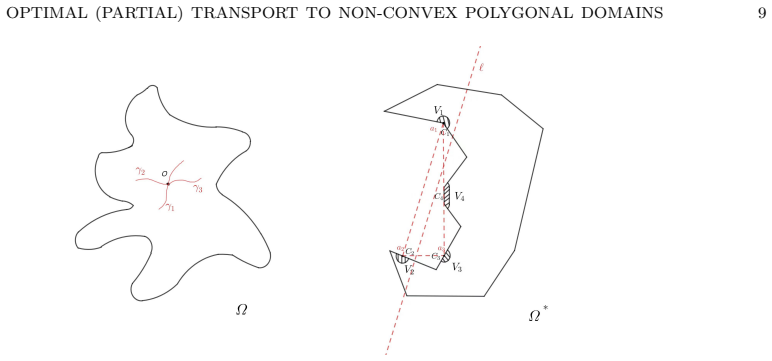
Optimal transport to non-convex polygonal domains in the plane has a singular set that is a smooth curve away from finitely many points.
A machine-rendered reading of the paper's core claim, the machinery that carries it, and where it could break.
Core claim
For the complete optimal transport problem, we prove that the singular set is locally a smooth one-dimensional curve away from finitely many points. For the optimal partial transport problem, we prove that the free boundary is smooth away from finitely many singular points. In higher dimensions, we formulate two conjectures concerning the structure of singularities when the target is a non-convex polytope.
What carries the argument
The flat sides and finite vertices of the non-convex polygonal target in R^2, which are used to localize and control the geometry of the singular set or free boundary.
If this is right
- The optimal map is smooth except along a one-dimensional curve that meets the boundary or itself only at finitely many points.
- The free boundary in the partial-transport setting obeys the same local smoothness description.
- These local descriptions continue to hold when the measures and cost satisfy the usual existence hypotheses.
- Analogous but possibly more intricate singularity structures are conjectured to exist for non-convex polytope targets in dimensions greater than two.
Where Pith is reading between the lines
- The two-dimensional results may serve as a model for approximating domains with piecewise-smooth boundaries by polygons.
- Numerical methods could explicitly track the one-dimensional singular curves rather than treating them as fully unstructured.
- Techniques developed here might transfer to related free-boundary problems whose targets have flat faces.
Load-bearing premise
The target domain is a non-convex polygon in two dimensions, with the source measure, target measure, and cost satisfying the standard conditions that guarantee existence of an optimal map.
What would settle it
An explicit pair of measures on a non-convex quadrilateral target whose optimal map has a singular set containing a point that is not locally a smooth curve or that accumulates infinitely many exceptional points.
Figures


read the original abstract
In this paper, we investigate optimal (partial) transport problems for which the target is a non-convex polygonal domain in \(\mathbb{R}^2\). For the complete optimal transport problem, we prove that the singular set is locally a smooth one-dimensional curve away from finitely many points. For the optimal partial transport problem, we prove that the free boundary is smooth away from finitely many singular points. In higher dimensions, we formulate two conjectures concerning the structure of singularities when the target is a non-convex polytope.
Editorial analysis
A structured set of objections, weighed in public.
Referee Report
Summary. The manuscript investigates optimal (partial) transport problems where the target is a non-convex polygonal domain in R^2. For the complete optimal transport problem, it proves that the singular set is locally a smooth one-dimensional curve away from finitely many points. For the optimal partial transport problem, it proves that the free boundary is smooth away from finitely many singular points. Two conjectures are formulated for the structure of singularities in higher dimensions when the target is a non-convex polytope.
Significance. If the results hold, they advance regularity theory for optimal transport and partial transport with non-convex targets, providing explicit geometric descriptions (smooth 1D curves or surfaces away from finite points) that extend beyond convex-domain results. The 2D theorems are stated as direct proofs, and the higher-dimensional conjectures are clearly posed. These could support further work on singularity structure in geometric PDEs.
minor comments (1)
- The abstract is clear, but the introduction should explicitly list the standing assumptions on the source/target measures and cost function to make the well-posedness statements self-contained.
Simulated Author's Rebuttal
We thank the referee for their positive evaluation of the manuscript and for recommending acceptance. The report contains no major comments requiring a point-by-point response.
Circularity Check
No significant circularity
full rationale
The paper states direct mathematical proofs of regularity for the singular set (smooth 1D curve away from finitely many points) and free boundary (smooth away from finitely many singular points) in optimal (partial) transport to non-convex polygonal domains in R^2, under standard well-posedness conditions. No equations, parameters, or claims in the abstract reduce by construction to inputs, fitted data, or self-citation chains; the results are presented as theorems derived from the geometric setting rather than renamed or self-referential constructs. This is a standard pure-math regularity paper with no load-bearing self-citations or ansatz smuggling visible.
Axiom & Free-Parameter Ledger
Lean theorems connected to this paper
-
IndisputableMonolith/Foundation/RealityFromDistinction.leanreality_from_one_distinction unclear?
unclearRelation between the paper passage and the cited Recognition theorem.
Theorem 1.1: the singular set A is either a finite set or, except for a finite number of points, A is locally a 1-dimensional smooth curve.
-
IndisputableMonolith/Cost/FunctionalEquation.leanwashburn_uniqueness_aczel unclear?
unclearRelation between the paper passage and the cited Recognition theorem.
det D²u ≥ χ_Ω in the Alexandrov sense; sections S_h^c[w](y0)
What do these tags mean?
- matches
- The paper's claim is directly supported by a theorem in the formal canon.
- supports
- The theorem supports part of the paper's argument, but the paper may add assumptions or extra steps.
- extends
- The paper goes beyond the formal theorem; the theorem is a base layer rather than the whole result.
- uses
- The paper appears to rely on the theorem as machinery.
- contradicts
- The paper's claim conflicts with a theorem or certificate in the canon.
- unclear
- Pith found a possible connection, but the passage is too broad, indirect, or ambiguous to say the theorem truly supports the claim.
Reference graph
Works this paper leans on
-
[1]
E. Andriyanova and S. Chen. Boundary C1,α regularity of potential functions in optimal transportation with quadratic cost. Analysis and PDE , 9 (2016), 1483–1496
work page 2016
-
[2]
Y. Brenier. Polar factorization and monotone rearrangement of vector-valued functions. Comm. Pure Appl. Math., 44 (1991), no. 4, 375–417
work page 1991
-
[3]
L. A. Caffarelli. The regularity of mappings with a convex potential. J. Amer. Math. Soc. , 5 (1992), 99–104
work page 1992
-
[4]
L. A. Caffarelli. Boundary regularity of maps with convex potentials. Comm. Pure Appl. Math. , 45 (1992), 1141–1151
work page 1992
-
[5]
L. A. Caffarelli. A note on the degeneracy of convex solutions to the Monge-Amp` ere equation. Comm. Partial Differential Equations , 18 (1993), 1213–1217
work page 1993
-
[6]
L. A. Caffarelli. Boundary regularity of maps with convex potentials. II. Ann. of Math. , 144 (1996), 453–496
work page 1996
-
[7]
L. A. Caffarelli and R. J. McCann. Free boundaries in optimal transport and Monge-Amp` ere obstacle problems. Ann. of Math. , 171 (2010), 673–730
work page 2010
-
[8]
S. Chen and J. Liu. Regularity of free boundaries in optimal transportation. Preprint, available at arXiv:1911.10790
-
[9]
S. Chen and J. Liu. Global regularity in the Monge-Amp` ere obstacle problem. Preprint, available arXiv:2307.00262
-
[10]
S. Chen and J. Liu. Regularity of singular set in optimal transportation. Preprint, available at arXiv:2210.13841
-
[11]
S. Chen, J. Liu and X.-J. Wang. Global regularity for the Monge-Amp` ere equation with natural boundary condition. Ann. of Math. , (2) 194 (2021), no.3, 745–793
work page 2021
-
[12]
S. Chen; J. Liu and X.-J. Wang. C2,α regularity of free boundary in optimal transport. Comm. Pure Appl. Math., 77 (2024), 731–794
work page 2024
- [13]
-
[14]
Figalli, A note on the regularity of the free boundaries in the optimal partial transport problem
A. Figalli, A note on the regularity of the free boundaries in the optimal partial transport problem. Rend. Circ. Mat. Palermo , 58 (2009), no. 2, 283–286
work page 2009
-
[15]
Figalli, The optimal partial transport problem
A. Figalli, The optimal partial transport problem. Arch. Ration. Mech. Anal., 195 (2010), 533–560. OPTIMAL (PARTIAL) TRANSPORT TO NON-CONVEX POLYGONAL DOMAINS 17
work page 2010
-
[16]
Figalli, Regularity properties of optimal maps between nonconvex domains in the plane Comm
A. Figalli, Regularity properties of optimal maps between nonconvex domains in the plane Comm. Partial Differential Equations , 35 (2010), 465–479
work page 2010
-
[17]
A. Figalli and Y.-H. Kim. Partial regularity of Brenier solutions of the Monge–Amp` ere equation.Discrete Contin. Dyn. Syst. , 28 (2010), 559–565
work page 2010
-
[18]
A. Figalli and G. Loeper. C1 regularity of solutions of the Monge–Amp` ere equation for optimal transport in dimension two. Calc. Var. Partial Differential Equations , 35 (2009), 537–550
work page 2009
-
[19]
D. Gilbarg and N. S. Trudinger. Elliptic partial differential equations of second order . Reprint of the 1998 edition. Classics in Mathematics. Springer-Verlag, Berlin, 2001
work page 1998
-
[20]
E. Indrei. Free boundary regularity in the optimal partial transport problem. J. Funct. Anal., 264 (2013), no. 11, 2497–2528
work page 2013
-
[21]
J. Kitagawa and R. McCann. Free discontinuties in optimal transport. Arch. Rational Mech. Anal., 232 (2019), 1505–1541
work page 2019
-
[22]
B. L´ evy. A numerical algorithm for L2 semi-discrete optimal transport in 3D. ESAIM: Mathematical Modelling and Numerical Analysis , 49 (2015), 1693–1715
work page 2015
-
[23]
J. Liu and X.-J. Wang. Interior a priori estimates for the Monge-Amp` ere equation.Surveys in Differential Geometry Vol. 19, International Press (2014), 151–177
work page 2014
- [24]
-
[25]
C. Mooney. Partial regularity for singular solutions to the Monge-Amp` ere equation.Comm. Pure Appl. Math., 68 (2015), no. 6, 1066–1084
work page 2015
-
[26]
C. Mooney and A. Rakshit. Sobolev regularity for optimal transport maps of non-convex planar domains. SIAM J. Math. Anal. , 56 (2024), 4742–4758
work page 2024
-
[27]
O. Savin and H. Yu. Regularity of optimal transport between planar convex domains. Duke Math. J. , 169 (2020), 1305–1327
work page 2020
-
[28]
J. Urbas. On the second boundary value problem of Monge-Amp` ere type. J. Reine Angew. Math. , 487 (1997), 115–124
work page 1997
-
[29]
C. Villani. Topics in optimal transportation . Grad. Stud. Math. 58, Amer. Math. Soc., 2003
work page 2003
-
[30]
C. Villani. Optimal transport, Old and new . Springer, Berlin, 2006
work page 2006
-
[31]
Y. Yu. Singular set of a convex potential in two dimensions. Comm. Partial Differential Equations , 32 (2007), 1883–1894. Shibing Chen, School of Mathematical Sciences, University of Science and Technology of China, Hefei, 230026, P.R. China. Email address: chenshib@ustc.edu.cn Yuanyuan Li, School of Mathematical Sciences, University of Science and Techno...
work page 2007
discussion (0)
Sign in with ORCID, Apple, or X to comment. Anyone can read and Pith papers without signing in.