Exponentially slow thermalization and the robustness of Hilbert space fragmentation
Pith reviewed 2026-05-24 04:40 UTC · model grok-4.3
The pith
A boundary bath leaves a pair-flip constrained quantum chain unthermalized for a time that grows exponentially with system size.
A machine-rendered reading of the paper's core claim, the machinery that carries it, and where it could break.
Core claim
In the random unitary circuit model of a pair-flip constrained chain with boundary bath coupling, thermalization time scales exponentially with system size because strong bottlenecks in configuration space restrict how the system can explore Hilbert space.
What carries the argument
Strong bottlenecks in configuration space within the random unitary circuit model with pair-flip constraints and boundary coupling.
If this is right
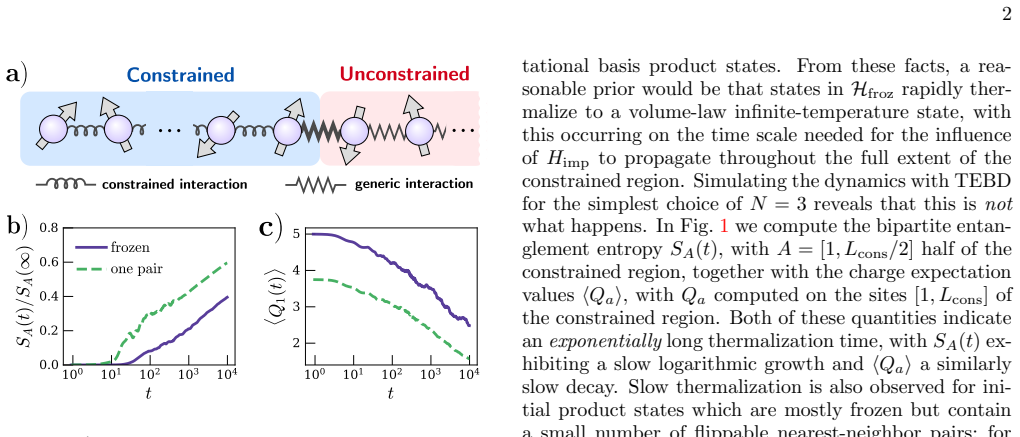
- Entanglement entropy grows only after an exponentially long waiting time.
- Local observables remain far from their thermal values for exponentially long times.
- The same exponential bottleneck persists when the bath is attached at the boundary rather than distributed throughout the chain.
- Slow thermalization appears even though the bath is designed to restore ergodicity.
Where Pith is reading between the lines
- Approximate versions of fragmentation may produce long-lived non-thermal states in open quantum systems of practical size.
- Similar configuration-space bottlenecks could appear in other locally constrained models once a weak bath is added.
- The mechanism offers a route to engineer slow relaxation without exact conservation laws.
- Quantum simulators with tunable pair-flip rules could directly measure the predicted exponential timescale.
Load-bearing premise
The random unitary circuit dynamics with the chosen pair-flip constraint and boundary bath coupling faithfully captures the essential slow-relaxation mechanism of the underlying Hamiltonian system.
What would settle it
A direct simulation of the random unitary circuit model that finds thermalization time scaling polynomially rather than exponentially with system size for accessible lengths would falsify the central claim.
Figures




read the original abstract
The phenomenon of Hilbert space fragmentation, whereby dynamical constraints fragment Hilbert space into many disconnected sectors, provides a simple mechanism by which thermalization can be arrested. However, little is known about how thermalization occurs in situations where the constraints are not exact. To study this, we consider a situation in which a fragmented 1d chain with pair-flip constraints is coupled to an ergodicity-restoring thermal bath at its boundary. We numerically observe an exponentially long thermalization time in Hamiltonian dynamics, manifested in both entanglement dynamics and the relaxation of local observables. To understand this, we study an analogous model of random unitary circuit dynamics, whose thermalization time we prove scales exponentially with system size. Slow thermalization in this model is shown to be a consequence of strong bottlenecks in configuration space, which restrict how the system can explore Hilbert space, and demonstrate a new way of producing anomalously slow thermalization dynamics.
Editorial analysis
A structured set of objections, weighed in public.
Referee Report
Summary. The paper examines a 1D chain with pair-flip constraints coupled to a boundary thermal bath. It reports numerical observations of exponentially long thermalization times in the Hamiltonian dynamics, visible in entanglement growth and local observable relaxation. An analogous random unitary circuit model is analyzed, for which the authors prove that thermalization time scales exponentially with system size due to strong bottlenecks in configuration space that limit Hilbert-space exploration.
Significance. If the results hold, the work supplies both numerical evidence and a rigorous proof of exponentially slow thermalization arising from approximate Hilbert-space fragmentation. The proof for the circuit model, grounded in configuration-space bottlenecks rather than fitted parameters, is a clear strength and illustrates a distinct mechanism for anomalously slow dynamics. This could inform studies of prethermalization in constrained many-body systems, provided the circuit faithfully reproduces the Hamiltonian bottlenecks.
major comments (2)
- [abstract (circuit-model paragraph) and Hamiltonian-numerics section] The exponential scaling is proven only for the random unitary circuit model; the Hamiltonian claim rests on numerical observation. The manuscript invokes the circuit to interpret the Hamiltonian results (abstract, circuit-model paragraph), but the load-bearing assumption that the pair-flip constraint plus boundary coupling produces equivalent bottlenecks in both models is not accompanied by a direct comparison of configuration-space exploration or relaxation pathways between the discrete-time circuit and continuous-time Hamiltonian.
- [numerical results for Hamiltonian dynamics] The numerical evidence for exponential scaling in the Hamiltonian dynamics should include explicit details on the range of system sizes, the functional form fitted to the relaxation times, and quantitative error analysis to distinguish exponential from sub-exponential behavior (e.g., Table or Figure reporting the scaling).
minor comments (2)
- Figure captions should explicitly state the system sizes and fitting procedures used to extract the exponential scaling.
- Notation for the pair-flip constraint and bath coupling should be made identical between the Hamiltonian and circuit sections to facilitate direct comparison.
Simulated Author's Rebuttal
We thank the referee for their careful reading and constructive comments on the manuscript. We respond to each major comment below.
read point-by-point responses
-
Referee: [abstract (circuit-model paragraph) and Hamiltonian-numerics section] The exponential scaling is proven only for the random unitary circuit model; the Hamiltonian claim rests on numerical observation. The manuscript invokes the circuit to interpret the Hamiltonian results (abstract, circuit-model paragraph), but the load-bearing assumption that the pair-flip constraint plus boundary coupling produces equivalent bottlenecks in both models is not accompanied by a direct comparison of configuration-space exploration or relaxation pathways between the discrete-time circuit and continuous-time Hamiltonian.
Authors: We agree that the rigorous proof of exponential scaling applies exclusively to the random unitary circuit model, while the Hamiltonian results rely on numerical observations. The circuit is introduced as an analogous discrete-time model to provide mechanistic insight into the bottlenecks observed numerically in the continuous-time Hamiltonian dynamics. We acknowledge that the manuscript does not include a direct side-by-side comparison of configuration-space exploration or relaxation pathways. In the revised manuscript we will add such a comparison (e.g., by tracking the fraction of accessible configurations or effective diffusion rates in both models) to better substantiate the analogy. revision: yes
-
Referee: [numerical results for Hamiltonian dynamics] The numerical evidence for exponential scaling in the Hamiltonian dynamics should include explicit details on the range of system sizes, the functional form fitted to the relaxation times, and quantitative error analysis to distinguish exponential from sub-exponential behavior (e.g., Table or Figure reporting the scaling).
Authors: We thank the referee for this suggestion. The current manuscript presents numerical data on entanglement growth and local-observable relaxation, but the details of system-size range, explicit functional fits, and quantitative error analysis are not presented in a consolidated form. In the revision we will add a dedicated table (or supplementary figure) that lists the system sizes examined, the fitted forms (e.g., relaxation time versus system size), and statistical measures such as fit uncertainties or bootstrap errors to allow readers to assess the exponential versus sub-exponential distinction. revision: yes
Circularity Check
No significant circularity; derivation is self-contained
full rationale
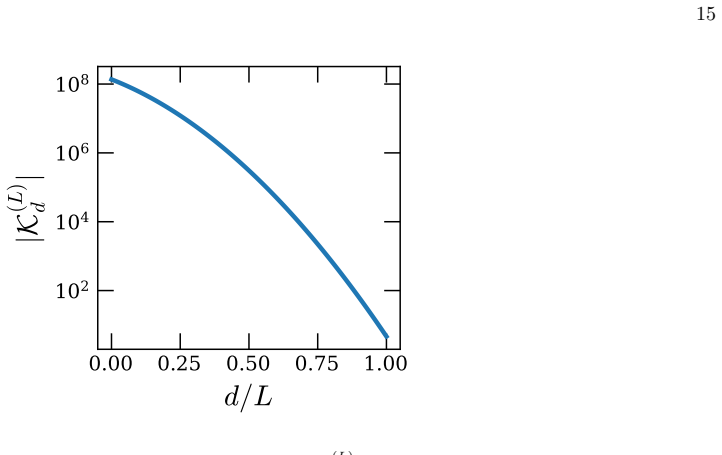
The paper's central result is a rigorous proof of exponential thermalization time in the random unitary circuit model, derived from analysis of configuration-space bottlenecks rather than any fitted parameters, self-referential definitions, or self-citations. The Hamiltonian dynamics are addressed via separate numerical observations, with the circuit presented as an analogous model under an explicit modeling assumption. No load-bearing step reduces by construction to the paper's inputs, and the derivation does not rely on prior author work for uniqueness or ansatzes.
Axiom & Free-Parameter Ledger
axioms (1)
- standard math Random unitary circuits with the stated pair-flip constraint generate a Markov chain on configuration space whose mixing time can be bounded by bottleneck analysis.
Forward citations
Cited by 1 Pith paper
-
Quantum Fragmentation
A Rokhsar-Kivelson-type construction turns classical or non-fragmented models into quantum fragmented Hamiltonians whose Krylov sectors require an entangled basis to resolve.
Reference graph
Works this paper leans on
-
[1]
J. M. Deutsch, Quantum statistical mechanics in a closed system, Phys. Rev. A 43, 2046 (1991)
work page 2046
-
[2]
Srednicki, Chaos and quantum thermalization, Phys
M. Srednicki, Chaos and quantum thermalization, Phys. Rev. E 50, 888 (1994)
work page 1994
- [3]
-
[4]
R. Nandkishore and D. A. Huse, Many-body localization and thermalization in quantum statistical mechanics, An- nual Review of Condensed Matter Physics 6, 15 (2015)
work page 2015
-
[5]
L. D’Alessio, Y. Kafri, A. Polkovnikov, and M. Rigol, From quantum chaos and eigenstate thermalization to statistical mechanics and thermodynamics, Advances in Physics 65, 239 (2016)
work page 2016
-
[6]
F. Alet and N. Laflorencie, Many-body localization: An introduction and selected topics, Comptes Rendus Physique 19, 498 (2018), quantum simulation / Simula- tion quantique
work page 2018
-
[7]
D. A. Abanin, E. Altman, I. Bloch, and M. Serbyn, Col- loquium: Many-body localization, thermalization, and entanglement, Rev. Mod. Phys. 91, 021001 (2019)
work page 2019
-
[8]
P. Sala, T. Rakovszky, R. Verresen, M. Knap, and F. Poll- mann, Ergodicity breaking arising from hilbert space fragmentation in dipole-conserving hamiltonians, Phys. Rev. X 10, 011047 (2020)
work page 2020
-
[9]
V. Khemani, M. Hermele, and R. Nandkishore, Local- ization from hilbert space shattering: From theory to physical realizations, Phys. Rev. B 101, 174204 (2020)
work page 2020
-
[10]
S. Moudgalya and O. I. Motrunich, Hilbert space frag- mentation and commutant algebras, Phys. Rev. X 12, 011050 (2022)
work page 2022
-
[11]
N. Pancotti, G. Giudice, J. I. Cirac, J. P. Garrahan, and M. C. Ba˜ nuls, Quantum east model: Localization, non- thermal eigenstates, and slow dynamics, Physical Review X 10, 021051 (2020)
work page 2020
-
[12]
M. van Horssen, E. Levi, and J. P. Garrahan, Dynam- ics of many-body localization in a translation-invariant quantum glass model, Physical Review B 92, 100305 (2015)
work page 2015
-
[13]
B. Mukherjee, D. Banerjee, K. Sengupta, and A. Sen, Minimal model for hilbert space fragmentation with local constraints, Physical Review B 104, 155117 (2021)
work page 2021
-
[14]
Z.-C. Yang, F. Liu, A. V. Gorshkov, and T. Iadecola, Hilbert-space fragmentation from strict confinement, Physical review letters 124, 207602 (2020). 6
work page 2020
- [15]
-
[16]
Z. Lan, M. van Horssen, S. Powell, and J. P. Garrahan, Quantum slow relaxation and metastability due to dy- namical constraints, Physical review letters 121, 040603 (2018)
work page 2018
-
[17]
J. P. Garrahan, Aspects of non-equilibrium in classical and quantum systems: Slow relaxation and glasses, dy- namical large deviations, quantum non-ergodicity, and open quantum dynamics, Physica A: Statistical Mechan- ics and its Applications 504, 130 (2018)
work page 2018
-
[18]
G. De Tomasi, D. Hetterich, P. Sala, and F. Pollmann, Dynamics of strongly interacting systems: From fock- space fragmentation to many-body localization, Phys. Rev. B 100, 214313 (2019)
work page 2019
-
[19]
S. Moudgalya, A. Prem, R. Nandkishore, N. Regnault, and B. A. Bernevig, Thermalization and its absence within krylov subspaces of a constrained hamiltonian, in Memorial Volume for Shoucheng Zhang (World Scien- tific, 2022) pp. 147–209
work page 2022
- [20]
- [21]
-
[22]
Y. Li, P. Sala, and F. Pollmann, Hilbert space fragmenta- tion in open quantum systems, Physical Review Research 5 (2023)
work page 2023
-
[23]
T. Kohlert, S. Scherg, P. Sala, F. Pollmann, B. Hebbe Madhusudhana, I. Bloch, and M. Aidelsburger, Exploring the regime of fragmentation in strongly tilted fermi-hubbard chains, Phys. Rev. Lett. 130, 010201 (2023)
work page 2023
-
[24]
T. Kinoshita, T. Wenger, and D. S. Weiss, A quantum newton’s cradle, Nature 440, 900 (2006)
work page 2006
- [25]
-
[26]
N. Malvania, Y. Zhang, Y. Le, J. Dubail, M. Rigol, and D. S. Weiss, Generalized hydrodynamics in strongly in- teracting 1d bose gases, Science 373, 1129 (2021)
work page 2021
-
[27]
D. Wei, A. Rubio-Abadal, B. Ye, F. Machado, J. Kemp, K. Srakaew, S. Hollerith, J. Rui, S. Gopalakrishnan, N. Y. Yao, et al., Quantum gas microscopy of kardar- parisi-zhang superdiffusion, Science 376, 716 (2022)
work page 2022
-
[28]
E. Guardado-Sanchez, A. Morningstar, B. M. Spar, P. T. Brown, D. A. Huse, and W. S. Bakr, Subdiffusion and heat transport in a tilted two-dimensional fermi-hubbard system, Physical Review X 10, 011042 (2020)
work page 2020
- [29]
-
[30]
S. Moudgalya, S. Rachel, B. A. Bernevig, and N. Reg- nault, Exact excited states of nonintegrable models, Phys. Rev. B 98, 235155 (2018)
work page 2018
-
[31]
M. T. Batchelor and A. Kuniba, Temperley-lieb lattice models arising from quantum groups, Journal of Physics A: Mathematical and General 24, 2599 (1991)
work page 1991
-
[32]
B. Aufgebauer and A. Kl¨ umper, Quantum spin chains of temperley–lieb type: periodic boundary conditions, spectral multiplicities and finite temperature, Journal of Statistical Mechanics: Theory and Experiment 2010, P05018 (2010)
work page 2010
-
[33]
S. Moudgalya and O. I. Motrunich, Hilbert space frag- mentation and commutant algebras, Physical Review X 12, 011050 (2022)
work page 2022
- [34]
-
[35]
S. Balasubramanian, S. Gopalakrishnan, A. Khu- dorozhkov, and E. Lake, Glassy word problems: ultraslow relaxation, hilbert space jamming, and computational complexity, arXiv preprint arXiv:2312.04562 (2023)
-
[36]
R. Lyons and Y. Peres, Probability on trees and networks, Vol. 42 (Cambridge University Press, 2017)
work page 2017
-
[37]
M. Fishman, S. White, and E. Stoudenmire, The itensor software library for tensor network calculations, SciPost Physics Codebases , 004 (2022)
work page 2022
-
[38]
V. Oganesyan and D. A. Huse, Localization of interacting fermions at high temperature, Phys. Rev. B 75, 155111 (2007)
work page 2007
-
[39]
L. Santos, Integrability of a disordered heisenberg spin- 1/2 chain, Journal of Physics A: Mathematical and Gen- eral 37, 4723 (2004)
work page 2004
-
[40]
V. B. Bulchandani, D. A. Huse, and S. Gopalakrishnan, Onset of many-body quantum chaos due to breaking in- tegrability, Physical Review B 105, 214308 (2022)
work page 2022
-
[41]
Hart, Exact mazur bounds in the pair-flip model and beyond, arXiv preprint arXiv:2308.00738 (2023)
O. Hart, Exact mazur bounds in the pair-flip model and beyond, arXiv preprint arXiv:2308.00738 (2023)
-
[42]
Woess, Random walks on infinite graphs and groups, 138 (Cambridge university press, 2000)
W. Woess, Random walks on infinite graphs and groups, 138 (Cambridge university press, 2000)
work page 2000
-
[43]
D. A. Levin and Y. Peres, Markov chains and mixing times, Vol. 107 (Ameri- can Mathematical Soc., 2017)
work page 2017
-
[44]
Q. Gao, P. Zhang, and X. Chen, Information scrambling in free fermion systems with a sole interaction (2023), arXiv:2310.07043 [quant-ph]. SUMMARY OF APPENDICES • Section A: preliminary remarks on notation • Section B: extended numerical results: entanglement dynamics, localization of eigenstates, and level statistics 7 • Section C: calculation of Krylov ...
-
[45]
Entanglement and Krylov entropy In this subsection we show the entanglement dynamics of a more general locally-perturbed PF model, including the half-chain entanglement entropy of the constrained system, and Krylov entropy, a quantity that measures the spreading of the wave function over different Krylov subspaces, i.e. SK(t) ≡ − X vs pvs ln pvs , (B2) wh...
-
[46]
Localization of eigenstates To determine the extent that eigenstates of H are localized on TN, we can measure the “expected depth” dµ of each eigenstate |µ⟩, defined as dµ ≡ L/2X d=0 X vs : irr(s)=d d⟨µ|ΠKvs |µ⟩. (B5) Histograms of dµ and eigenstate energy E are shown in Figs. 5, 6, and 7 for SU (3)-symmetric pair-flip models, SU (3)-breaking pair-flip mo...
-
[47]
r statistics The models with N > 2 that we study all exhibit strong HSF, with |Kmax| being exponentially smaller than |H|. This implies that if one examines the spectrum of H, consecutive eigenstates will almost certainly belong to distinct Krylov sectors, and hence the spectrum of H will exhibit no nearest-neighbor level repulsion in the absence of const...
-
[48]
N = 2 We first dispatch with the easy case of N = 2, for which the dynamics is not fragmented. The tree T2 is simply a line, and the different Krylov sectors can be fully distinguished by the charge Q1 defined in (2), the value of which gives the distance of the Krylov sector along the line. The number of Kyrlov sectors is simply NK(L) = L + 1. (C1) The d...
-
[49]
N > 2 When N > 2 the dynamics is strongly fragmented, and determining the sizes of the different Krylov sectors is less trivial. We start with the total number of Kyrlov sectors NK(L). From thinking about the tree structure of TN, it is 12 0.00 0.25 0.50 0.75 1.00 d/L 0.00 0.05 0.10 0.15 0.20 0.25 0.30 Pr[|s|= d] L 10 13 16 19 22 0.00 0.25 0.50 0.75 1.00 ...
-
[50]
those of the form |a, b⟩, a ̸= b
Pair-flip For general pair-flip dynamics, the elementary gates Ui,i+1 take the form Ui,i+1 = X a,b U P F ab |aa⟩⟨bb| + X a̸=b eiϕab |ab⟩⟨ab| = U P F ⊕ M a̸=b eiϕab , (D3) where the matrix U P F is drawn from the Haar ensemble on U(N), and the second term in the direct sum acts as a diagonal matrix of random phases on the subspace of states frozen under th...
-
[51]
and the slightly modified treatment given in [35]. We let O(t) ≡ E Ct [Ct(O)] (D4) denote the circuit-averaged evolution of O over time t, where the ECt denotes averaging over the unitaries constituting U. To help with notation, we will divide each unit time interval into three steps of length t = 1 /3: at t ∈ N the depolarizing noise is applied, at t ∈ N...
-
[52]
Temperley-Lieb For Temperley-Lieb dynamics, the elementary unitary gates are constrained to preserve the pair-flip constraint in any onsite basis, which is done by enriching the previously studied pair-flip dynamics with SU (N) symmetry. The elementary unitary gates for this model take the form Ui,i+1 = eiϕi,i+1ΠT L + (1 − ΠT L), (D12) where ΠT L ≡ 1 N X ...
-
[53]
A key notion in what follows will be that of the expansion: Definition 1
Markov chains and graph expansion We begin by reviewing some central concepts in the theory of Markov chains, 2 letting M to denote the generator of a given Markov process. A key notion in what follows will be that of the expansion: Definition 1. Let R ⊂ H . The expansion of R is defined as the amount of probability flow that the uniform distribution expe...
-
[54]
Local and non-local chains The Markov generator derived in Sec. D was obtained by considering brickwork RU dynamics composed of three alternating layers: one layer of constrained 2-site gates on the even sublattice ( Me in the notation of Sec. D), one layer on the odd sublattice ( Mo), and one layer consisting solely of depolarizing noise applied to the s...
-
[55]
N > 2 In this subsection we prove a variety of results establishing exponentially slow thermalization in the strongly fragmented models obtained when N > 2. The case of N = 2, where thermalization is expected to be much faster, is dealt with in a subsequent subsection. a. The spectral gap We begin by proving the following theorem: Theorem 4. For N > 2, th...
-
[56]
between” two Krylov sectors, rather than cutting “within
N = 2 We now compute the expansion for N = 2. In this case we expect a large expansion—and hence a fast mixing time—due to the absence of strong Hilbert space bottlenecks. In this subsection we will find it most convenient to label the Krylov sectors by their charge Q, defined as Q ≡ X i (−1)iZi, (E75) with ⟨Q⟩ψ measuring the endpoint of the random walk d...
discussion (0)
Sign in with ORCID, Apple, or X to comment. Anyone can read and Pith papers without signing in.