Inevitability of Polarization in Geometric Opinion Exchange
Pith reviewed 2026-05-24 04:21 UTC · model grok-4.3
The pith
In geometric models of opinion exchange, polarization occurs almost surely in two dimensions under a broad class of biased assimilation update rules.
A machine-rendered reading of the paper's core claim, the machinery that carries it, and where it could break.
Core claim
The central claim is that polarization appears to be ubiquitous in the class of models studied, requiring only relatively modest assumptions reflecting biased assimilation. The authors prove almost sure polarization for a large class of update rules in two dimensions, and prove polarization in three and more dimensions in more limited cases, highlighting qualitative differences between two-dimensional dynamics and those in higher dimensions.
What carries the argument
Opinions represented as unit vectors on a sphere, updated by geometric rules in a general class that reflects biased assimilation during random pairwise interactions.
If this is right
- Polarization is almost sure in two dimensions for a large class of update rules.
- Polarization holds in three and higher dimensions only in more limited cases.
- Dynamics exhibit a qualitative difference between two dimensions and three or more dimensions.
- Biased assimilation assumptions alone suffice for polarization when combined with the geometric sphere representation.
Where Pith is reading between the lines
- The geometric sphere structure may explain both polarization and unexpected correlations between opinions on unrelated topics through the same mechanism.
- Real-world opinion data could be checked for consistency with unit-vector distributions on low-dimensional spheres to test the model's applicability.
- The almost-sure result in two dimensions suggests that dimensionality of the opinion space itself influences how readily polarization emerges.
Load-bearing premise
The update rules must belong to a general class whose properties reflect biased assimilation and enable the geometric polarization proofs on the sphere.
What would settle it
A concrete counterexample consisting of an update rule inside the defined class for which two-dimensional simulations or analysis show no polarization would falsify the almost-sure result.
Figures
read the original abstract
Polarization and unexpected correlations between opinions on diverse topics (including in politics, culture and consumer choices) are an object of sustained attention. However, numerous theoretical models do not seem to convincingly explain these phenomena. This paper is motivated by a recent line of work, studying models where polarization can be explained in terms of biased assimilation and geometric interplay between opinions on various topics. The agent opinions are represented as unit vectors on a multidimensional sphere and updated according to geometric rules. In contrast to previous work, we focus on the classical opinion exchange setting, where the agents update their opinions in discrete time steps, with a pair of agents interacting randomly at every step. The opinions are updated according to an update rule belonging to a general class. Our findings are twofold. First, polarization appears to be ubiquitous in the class of models we study, requiring only relatively modest assumptions reflecting biased assimilation. Second, there is a qualitative difference between two-dimensional dynamics on the one hand, and three or more dimensions on the other. Accordingly, we prove almost sure polarization for a large class of update rules in two dimensions. Then, we prove polarization in three and more dimensions in more limited cases and try to shed light on central difficulties that are absent in two dimensions.
Editorial analysis
A structured set of objections, weighed in public.
Referee Report
Summary. The paper analyzes a class of geometric opinion dynamics models in which agent opinions are unit vectors on the sphere and pairwise interactions occur in discrete time according to update rules that encode biased assimilation. It claims that polarization is almost sure in two dimensions for a broad class of such rules, proved via direct analysis of the associated stochastic process on the sphere, while results in three or more dimensions are more limited and the paper identifies central technical difficulties that appear only in higher dimensions.
Significance. If the stated proofs hold, the work supplies a parameter-free mathematical demonstration that polarization emerges under modest assumptions on the update class in 2D, offering a geometric mechanism that could account for observed opinion correlations without strong additional hypotheses. The explicit distinction between 2D and higher-D behavior, together with the identification of dimension-dependent obstacles, is a substantive contribution to the literature on geometric opinion models.
minor comments (2)
- [Section 2 or 3 (update rule class)] The precise axiomatic properties required of the update-rule class (e.g., continuity, monotonicity, or invariance conditions) should be stated in a single numbered definition or proposition early in the manuscript so that the 2D almost-sure result can be read as a direct corollary.
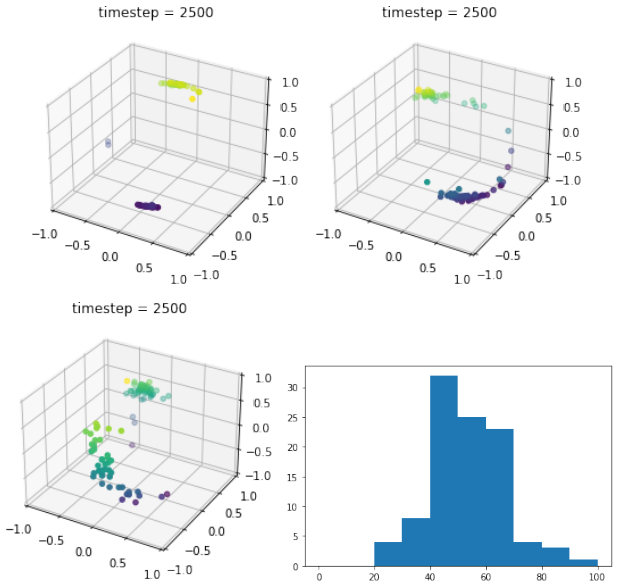
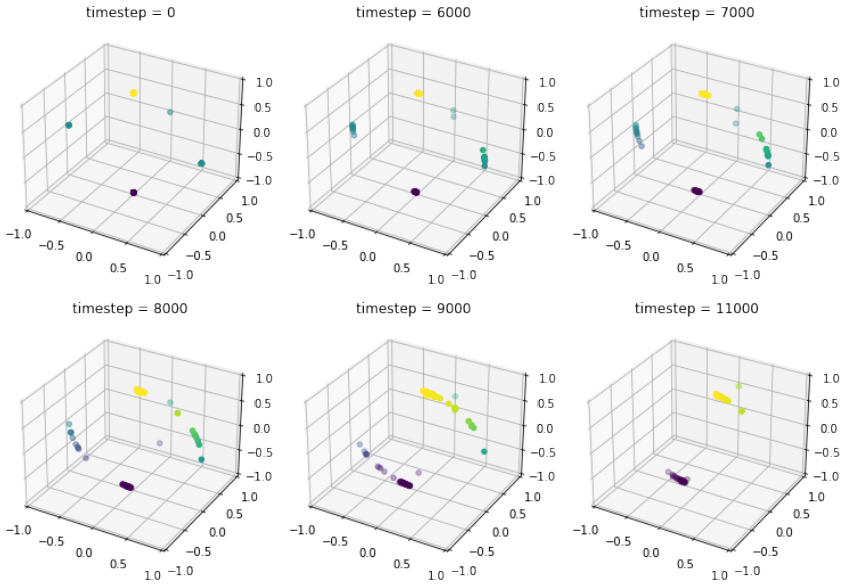
- [Figures] Figure captions and axis labels for any simulation trajectories or phase portraits should explicitly indicate the dimension and the specific update rule used, to avoid ambiguity when comparing 2D and higher-D behavior.
Simulated Author's Rebuttal
We thank the referee for their positive assessment of the manuscript and for recommending minor revision. The referee's summary accurately reflects the paper's focus on proving almost-sure polarization in 2D geometric opinion dynamics under modest biased-assimilation assumptions, together with the more limited higher-dimensional results and the explicit identification of dimension-dependent obstacles.
Circularity Check
No significant circularity; direct mathematical proof of stochastic process
full rationale
The paper derives almost-sure polarization via direct analysis of a stochastic process on the sphere for a defined class of geometric update rules encoding biased assimilation. No parameters are fitted to data, no predictions reduce to prior fitted quantities by construction, and no load-bearing steps rely on self-citation chains or self-definitional reductions. The result is a theorem proved under explicitly stated assumptions on the update class, with weaker results noted in higher dimensions. This is self-contained mathematical reasoning against external benchmarks.
Axiom & Free-Parameter Ledger
axioms (2)
- domain assumption Agent opinions are represented as unit vectors on a multidimensional sphere
- domain assumption Agents update opinions in discrete time steps with random pairwise interactions according to a general class of geometric update rules reflecting biased assimilation
Lean theorems connected to this paper
-
IndisputableMonolith/Cost/FunctionalEquation.leanwashburn_uniqueness_aczel unclear?
unclearRelation between the paper passage and the cited Recognition theorem.
opinions represented as unit vectors on multidimensional sphere... update rule belonging to a general class... stable function... f(0)=0, sign(f(A))=sign(A)
-
IndisputableMonolith/Foundation/AlexanderDuality.leanalexander_duality_circle_linking unclear?
unclearRelation between the paper passage and the cited Recognition theorem.
qualitative difference between two-dimensional dynamics... and three or more dimensions... prove almost sure polarization for d=2
What do these tags mean?
- matches
- The paper's claim is directly supported by a theorem in the formal canon.
- supports
- The theorem supports part of the paper's argument, but the paper may add assumptions or extra steps.
- extends
- The paper goes beyond the formal theorem; the theorem is a base layer rather than the whole result.
- uses
- The paper appears to rely on the theorem as machinery.
- contradicts
- The paper's claim conflicts with a theorem or certificate in the canon.
- unclear
- Pith found a possible connection, but the passage is too broad, indirect, or ambiguous to say the theorem truly supports the claim.
Reference graph
Works this paper leans on
-
[1]
[Aum76] Robert J. Aumann. “Agreeing to Disagree”. In: The Annals of Statistics 4.6 (1976), pp. 1236–1239. [Axe97] Robert Axelrod. “The dissemination of culture: A model with local convergence and global polarization”. In: Journal of Conflict Resolution 41.2 (1997), pp. 203–
work page 1976
-
[2]
Dynamics of political polarization
[BB07] Delia Baldassarri and Peter Bearman. “Dynamics of political polarization”. In: Amer- ican Sociological Review 72.5 (2007), pp. 784–811. [BG08] Delia Baldassarri and Andrew Gelman. “Partisans without Constraint: Political Po- larization and Trends in American Public Opinion”. In: American Journal of Soci- ology 114.2 (2008), pp. 408–446. [CWT22] Tia...
work page 2007
-
[3]
Bayesian learning in social networks
[GK03] Douglas Gale and Shachar Kariv. “Bayesian learning in social networks”. In: Games and Economic Behavior 45.2 (2003). Special Issue in Honor of Robert W . Rosenthal, pp. 329–346. [GKT21] Jason Gaitonde, Jon Kleinberg, and Éva Tardos. “Polarization in geometric opinion dynamics”. In: Conference on Economics and Computation (EC) . 2021, pp. 499–
work page 2003
-
[4]
A survey on nonstrategic models of opinion dynamics
[GR20] Michel Grabisch and Agnieszka Rusinowska. “A survey on nonstrategic models of opinion dynamics”. In: Games 11.4 (2020), p
work page 2020
-
[5]
A Geometric Model of Opinion Polarization
[HJMR23] Jan H ˛ azła, Yan Jin, Elchanan Mossel, and Govind Ramnarayan. “A Geometric Model of Opinion Polarization”. In:Mathematics of Operations Research (2023). [Kle20] Ezra Klein. Why we’re polarized. Simon and Schuster,
work page 2023
-
[6]
Polarization of Multi-Agent Gradi- ent Flows Over Manifolds With Application to Opinion Dynamics
[MGM23] La Mi, Jorge Gonçalves, and Johan Markdahl. “Polarization of Multi-Agent Gradi- ent Flows Over Manifolds With Application to Opinion Dynamics”. In:IEEE Trans- actions on Automatic Control (2023). [MKFB03] Michael W . Macy, James A. Kitts, Andreas Flache, and Steve Benard. “Polarization in dynamic networks: A Hopfield model of emergent structure”. ...
work page 2023
-
[7]
Animating rotation with quaternion curves
[Sho85] Ken Shoemake. “Animating rotation with quaternion curves”. In: Conference on Computer Graphics and Interactive Techniques (SIGGRAPH). 1985, pp. 245–254. [YYF22] Baizhong Yang, Quan Yu, and Yi Fan. “A Hybrid Opinion Formation and Polariza- tion Model”. In: Entropy 24.11 (2022), p
work page 1985
discussion (0)
Sign in with ORCID, Apple, or X to comment. Anyone can read and Pith papers without signing in.