Anyon braiding and telegraph noise in a graphene interferometer
Pith reviewed 2026-05-24 03:34 UTC · model grok-4.3
The pith
A graphene interferometer reveals the anyonic braiding phase through three-state random telegraph noise at filling factors 1/3 and 4/3.
A machine-rendered reading of the paper's core claim, the machinery that carries it, and where it could break.
Core claim
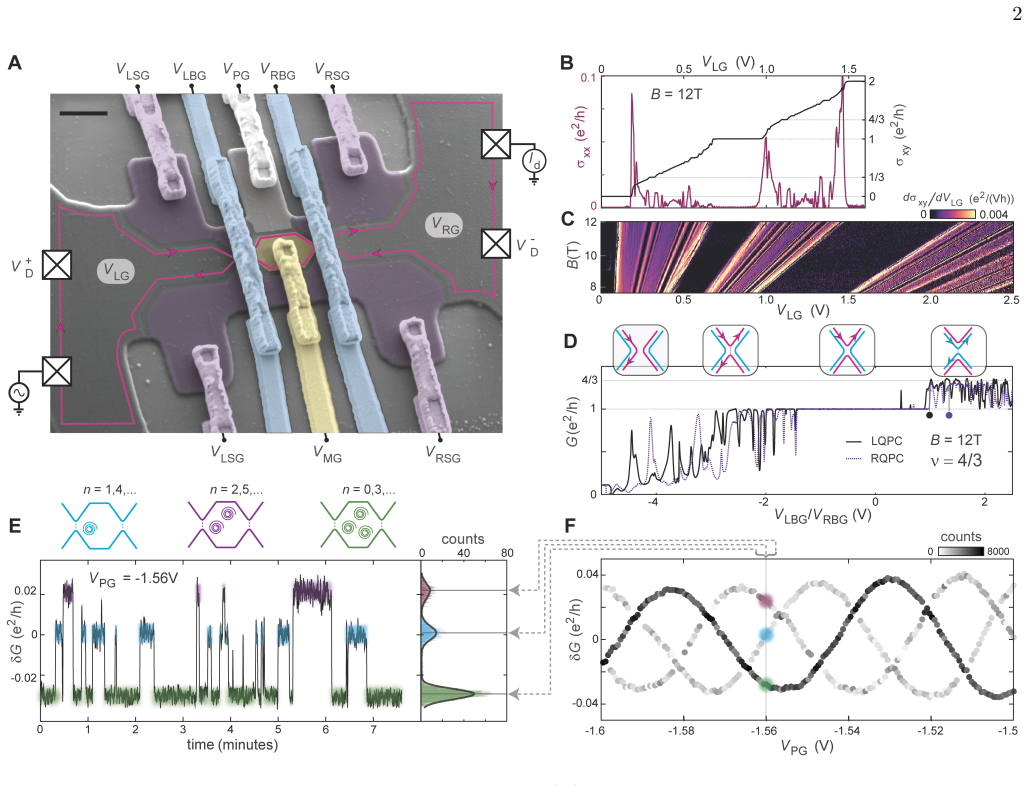
We observe the universal anyonic braiding phase in both the ν = 1/3 and 4/3 fractional quantum Hall states by probing three-state random telegraph noise (RTN) in real-time. We find that the observed RTN stems from anyon quasiparticle number n fluctuations and reconstruct three Aharonov-Bohm oscillation signals phase shifted by 2π/3, corresponding to the three possible interference branches from braiding around n (mod 3) anyons. Hence, we fully characterize the anyon exchange statistics using new methods that can readily extend to non-abelian states.
What carries the argument
Three-state random telegraph noise produced by anyon number n fluctuations (mod 3) inside the interferometer loop, which supplies three distinct Aharonov-Bohm traces whose mutual phase offsets directly encode the braiding phase.
If this is right
- The anyonic braiding phase is observed at both the 1/3 and 4/3 filling factors.
- The random telegraph noise arises specifically from quasiparticle number fluctuations inside the loop.
- The same reconstruction procedure can be applied to characterize statistics in non-abelian states.
Where Pith is reading between the lines
- The real-time noise method could shorten the integration times needed in future interferometer experiments.
- If the three states truly index n mod 3, the technique supplies a direct readout of discrete anyon occupancy.
- Analogous telegraph-noise analysis might be tried in interferometers built from other two-dimensional electron systems.
Load-bearing premise
The three observed noise levels are produced by integer changes in the number of anyons enclosed by the loop rather than by unrelated charge motion or electrostatic shifts.
What would settle it
Reconstructing the three oscillation curves and finding phase differences that deviate from 2π/3, or finding that the noise states do not track discrete anyon number changes, would falsify the braiding interpretation.
Figures


read the original abstract
The search for anyons, quasiparticles with fractional charge and exotic exchange statistics, has inspired decades of condensed matter research. Quantum Hall interferometers enable direct observation of the anyon braiding phase via discrete interference phase jumps when the quasiparticle number changes. Here, we observe the universal anyonic braiding phase in both the $\nu = 1/3$ and $4/3$ fractional quantum Hall states by probing three-state random telegraph noise (RTN) in real-time. We find that the observed RTN stems from anyon quasiparticle number $n$ fluctuations and reconstruct three Aharonov-Bohm oscillation signals phase shifted by $2\pi/3$, corresponding to the three possible interference branches from braiding around $n$ (mod 3) anyons. Hence, we fully characterize the anyon exchange statistics using new methods that can readily extend to non-abelian states.
Editorial analysis
A structured set of objections, weighed in public.
Referee Report
Summary. The manuscript reports real-time measurements of three-state random telegraph noise (RTN) in a graphene quantum Hall interferometer at filling factors ν=1/3 and 4/3. The authors attribute the discrete noise levels to fluctuations in the enclosed anyon number n (mod 3), reconstruct three distinct Aharonov-Bohm interference signals phase-shifted by 2π/3, and interpret this as direct observation of the universal anyonic braiding phase. The work claims this fully characterizes the exchange statistics and offers a method extensible to non-abelian states.
Significance. If the RTN attribution holds, the result supplies a concrete experimental signature of abelian anyon statistics via phase reconstruction from telegraph noise, a technique that could generalize to non-abelian anyons. The real-time probing approach and use of both 1/3 and 4/3 states add value to the FQHE literature. The significance is limited by the absence of independent verification for the noise mechanism, which is required to convert the observed phase shifts into a robust claim about braiding.
major comments (2)
- [Results section on RTN analysis and phase reconstruction] The central assignment that the observed three-state RTN originates from anyon number n fluctuations (mod 3) inside the interferometer loop, rather than other discrete charge or potential sources, is load-bearing for the braiding-phase claim. This assignment is made primarily by consistency with the expected 2π/3 shift (see abstract and the reconstruction paragraph following the RTN time traces); no independent discriminator such as quantized charge jumps of the fluctuators (e/3) or systematic exclusion of device-specific two-level systems is provided.
- [Discussion of three-state RTN and AB oscillation reconstruction] The reconstruction of the three Aharonov-Bohm branches (phase-shifted by 2π/3) assumes the mod-3 anyon-number interpretation to bin the data; without an orthogonal test (e.g., area dependence of the jump statistics or temperature scaling matching the anyon charge), the mapping from raw telegraph levels to braiding phase remains under-constrained.
minor comments (2)
- [Figure 2 and 3 captions] Figure captions for the RTN time traces and reconstructed oscillations should explicitly state the binning procedure and any filtering applied to the raw voltage signal.
- [Device schematic and methods] Notation for the anyon number n (mod 3) is introduced without a clear definition of the enclosed area or how the interferometer loop is defined in the device schematic.
Simulated Author's Rebuttal
We thank the referee for the detailed review and constructive comments on our manuscript. We address each major comment below, providing clarifications on our analysis and indicating where revisions will be made.
read point-by-point responses
-
Referee: [Results section on RTN analysis and phase reconstruction] The central assignment that the observed three-state RTN originates from anyon number n fluctuations (mod 3) inside the interferometer loop, rather than other discrete charge or potential sources, is load-bearing for the braiding-phase claim. This assignment is made primarily by consistency with the expected 2π/3 shift (see abstract and the reconstruction paragraph following the RTN time traces); no independent discriminator such as quantized charge jumps of the fluctuators (e/3) or systematic exclusion of device-specific two-level systems is provided.
Authors: We agree that the interpretation relies on the observed consistency with the expected anyonic phase shift of 2π/3, which is extracted directly from the data rather than imposed. The three discrete levels appear reproducibly in both ν=1/3 and ν=4/3, and the reconstructed branches yield phase differences that match the braiding phase for both states; unrelated two-level systems would be unlikely to produce this specific, filling-factor-independent phase relation. Direct measurement of e/3 charge jumps is not available in the present device geometry, but we will add a dedicated paragraph in the revised manuscript discussing why alternative mechanisms (e.g., potential fluctuations or unrelated TLS) are disfavored by the observed statistics and phase values. revision: partial
-
Referee: [Discussion of three-state RTN and AB oscillation reconstruction] The reconstruction of the three Aharonov-Bohm branches (phase-shifted by 2π/3) assumes the mod-3 anyon-number interpretation to bin the data; without an orthogonal test (e.g., area dependence of the jump statistics or temperature scaling matching the anyon charge), the mapping from raw telegraph levels to braiding phase remains under-constrained.
Authors: The binning into three states follows directly from the distinct, long-lived levels visible in the raw time traces; the phase shifts are then obtained by separate Fourier analysis of each binned subset, yielding 2π/3 without presupposing the anyon model. The same phase difference appears at both filling factors, providing an internal consistency check. We acknowledge that area- or temperature-dependent tests would further constrain the mechanism and will expand the discussion section to outline such possible future measurements while noting that the current phase reconstruction already matches the universal anyonic prediction. revision: partial
Circularity Check
No significant circularity; experimental confirmation uses independent theoretical phase value.
full rationale
The paper reports an experimental observation of three-state RTN in a quantum Hall interferometer and attributes it to anyon number fluctuations by reconstructing Aharonov-Bohm oscillations whose measured phase shifts match the established 2π/3 value from FQHE braiding theory. This value is not fitted or defined from the present dataset; it is an external prediction used to interpret the data. No self-definitional equations, fitted inputs renamed as predictions, or load-bearing self-citations appear in the abstract or described chain. The central claim remains a test against independent theory rather than a reduction to the authors' own parameters or prior unverified results.
Axiom & Free-Parameter Ledger
axioms (2)
- domain assumption Anyons at ν=1/3 and 4/3 possess exchange statistics of 2π/3
- domain assumption Observed three-level RTN arises exclusively from changes in enclosed anyon number n mod 3
Forward citations
Cited by 1 Pith paper
-
Photo-assisted shot noise probes multiple charge carriers in quantum Hall edges
Photo-assisted shot noise can detect different tunneling charges in the ν=2/3 fractional quantum Hall state even when one tunneling amplitude is much smaller than the other.
Reference graph
Works this paper leans on
-
[1]
at a given time. The device accordingly remains static in configurable parameter space (B,VPG ) while observing conductance switching from real-time fluctuations n(t). Therefore, as this method demonstrates the existence of all three branches associated with the exchange statistics of charge e/3 anyons, we construct a complete represen- tation of the stat...
-
[2]
R. B. Laughlin, Anomalous Quantum Hall Effect: An In- compressible Quantum Fluid with Fractionally Charged Excitations, Physical Review Letters 50, 1395 (1983)
work page 1983
-
[3]
B. I. Halperin, Statistics of Quasiparticles and the Hierar- chy of Fractional Quantized Hall States, Physical Review Letters 52, 1583 (1984)
work page 1984
- [4]
-
[5]
Stern, Anyons and the quantum Hall effect—A peda- gogical review, Annals of Physics 323, 204 (2008)
A. Stern, Anyons and the quantum Hall effect—A peda- gogical review, Annals of Physics 323, 204 (2008)
work page 2008
-
[6]
D. E. Feldman and B. I. Halperin, Fractional charge and fractional statistics in the quantum Hall effects, Reports on Progress in Physics 84, 076501 (2021)
work page 2021
-
[7]
A. Kitaev, Anyons in an exactly solved model and be- yond, Annals of Physics January Special Issue, 321, 2 (2006)
work page 2006
- [8]
-
[9]
A. Stern and N. H. Lindner, Topological Quantum Computation—From Basic Concepts to First Experi- ments, Science 339, 1179 (2013)
work page 2013
-
[10]
S. D. Sarma, M. Freedman, and C. Nayak, Majorana zero modes and topological quantum computation, npj Quantum Information 1, 1 (2015)
work page 2015
-
[11]
A. Yazdani, F. von Oppen, B. I. Halperin, and A. Yacoby, Hunting for Majoranas, Science 380, eade0850 (2023)
work page 2023
-
[12]
C. de C. Chamon, D. E. Freed, S. A. Kivelson, S. L. Sondhi, and X. G. Wen, Two point-contact interferom- eter for quantum Hall systems, Physical Review B 55, 8 2331 (1997)
work page 1997
-
[13]
B. I. Halperin, A. Stern, I. Neder, and B. Rosenow, The- ory of the fabry-p´ erot quantum hall interferometer, Phys- ical Review B 83, 155440 (2011)
work page 2011
-
[14]
M. Carrega, L. Chirolli, S. Heun, and L. Sorba, Anyons in quantum Hall interferometry, Nature Reviews Physics 3, 698 (2021)
work page 2021
-
[15]
N. Read and S. Das Sarma, Clarification of braiding statistics in Fabry–Perot interferometry, Nature Physics 20, 381 (2024)
work page 2024
-
[16]
J. Nakamura, S. Liang, G. C. Gardner, and M. J. Manfra, Direct observation of anyonic braiding statistics, Nature Physics 16, 931 (2020)
work page 2020
-
[17]
J. Nakamura, S. Liang, G. C. Gardner, and M. J. Manfra, Impact of bulk-edge coupling on observation of anyonic braiding statistics in quantum Hall interferometers, Na- ture Communications 13, 344 (2022)
work page 2022
-
[18]
J. Nakamura, S. Fallahi, H. Sahasrabudhe, R. Rah- man, S. Liang, G. C. Gardner, and M. J. Manfra, Aharonov–Bohm interference of fractional quantum Hall edge modes, Nature Physics 15, 563 (2019)
work page 2019
-
[19]
K. Zimmermann, A. Jordan, F. Gay, K. Watanabe, T. Taniguchi, Z. Han, V. Bouchiat, H. Sellier, and B. Sac´ ep´ e, Tunable transmission of quantum Hall edge channels with full degeneracy lifting in split-gated graphene devices, Nature Communications 8, 14983 (2017)
work page 2017
-
[20]
H. Overweg, H. Eggimann, X. Chen, S. Slizovskiy, M. Eich, R. Pisoni, Y. Lee, P. Rickhaus, K. Watanabe, T. Taniguchi, V. Fal’ko, T. Ihn, and K. Ensslin, Electro- statically Induced Quantum Point Contacts in Bilayer Graphene, Nano Letters 18, 553 (2018)
work page 2018
-
[21]
C. D´ eprez, L. Veyrat, H. Vignaud, G. Nayak, K. Watan- abe, T. Taniguchi, F. Gay, H. Sellier, and B. Sac´ ep´ e, A tunable Fabry–P´ erot quantum Hall interferometer in graphene, Nature Nanotechnology 16, 555 (2021)
work page 2021
-
[22]
Y. Ronen, T. Werkmeister, D. Haie Najafabadi, A. T. Pierce, L. E. Anderson, Y. J. Shin, S. Y. Lee, Y. H. Lee, B. Johnson, K. Watanabe, T. Taniguchi, A. Yacoby, and P. Kim, Aharonov–Bohm effect in graphene-based Fabry–P´ erot quantum Hall interferometers, Nature Nan- otechnology 16, 563 (2021)
work page 2021
-
[23]
L. Zhao, E. G. Arnault, T. F. Q. Larson, Z. Iftikhar, A. Seredinski, T. Fleming, K. Watanabe, T. Taniguchi, F. Amet, and G. Finkelstein, Graphene-Based Quantum Hall Interferometer with Self-Aligned Side Gates, Nano Letters 22, 9645 (2022)
work page 2022
-
[24]
H. Fu, K. Huang, K. Watanabe, T. Taniguchi, M. Kayyalha, and J. Zhu, Aharonov–Bohm Oscillations in Bilayer Graphene Quantum Hall Edge State Fabry– P´ erot Interferometers, Nano Letters23, 718 (2023)
work page 2023
- [25]
-
[26]
Y. Zeng, J. I. A. Li, S. A. Dietrich, O. M. Ghosh, K. Watanabe, T. Taniguchi, J. Hone, and C. R. Dean, High-Quality Magnetotransport in Graphene Using the Edge-Free Corbino Geometry, Physical Review Letters 122, 137701 (2019)
work page 2019
-
[27]
R. Ribeiro-Palau, S. Chen, Y. Zeng, K. Watan- abe, T. Taniguchi, J. Hone, and C. R. Dean, High- Quality Electrostatically Defined Hall Bars in Monolayer Graphene, Nano Letters 19, 2583 (2019)
work page 2019
-
[28]
L. A. Cohen, N. L. Samuelson, T. Wang, K. Klocke, C. C. Reeves, T. Taniguchi, K. Watanabe, S. Vijay, M. P. Za- letel, and A. F. Young, Nanoscale electrostatic control in ultraclean van der Waals heterostructures by local anodic oxidation of graphite gates, Nature Physics , 1 (2023)
work page 2023
-
[29]
L. A. Cohen, N. L. Samuelson, T. Wang, T. Taniguchi, K. Watanabe, M. P. Zaletel, and A. F. Young, Universal chiral Luttinger liquid behavior in a graphene fractional quantum Hall point contact, Science 382, 542 (2023)
work page 2023
-
[30]
T. Werkmeister, J. R. Ehrets, Y. Ronen, M. E. Wes- son, D. Najafabadi, Z. Wei, K. Watanabe, T. Taniguchi, D. E. Feldman, B. I. Halperin, A. Yacoby, and P. Kim, Strongly coupled edge states in a graphene quantum Hall interferometer (2024), arxiv:2312.03150 [cond-mat]
-
[31]
A. A. Zibrov, C. Kometter, H. Zhou, E. M. Spanton, T. Taniguchi, K. Watanabe, M. P. Zaletel, and A. F. Young, Tunable interacting composite fermion phases in a half-filled bilayer-graphene Landau level, Nature 549, 360 (2017)
work page 2017
-
[32]
J. I. A. Li, C. Tan, S. Chen, Y. Zeng, T. Taniguchi, K. Watanabe, J. Hone, and C. R. Dean, Even- denominator fractional quantum Hall states in bilayer graphene, Science 358, 648 (2017)
work page 2017
- [33]
-
[34]
A. Assouline, T. Wang, H. Zhou, L. A. Cohen, F. Yang, R. Zhang, T. Taniguchi, K. Watanabe, R. S. K. Mong, M. P. Zaletel, and A. F. Young, Energy Gap of the Even- Denominator Fractional Quantum Hall State in Bilayer Graphene, Physical Review Letters 132, 046603 (2024)
work page 2024
- [35]
-
[36]
A. A. Zibrov, E. M. Spanton, H. Zhou, C. Kometter, T. Taniguchi, K. Watanabe, and A. F. Young, Even- denominator fractional quantum Hall states at an isospin transition in monolayer graphene, Nature Physics14, 930 (2018)
work page 2018
-
[37]
Y. Kim, A. C. Balram, T. Taniguchi, K. Watanabe, J. K. Jain, and J. H. Smet, Even denominator fractional quan- tum Hall states in higher Landau levels of graphene, Na- ture Physics 15, 154 (2019)
work page 2019
-
[38]
C. L. Kane, Telegraph Noise and Fractional Statistics in the Quantum Hall Effect, Physical Review Letters 90, 226802 (2003)
work page 2003
-
[39]
E. Grosfeld, S. H. Simon, and A. Stern, Switching Noise as a Probe of Statistics in the Fractional Quantum Hall Effect, Physical Review Letters 96, 226803 (2006)
work page 2006
-
[40]
B. Rosenow and S. H. Simon, Telegraph noise and the Fabry-Perot quantum Hall interferometer, Physical Re- view B 85, 201302 (2012)
work page 2012
-
[41]
J. Nakamura, S. Liang, G. C. Gardner, and M. J. Manfra, Fabry-P´ erot Interferometry at theν= 2 / 5 Fractional Quantum Hall State, Physical Review X 13, 041012 (2023)
work page 2023
-
[42]
R. L. Willett, K. Shtengel, C. Nayak, L. N. Pfeiffer, Y. J. Chung, M. L. Peabody, K. W. Baldwin, and K. W. West, Interference measurements of non-abelian e/4 & abelian e/2 quasiparticle braiding, Physical Review X13, 011028 9 (2023)
work page 2023
-
[43]
H. K. Kundu, S. Biswas, N. Ofek, V. Umansky, and M. Heiblum, Anyonic interference and braiding phase in a Mach-Zehnder interferometer, Nature Physics 19, 515 (2023)
work page 2023
-
[44]
C. R. Dean, A. F. Young, I. Meric, C. Lee, L. Wang, S. Sorgenfrei, K. Watanabe, T. Taniguchi, P. Kim, K. L. Shepard, and J. Hone, Boron nitride substrates for high- quality graphene electronics, Nature Nanotechnology 5, 722 (2010)
work page 2010
-
[45]
S. Baer, C. R¨ ossler, E. C. de Wiljes, P.-L. Ardelt, T. Ihn, K. Ensslin, C. Reichl, and W. Wegscheider, Interplay of fractional quantum Hall states and localization in quantum point contacts, Physical Review B 89, 085424 (2014)
work page 2014
-
[46]
N. Ofek, A. Bid, M. Heiblum, A. Stern, V. Umansky, and D. Mahalu, Role of interactions in an electronic Fabry– Perot interferometer operating in the quantum Hall effect regime, Proceedings of the National Academy of Sciences 107, 5276 (2010)
work page 2010
-
[47]
D. T. McClure, W. Chang, C. M. Marcus, L. N. Pfeif- fer, and K. W. West, Fabry-Perot Interferometry with Fractional Charges, Physical Review Letters108, 256804 (2012)
work page 2012
-
[48]
D. E. Feldman and B. I. Halperin, Robustness of quan- tum Hall interferometry, Physical Review B 105, 165310 (2022)
work page 2022
- [49]
-
[50]
C. W. von Keyserlingk, S. H. Simon, and B. Rosenow, Enhanced Bulk-Edge Coulomb Coupling in Fractional Fabry-Perot Interferometers, Physical Review Letters 115, 126807 (2015)
work page 2015
-
[51]
M. P. R¨ o¨ osli, L. Brem, B. Kratochwil, G. Nicol´ ı, B. A. Braem, S. Hennel, P. M¨ arki, M. Berl, C. Reichl, W. Wegscheider, K. Ensslin, T. Ihn, and B. Rosenow, Observation of quantum Hall interferometer phase jumps due to a change in the number of bulk quasiparticles, Physical Review B 101, 125302 (2020)
work page 2020
-
[52]
M. P. R¨ o¨ osli, M. Hug, G. Nicol´ ı, P. M¨ arki, C. Reichl, B. Rosenow, W. Wegscheider, K. Ensslin, and T. Ihn, Fractional Coulomb blockade for quasi-particle tunnel- ing between edge channels, Science Advances7, eabf5547 (2021)
work page 2021
-
[53]
B. Rosenow and A. Stern, Flux Superperiods and Pe- riodicity Transitions in Quantum Hall Interferometers, Physical Review Letters 124, 106805 (2020)
work page 2020
-
[54]
M. B. Weissman, 1/f noise and other slow, nonexponen- tial kinetics in condensed matter, Reviews of Modern Physics 60, 537 (1988)
work page 1988
-
[55]
Sh. Kogan, 1/f noise and random telegraph noise, in Elec- tronic Noise and Fluctuations in Solids (Cambridge Uni- versity Press, Cambridge, 1996) pp. 203–286
work page 1996
-
[56]
A. L. Efros and B. I. Shklovskii, Coulomb gap and low temperature conductivity of disordered systems, Journal of Physics C: Solid State Physics 8, L49 (1975)
work page 1975
- [57]
-
[58]
K. Bennaceur, P. Jacques, F. Portier, P. Roche, and D. C. Glattli, Unveiling quantum Hall transport by Efros- Shklovskii to Mott variable-range hopping transition in graphene, Physical Review B 86, 085433 (2012)
work page 2012
-
[59]
A. J. M. Giesbers, U. Zeitler, L. A. Ponomarenko, R. Yang, K. S. Novoselov, A. K. Geim, and J. C. Maan, Scaling of the quantum Hall plateau-plateau transition in graphene, Physical Review B 80, 241411 (2009)
work page 2009
- [60]
-
[61]
J. Kim, H. Dev, R. Kumar, A. Ilin, A. Haug, V. Bhard- waj, C. Hong, K. Watanabe, T. Taniguchi, A. Stern, and Y. Ronen, Aharonov-Bohm interference and the evolu- tion of phase jumps in fractional quantum Hall Fabry- Perot interferometers based on bi-layer graphene (2024), arxiv:2402.12432 [cond-mat]
-
[62]
S. Das Sarma, M. Freedman, and C. Nayak, Topologically Protected Qubits from a Possible Non-Abelian Fractional Quantum Hall State, Physical Review Letters94, 166802 (2005)
work page 2005
-
[63]
A. Stern and B. I. Halperin, Proposed experiments to probe the non-abelianν= 5/2 quantum hall state, Phys- ical Review Letters 96, 016802 (2006)
work page 2006
-
[64]
P. Bonderson, A. Kitaev, and K. Shtengel, Detecting Non-Abelian Statistics in the ν= 5 / 2 Fractional Quan- tum Hall State, Physical Review Letters 96, 016803 (2006)
work page 2006
-
[65]
N. L. Samuelson, L. A. Cohen, W. Wang, S. Blanch, T. Taniguchi, K. Watanabe, M. P. Zaletel, and A. F. Young, Anyonic statistics and slow quasiparticle dynam- ics in a graphene fractional quantum Hall interferometer (2024), arxiv:2403.19628 [cond-mat]. Supplementary Materials: Anyon braiding and telegraph noise in a graphene interferometer MATERIALS AND ME...
discussion (0)
Sign in with ORCID, Apple, or X to comment. Anyone can read and Pith papers without signing in.