Long-time asymptotics of the Tzitz\'eica equation on the line
Pith reviewed 2026-05-24 02:13 UTC · model grok-4.3
The pith
The Tzitzéica equation on the line admits explicit long-time asymptotic formulas in different regions, obtained by constructing and deforming a Riemann-Hilbert problem from two initial-value reflection coefficients.
A machine-rendered reading of the paper's core claim, the machinery that carries it, and where it could break.
Core claim
For the Tzitzéica equation on the real line, the initial data determine two reflection coefficients whose analytic and decay properties permit the construction of a Riemann-Hilbert problem; the nonlinear steepest descent method applied to this problem yields the long-time asymptotic behavior of the solution in distinct regions of the (x,t)-plane.
What carries the argument
The Riemann-Hilbert problem built from the two reflection coefficients, deformed by the nonlinear steepest descent method to extract asymptotics.
If this is right
- The solution decays or oscillates according to explicit formulas that depend on the region in the (x,t) plane.
- Leading-order terms are given by expressions involving the reflection coefficients evaluated at stationary points.
- The same Riemann-Hilbert framework supplies error estimates that become small as t tends to infinity.
- The method applies uniformly across sectors separated by the rays determined by the phase function.
Where Pith is reading between the lines
- The same reflection-coefficient construction and steepest-descent procedure could be tested on other integrable equations whose scattering data split into two coefficients.
- If the reflection coefficients satisfy additional symmetry, the asymptotic formulas might simplify to closed expressions involving only elementary functions.
- The numerical agreement reported for the leading term suggests that higher-order corrections could be extracted by retaining further terms in the steepest-descent expansion.
Load-bearing premise
The initial values produce two reflection coefficients that are sufficiently regular and decaying to allow a Riemann-Hilbert problem whose contour can be deformed for steepest-descent analysis.
What would settle it
A direct numerical simulation of the Tzitzéica equation whose solution, at large but finite time, deviates from the explicit leading-order asymptotic formula in any of the reported spatial regions.
Figures


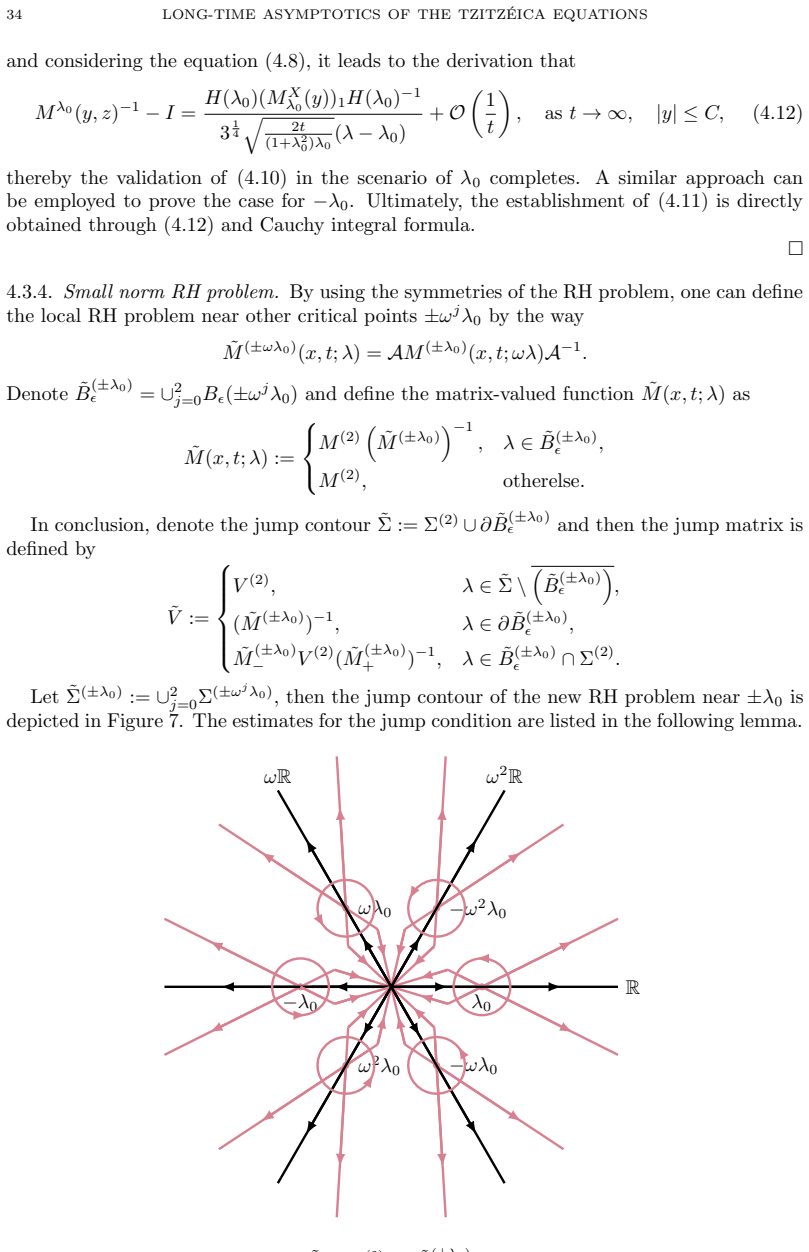

read the original abstract
In this paper, the renowned Riemann-Hilbert method is employed to investigate the initial value problem of Tzitz\'eica equation on the line. Initially, our analysis focuses on elucidating the properties of two reflection coefficients, which are determined by the initial values. Subsequently, leveraging these reflection coefficients, we construct a Riemann-Hilbert problem that is a powerful tool to articulate the solution of the Tzitz\'eica equation. Finally, the nonlinear steepest descent method is applied to the oscillatory Riemann-Hilbert problem, which enables us to delineate the long-time asymptotic behaviors of solutions to the Tzitz\'eica equation across various regions. Moreover, it is shown that the leading-order terms of asymptotic formulas match well with direct numerical simulations.
Editorial analysis
A structured set of objections, weighed in public.
Referee Report
Summary. The manuscript applies the Riemann-Hilbert method to the initial-value problem for the Tzitzéica equation on the line. It first elucidates properties of two reflection coefficients determined by the initial data, constructs an associated Riemann-Hilbert problem, and applies the nonlinear steepest-descent method to obtain long-time asymptotics in various regions of the (x,t)-plane. Leading-order terms of the resulting asymptotic formulas are reported to agree with direct numerical simulations.
Significance. If the central derivations hold, the work would furnish explicit long-time asymptotics for an integrable nonlinear PDE via the Deift-Zhou technique, together with numerical confirmation of the leading terms.
major comments (2)
- [Abstract] Abstract: the assertion that the two reflection coefficients determined by arbitrary initial data possess the analyticity, boundedness, and regularity needed for a well-posed oscillatory RH problem (and subsequent steepest-descent deformations) is stated without any explicit estimates, contour choices, or lemmas guaranteeing the required L²/Hölder conditions or absence of obstructing poles/zeros.
- [Abstract] Abstract (numerical comparison paragraph): the statement that leading-order asymptotic terms 'match well' with direct simulations supplies no error bounds, quantitative discrepancy measures, or details on data exclusion, rendering the verification claim unverifiable from the given text.
minor comments (1)
- Notation for the two reflection coefficients should be introduced with explicit functional dependence on the initial data and kept consistent across the scattering and RH sections.
Simulated Author's Rebuttal
We thank the referee for their careful reading of the manuscript and for the constructive comments. We address each major comment below.
read point-by-point responses
-
Referee: [Abstract] Abstract: the assertion that the two reflection coefficients determined by arbitrary initial data possess the analyticity, boundedness, and regularity needed for a well-posed oscillatory RH problem (and subsequent steepest-descent deformations) is stated without any explicit estimates, contour choices, or lemmas guaranteeing the required L²/Hölder conditions or absence of obstructing poles/zeros.
Authors: The required analyticity, boundedness, and regularity of the two reflection coefficients, together with the L²/Hölder estimates, contour choices, and absence of obstructing poles or zeros, are established rigorously in Section 2 (Lemmas 2.1–2.4 and Propositions 2.5–2.6). These results are then used to construct the oscillatory RH problem in Section 3 and to justify the steepest-descent deformations in Section 4. The abstract is intended only as a concise overview; the supporting analysis appears in the body of the paper, which is the appropriate location for the detailed estimates and lemmas. revision: no
-
Referee: [Abstract] Abstract (numerical comparison paragraph): the statement that leading-order asymptotic terms 'match well' with direct simulations supplies no error bounds, quantitative discrepancy measures, or details on data exclusion, rendering the verification claim unverifiable from the given text.
Authors: The numerical comparisons are presented in Section 5, where the leading-order asymptotic expressions are plotted against direct simulations of the initial-value problem for several choices of initial data. While the agreement is visual, we agree that quantitative measures would strengthen the claim. In a revised version we will add explicit L²-error values, simulation parameters (spatial domain, time-stepping scheme, and grid resolution), and a brief description of the data sets used, either in the main text or in a supplementary note referenced from the abstract. revision: partial
Circularity Check
No circularity; standard RH construction from initial data
full rationale
The paper's chain proceeds from initial values to reflection coefficients (whose properties are derived), then to an RH problem, then to nonlinear steepest descent for asymptotics. No step equates a claimed prediction or result to its own inputs by definition, fitted parameter, or self-citation load-bearing premise. The method is the conventional one for integrable PDEs on the line; the leading asymptotics are obtained by contour deformation and not presupposed.
Axiom & Free-Parameter Ledger
axioms (1)
- domain assumption Initial values determine two reflection coefficients with properties that allow construction of an RH problem amenable to nonlinear steepest descent
Reference graph
Works this paper leans on
-
[1]
C. N. Babalic, R. Constantinescu, V. S. Gerdjikov, On the soliton solutions of a family of Tzitz´ eica equations, J. Geom. Symmetry Phys. 37 (2015) 1-24
work page 2015
- [2]
- [3]
-
[4]
A. Boutet de Monvel, D. A. Shepelsky, A Riemann-Hilbert approach for the Degasperis- Procesi equation, Nonlinearity 26 (2013) 2081-2107
work page 2013
-
[5]
A. Boutet de Monvel, J. Lenells, D. Shepelsky, Long-time asymptotics for the Degasperis- Procesi equation on the half-line, Ann. Inst. Fourier 69 (2019) 171-230
work page 2019
-
[6]
A. Boutet de Monvel, D. Shepelsky, L. Zielinski, A Riemann-Hilbert approach for the Novikov equation, SIGMA 12 (2016) 095
work page 2016
-
[7]
Y. V. Brezhnev, Darboux transformation and some multi-phase solutions of the Dodd- Bullough-Tzitz´ eica equation:Uxt =e U −e −2U, Phys. Lett. A 211 (1996) 94-100
work page 1996
-
[8]
Charlier, Blow-up solutions of the “bad” Boussinesq equation, arXiv:2405.12210, 2024
C. Charlier, Blow-up solutions of the “bad” Boussinesq equation, arXiv:2405.12210, 2024
work page internal anchor Pith review arXiv 2024
-
[9]
C. Charlier, J. Lenells, The “good” Boussinesq equation: a Riemann-Hilbert approach, Indiana Univ. Math. J. 71 (2022) 1505-1562
work page 2022
-
[10]
C. Charlier, J. Lenells, Long-time asymptotics for an integrable evolution equation with a 3×3 Lax pair, Physica D 426 (2021) 132987
work page 2021
-
[11]
C. Charlier, J. Lenells, D. S. Wang, The “good” Boussinesq equation: long-time asymp- totics, Anal. PDE 16 (2023) 1351-1388
work page 2023
-
[12]
C. Charlier, J. Lenells, Direct and inverse scattering for the Boussinesq equation with solitons, arXiv:2302.14593, 37pp
-
[13]
C. Charlier, J. Lenells, Boussinesq’s equation for water waves: the soliton resolution conjecture for Sector IV, Adv. Nonlinear Stud. 25 (2025), 106–151
work page 2025
-
[14]
C. Charlier, J. Lenells, Boussinesq’s equation for water waves: Asymptotics in Sector I, Adv. Nonlinear Anal. 13 (2024), 20240022
work page 2024
-
[15]
C. Charlier, J. Lenells, Boussinesq’s equation for water waves: asymptotics in sector V, SIAM J. Math. Anal. 56 (2024), 4104–4142
work page 2024
-
[16]
C. Charlier, J. Lenells, The soliton resolution conjecture for the Boussinesq equation, J. Math. Pures Appl. 191 (2024), 103621
work page 2024
-
[17]
P. J. Cheng, S. Venakides, X. Zhou, Long-time asymptotics for the pure radiation solu- tion of the sine-Gordon equation, Commun. Partial Differ. Equ. 24 (1999) 1195-1262
work page 1999
-
[18]
A. Constantin, R. I. Ivanov, J. Lenells, Inverse scattering transform for the Degasperis- Procesi equation, Nonlinearity 23 (2010) 2559. LONG-TIME ASYMPTOTICS OF THE TZITZ ´EICA EQUATIONS 41
work page 2010
- [19]
-
[20]
P. Deift, T. Kriecherbauer, K. T-R. McLaughlin, S. Venakides, X. Zhou, Uniform asymp- totics for polynomials orthogonal with respect to varying exponential weights and appli- cations to universality questions in random matrix theory, Commun. Pure Appl. Math. 52 (1999) 1335-1425
work page 1999
- [21]
- [22]
-
[23]
R. K. Dodd, R. K. Bullough, Polynomial conserved densities for the sine-Gordon equa- tions, Proc. R. Soc. Lond. Ser. A 352 (1977) 481-503
work page 1977
-
[24]
M. Dunajski, P. Plansangkate, Strominger-Yau-Zaslow Geometry, Affine Spheres and Painlev´ e III, Commun. Math. Phys. 290 (2009) 997-1024
work page 2009
-
[25]
A. P. Fordy, J. Bibbons, Integrable nonlinear Klein-Gordon equations and Toda lattice, Commun. Math. Phys. 77 (1980) 21-30
work page 1980
-
[26]
X. Geng, K. Wang, M. Chen, Long-time asymptotics for the spin-1 Gross-Pitaevskii equation, Commun. Math. Phys. 382 (2021) 585-611
work page 2021
-
[27]
X. Geng, H. Liu, The nonlinear steepest descent method to long-time asymptotics of the coupled nonlinear Schr¨ odinger equation, J. Nonlinear Sci. 28 (2018) 739-763
work page 2018
- [28]
- [29]
-
[30]
J. Inoguchi, S. Udagawa, Affine spheres and finite gap solutions of Tzitz´ eica equation, J. Phys. Commun. 2 (2018) 115020
work page 2018
-
[31]
A. Jevnikar, W. Yang, Analytic aspects of the Tzitz´ eica equation: blow-up analysis and existence results, Calc. Var. Partial Differ. Equ. 56 (2017) 1-38
work page 2017
-
[32]
O. V. Kaptsov, Yu. V. Shan’ko, Multiparameter solutions of the Tzitz´ eica equation [in Russian], Differ. Equ. 35 (1999) 1660-1668
work page 1999
-
[33]
S.N. Krivoshapko, V.N. Ivanov, Encyclopedia of Analytical Surfaces, Springer, Switzer- land, 2015
work page 2015
-
[34]
B. A. Kupershmidt, G. Wilson, Conservation laws and symmetries of generalized sine- Gordon equations, Commun. Math. Phys. 81 (1981) 189-202
work page 1981
-
[35]
Lenells, Matrix Riemann-Hilbert problems with jumps across Carleson contours, Monatsh
J. Lenells, Matrix Riemann-Hilbert problems with jumps across Carleson contours, Monatsh. Math. 186 (2018) 111-152
work page 2018
-
[36]
J. Lenells, The nonlinear steepest descent method: Asymptotics for initial-boundary value problems, SIAM J. Math. Anal. 48 (2016) 2076-2118
work page 2016
-
[37]
B. Y. Lu, P. Miller, Universality near the gradient catastrophe point in the semiclassical sine-Gordon equation, Commun. Pure Appl. Math. 75 (2022) 1517-1641
work page 2022
-
[38]
A. V. Mikhailov, The reduction problem and the inverse scattering method, Physica D 3 (1981) 73-117
work page 1981
-
[39]
J. J. C. Nimmo, R. Willox, Darboux transformations for the two-dimensional Toda system, Proc. R. Soc. Lond. A: Math. Phys. Eng. Sci. 453 (1997) 2497-2525
work page 1997
- [40]
-
[41]
S. S. Safin, R. A. Sharipov, B¨ acklund auto–transformation for the equationu xt =e u − e−2u, Theor. Math. Phys. 95 (1993) 462-470
work page 1993
-
[42]
Tzitz´ eica, Sur une nouvelle classe de surfaces, C
G. Tzitz´ eica, Sur une nouvelle classe de surfaces, C. R. Acad. Sci. Paris 144 (1907) 1257-1259; 146 (1908) 165-166; 150 (1910) 955-956, 1227-1229
work page 1907
-
[43]
C. Udriste, V. Arsinte, C. Cipu, Tzitzeica and sine-Gordon solitons, Balkan J. Geom. Appl. 16 no. 1 (2011) 150-154. 42 LONG-TIME ASYMPTOTICS OF THE TZITZ ´EICA EQUATIONS
work page 2011
-
[44]
D. S. Wang, X. Zhu, Long-time asymptotics of the good Boussinesq equation withq xx- term and its modified version, J. Math. Phys. 63 (2022) 123501
work page 2022
-
[45]
D.-S. Wang, X. Zhu, Long-time asymptotics of the Sawada–Kotera equation on the line, SIAM J. Math. Anal., to appear
-
[46]
L. Wu, X. Geng, J. Zhang, Algebro-geometric solution to the Bullough-Dodd-Zhiber- Shabat equation, Int. Math. Res. Not. 2015 (2015) 2141-2167
work page 2015
-
[47]
W. Xun, E. Fan, Long time and Painlev´ e-type asymptotics for the Sasa-Satsuma equa- tion in solitonic space time regions, J. Differential Equations 329 (2022) 89-130
work page 2022
-
[48]
Y. Yang, E. Fan, Soliton resolution and large time behavior of solutions to the Cauchy problem for the Novikov equation with a nonzero background, Adv. Math. 426 (2023) 109088
work page 2023
-
[49]
V. E. Zakharov, S. V. Manakov, S. P. Novikov, L. P. Pitaevskii, The Theory of Solitons: The Inverse Scattering Method, Consultants Bureau, New York, 1984
work page 1984
-
[50]
A. V. Zhiber, A. B. Shabat, Klein-Gordon equation with nontrivial group, Sov. Phys. Dokl. 24 (1979) 607-609
work page 1979
-
[51]
Zhou, Inverse scattering transform for systems with rational spectral dependence, J
X. Zhou, Inverse scattering transform for systems with rational spectral dependence, J. Differential Equations 115 (1995) 277-303
work page 1995
-
[52]
J. Zhu, X. Geng, Darboux transformation for Tzitz´ eica equation, Commun. Theor. Phys. 45 (2006) 577-580
work page 2006
discussion (0)
Sign in with ORCID, Apple, or X to comment. Anyone can read and Pith papers without signing in.