A Necessary and Sufficient Condition for Local Synchronization in Nonlinear Oscillator Networks
Pith reviewed 2026-05-24 02:15 UTC · model grok-4.3
The pith
A positive coupling strength is necessary and sufficient for local synchronization in networks of identical oscillators with linear full-state coupling.
A machine-rendered reading of the paper's core claim, the machinery that carries it, and where it could break.
Core claim
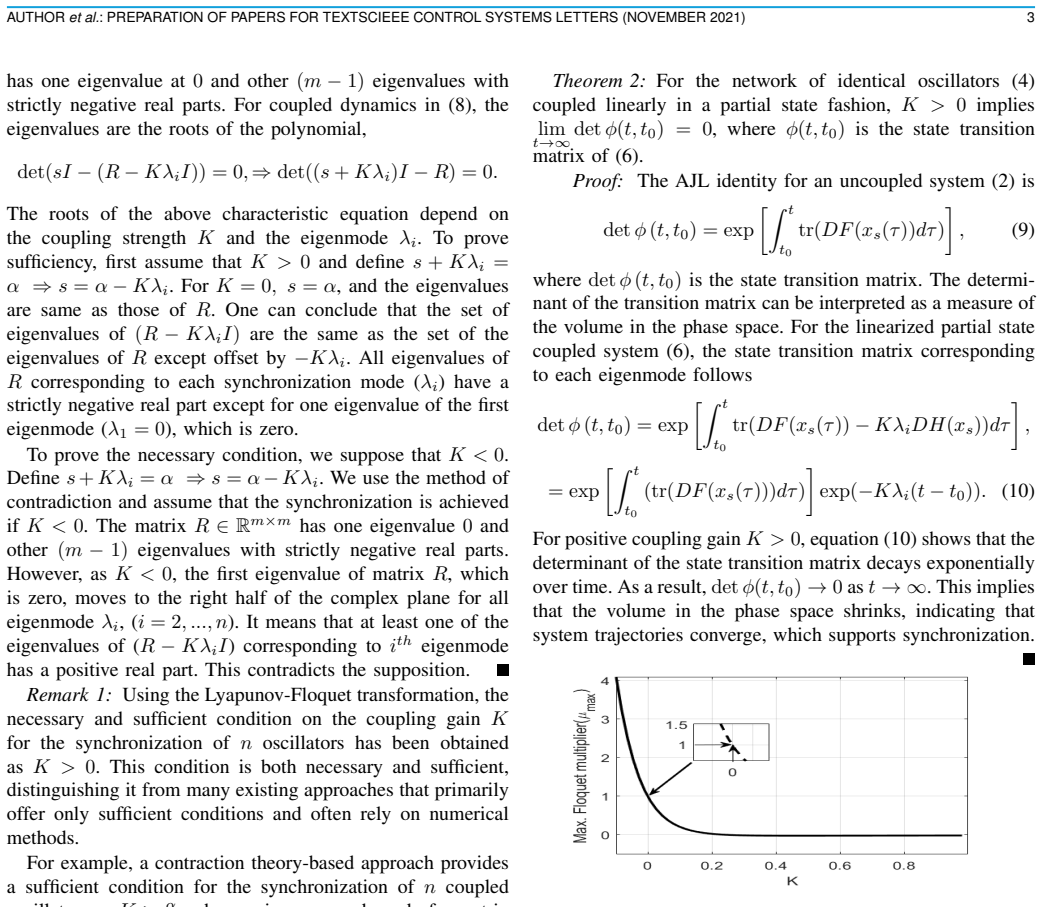
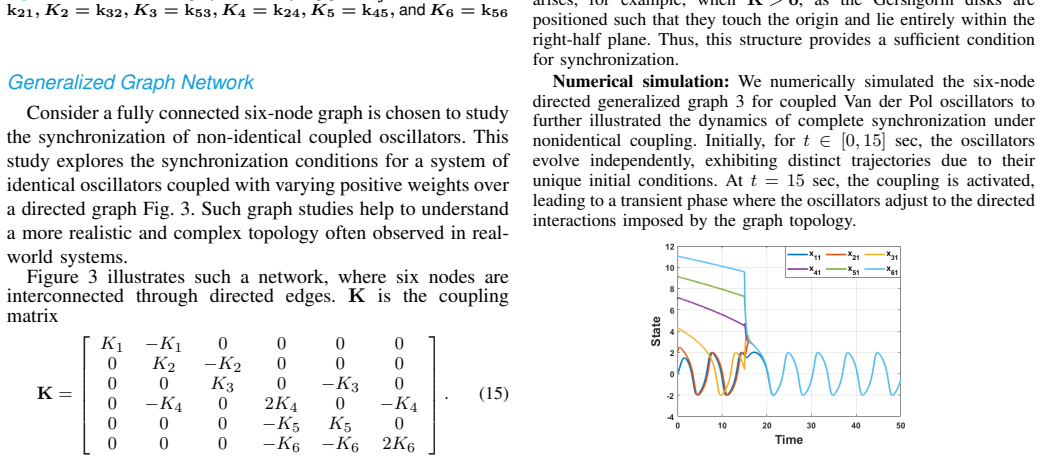
We addressed the gap between the sufficient coupling strength and numerically observations using the Lyapunov-Floquet Theory and the Master Stability Function framework. We showed that a positive coupling strength is a necessary and sufficient condition for local synchronization in a network of identical oscillators coupled linearly and in full state fashion. For partial state coupling, we showed that a positive coupling constant results in an asymptotic contraction of the trajectories in the state space, which results in synchronisation for two-dimensional oscillators. We extended the results to networks with non-identical coupling over directed graphs and showed that positive coupling is a
What carries the argument
The combination of Lyapunov-Floquet theory and the master stability function framework applied to the variational equations of the network, which produces the exact threshold on the coupling strength.
If this is right
- Local synchronization occurs in identical full-state coupled networks precisely when the coupling strength is positive.
- For two-dimensional oscillators with partial-state coupling, positive coupling produces asymptotic contraction of trajectories and therefore synchronization.
- In networks with non-identical coupling strengths over directed graphs, any positive coupling constants remain sufficient for synchronization.
- The exact criterion removes the need to compute conservative lower bounds on coupling strength for these network classes.
Where Pith is reading between the lines
- The contraction result for partial coupling might extend to higher-dimensional oscillators if a suitable transverse Lyapunov exponent analysis can be constructed.
- Engineers could use the positive-coupling threshold directly to set minimal gains in hardware implementations of oscillator networks without iterative tuning.
- The same framework could be tested on networks containing a small number of non-identical nodes to see whether the necessary-and-sufficient property survives limited heterogeneity.
Load-bearing premise
Lyapunov-Floquet theory combined with the master stability function framework yields an exact necessary-and-sufficient criterion without hidden restrictions on the form of the individual oscillator vector fields or the spectrum of the coupling matrix.
What would settle it
A numerical simulation or experiment on identical oscillators with full-state linear coupling that either achieves local synchronization for zero or negative coupling strength or fails to synchronize for any positive coupling strength would falsify the claim.
Figures
read the original abstract
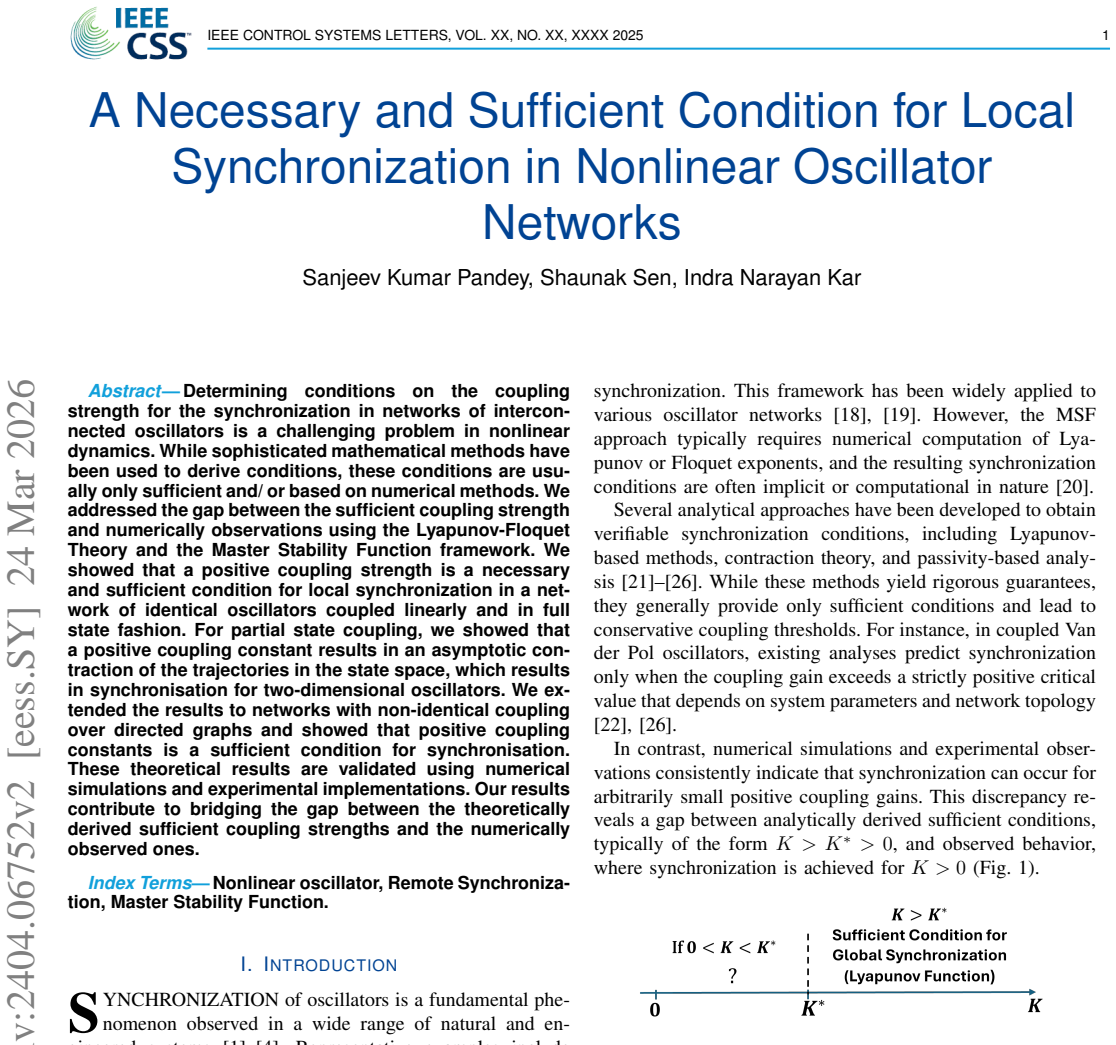
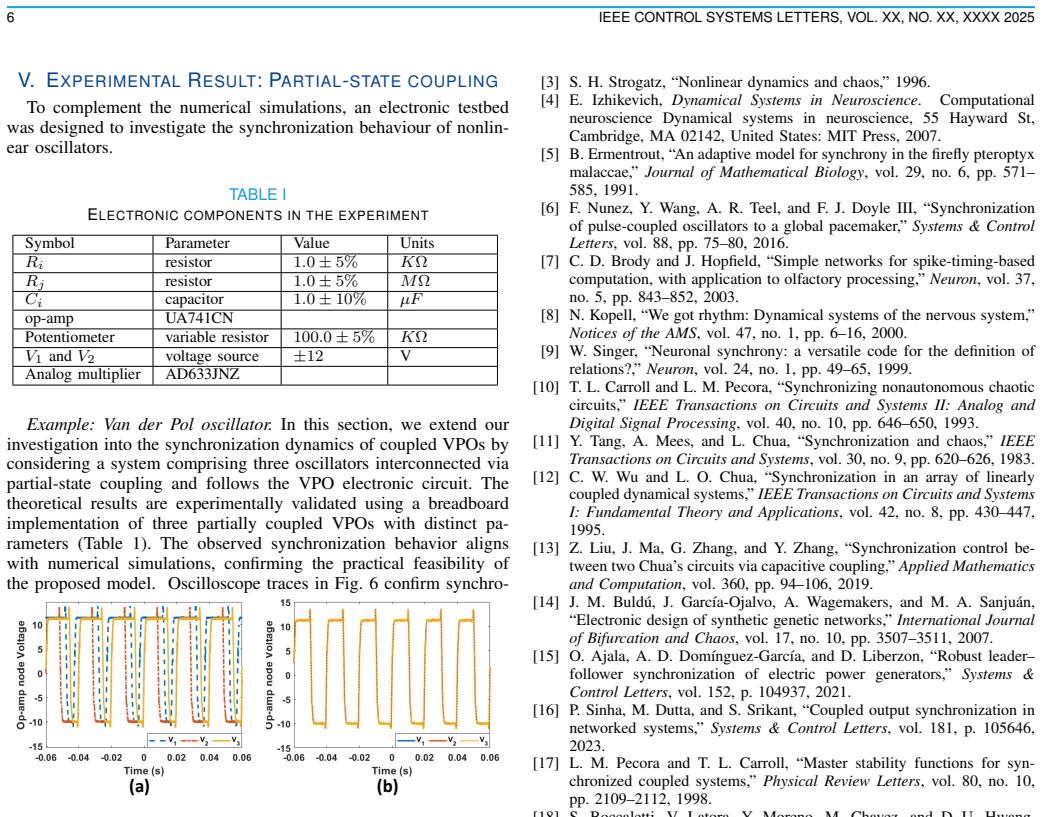
Determining conditions on the coupling strength for the synchronization in networks of interconnected oscillators is a challenging problem in nonlinear dynamics. While sophisticated mathematical methods have been used to derive conditions, these conditions are usually only sufficient and/ or based on numerical methods. We addressed the gap between the sufficient coupling strength and numerically observations using the Lyapunov-Floquet Theory and the Master Stability Function framework. We showed that a positive coupling strength is a necessary and sufficient condition for local synchronization in a network of identical oscillators coupled linearly and in full state fashion. For partial state coupling, we showed that a positive coupling constant results in an asymptotic contraction of the trajectories in the state space, which results in synchronisation for two-dimensional oscillators. We extended the results to networks with non-identical coupling over directed graphs and showed that positive coupling constants is a sufficient condition for synchronisation. These theoretical results are validated using numerical simulations and experimental implementations. Our results contribute to bridging the gap between the theoretically derived sufficient coupling strengths and the numerically observed ones.
Editorial analysis
A structured set of objections, weighed in public.
Referee Report
Summary. The paper claims that a positive coupling strength is a necessary and sufficient condition for local synchronization in networks of identical nonlinear oscillators with linear full-state coupling, derived via Lyapunov-Floquet theory and the master stability function (MSF) framework. It further shows that positive coupling yields asymptotic contraction for partial-state coupling in 2D oscillators, extends the results to non-identical coupling on directed graphs as a sufficient condition, and validates all claims with numerical simulations and experiments.
Significance. If the central derivation holds without hidden restrictions, the result would provide an exact necessary-and-sufficient criterion that bridges the gap between purely sufficient analytic bounds and observed synchronization at arbitrarily small positive couplings, which is a meaningful contribution to synchronization theory. The combination of Lyapunov-Floquet reduction with MSF and the experimental validation are strengths that would remain valuable even after scope clarification.
major comments (2)
- [Abstract; derivation of the MSF variational equation] Abstract and the derivation using Lyapunov-Floquet theory: the claim that positive coupling is necessary and sufficient for general 'nonlinear oscillator networks' is not supported, because Lyapunov-Floquet theory applies only when the synchronous trajectory s(t) is T-periodic; the transverse variational equation Df(s(t)) − σλI is then periodic, but for aperiodic (e.g., chaotic) f the Floquet multipliers are undefined and the necessity direction fails.
- [Main theoretical result on full-state coupling] The necessity-and-sufficiency statement for full-state coupling therefore holds only inside the subclass of oscillators possessing stable limit cycles; the manuscript does not state this restriction or provide a separate argument (e.g., via Lyapunov exponents) that would cover chaotic cases such as Lorenz or Rössler oscillators.
minor comments (2)
- [Preliminaries] Notation for the coupling matrix eigenvalues and the transverse modes should be introduced with an explicit reference to the graph Laplacian or adjacency matrix spectrum.
- [Experimental validation] The experimental section would benefit from a brief statement of the hardware oscillator model and measured coupling range to allow direct comparison with the analytic condition.
Simulated Author's Rebuttal
We thank the referee for the careful and constructive review. The comments correctly identify that our use of Lyapunov-Floquet theory implicitly restricts the necessity-and-sufficiency claim to cases with periodic synchronous trajectories. We will revise the manuscript to make this scope explicit.
read point-by-point responses
-
Referee: Abstract and the derivation using Lyapunov-Floquet theory: the claim that positive coupling is necessary and sufficient for general 'nonlinear oscillator networks' is not supported, because Lyapunov-Floquet theory applies only when the synchronous trajectory s(t) is T-periodic; the transverse variational equation Df(s(t)) − σλI is then periodic, but for aperiodic (e.g., chaotic) f the Floquet multipliers are undefined and the necessity direction fails.
Authors: We agree that the Lyapunov-Floquet approach requires a T-periodic synchronous trajectory s(t). The manuscript's derivation therefore applies to oscillator networks whose synchronous solution is periodic (e.g., limit-cycle oscillators). We will revise the abstract, introduction, and theoretical sections to state this assumption explicitly and to note that the necessity direction relies on the existence of well-defined Floquet multipliers. revision: yes
-
Referee: The necessity-and-sufficiency statement for full-state coupling therefore holds only inside the subclass of oscillators possessing stable limit cycles; the manuscript does not state this restriction or provide a separate argument (e.g., via Lyapunov exponents) that would cover chaotic cases such as Lorenz or Rössler oscillators.
Authors: We acknowledge that the current text does not explicitly restrict the result to oscillators with stable limit cycles. We will add a clarifying paragraph in the introduction and in the statement of the main theorem, specifying that the necessity-and-sufficiency result is derived under the assumption of a stable periodic synchronous trajectory. Extension to chaotic oscillators via Lyapunov exponents lies outside the present Lyapunov-Floquet framework and is not claimed. revision: yes
Circularity Check
No significant circularity; derivation relies on independent standard tools
full rationale
The paper's central claim is obtained by applying the pre-existing Lyapunov-Floquet theory and master stability function (MSF) framework to the variational equation along the synchronization manifold. These frameworks predate the paper and are not shown to be redefined or fitted inside it. The abstract and described steps contain no self-definitional equations, no parameter fitted to a subset then relabeled as prediction, and no load-bearing self-citation whose content reduces to the present result. The derivation chain therefore remains self-contained against external benchmarks.
Axiom & Free-Parameter Ledger
axioms (2)
- domain assumption The individual oscillator dynamics admit a well-defined variational equation whose stability is governed by the Floquet multipliers of the linearized time-periodic system.
- domain assumption The coupling is linear and identical across all pairs for the main necessity-and-sufficiency result.
Reference graph
Works this paper leans on
-
[1]
Sync: The emerging science of spontaneous order,
S. Strogatz, “Sync: The emerging science of spontaneous order,” 2004
work page 2004
-
[2]
Synchronization: a universal concept in nonlinear sciences,
A. Pikovsky, J. Kurths, M. Rosenblum, and J. Kurths, “Synchronization: a universal concept in nonlinear sciences,” No. 12, Cambridge university press, 2003
work page 2003
- [3]
-
[4]
Izhikevich,Dynamical Systems in Neuroscience
E. Izhikevich,Dynamical Systems in Neuroscience. Computational neuroscience Dynamical systems in neuroscience, 55 Hayward St, Cambridge, MA 02142, United States: MIT Press, 2007
work page 2007
-
[5]
An adaptive model for synchrony in the firefly pteroptyx malaccae,
B. Ermentrout, “An adaptive model for synchrony in the firefly pteroptyx malaccae,”Journal of Mathematical Biology, vol. 29, no. 6, pp. 571– 585, 1991
work page 1991
-
[6]
Synchronization of pulse-coupled oscillators to a global pacemaker,
F. Nunez, Y . Wang, A. R. Teel, and F. J. Doyle III, “Synchronization of pulse-coupled oscillators to a global pacemaker,”Systems & Control Letters, vol. 88, pp. 75–80, 2016
work page 2016
-
[7]
Simple networks for spike-timing-based computation, with application to olfactory processing,
C. D. Brody and J. Hopfield, “Simple networks for spike-timing-based computation, with application to olfactory processing,”Neuron, vol. 37, no. 5, pp. 843–852, 2003
work page 2003
-
[8]
We got rhythm: Dynamical systems of the nervous system,
N. Kopell, “We got rhythm: Dynamical systems of the nervous system,” Notices of the AMS, vol. 47, no. 1, pp. 6–16, 2000
work page 2000
-
[9]
Neuronal synchrony: a versatile code for the definition of relations?,
W. Singer, “Neuronal synchrony: a versatile code for the definition of relations?,”Neuron, vol. 24, no. 1, pp. 49–65, 1999
work page 1999
-
[10]
Synchronizing nonautonomous chaotic circuits,
T. L. Carroll and L. M. Pecora, “Synchronizing nonautonomous chaotic circuits,”IEEE Transactions on Circuits and Systems II: Analog and Digital Signal Processing, vol. 40, no. 10, pp. 646–650, 1993
work page 1993
-
[11]
Y . Tang, A. Mees, and L. Chua, “Synchronization and chaos,”IEEE Transactions on Circuits and Systems, vol. 30, no. 9, pp. 620–626, 1983
work page 1983
-
[12]
Synchronization in an array of linearly coupled dynamical systems,
C. W. Wu and L. O. Chua, “Synchronization in an array of linearly coupled dynamical systems,”IEEE Transactions on Circuits and Systems I: Fundamental Theory and Applications, vol. 42, no. 8, pp. 430–447, 1995
work page 1995
-
[13]
Synchronization control be- tween two Chua’s circuits via capacitive coupling,
Z. Liu, J. Ma, G. Zhang, and Y . Zhang, “Synchronization control be- tween two Chua’s circuits via capacitive coupling,”Applied Mathematics and Computation, vol. 360, pp. 94–106, 2019
work page 2019
-
[14]
Electronic design of synthetic genetic networks,
J. M. Buld ´u, J. Garc ´ıa-Ojalvo, A. Wagemakers, and M. A. Sanju ´an, “Electronic design of synthetic genetic networks,”International Journal of Bifurcation and Chaos, vol. 17, no. 10, pp. 3507–3511, 2007
work page 2007
-
[15]
Robust leader– follower synchronization of electric power generators,
O. Ajala, A. D. Dom ´ınguez-Garc´ıa, and D. Liberzon, “Robust leader– follower synchronization of electric power generators,”Systems & Control Letters, vol. 152, p. 104937, 2021
work page 2021
-
[16]
Coupled output synchronization in networked systems,
P. Sinha, M. Dutta, and S. Srikant, “Coupled output synchronization in networked systems,”Systems & Control Letters, vol. 181, p. 105646, 2023
work page 2023
-
[17]
Master stability functions for syn- chronized coupled systems,
L. M. Pecora and T. L. Carroll, “Master stability functions for syn- chronized coupled systems,”Physical Review Letters, vol. 80, no. 10, pp. 2109–2112, 1998
work page 1998
-
[18]
Complex networks: Structure and dynamics,
S. Boccaletti, V . Latora, Y . Moreno, M. Chavez, and D.-U. Hwang, “Complex networks: Structure and dynamics,”Physics reports, vol. 424, no. 4-5, pp. 175–308, 2006
work page 2006
-
[19]
Selecting the coupling variable to synchronize nonlinear oscillators,
P. A. d. S. Braga and L. A. Aguirre, “Selecting the coupling variable to synchronize nonlinear oscillators,”Nonlinear Dynamics, vol. 112, no. 17, pp. 15177–15191, 2024
work page 2024
-
[20]
Synchroniza- tion of diffusively-coupled limit cycle oscillators,
S. Y . Shafi, M. Arcak, M. Jovanovi ´c, and A. K. Packard, “Synchroniza- tion of diffusively-coupled limit cycle oscillators,”Automatica, vol. 49, no. 12, pp. 3613–3622, 2013
work page 2013
-
[21]
Certifying spatially uniform behavior in reaction–diffusion pde and compartmental ode systems,
M. Arcak, “Certifying spatially uniform behavior in reaction–diffusion pde and compartmental ode systems,”Automatica, vol. 47, no. 6, pp. 1219–1229, 2011
work page 2011
-
[22]
Global convergence of quorum-sensing networks,
G. Russo and J. J. E. Slotine, “Global convergence of quorum-sensing networks,”Physical Review E, vol. 82, no. 4, p. 041919, 2010
work page 2010
-
[23]
Synchronization in networks of identical linear systems,
L. Scardovi and R. Sepulchre, “Synchronization in networks of identical linear systems,” in47th Conference on Decision and Control (CDC), pp. 546–551, IEEE, 2008
work page 2008
-
[24]
Synchronization in small-world sys- tems,
M. Barahona and L. M. Pecora, “Synchronization in small-world sys- tems,”Physical review letters, vol. 89, no. 5, p. 054101, 2002
work page 2002
-
[25]
On the stability of the kuramoto model of coupled nonlinear oscillators,
A. Jadbabaie, N. Motee, and M. Barahona, “On the stability of the kuramoto model of coupled nonlinear oscillators,” inProceedings of the 2004 American Control Conference, vol. 5, pp. 4296–4301, IEEE, 2004
work page 2004
-
[26]
Synchronization of coupled benchmark oscillators: analysis and experiments,
S. K. Joshi, S. Sen, and I. N. Kar, “Synchronization of coupled benchmark oscillators: analysis and experiments,”International Journal of Dynamics and Control, vol. 10, no. 2, pp. 577–597, 2022
work page 2022
-
[27]
V . A. Yakubovich and V . M. Starzhinskii,Linear differential equations with periodic coefficients. New York: Wiley, 1975
work page 1975
-
[28]
Synchronization in chaotic systems,
L. M. Pecora and T. L. Carroll, “Synchronization in chaotic systems,” Physical review letters, vol. 64, no. 8, p. 821, 1990
work page 1990
-
[29]
Liapunov-floquet transformation: Computation and applications to periodic systems,
S. Sinha, R. Pandiyan, and J. Bibb, “Liapunov-floquet transformation: Computation and applications to periodic systems,”Journal of Vibration and Acoustics, vol. 118, pp. 209–219, 1996
work page 1996
-
[30]
Brockett,Finite Dimensional Linear Systems
R. Brockett,Finite Dimensional Linear Systems. Classics in Applied Mathematics, Philadelphia: Society for Industrial and Applied Mathe- matics, 2015
work page 2015
discussion (0)
Sign in with ORCID, Apple, or X to comment. Anyone can read and Pith papers without signing in.