Integrated Sensing and Communications for Unsourced Random Access: Fundamental Limits
Pith reviewed 2026-05-24 01:54 UTC · model grok-4.3
The pith
An approximate achievable result shows unsourced users can jointly decode messages and estimate angles despite simultaneous transmissions and no identities.
A machine-rendered reading of the paper's core claim, the machinery that carries it, and where it could break.
Core claim
In the unsourced ISAC model, all active users transmit simultaneously in a short frame with no scheduling and without user identities known at the base station; an approximate achievable result is derived that decodes transmitted message sequences from communication users while simultaneously detecting active sensing users and estimating their angles of arrival, and this result is superior to conventional approaches.
What carries the argument
The approximate achievable result for the UNISAC model, which handles the significant interference from numerous simultaneous transmissions to enable joint decoding and angle estimation.
If this is right
- The system supports both communication decoding and sensing angle estimation for a large number of users transmitting at once.
- No scheduling or knowledge of user identities is required at the receiver.
- The approach outperforms separated conventional methods such as ALOHA and time-division multiple access.
- Numerical simulations confirm the joint sensing and communication capabilities remain effective at scale.
Where Pith is reading between the lines
- The same unsourced simultaneous-transmission model might extend to estimating additional sensing parameters such as range or velocity.
- This could reduce coordination overhead in dense machine-type communication networks where scheduling is impractical.
- Real deployments would need to check robustness when channel conditions deviate from the modeled assumptions.
Load-bearing premise
The model assumes an approximate achievable result can be derived that remains meaningful and superior even when every active user transmits simultaneously in a short frame with no scheduling and without user identities being known at the receiver.
What would settle it
A numerical simulation or theoretical bound in which the message decoding error rate or angle estimation accuracy of the derived result is not better than ALOHA, TDMA, treating interference as noise, or MUSIC under the same conditions with a large number of users.
Figures



read the original abstract
This work considers the problem of integrated sensing and communications (ISAC) with a massive number of unsourced and uncoordinated users. In the proposed model, known as the unsourced ISAC system (UNISAC), all active communication and sensing users simultaneously share a short frame to transmit their signals, without requiring scheduling with the base station (BS). Hence, the signal received from each user is affected by significant interference from numerous interfering users, making it challenging to extract the transmitted signals. UNISAC aims to decode the transmitted message sequences from communication users while simultaneously detecting active sensing users and estimating their angles of arrival, regardless of the identity of the senders. In this paper, we derive an approximate achievable result for UNISAC and demonstrate its superiority over conventional approaches such as ALOHA, time-division multiple access, treating interference as noise, and multiple signal classification. Through numerical simulations, we validate the effectiveness of UNISAC's sensing and communication capabilities for a large number of users.
Editorial analysis
A structured set of objections, weighed in public.
Referee Report
Summary. The paper introduces the UNISAC model for integrated sensing and communications under unsourced random access, where a massive number of uncoordinated users transmit simultaneously in a short frame. It derives an approximate achievable result for joint message decoding from communication users and active user detection plus angle-of-arrival estimation from sensing users, then uses numerical simulations to claim superiority over ALOHA, TDMA, TIN, and MUSIC baselines.
Significance. If the approximation remains faithful, the result would establish non-trivial fundamental limits for joint unsourced communication and sensing under strong uncoordinated interference, a setting relevant to massive IoT and 6G. The explicit comparison to multiple standard baselines and the simulation validation are positive features; however, the absence of error bounds on the approximation limits the strength of the superiority claim.
major comments (3)
- [§IV] §IV (Approximate Achievable Result): the derivation of the approximate achievable rate/region is presented without an explicit error bound or convergence statement on the approximation (e.g., large-system limit or relaxation gap). Because the central superiority claim rests on this approximation outperforming the baselines, the lack of a quantitative guarantee on approximation fidelity is load-bearing.
- [§V] §V (Numerical Results): the simulation comparison applies the UNISAC scheme and the four baselines, but does not state whether the same approximation (or relaxation) was used uniformly across all schemes. If the baselines were evaluated under a tighter or different approximation, the reported gains may not be directly comparable.
- [§III] §III (System Model): the model assumes all active users transmit simultaneously with no scheduling and unknown identities, yet the approximate result is claimed to remain meaningful; a concrete test (e.g., finite-user correction term or sensitivity analysis) is needed to confirm the approximation does not break under the massive-interference regime that defines the problem.
minor comments (2)
- Notation for the approximate achievable region should be introduced with a clear symbol (e.g., R_approx) and distinguished from any exact inner bound.
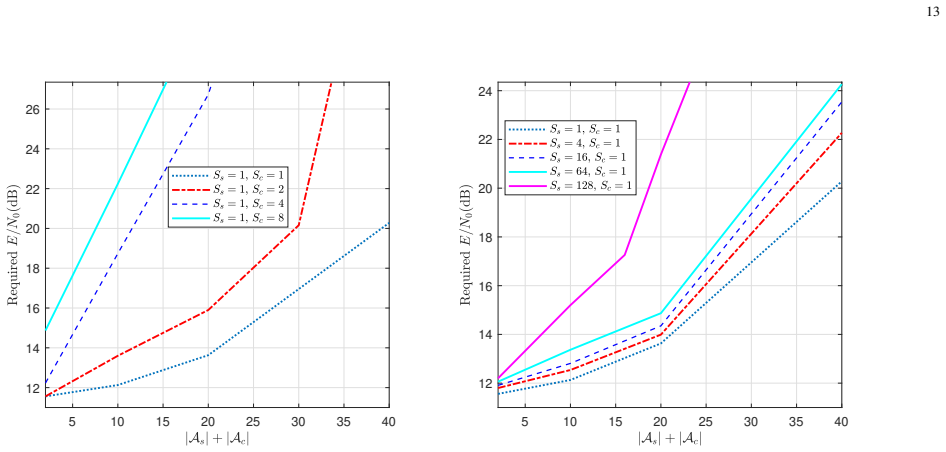
- Figure captions in the simulation section should explicitly list the parameter values (number of users, frame length, SNR) used for each curve.
Simulated Author's Rebuttal
We thank the referee for the thoughtful review and constructive feedback on our manuscript. We address each major comment below, providing clarifications and indicating where revisions will be made to strengthen the presentation.
read point-by-point responses
-
Referee: [§IV] §IV (Approximate Achievable Result): the derivation of the approximate achievable rate/region is presented without an explicit error bound or convergence statement on the approximation (e.g., large-system limit or relaxation gap). Because the central superiority claim rests on this approximation outperforming the baselines, the lack of a quantitative guarantee on approximation fidelity is load-bearing.
Authors: The approximate achievable result is obtained via the standard large-system analysis with fixed load factor, as is conventional in the unsourced random access literature. Section IV explicitly invokes this asymptotic regime. While explicit finite-N error bounds are not derived, the approximation is validated by the close agreement between the analytical expressions and the Monte Carlo simulations in Section V across a range of user densities. We will add a clarifying remark on the asymptotic justification and relevant citations in the revised manuscript. revision: partial
-
Referee: [§V] §V (Numerical Results): the simulation comparison applies the UNISAC scheme and the four baselines, but does not state whether the same approximation (or relaxation) was used uniformly across all schemes. If the baselines were evaluated under a tighter or different approximation, the reported gains may not be directly comparable.
Authors: The identical large-system approximation and interference model were applied uniformly to UNISAC and all four baselines (ALOHA, TDMA, TIN, MUSIC) to ensure comparability. Each baseline was adapted to the unsourced massive-access setting under the same channel and load assumptions used for the proposed scheme. We will add an explicit statement to this effect in the revised Section V. revision: yes
-
Referee: [§III] §III (System Model): the model assumes all active users transmit simultaneously with no scheduling and unknown identities, yet the approximate result is claimed to remain meaningful; a concrete test (e.g., finite-user correction term or sensitivity analysis) is needed to confirm the approximation does not break under the massive-interference regime that defines the problem.
Authors: The system model and the ensuing approximation are formulated specifically for the massive unsourced regime that defines the problem. Section V already contains numerical results for several hundred simultaneous users, which serve as the requested sensitivity check and demonstrate that the reported gains persist under heavy interference. Deriving an explicit finite-user correction term lies outside the scope of the present work. revision: no
Circularity Check
No circularity; derivation presented as independent
full rationale
The provided abstract and model description state that an approximate achievable result is derived for the UNISAC problem and compared to baselines. No equations, self-citations, or steps are exhibited that reduce the claimed result to a definition, a fitted input renamed as prediction, or a load-bearing self-citation chain. The central claim remains a derived bound rather than a tautology, consistent with the default expectation that most papers are non-circular.
Axiom & Free-Parameter Ledger
Forward citations
Cited by 1 Pith paper
-
MAP-Based Task-Oriented Precoding for Multiuser Communication
A MAP-driven task-oriented precoding framework derives a tractable class-mean separation objective to enable low-complexity feature extraction and precoding that improves classification accuracy after wireless distort...
Reference graph
Works this paper leans on
-
[1]
A perspective on massive random-access ,
Y . Polyanskiy, “A perspective on massive random-access ,” in Proc. IEEE Int. Symp. Inf. Theory (ISIT) , Aachen, Germany, June 2017, pp. 2523– 2527
work page 2017
-
[2]
Unsourced random access: A comprehen sive survey,
M. Ozates, et al., “Unsourced random access: A comprehen sive survey,” arXiv, 2024. Available: https://arxiv.org/abs/2409.14911
-
[3]
Novel unsourced random access algorithms over Gaus- sian and fading channels,
M. J. Ahmadi, “Novel unsourced random access algorithms over Gaus- sian and fading channels,” Ph.D. dissertation, Bilkent uni versity, 2024
work page 2024
-
[4]
Random spreading with higher order modulation in unsourced random access,
J. Dang, Z. Zhang and Y . Wu, “Random spreading with higher order modulation in unsourced random access,” IEEE Commun. Lett. , vol. 29, no. 4, pp. 829–833, Apr. 2025
work page 2025
-
[5]
Random spreading for unsour ced MAC with power diversity,
M. J. Ahmadi and T. M. Duman, “Random spreading for unsour ced MAC with power diversity,” IEEE Commun. Lett. , vol. 25, no. 12, pp. 3995–3999, Dec. 2021
work page 2021
-
[6]
Z. Zhang, et al., “Sparse code transceiver design for uns ourced random access with analytical power division in Gaussian MAC,” arX iv, 2025. Available: https://arxiv.org/abs/2505.01988
-
[7]
Unsourced random access wit h a massive MIMO receiver using multiple stages of orthogonal p ilots,
M. J. Ahmadi and T. M. Duman, “Unsourced random access wit h a massive MIMO receiver using multiple stages of orthogonal p ilots,” in Proc. IEEE Int. Symp. Inf. Theory (ISIT) , Espoo, Finland, July 2022, pp. 2880-2885
work page 2022
-
[8]
A slotted pilot-bas ed unsourced random access scheme with a multiple-antenna rec eiver,
M. Ozates, M. Kazemi and T. M. Duman, “A slotted pilot-bas ed unsourced random access scheme with a multiple-antenna rec eiver,” IEEE Trans. Wireless Commun. , vol. 23, no. 4, pp. 3437–33449, April 2024
work page 2024
-
[9]
Probabilistic ODMA rece iver with low-complexity algorithm for MIMO unsourced random access ,
Z. Zhang, J. Dang, and Z. Zhang, “Probabilistic ODMA rece iver with low-complexity algorithm for MIMO unsourced random access ,” IEEE Trans. V ehicular Tech., early access, pp. 1–6, 2025
work page 2025
-
[10]
Efficient ODMA for unsourced random access in MIMO and hybrid massive MIMO,
Z. Zhang et al. , “Efficient ODMA for unsourced random access in MIMO and hybrid massive MIMO,” IEEE Internet Things J. , vol. 11, no. 23, pp. 38846–38860, Dec. 1, 2024
work page 2024
-
[11]
Uncoupled unsourced random access: Exploiting geographical diversity of access points,
Z. Zhang et al. , “Uncoupled unsourced random access: Exploiting geographical diversity of access points,” IEEE Trans. V ehicular Tech. , vol. 74, no. 6, pp. 9882–9887, 2025
work page 2025
-
[12]
M. J. Ahmadi, M. Kazemi, and T. M. Duman, “Unsourced rand om access with a massive MIMO receiver using multiple stages of orthogo- nal pilots: MIMO and single-antenna structures,” IEEE Trans. Wireless Commun., vol. 23, no. 2, pp. 1343–1355, Feb. 2024
work page 2024
-
[13]
Unsourced random access via random dictionary learning with pilot-free tran sceiver design,
Z. Zhang, J. Dang, Z. Zhang, L. Wu, and B. Zhu, “Unsourced random access via random dictionary learning with pilot-free tran sceiver design,” IEEE Trans. Wireless Commun. , vol. 23, no. 12, pp. 17884–17898, Dec. 2024
work page 2024
-
[14]
Unsourced random massive access with beam-space tree deco ding,
J. Che, Z. Zhang, Z. Y ang, X. Chen, C. Zhong and D. W. K. Ng, “Unsourced random massive access with beam-space tree deco ding,” IEEE J. Select. Areas Commun. , vol. 40, no. 4, pp. 1146–1161, Apr. 2022
work page 2022
-
[15]
RIS-aided unso urced random access,
M. J. Ahmadi, M. Kazemi, and T. M. Duman, “RIS-aided unso urced random access,” in Proc. IEEE Global Commun. Conf. (GLOBECOM) , Kuala Lumpur, Malaysia, Dec. 2023, pp. 3270–3275
work page 2023
-
[16]
RIS-aided unso urced multiple access (RISUMA): Coding strategy and performance limits,
M. J. Ahmadi, M. Kazemi, and T. M. Duman, “RIS-aided unso urced multiple access (RISUMA): Coding strategy and performance limits,” IEEE Trans. Wireless Commun. , vol. 24, no. 7, pp. 6225–6239, Jul. 2025
work page 2025
-
[17]
X. Shao, L. Cheng, X. Chen, C. Huang and D. W. K. Ng, “Recon - figurable intelligent surface-aided 6G massive access: cou pled tensor modeling and sparse bayesian learning,” IEEE Trans. Wireless Commun., vol. 21, no. 12, pp. 10145–10161, Dec. 2022
work page 2022
-
[18]
Unsourced random access over frequency- selective channels,
M. Ozates and T. M. Duman, “Unsourced random access over frequency- selective channels,” IEEE Commun. Lett. , vol. 27, no. 4, pp. 1230–1234, Apr. 2023
work page 2023
-
[19]
W. Wang, J. Y ou, S. Liang, W. Han and B. Bai, “Slotted conc atenated coding scheme for asynchronous uplink unsourced random acc ess with a massive MIMO receiver,” in Proc. IEEE 33rd Annual Int. Symp. Personal, Indoor and Mobile Radio Commun. (PIMRC) , Kyoto, Japan, 2022, pp. 246-252
work page 2022
-
[20]
Message and activity dete ction for an asynchronous random access receiver using AMP ,
O. Musa, P . Jung and G. Caire, “Message and activity dete ction for an asynchronous random access receiver using AMP ,” in Proc. IEEE Int. Conf. Commun. (ICC) , Rome, Italy, 2023, pp. 1940-1945
work page 2023
-
[21]
Asynchronous MIMO-OFDM massive unsource d random access with codeword collisions,
T. Li et al., “Asynchronous MIMO-OFDM massive unsource d random access with codeword collisions,” IEEE Trans. Wireless Commun. , vol. 24, no. 1, pp. 84-100, Jan. 2025
work page 2025
-
[22]
Unsourced multiple access for mission-c ritical control systems in industrial Internet of Things,
J. Che et al., “Unsourced multiple access for mission-c ritical control systems in industrial Internet of Things,” IEEE Internet Things J. , vol. 11, no. 17, pp. 27955–27968, Sept. 1, 2024
work page 2024
-
[23]
Has hBeam: Enabling feedback through downlink beamforming in unsourc ed random access,
J. R. Ebert, K. R. Narayanan and J. -F. Chamberland, “Has hBeam: Enabling feedback through downlink beamforming in unsourc ed random access,” in Proc. Asilomar Conf. Signals, Systems, and Computers. , Pacific Grove, CA, USA, 2022, pp. 692-697
work page 2022
-
[24]
Unsourced random access with threshold-based feedback,
M. Bashir, E. Nassaji, D. Truhachev, A. Bayesteh and M. V ameghes- tahbanati, “Unsourced random access with threshold-based feedback,” IEEE Trans. Commun. , vol. 71, no. 12, pp. 7072-7086, Dec. 2023
work page 2023
-
[25]
Efficient fee dback design for unsourced random access with integrated sensing and com munica- tion,
M. J. Ahmadi, M. Kazemi and R. F. Schaefer, “Efficient fee dback design for unsourced random access with integrated sensing and com munica- tion,” arXiv, 2025. Available: https://arxiv.org/abs/25 06.20262. 15
work page 2025
-
[26]
Integrated sensing and communications: Toward dua l-functional wireless networks for 6G and beyond,
F. Liu, Y . Cui, C. Masouros, J. Xu, T. X. Han, Y . C. Eldar, a nd S. Buzzi, “Integrated sensing and communications: Toward dua l-functional wireless networks for 6G and beyond,” IEEE J. Sel. Areas Commun. , vol. 40, no. 6, pp. 1728–1767, June 2022
work page 2022
-
[27]
Uplink multi-RSU coop erative sensing strategy for integrated sensing and communication system,
Y . Li, Z. Wei, H. Liu, and Z. Feng, “Uplink multi-RSU coop erative sensing strategy for integrated sensing and communication system,” IEEE Trans. Cogn. Commun. Netw. , early access, 2025
work page 2025
-
[28]
Cooperative sensi ng and user- echo associations for integrated sensing and communicatio n networks,
H. Zhang, S. Chen, W. Meng, and C. Li, “Cooperative sensi ng and user- echo associations for integrated sensing and communicatio n networks,” in Proc. IEEE Global Commun. Conf. (GLOBECOM), Cape Town, South Africa, 2024, pp. 1371-1376
work page 2024
-
[29]
MARL-based UA V tra jectory and beamforming optimization for ISAC system,
Q. Gao, R. Zhong, H. Shin, and Y . Liu, “MARL-based UA V tra jectory and beamforming optimization for ISAC system,” IEEE Internet Things J., vol. 11, no. 24, pp. 40492-40505, Dec. 15, 2024
work page 2024
-
[30]
Transmit beamforming an d array steering optimization for UA V -aided bistatic ISAC,
F. Pei, L. Xiang, and A. Klein, “Transmit beamforming an d array steering optimization for UA V -aided bistatic ISAC,” in Proc. IEEE Global Commun. Conf. (GLOBECOM) , Cape Town, South Africa, 2024, pp. 5405-5410
work page 2024
-
[31]
UA V -assisted NOMA for enhancing ISAC: A deep reinforcement learning solu tion,
A. Amhaz, M. Elhattab, S. Sharafeddine, and C. Assi, “UA V -assisted NOMA for enhancing ISAC: A deep reinforcement learning solu tion,” IEEE Commun. Lett. , vol. 29, no. 2, pp. 249-253, Feb. 2025
work page 2025
-
[32]
Minimizing U RLLC task offloading latency with full-duplex STAR-RIS-aided DR L-ISAC systems,
A. Paul, K. Singh, C.-P . Li, and S. Mumtaz, “Minimizing U RLLC task offloading latency with full-duplex STAR-RIS-aided DR L-ISAC systems,” in Proc. IEEE Global Commun. Conf. (GLOBECOM) , Cape Town, South Africa, 2024, pp. 73–78
work page 2024
-
[33]
Joint s ecure and covert communications for active STAR-RIS assisted ISAC sy stems,
L. Guo, J. Jia, X. Mu, Y . Liu, J. Chen, and X. Wang, “Joint s ecure and covert communications for active STAR-RIS assisted ISAC sy stems,” IEEE Trans. Wireless Commun. , early access, Apr. 2025
work page 2025
-
[34]
S. Pala, K. Singh, C.-P . Li, and O. A. Dobre, “Empowering ISAC systems with federated learning: A focus on satellite and RI S-enhanced terrestrial integrated networks,” IEEE Trans. Wireless Commun., vol. 24, no. 1, pp. 810–824, Jan. 2025
work page 2025
-
[35]
Optimization of power allocation fo r OFDM based ISAC systems,
X. Wang and S. Han, “Optimization of power allocation fo r OFDM based ISAC systems,” in Proc. IEEE Global Commun. Conf. (GLOBE- COM), Cape Town, South Africa, 2024, pp. 5387-5392
work page 2024
-
[36]
A. Khalili, A. Rezaei, D. Xu, F. Dressler, and R. Schober , “Efficient UA V hovering, resource allocation, and trajectory design f or ISAC with limited backhaul capacity,” IEEE Trans. Wireless Commun. , vol. 23, no. 11, pp. 17635–17650, Nov. 2024
work page 2024
-
[37]
W. Men, J. Du, J. Wang, X. Hou, Y . Ren, and D. Niyato, “Desi gn of ISAC waveform and multiple-access interference suppressi on receiver for underwater acoustic sensor networks,” in Proc. IEEE Global Com- mun. Conf. (GLOBECOM) , Cape Town, South Africa, 2024, pp. 3461- 3466
work page 2024
-
[38]
Frequency hopping waveform de sign for secure integrated sensing and communications,
A. K. Boroujeni, et al., “Frequency hopping waveform de sign for secure integrated sensing and communications,” arXiv, 202 5. Available: https://arxiv.org/abs/2504.10052
-
[39]
Short-length code designs for integrat ed sensing and communications using deep learning,
M. Kim, et al., “Short-length code designs for integrat ed sensing and communications using deep learning,” in Proc. IEEE Int. Conf. Commun. (ICC), Denver, CO, USA, 2024, pp. 3536–3541
work page 2024
-
[40]
Sensing-assisted secure commu nications over correlated Rayleigh fading channels,
M. Mittelbach, et al., “Sensing-assisted secure commu nications over correlated Rayleigh fading channels,” Entropy, vol. 27, no. 3, p. 225, 2025
work page 2025
-
[41]
L. Yin, Y . Mao, O. Dizdar, and B. Clerckx, “Rate-splitti ng multiple access for 6G—Part II: Interplay with integrated sensing an d commu- nications,” IEEE Commun. Lett. , vol. 26, no. 10, pp. 2237–2241, Oct. 2022
work page 2022
-
[42]
S. Ghosh, K. Singh, H. Jung, C.-P . Li, and T. Q. Duong, “On the performance of rate splitting multiple access for ISAC in de vice-to- multi-device IoT communications,” IEEE Trans. Cogn. Commun. Netw. , vol. 11, no. 1, pp. 333–348, Feb. 2025
work page 2025
-
[43]
P . Gao, L. Lian, and J. Y u, “Cooperative ISAC with direct localization and rate-splitting multiple access communication: A Paret o optimization framework,” IEEE J. Sel. Areas Commun. , vol. 41, no. 5, pp. 1496–1515, May 2023
work page 2023
-
[44]
Integrated sen sing and communications for unsourced random access: fundamental l imits,
M. J. Ahmadi, R. F. Schaefer, H. V . Poor, “Integrated sen sing and communications for unsourced random access: fundamental l imits,” in Proc. IEEE Global Commun. Conf. (GLOBECOM) , Cape Town, South Africa, 2024, pp. 1365-1370
work page 2024
-
[45]
Z. Zhang, J. Dang, K.-K. Wong, Z. Zhang and C. Masouros, “ Integrated sensing and communications for unsourced random access: A s pec- trum sharing compressive sensing approach,” arXiv, 2025. A vailable: https://arxiv.org/abs/2504.17629
-
[46]
Z. Zhang, K.-K. Wong, J. Dang, Z. Zhang and C.-B. Chae, “O n fundamental limits for fluid antenna-assisted integrated s ensing and communications for unsourced random access,” arXiv, 2025. Available: https://arxiv.org/abs/2504.03183
-
[47]
E. Gkiouzepi, B. C ¸ akmak, M. Opper and G. Caire, “Joint m essage detection, channel, and user position estimation for unsou rced random access in cell-free networks,” Proc. IEEE W orkshop Signal Process. Adv. Wireless Commun. (SPAWC), Lucca, Italy, 2024, pp. 151–155
work page 2024
-
[48]
Massive digital over-the-air computation for communication-effic ient federated edge learning,
L. Qiao, Z. Gao, M. Boloursaz Mashhadi and D. G¨ und¨ uz, “ Massive digital over-the-air computation for communication-effic ient federated edge learning,” IEEE J. Sel. Areas Commun. , vol. 42, no. 11, pp. 3078– 3094, Nov. 2024
work page 2024
-
[49]
Anti- jamming design for integrated sensing and communication via aerial IRS,
J. Xu, D. Li, Z. Zhu, Z. Y ang, N. Zhao and D. Niyato, “Anti- jamming design for integrated sensing and communication via aerial IRS,” IEEE Trans. Commun., vol. 72, no. 8, pp. 4607–4619, Aug. 2024
work page 2024
-
[50]
Un sourced multiple access with random user activity,
K.-H. Ngo, A. Lancho, G. Durisi, and A. Graell i Amat, “Un sourced multiple access with random user activity,” IEEE Trans. Inf . Theory, vol. 69, no. 7, pp. 4537–4558, Jul. 2023
work page 2023
-
[51]
A. Fengler, S. Haghighatshoar, P . Jung and G. Caire, “No n-Bayesian ac- tivity detection, large-scale fading coefficient estimati on, and unsourced random access with a massive MIMO receiver,” IEEE Trans. Inf. Theory, vol. 67, no. 5, pp. 2925–2951, May 2021
work page 2021
-
[52]
The third-order term in t he normal approximation for the AWGN channel,
V . Y . F. Tan and M. Tomamichel, “The third-order term in t he normal approximation for the AWGN channel,” IEEE Trans. Inf. Theor y, vol. 61, no. 5, pp. 2430–2438, May 2015
work page 2015
-
[53]
MUSIC, maximum likelihood, a nd Cramer- Rao bound,
P . Stoica and A. Nehorai, “MUSIC, maximum likelihood, a nd Cramer- Rao bound,” IEEE Trans. Acoust., Speech, Signal Process. , vol. 38, no. 12, pp. 2140–2150, Dec 1990
work page 1990
-
[54]
J. Proakis and M. Salehi, Digital Communications, 5th ed. Boston, MA, USA: McGraw-Hill Educ., 2007
work page 2007
-
[55]
Y . Hu et al., “Optimized unsourced random access schemes with sparse- correction-based approximate message passing for massive MIMO sys- tems,” IEEE Trans. V ehicular Tech., vol. 74, no. 1, pp. 1104–1120, Jan. 2025
work page 2025
discussion (0)
Sign in with ORCID, Apple, or X to comment. Anyone can read and Pith papers without signing in.