A Non-Markovian Approach to a Stochastic Rumor Dynamics with Cognitive Deliberation
Pith reviewed 2026-05-23 22:43 UTC · model grok-4.3
The pith
A rumor model with cognitive deliberation delays satisfies a functional law of large numbers and central limit theorem.
A machine-rendered reading of the paper's core claim, the machinery that carries it, and where it could break.
Core claim
The non-Markovian rumor process that incorporates independent deliberation delay times on a complete graph of n vertices obeys a functional law of large numbers, converging to a deterministic trajectory, and a functional central limit theorem, with diffusion-scaled fluctuations converging to a Gaussian process.
What carries the argument
The deliberation delay, a decision-making window where individuals evaluate information before committing to dissemination or refutation, which renders the process non-Markovian and requires new asymptotic analysis.
Load-bearing premise
The deliberation delay times are independent and identically distributed according to a fixed distribution that aligns with the complete-graph interaction rates.
What would settle it
A simulation of the process on a graph with 10,000 vertices where the observed path of the proportion of spreaders deviates systematically from the predicted deterministic limit when delays are drawn from the assumed distribution.
Figures
read the original abstract
We introduce a non-Markovian rumor model on a complete graph of $n$ vertices, integrating the classical interactional framework of Daley and Kendall (1964) with modern cognitive insights into misinformation. Unlike traditional Markovian models, our approach incorporates a deliberation delay -- a decision-making window where individuals evaluate information before committing to dissemination or refutation. We establish a Functional Law of Large Numbers (FLLN) and a Functional Central Limit Theorem (FCLT) to characterize the asymptotic behavior and diffusion-scaled fluctuations of the process.
Editorial analysis
A structured set of objections, weighed in public.
Referee Report
Summary. The manuscript introduces a non-Markovian rumor model on the complete graph that augments the classical Daley-Kendall framework with i.i.d. deliberation delay times drawn from a fixed distribution. It claims to establish a Functional Law of Large Numbers (FLLN) for convergence of the empirical measure to a deterministic limit and a Functional Central Limit Theorem (FCLT) for the diffusion-scaled fluctuations around that limit.
Significance. If the stated limit theorems are rigorously derived under the given conditions, the work supplies a mathematically grounded extension of interacting-particle-system techniques to a non-Markovian rumor process with cognitive delays. This could be useful for asymptotic analysis of misinformation models, provided the independence assumptions are compatible with the intended cognitive interpretation.
major comments (2)
- [Model formulation and proof of FLLN] The FLLN and FCLT rest on the assumption that deliberation times are i.i.d. draws from a fixed distribution and independent of the contact process. The manuscript must explicitly verify (in the proof of the FLLN) that this independence supplies the necessary averaging on the complete graph; any residual dependence between an agent's delay and the current global state would couple the memory terms and prevent the limit from closing in the claimed deterministic form.
- [Abstract and §3 (asymptotic analysis)] The abstract asserts that FLLN and FCLT are established, yet the provided text supplies neither the explicit generator of the non-Markovian process nor quantitative error bounds or tightness arguments. Without these, the support for the central claims cannot be verified.
minor comments (1)
- Define the empirical-measure notation and the precise scaling for the diffusion approximation at the first appearance of the FCLT statement.
Simulated Author's Rebuttal
We thank the referee for the careful reading and constructive comments on our manuscript. We address each major comment below.
read point-by-point responses
-
Referee: [Model formulation and proof of FLLN] The FLLN and FCLT rest on the assumption that deliberation times are i.i.d. draws from a fixed distribution and independent of the contact process. The manuscript must explicitly verify (in the proof of the FLLN) that this independence supplies the necessary averaging on the complete graph; any residual dependence between an agent's delay and the current global state would couple the memory terms and prevent the limit from closing in the claimed deterministic form.
Authors: We agree that explicit verification is necessary. The i.i.d. deliberation times, drawn independently of the contact process, are used to ensure that the memory terms average via the law of large numbers on the complete graph. In the current proof of the FLLN we invoke this independence to close the limit, but we will revise the manuscript to add a dedicated step or lemma that explicitly shows how the independence precludes residual state-dependent coupling and yields the deterministic limit equation. revision: yes
-
Referee: [Abstract and §3 (asymptotic analysis)] The abstract asserts that FLLN and FCLT are established, yet the provided text supplies neither the explicit generator of the non-Markovian process nor quantitative error bounds or tightness arguments. Without these, the support for the central claims cannot be verified.
Authors: The abstract summarizes the main theorems, and Section 3 states and derives the FLLN and FCLT. However, we acknowledge that an explicit generator for the non-Markovian process and expanded details on tightness and quantitative error bounds are not fully spelled out. We will revise the manuscript to include the generator and to provide sketches of the tightness arguments together with error-bound estimates. revision: yes
Circularity Check
No circularity: FLLN/FCLT derived from standard particle-system techniques under explicit i.i.d. delay assumptions
full rationale
The paper introduces a non-Markovian rumor process on the complete graph with i.i.d. deliberation delays drawn from a fixed distribution, independent of the contact process. It then invokes standard functional law of large numbers and central limit theorem machinery for interacting particle systems to obtain convergence of the empirical measure and diffusion-scaled fluctuations. These limit theorems are applied to the given model inputs (independence, moment conditions, complete-graph interaction structure) rather than being used to define or fit those inputs. No self-citations are load-bearing for the core claims, no parameters are fitted and then relabeled as predictions, and no ansatz or uniqueness result is smuggled in via prior work by the same authors. The derivation chain is therefore self-contained against external benchmarks.
Axiom & Free-Parameter Ledger
Lean theorems connected to this paper
-
IndisputableMonolith/Cost/FunctionalEquation.leanwashburn_uniqueness_aczel unclear?
unclearRelation between the paper passage and the cited Recognition theorem.
the F n_t-stochastic intensities of An(t) and Bn(t) are λ(t)X n(t)Y n(t)/n and α(t)Y n(t)Z n(t)/n
-
IndisputableMonolith/Foundation/RealityFromDistinction.leanreality_from_one_distinction unclear?
unclearRelation between the paper passage and the cited Recognition theorem.
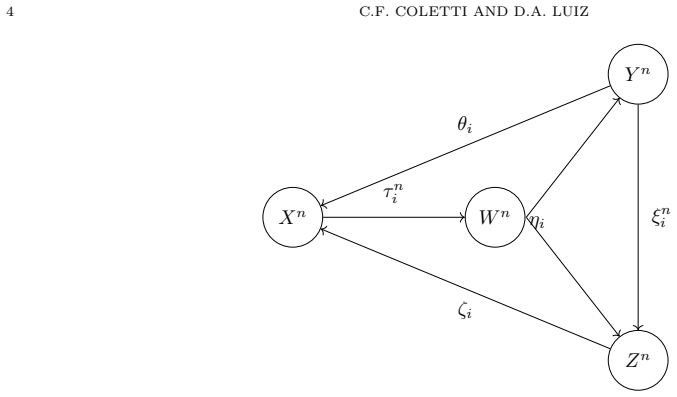
Assume that (η0_i), (θ0_i), (ζ0_i) are i.i.d. sequences with distributions F0,G0,H0
What do these tags mean?
- matches
- The paper's claim is directly supported by a theorem in the formal canon.
- supports
- The theorem supports part of the paper's argument, but the paper may add assumptions or extra steps.
- extends
- The paper goes beyond the formal theorem; the theorem is a base layer rather than the whole result.
- uses
- The paper appears to rely on the theorem as machinery.
- contradicts
- The paper's claim conflicts with a theorem or certificate in the canon.
- unclear
- Pith found a possible connection, but the passage is too broad, indirect, or ambiguous to say the theorem truly supports the claim.
Reference graph
Works this paper leans on
-
[1]
E. Agliari, A. Pachon, P. M. Rodriguez, and F. Tavani , Phase transition for the maki–thompson rumour model on a small-world network , Journal of Statistical Physics, 169 (2017), pp. 846–875
work page 2017
-
[2]
Aldous , Stopping times and tightness , The Annals of Probability, (1978), pp
D. Aldous , Stopping times and tightness , The Annals of Probability, (1978), pp. 335–340
work page 1978
-
[3]
P. Billingsley, Convergence of probability measures, Wiley Series in Probability and Statistics: Probability a nd Statistics, John Wiley & Sons, Inc., New York, second ed., 1999. A Wiley-I nterscience Publication
work page 1999
-
[4]
P. Br ´emaud, Point processes and queues , Springer Series in Statistics, Springer-Verlag, New York -Berlin, 1981. Martingale dynamics
work page 1981
-
[5]
C. F. Coletti, P. M. Rodr ´ıguez, and R. B. Schinazi , A spatial stochastic model for rumor transmission , Journal of Statistical Physics, 147 (2012), pp. 375–381
work page 2012
-
[6]
D. J. Daley and D. G. Kendall , Epidemics and rumours , Nature, 204 (1964), pp. 1118–1118
work page 1964
-
[7]
G. F. De Arruda, A. L. Barbieri, P. M. Rodriguez, F. A. Rodrigues, Y. Moreno, and L. da Fontoura Costa , Role of centrality for the identification of influential spreader s in complex networks , Physical Review E, 90 (2014), p. 032812
work page 2014
-
[8]
S. N. Ethier and T. G. Kurtz , Markov processes, Wiley Series in Probability and Mathematical Statistics: Probability and Mathematical Statistics, John Wiley & Sons, Inc., New Yo rk, 1986. Characterization and convergence
work page 1986
-
[9]
G. Ferraz de Arruda, F. Aparecido Rodrigues, P. Mart ´ın Rodr ´ıguez, E. Cozzo, and Y. Moreno , A general markov chain approach for disease and rumour spreading in co mplex networks , Journal of Complex Networks, 6 (2018), pp. 215–242. 23
work page 2018
- [10]
- [11]
-
[12]
M. G. Hahn , Central limit theorems in d [0, 1] , Zeitschrift f¨ ur W ahrscheinlichkeitstheorie und verwan dte Gebiete, 44 (1978), pp. 89–101
work page 1978
-
[13]
V. V. Junior, P. M. Rodriguez, and A. Speroto , The maki-thompson rumor model on infinite cayley trees , Journal of Statistical Physics, 181 (2020), pp. 1204–1217
work page 2020
-
[14]
K. Kaw achi, Deterministic models for rumor transmission , Nonlinear analysis: Real world applications, 9 (2008), pp . 1989– 2028
work page 2008
-
[15]
W. O. Kermack and A. G. McKendrick , A contribution to the mathematical theory of epidemics , Proceedings of the royal society of london. Series A, Containing papers of a mat hematical and physical character, 115 (1927), pp. 700–721
work page 1927
-
[16]
A. J. Kimmel , Rumors and the financial marketplace , The Journal of Behavioral Finance, 5 (2004), pp. 134–141
work page 2004
-
[17]
E. Lebensztayn, F. P. Machado, and P. M. Rodr ´ıguez, Limit theorems for a general stochastic rumour model , SIAM Journal on Applied Mathematics, 71 (2011), pp. 1476–1486
work page 2011
-
[18]
E. Lebensztayn, F. P. Machado, and P. M. Rodr ´ıguez, On the behaviour of a rumour process with random stifling , Environmental Modelling & Software, 26 (2011), pp. 517–522
work page 2011
-
[19]
A. Linero and A. Rosalsky , On the Toeplitz lemma, convergence in probability, and mean convergence, Stoch. Anal. Appl., 31 (2013), pp. 684–694
work page 2013
-
[20]
D. P. Maki and M. Thompson , Mathematical models and applications , Prentice-Hall, Inc., Englewood Cliffs, N.J., 1973. With emphasis on the social, life, and management sciences
work page 1973
-
[21]
R. K. Miller , Nonlinear Volterra integral equations , vol. 468, W A Benjamin Menlo Park, California, 1971
work page 1971
-
[22]
M. Nekovee, Y. Moreno, G. Bianconi, and M. Marsili , Theory of rumour spreading in complex social networks , Physica A: Statistical Mechanics and its Applications, 374 (2007), pp. 457–470
work page 2007
-
[23]
G. Pang and E. Pardoux , Functional limit theorems for non-Markovian epidemic mode ls, Ann. Appl. Probab., 32 (2022), pp. 1615–1665
work page 2022
-
[24]
C. E. Pearce , The exact solution of the general stochastic rumour , Mathematical and Computer Modelling, 31 (2000), pp. 289–298
work page 2000
-
[25]
E. Pertwee, C. Simas, and H. J. Larson , An epidemic of uncertainty: rumors, conspiracy theories an d vaccine hesitancy , Nature medicine, 28 (2022), pp. 456–459
work page 2022
-
[26]
A. Rada, C. Coletti, E. Lebensztayn, and P. M. Rodriguez , The role of multiple repetitions on the size of a rumor , SIAM Journal on Applied Dynamical Systems, 20 (2021), pp. 12 09–1231
work page 2021
-
[27]
G. Reinert , The asymptotic evolution of the general stochastic epidemi c, The Annals of Applied Probability, (1995), pp. 1061–1086
work page 1995
-
[28]
T. Sellke , On the asymptotic distribution of the size of a stochastic ep idemic, Journal of Applied Probability, 20 (1983), pp. 390–394
work page 1983
-
[29]
A. N. Shiryayev , Probability, vol. 95 of Graduate Texts in Mathematics, Springer-Verlag , New York, 1984. Translated from the Russian by R. P. Boas
work page 1984
-
[30]
K. Thompson, R. Castro Estrada, D. Daugherty, A. Cintron-Aria s, et al. , A deterministic approach to the spread of rumors , (2003)
work page 2003
-
[31]
D. Trpevski, W. K. Tang, and L. Kocarev , Model for rumor spreading over networks , Physical Review E, 81 (2010), p. 056102
work page 2010
-
[32]
W atson, On the size of a rumour , Stochastic processes and their applications, 27 (1987), p p
R. W atson, On the size of a rumour , Stochastic processes and their applications, 27 (1987), p p. 141–149
work page 1987
-
[33]
B. E. Weeks and R. K. Garrett , Electoral consequences of political rumors: Motivated rea soning, candidate rumors, and vote choice during the 2008 us presidential election , International Journal of Public Opinion Research, 26 (201 4), pp. 401–422
work page 2008
-
[34]
L. Zhao, J. W ang, Y. Chen, Q. W ang, J. Cheng, and H. Cui , Sihr rumor spreading model in social networks , Physica A: Statistical Mechanics and its Applications, 391 (2012), pp. 2444–2453. Centro de Matem ´atica, Computac ¸˜ao e Cognic ¸˜ao, Universidade Federal do ABC, A v. dos Estados, 5001, 09210- 580 Santo Andr ´e, S ˜ao Paulo, Brazil. Email address...
work page 2012
discussion (0)
Sign in with ORCID, Apple, or X to comment. Anyone can read and Pith papers without signing in.