HADES: Detecting Active Directory Attacks via Whole Network Provenance Analytics
Pith reviewed 2026-05-23 23:24 UTC · model grok-4.3
The pith
HADES performs the first accurate cross-machine provenance tracing for Active Directory attacks by partitioning executions according to logon sessions.
A machine-rendered reading of the paper's core claim, the machinery that carries it, and where it could break.
Core claim
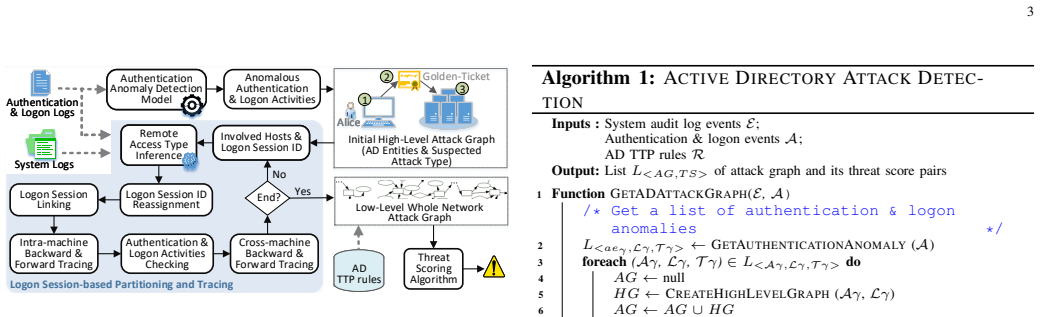
HADES is the first PIDS capable of performing accurate causality-based cross-machine tracing by leveraging logon session based execution partitioning to overcome several challenges in cross-machine tracing, supported by an on-demand design triggered by a novel authentication anomaly detection model and a triage algorithm that integrates two key insights from AD attacks.
What carries the argument
logon session based execution partitioning, which divides system executions by logon sessions to create accurate cross-machine causal relationships for whole-network provenance graphs.
If this is right
- Whole-network tracing becomes feasible only on demand rather than continuously, reducing overhead.
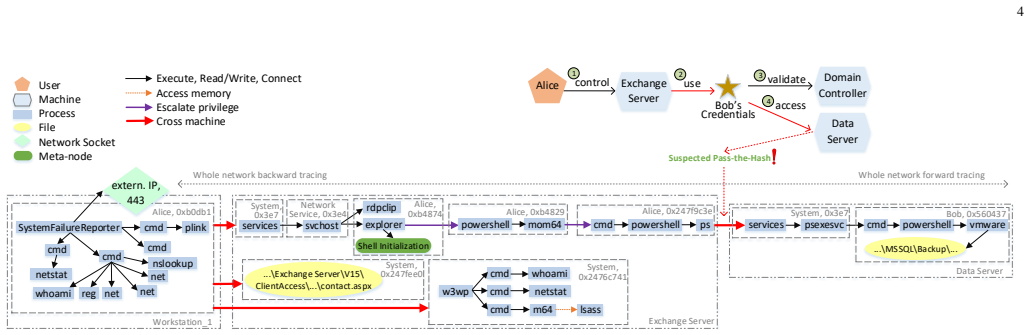
- Attackers' traversal across machines can be exposed in a single causal graph instead of isolated per-machine views.
- Authentication anomalies serve as reliable early triggers for deeper provenance analysis.
- Triage of alerts improves by incorporating two specific insights observed in AD attack patterns.
Where Pith is reading between the lines
- The partitioning approach could be tested on other centralized identity systems that rely on session-based authentication.
- Integration with existing enterprise logging would require mapping logon events to the partitioning logic without custom kernel changes.
- False linkage rates might vary with different Windows domain configurations or non-Windows clients.
Load-bearing premise
Logon session based execution partitioning correctly links events across machines in real enterprise networks without generating excessive false connections or missing genuine ones.
What would settle it
Running HADES on a labeled enterprise network trace containing a known multi-machine AD attack and observing either missed causal links or many spurious ones in the resulting graph.
Figures

read the original abstract
Due to its crucial role in identity and access management in modern enterprise networks, Active Directory (AD) is a top target of Advanced Persistence Threat (APT) actors. Conventional intrusion detection systems (IDS) excel at identifying malicious behaviors caused by malware, but often fail to detect stealthy attacks launched by APT actors. Recent advance in provenance-based IDS (PIDS) shows promises by exposing malicious system activities in causal attack graphs. However, existing approaches are restricted to intra-machine tracing, and unable to reveal the scope of attackers' traversal inside a network. We propose HADES, the first PIDS capable of performing accurate causality-based cross-machine tracing by leveraging a novel concept called logon session based execution partitioning to overcome several challenges in cross-machine tracing. We design HADES as an efficient on-demand tracing system, which performs whole-network tracing only when it first identifies an authentication anomaly signifying an ongoing AD attack, for which we introduce a novel lightweight authentication anomaly detection model rooted in our extensive analysis of AD attacks. To triage attack alerts, we present a new algorithm integrating two key insights we identified in AD attacks. Our evaluations show that HADES outperforms both popular open source detection systems and a prominent commercial AD attack detector.
Editorial analysis
A structured set of objections, weighed in public.
Referee Report
Summary. The paper introduces HADES, the first provenance-based IDS (PIDS) for Active Directory environments that performs whole-network causality-based tracing. It relies on a novel logon session based execution partitioning technique to address cross-machine tracing challenges, an on-demand design triggered by a lightweight authentication anomaly detection model derived from AD attack analysis, and a triage algorithm incorporating two key AD attack insights. Evaluations claim superior performance over open-source IDS and a commercial AD detector.
Significance. If the logon session partitioning reliably produces accurate cross-machine causal graphs without excessive false linkages or missed connections, the work would meaningfully extend PIDS beyond intra-machine limits and improve detection of stealthy APT activity in enterprise AD deployments. The on-demand architecture and empirical outperformance claims are the primary contributions; no machine-checked proofs or parameter-free derivations are present.
major comments (2)
- [Evaluation / Design] The central claim that logon session based execution partitioning enables accurate cross-machine causality (abstract and design sections) rests on the assumption that session boundaries correctly capture inter-machine dependencies in real enterprise logs. The evaluation must report concrete metrics (e.g., precision/recall of cross-machine edges against ground-truth attack graphs) rather than only end-to-end detection rates; without these, the outperformance claim cannot be isolated from possible over- or under-linkage artifacts.
- [Anomaly Detection Model] The lightweight authentication anomaly detection model is described as rooted in extensive AD attack analysis, yet no quantitative breakdown (false-positive rates on benign logon patterns, feature importance, or comparison to standard AD event baselines) is referenced in the abstract. This model triggers the expensive whole-network tracing, so its accuracy directly affects system practicality and must be validated on representative enterprise traces.
minor comments (2)
- [System Overview] Clarify the exact provenance data sources (e.g., Windows event logs, Sysmon) and any preprocessing steps for logon session extraction in the system overview.
- [Evaluation] The abstract states outperformance over 'popular open source detection systems' and 'a prominent commercial AD attack detector'; name the specific baselines and report the evaluation metrics (F1, detection latency, etc.) with dataset sizes and attack coverage.
Simulated Author's Rebuttal
We thank the referee for the constructive feedback on our evaluation of cross-machine causality and the anomaly detection model. We address each major comment below, indicating where revisions will be made to strengthen the manuscript.
read point-by-point responses
-
Referee: [Evaluation / Design] The central claim that logon session based execution partitioning enables accurate cross-machine causality (abstract and design sections) rests on the assumption that session boundaries correctly capture inter-machine dependencies in real enterprise logs. The evaluation must report concrete metrics (e.g., precision/recall of cross-machine edges against ground-truth attack graphs) rather than only end-to-end detection rates; without these, the outperformance claim cannot be isolated from possible over- or under-linkage artifacts.
Authors: We agree that reporting precision and recall for cross-machine edges against ground-truth would better isolate the contribution of logon session partitioning. Our evaluations emphasize end-to-end detection on realistic AD attack scenarios because constructing comprehensive ground-truth cross-machine attack graphs requires extensive manual labeling not available in standard datasets. In the revision we will add a dedicated analysis subsection that measures edge-level accuracy on a manually inspected subset of traces, quantifies observed false linkages in benign traffic, and discusses the practical challenges of ground-truth construction. This will clarify the reliability of the partitioning technique. revision: yes
-
Referee: [Anomaly Detection Model] The lightweight authentication anomaly detection model is described as rooted in extensive AD attack analysis, yet no quantitative breakdown (false-positive rates on benign logon patterns, feature importance, or comparison to standard AD event baselines) is referenced in the abstract. This model triggers the expensive whole-network tracing, so its accuracy directly affects system practicality and must be validated on representative enterprise traces.
Authors: The abstract summarizes the model as derived from AD attack analysis but does not include quantitative metrics. The full manuscript evaluates the model on enterprise traces and reports low false-positive rates that make on-demand tracing practical. We will revise the abstract to explicitly reference these metrics (false-positive rates on benign patterns and comparison to AD event baselines) and expand the evaluation section with feature importance results if not already detailed. This addresses the concern that the trigger mechanism's accuracy must be validated. revision: yes
Circularity Check
No significant circularity; system design and empirical claims are self-contained
full rationale
The paper presents HADES as a system design leveraging a novel logon session based execution partitioning for cross-machine tracing, an authentication anomaly detection model, and a triage algorithm, supported by evaluations against baselines. No equations, fitted parameters, or derivations are described that reduce claims to self-referential inputs. The central claims rest on the described construction and empirical results rather than any self-citation chain, uniqueness theorem, or renaming of known results. The provided text contains no load-bearing self-citations or ansatzes smuggled via prior work by the same authors.
Axiom & Free-Parameter Ledger
invented entities (1)
-
logon session based execution partitioning
no independent evidence
Lean theorems connected to this paper
-
IndisputableMonolith/Foundation/RealityFromDistinction.leanreality_from_one_distinction unclear?
unclearRelation between the paper passage and the cited Recognition theorem.
We propose HADES, the first PIDS capable of performing accurate causality-based cross-machine tracing by leveraging a novel concept called logon session based execution partitioning
-
IndisputableMonolith/Cost/FunctionalEquation.leanwashburn_uniqueness_aczel unclear?
unclearRelation between the paper passage and the cited Recognition theorem.
logon session ID reassignment module, and a logon session linking module
What do these tags mean?
- matches
- The paper's claim is directly supported by a theorem in the formal canon.
- supports
- The theorem supports part of the paper's argument, but the paper may add assumptions or extra steps.
- extends
- The paper goes beyond the formal theorem; the theorem is a base layer rather than the whole result.
- uses
- The paper appears to rely on the theorem as machinery.
- contradicts
- The paper's claim conflicts with a theorem or certificate in the canon.
- unclear
- Pith found a possible connection, but the passage is too broad, indirect, or ambiguous to say the theorem truly supports the claim.
Reference graph
Works this paper leans on
-
[1]
CrowdStrike 2023 Global Threat Report
CrowdStrike, Inc. CrowdStrike 2023 Global Threat Report
work page 2023
-
[2]
[Online]. Available: https : / / www . crowdstrike . com / global-threat-report/
-
[3]
CrowdStrike 2023 Threat Hunting Report
CrowdStrike, Inc. CrowdStrike 2023 Threat Hunting Report
work page 2023
-
[4]
[Online]. Available: https : / / www . crowdstrike . com / resources/reports/threat-hunting-report/
-
[5]
Attackers Set Sights on Active Directory: Un- derstanding Your Identity Exposure
Venu Shastri. Attackers Set Sights on Active Directory: Un- derstanding Your Identity Exposure . Accessed: Dec. 2023. [Online]. Available: https : / / www . crowdstrike . com / blog / attackers-set-sights-on-active-directory-understanding-your- identity-exposure/
work page 2023
-
[6]
Endpoint and Identity Security: A Critical Combination to Stop Modern Attacks
Venu Shastri. Endpoint and Identity Security: A Critical Combination to Stop Modern Attacks . Accessed: Dec. 2023. [Online]. Available: https : / / www . crowdstrike . com / blog / unifying-endpoint-and-identity-security/
work page 2023
- [7]
-
[8]
Available: https://attack.mitre.org/techniques/ T1558/003/
[Online]. Available: https://attack.mitre.org/techniques/ T1558/003/
- [9]
-
[10]
Available: https://attack.mitre.org/techniques/ T1550/002/
[Online]. Available: https://attack.mitre.org/techniques/ T1550/002/
-
[11]
Active Directory Holds the Keys to your Kingdom, but is it Secure? 2020
Swetha Krishnamoorthi and Jarad Carleton. Active Directory Holds the Keys to your Kingdom, but is it Secure? 2020. [Online]. Available: https://www.frost.com/frost-perspectives/ active-directory-holds-the-keys-to-your-kingdom-but-is-it- secure/
work page 2020
- [12]
-
[13]
Microsoft. Setspn. Accessed: Jan. 2024. [Online]. Available: https://learn.microsoft.com/en-us/previous-versions/windows/ it- pro/windows- server- 2012- r2- and- 2012/cc731241(v=ws. 11)
work page 2024
-
[14]
8 LOLBins Every Threat Hunter Should Know
Falcon OverWatch Team. 8 LOLBins Every Threat Hunter Should Know. Accessed: May 2023. [Online]. Available: https: //www.crowdstrike.com/blog/8-lolbins-every-threat-hunter- should-know/
work page 2023
-
[15]
Trellix. Trellix Threat Report 2023. 2023. [Online]. Available: https : / / www. trellix . com / advanced - research - center / threat - reports/feb-2023/
work page 2023
-
[16]
The MITRE Corporation. MITRE Matrix. Accessed: Jan. 2023. [Online]. Available: https : / / attack . mitre . org / matrices / enterprise/
work page 2023
-
[17]
ProTracer: Towards practical provenance tracing by alternating between logging and tainting
Shiqing Ma, Xiangyu Zhang, and Dongyan Xu. “ProTracer: Towards practical provenance tracing by alternating between logging and tainting”. In: Network and Distributed System Security (NDSS). 2016, pp. 1–15. 12
work page 2016
-
[18]
SLEUTH: Real-time attack scenario re- construction from COTS audit data
Md Nahid Hossain, Sadegh M Milajerdi, Junao Wang, Birhanu Eshete, Rigel Gjomemo, R Sekar, Scott D Stoller, and VN Venkatakrishnan. “SLEUTH: Real-time attack scenario re- construction from COTS audit data”. In: USENIX Security Symposium. 2017, pp. 487–504
work page 2017
-
[19]
Towards scalable cluster audit- ing through grammatical inference over provenance graphs
Wajih Ul Hassan, LeMay Mark, Nuraini Aguse, Adam Bates, and Thomas Moyer. “Towards scalable cluster audit- ing through grammatical inference over provenance graphs”. In: Network and Distributed System Security (NDSS) . 2018, pp. 1–15
work page 2018
-
[20]
HOLMES: Real-Time APT Detec- tion through Correlation of Suspicious Information Flows
S. M. Milajerdi, R. Gjomemo, B. Eshete, R. Sekar, and V . N. Venkatakrishnan. “HOLMES: Real-Time APT Detec- tion through Correlation of Suspicious Information Flows”. In: IEEE Symposium on Security and Privacy (S&P) . 2019, pp. 1137–1152
work page 2019
-
[21]
NoDoze: Com- batting threat alert fatigue with automated provenance triage
Wajih Ul Hassan, Shengjian Guo, Ding Li, Zhengzhang Chen, Kangkook Jee, Zhichun Li, and Adam Bates. “NoDoze: Com- batting threat alert fatigue with automated provenance triage”. In: Network and Distributed System Security (NDSS) . 2019, pp. 1–15
work page 2019
-
[22]
Tactical Provenance Analysis for Endpoint Detection and Response Systems
Wajih Ul Hassan, Adam Bates, and Daniel Marino. “Tactical Provenance Analysis for Endpoint Detection and Response Systems”. In: IEEE Symposium on Security and Privacy (S&P). 2020, pp. 1172–1189
work page 2020
-
[23]
Combating Dependence Explosion in Forensic Analysis Using Alternative Tag Propagation Semantics
Md Nahid Hossain, Sanaz Sheikhi, and R Sekar. “Combating Dependence Explosion in Forensic Analysis Using Alternative Tag Propagation Semantics”. In: IEEE Symposium on Security and Privacy (S&P) . 2020, pp. 1139–1155
work page 2020
-
[24]
KAIROS: Practical Intrusion Detection and Investi- gation using Whole-system Provenance
Z. Cheng, Q. Lv, J. Liang, Y . Wang, D. Sun, T. Pasquier, and X. Han. “KAIROS: Practical Intrusion Detection and Investi- gation using Whole-system Provenance”. In: IEEE Symposium on Security and Privacy (S&P) . 2024, pp. 9–28
work page 2024
-
[25]
M. Rehman, H. Ahmadi, and W. Hassan. “FLASH: A Compre- hensive Approach to Intrusion Detection via Provenance Graph Representation Learning”. In: IEEE Symposium on Security and Privacy (S&P) . 2024, pp. 142–161
work page 2024
-
[26]
Shade- watcher: Recommendation-guided cyber threat analysis using system audit records
Jun Zeng, Xiang Wang, Jiahao Liu, Yinfang Chen, Zhenkai Liang, Tat-Seng Chua, and Zheng Leong Chua. “Shade- watcher: Recommendation-guided cyber threat analysis using system audit records”. In: IEEE Symposium on Security and Privacy (S&P). 2022, pp. 489–506
work page 2022
-
[27]
PROGRAPHER: An Anomaly Detection System based on Provenance Graph Embedding
Fan Yang, Jiacen Xu, Chunlin Xiong, Zhou Li, and Ke- huan Zhang. “PROGRAPHER: An Anomaly Detection System based on Provenance Graph Embedding”. In:USENIX Security Symposium. 2023, pp. 4355–4372
work page 2023
-
[28]
Feng Dong, Shaofei Li, Peng Jiang, Ding Li, Haoyu Wang, Liangyi Huang, Xusheng Xiao, Jiedong Chen, Xiapu Luo, Yao Guo, and Xiangqun Chen. “Are we there yet? An In- dustrial Viewpoint on Provenance-based Endpoint Detection and Response Tools”. In: ACM Conference on Computer and Communications Security (CCS) . 2023, pp. 2396–2410
work page 2023
-
[29]
High accuracy attack provenance via binary-based execution parti- tion
Kyu Hyung Lee, Xiangyu Zhang, and Dongyan Xu. “High accuracy attack provenance via binary-based execution parti- tion”. In: Network and Distributed System Security (NDSS) . 2013, pp. 1–16
work page 2013
-
[30]
Accurate, low cost and instrumentation-free security audit logging for Windows
Shiqing Ma, Kyu Hyung Lee, Chung Hwan Kim, Junghwan Rhee, Xiangyu Zhang, and Dongyan Xu. “Accurate, low cost and instrumentation-free security audit logging for Windows”. In: Annual Computer Security Applications Conference (AC- SAC). 2015, pp. 401–410
work page 2015
-
[31]
TRACE: Enterprise-Wide Provenance Tracking for Real-Time APT Detection
Hassaan Irshad, Gabriela Ciocarlie, Ashish Gehani, Vinod Yegneswaran, Kyu Hyung Lee, Jignesh Patel, Somesh Jha, Yonghwi Kwon, Dongyan Xu, and Xiangyu Zhang. “TRACE: Enterprise-Wide Provenance Tracking for Real-Time APT Detection”. In: IEEE Transactions on Information Forensics and Security 16 (2021), pp. 4363–4376
work page 2021
-
[32]
99% False Positives: A Qualitative Study of SOC Analysts’ Perspectives on Security Alarms
Bushra A. Alahmadi, Louise Axon, and Ivan Martinovic. “99% False Positives: A Qualitative Study of SOC Analysts’ Perspectives on Security Alarms”. In: USENIX Security Sym- posium. 2022, pp. 2783–2800
work page 2022
-
[33]
Elastic. Elastic Detection Rules . Accessed: Sept. 2023. [On- line]. Available: https://github.com/elastic/detection-rules
work page 2023
-
[34]
SigmaHQ. Sigma. Accessed: Sept. 2023. [Online]. Available: https://github.com/SigmaHQ/sigma
work page 2023
-
[35]
Why 86% of Organizations Are Increasing Their Investment in Active Directory Security
Michele Crockett. Why 86% of Organizations Are Increasing Their Investment in Active Directory Security . Accessed: Dec
-
[36]
[Online]. Available: https://securityboulevard.com/2021/ 11/why-86-of-organizations-are-increasing-their-investment- in-active-directory-security/
work page 2021
-
[37]
noPac Exploit: Latest Microsoft AD Flaw May Lead to Total Domain Compromise in Seconds
Alex Talyanski. noPac Exploit: Latest Microsoft AD Flaw May Lead to Total Domain Compromise in Seconds. Accessed: June
-
[38]
[Online]. Available: https://www.crowdstrike.com/blog/ nopac- exploit- latest- microsoft- ad- flaw- may- lead- to- total- domain-compromise/
-
[39]
A gloabl threat to enterprises: the impact of Active Directory attacks
Tenable, Inc. A gloabl threat to enterprises: the impact of Active Directory attacks . Accessed: June 2024. [Online]. Available: https://de.tenable.com/whitepapers/a-global-threat- to-enterprises-the-impact-of-ad-attacks?page=2
work page 2024
-
[40]
UNICORN: Runtime Provenance-Based Detector for Advanced Persistent Threats
Xueyan Han, Thomas Pasqueir, Adam Bates, James Mickens, and Margo Seltzer. “UNICORN: Runtime Provenance-Based Detector for Advanced Persistent Threats”. In: Network and Distributed System Security (NDSS) . 2020, pp. 1–18
work page 2020
-
[41]
The MITRE Corporation. Oilrig emulation plan . Accessed: Oct. 2023. [Online]. Available: https : / / github. com / center - for-threat-informed-defense/adversary emulation library/tree/ master/oilrig
work page 2023
-
[42]
The MITRE Corporation. Golden Ticket. Accessed: Jan. 2024. [Online]. Available: https://attack.mitre.org/techniques/T1558/ 001/
work page 2024
-
[43]
SoK: History is a Vast Early Warning System: Auditing the Provenance of System Intrusions
Muhammad Adil Inam, Yinfang Chen, Akul Goyal, Jason Liu, Jaron Mink, Noor Michael, Sneha Gaur, Adam Bates, and Wajih Ul Hassan. “SoK: History is a Vast Early Warning System: Auditing the Provenance of System Intrusions”. In: IEEE Symposium on Security and Privacy (S&P) . 2023, pp. 2620–2638
work page 2023
-
[44]
Microsoft. Security auditing . Accessed: May 2023. [Online]. Available: https : / / learn . microsoft . com / en - us / previous - versions / windows / it - pro / windows - 10 / security / threat - protection/auditing/security-auditing-overview
work page 2023
-
[45]
Microsoft. LSA Logon Sessions . Accessed: Feb. 2024. [On- line]. Available: https://learn.microsoft.com/en-us/windows/ win32/secauthn/lsa-logon-sessions
work page 2024
-
[46]
Russinovich and Aaron Margosis
Mark E. Russinovich and Aaron Margosis. Troubleshooting with the Windows Sysinternals Tools, 2nd Edition . Microsoft Press, 2016
work page 2016
-
[47]
Solomon, Kate Chase, and Mark E
Andrea Allievi, Alex Ionescu, David A. Solomon, Kate Chase, and Mark E. Russinovich. Windows Internals, Part 2, 7th Edition. Microsoft Press, 2022
work page 2022
-
[48]
Windows Security Monitoring: Scenarios and Patterns
Andrei Miroshnikov. Windows Security Monitoring: Scenarios and Patterns. Wiley, 2018
work page 2018
-
[49]
Windows Security Internals: A Deep Dive into Windows Authentication, Authorization, and Auditing
James Forshaw. Windows Security Internals: A Deep Dive into Windows Authentication, Authorization, and Auditing . No Starch Press, 2024
work page 2024
- [50]
-
[51]
Microsoft. Fast User Switching . Accessed: Feb. 2024. [On- line]. Available: https://learn.microsoft.com/en-us/windows/ win32/shell/fast-user-switching
work page 2024
-
[52]
Microsoft. User Account Control . Accessed: Feb. 2024. [On- line]. Available: https://learn.microsoft.com/en-us/windows/ security/application-security/application-control/user-account- control/
work page 2024
-
[53]
The MITRE Corporation. MITRE ATT&CK Campaigns . Ac- cessed: May 2024. [Online]. Available: https://attack.mitre. org/campaigns/
work page 2024
-
[54]
Elastic NV. Elasticsearch. Accessed: Sept. 2023. [Online]. Available: https://www.elastic.co/. 13
work page 2023
-
[55]
Elastic NV. EQL search . Accessed: Sept. 2023. [Online]. Available: https : / / www. elastic . co / guide / en / elasticsearch / reference/current/eql.html
work page 2023
-
[56]
Mark Russinovich and Thomas Garnier. System Monitor. Ac- cessed: Feb. 2023. [Online]. Available: https://learn.microsoft. com/en-us/sysinternals/downloads/sysmon
work page 2023
-
[57]
Sean Wheeler and Mikey Lombardi. About Logging Windows. Accessed: April 2023. [Online]. Available: https : / / learn . microsoft.com/en-us/powershell/module/microsoft.powershell. core/about/about logging windows?view=powershell-7.3
work page 2023
- [58]
- [59]
-
[60]
[Online]. Available: https : / / github . com / darpa - i2o / Transparent-Computing
-
[61]
Mike van Opstal and William Arbaugh. DARPA OpTC. Ac- cessed: Sept. 2023. [Online]. Available: https://github.com/ FiveDirections/OpTC-data
work page 2023
-
[62]
MITRE Adversary Emulation Li- brary
The MITRE Corporation. MITRE Adversary Emulation Li- brary. Accessed: Jan. 2023. [Online]. Available: https : / / github. com / center- for- threat - informed - defense / adversary emulation library
work page 2023
- [63]
-
[64]
Available: https://attackevals.mitre-engenuity
[Online]. Available: https://attackevals.mitre-engenuity. org/
-
[65]
The MITRE Corporation. APT29 emulation plan . Accessed: Oct. 2023. [Online]. Available: https : / / github. com / center - for-threat-informed-defense/adversary emulation library/tree/ master/apt29
work page 2023
-
[66]
The MITRE Corporation. WizardSpider emulation plan . Ac- cessed: Oct. 2023. [Online]. Available: https : / / github. com / center - for - threat - informed - defense / adversaryemulation library/tree/master/wizard spider
work page 2023
-
[67]
Google Security Operations. Chronicle Detection Rules . Ac- cessed: Sept. 2023. [Online]. Available: https://github.com/ chronicle/detection-rules
work page 2023
-
[68]
A different cup of TI? The added value of commercial threat intelligence
Xander Bouwman, Harm Griffioen, Jelle Egbers, Christian Doerr, Bram Klievink, and Michel van Eeten. “A different cup of TI? The added value of commercial threat intelligence”. In: USENIX Security Symposium . 2020, pp. 433–450
work page 2020
-
[69]
Magic Quadrant for Endpoint Protection Platforms
Evgeny Mirolyubov, Max Taggett, Franz Hinner, and Nikul Patel. Magic Quadrant for Endpoint Protection Platforms
-
[70]
[Online]. Available: https : / / www. gartner. com / doc / reprints?id=1-2FFCXFOM&ct=231025&st=sb
-
[71]
The Forrester New Wave: Extended Detection And Response (XDR) Providers, Q4 2021
Allie Mellen. The Forrester New Wave: Extended Detection And Response (XDR) Providers, Q4 2021 . 2021. [Online]. Available: https://www.forrester.com/report/the-forrester-new- wave-tm-extended-detection-and-response-xdr-providers-q4- 2021/RES176400
work page 2021
-
[72]
MPI: Multiple perspective attack investigation with semantic aware execution partitioning
Shiqing Ma, Juan Zhai, Fei Wang, Kyu Hyung Lee, Xiangyu Zhang, and Dongyan Xu. “MPI: Multiple perspective attack investigation with semantic aware execution partitioning”. In: USENIX Security Symposium . 2017, pp. 1111–1128
work page 2017
-
[73]
Hopper: Modeling and Detecting Lateral Movement
Grant Ho, Mayank Dhiman, Devdatta Akhawe, Vern Paxson, Stefan Savage, Geoffrey M V oelker, and David A Wagner. “Hopper: Modeling and Detecting Lateral Movement”. In: USENIX Security Symposium . 2021, pp. 3093–3110
work page 2021
discussion (0)
Sign in with ORCID, Apple, or X to comment. Anyone can read and Pith papers without signing in.