A Note on Piecewise Affine Decision Rules for Robust, Stochastic, and Data-Driven Optimization
Pith reviewed 2026-05-23 20:31 UTC · model grok-4.3
The pith
An improved approximation for piecewise affine decision rules generates superior policies for multi-stage stochastic programs and extends to robust and Wasserstein data-driven settings.
A machine-rendered reading of the paper's core claim, the machinery that carries it, and where it could break.
Core claim
The central claim is that revisiting and improving the piecewise affine decision rule approximation scheme for multi-stage stochastic programs yields superior policies, while the same construction applies directly to robust optimization problems and to Wasserstein-based data-driven optimization, with the policies remaining efficiently computable.
What carries the argument
The improved piecewise affine decision rules that constitute the algorithmic framework for approximating multi-stage decision problems under uncertainty.
If this is right
- Better policies than the prior approximation become available for multi-stage stochastic programs.
- The same construction supplies policies for robust optimization problems.
- The construction also supplies policies for Wasserstein-based data-driven optimization.
- All such policies can be obtained through efficient computation.
Where Pith is reading between the lines
- The framework could be tested on other distance measures or ambiguity sets beyond Wasserstein.
- It might combine with existing dynamic programming or column-generation techniques for further scalability gains.
- Real managerial problems with sequential decisions could adopt the method once software implementations appear.
Load-bearing premise
The claimed improvements to the decision rules produce superior policies that remain efficiently computable, as the numerical experiments are said to demonstrate.
What would settle it
A set of benchmark instances in which the new policies do not outperform those from the Georghiou et al. (2015) scheme in the stochastic setting would falsify the superiority claim.
Figures
read the original abstract
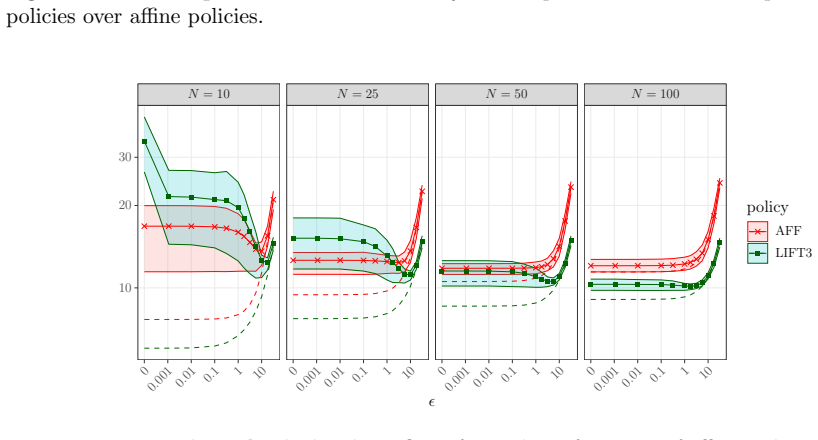
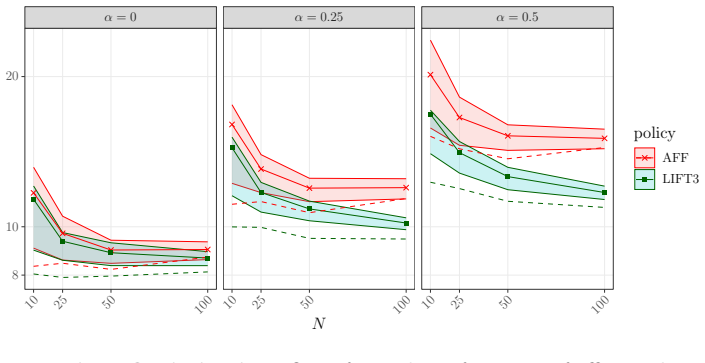
Multi-stage decision-making under uncertainty, where decisions are taken under sequentially revealing uncertain problem parameters, is often essential to faithfully model managerial problems. Given the significant computational challenges involved, these problems are typically solved approximately. This short note introduces an algorithmic framework that revisits a popular approximation scheme for multi-stage stochastic programs by Georghiou et al. (2015) and improves upon it to deliver superior policies in the stochastic setting, as well as extend its applicability to robust optimization and a contemporary Wasserstein-based data-driven setting. We demonstrate how the policies of our framework can be computed efficiently, and we present numerical experiments that highlight the benefits of our method.
Editorial analysis
A structured set of objections, weighed in public.
Referee Report
Summary. The manuscript introduces an algorithmic framework that revisits and improves the piecewise affine decision rule approximation scheme of Georghiou et al. (2015) for multi-stage stochastic programs, claiming to deliver superior policies. It extends the framework to robust optimization and Wasserstein-based data-driven settings, asserts efficient computability of the resulting policies, and supports the benefits via numerical experiments.
Significance. If the claimed improvements in policy quality and the extensions hold with proper validation, the work could provide a practical enhancement to approximation methods in multi-stage optimization under uncertainty. The unified treatment across stochastic, robust, and contemporary data-driven (Wasserstein) settings would be a useful contribution to the operations research literature on decision rules.
major comments (1)
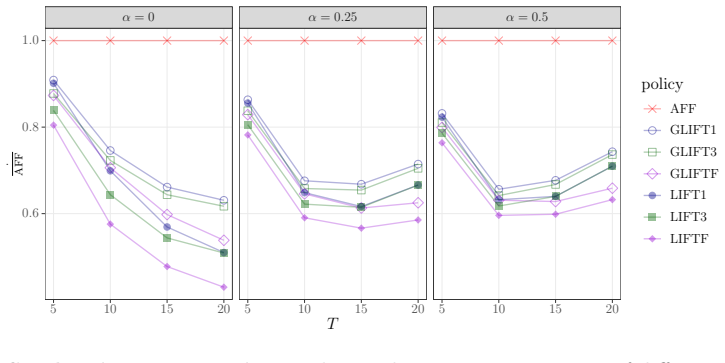
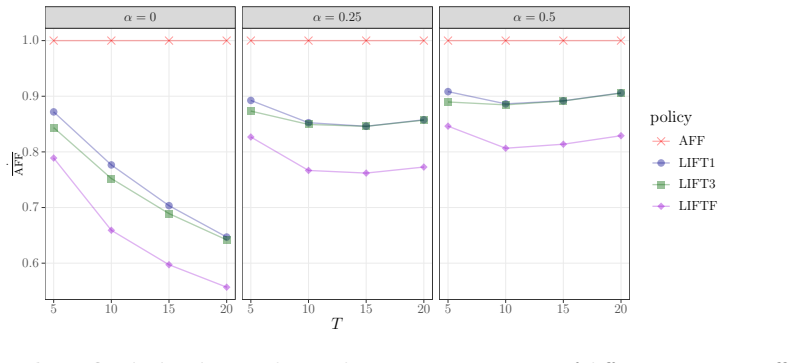
- [Numerical Experiments] Numerical Experiments section: the abstract and introduction assert that the framework delivers superior policies 'as demonstrated by numerical experiments,' but the manuscript provides no details on the experimental setup, specific algorithmic modifications relative to Georghiou et al. (2015), performance metrics, baseline methods, number of instances, or error bars/statistical significance. This is load-bearing for the central claim of improvement and extension.
minor comments (2)
- The notation for the piecewise affine decision rules and any auxiliary variables introduced in the algorithmic framework should be defined more explicitly at first use to aid readability.
- Add a short discussion of computational complexity or runtime scaling to substantiate the claim of efficient computation.
Simulated Author's Rebuttal
We thank the referee for their careful reading of the manuscript and for highlighting the need for greater detail in the numerical experiments. We address the single major comment below.
read point-by-point responses
-
Referee: [Numerical Experiments] Numerical Experiments section: the abstract and introduction assert that the framework delivers superior policies 'as demonstrated by numerical experiments,' but the manuscript provides no details on the experimental setup, specific algorithmic modifications relative to Georghiou et al. (2015), performance metrics, baseline methods, number of instances, or error bars/statistical significance. This is load-bearing for the central claim of improvement and extension.
Authors: We agree that the current short-note format provides only a high-level description of the numerical experiments and omits the requested details on setup, modifications relative to Georghiou et al. (2015), metrics, baselines, instance counts, and statistical reporting. This is a valid observation that weakens the support for the central claims. In the revised manuscript we will expand the Numerical Experiments section to supply these elements, including explicit comparisons, performance metrics, number of instances, and any error bars or significance tests that are feasible within the page constraints of a note. revision: yes
Circularity Check
No significant circularity identified
full rationale
The paper presents an algorithmic framework that revisits and improves the piecewise affine decision rule approximation from Georghiou et al. (2015) for multi-stage stochastic programs, with extensions to robust optimization and Wasserstein data-driven settings. These improvements are positioned as delivering superior policies via new algorithmic developments, supported by efficient computation methods and numerical experiments. No load-bearing step reduces by construction to fitted inputs, self-definitions, or self-citation chains; the cited prior work is external and the central claims rest on independent algorithmic contributions rather than renaming or smuggling ansatzes.
Axiom & Free-Parameter Ledger
Reference graph
Works this paper leans on
-
[1]
Bampou, D. and Kuhn, D. (2011). Scenario-free stochastic programming with polynomial decision rules. In IEEE Conference on Decision and Control and European Control Conference , pages 7806--7812, Orlando, FL. IEEE
work page 2011
-
[2]
Beck, A. and Ben-Tal, A. (2009). Duality in robust optimization: Primal worst equals dual best. Operations Research Letters , 37(1):1--6
work page 2009
-
[3]
Ben-Tal, A., Goryashko, A., Guslitzer, E., and Nemirovski, A. (2004). Adjustable robust solutions of uncertain linear programs. Mathematical Programming , 99(2):351--376
work page 2004
-
[4]
Ben-Tal, A., Housni, O. E., and Goyal, V. (2020). A tractable approach for designing piecewise affine policies in two-stage adjustable robust optimization. Mathematical Programming , 182(1-2):57--102
work page 2020
-
[5]
Bertsimas, D. and Georghiou, A. (2015). Design of near optimal decision rules in multistage adaptive mixed-integer optimization. Operations Research , 63(3):610--627
work page 2015
-
[6]
Bertsimas, D., Goyal, V., and Sun, X. A. (2011a). A geometric characterization of the power of finite adaptability in multistage stochastic and adaptive optimization. Mathematics of Operations Research , 36(1):24--54
-
[7]
Bertsimas, D., Iancu, D. A., and Parrilo, P. A. (2011b). A hierarchy of near-optimal policies for multistage adaptive optimization. IEEE Transactions on Automatic Control , 56(12):2809--2824
-
[8]
Bertsimas, D., Shtern, S., and Sturt, B. (2023). A data-driven approach to multistage stochastic linear optimization. Management Science , 69(1):51--74
work page 2023
-
[9]
Blanchet, J., Kang, Y., and Murthy, K. (2019). Robust W asserstein profile inference and applications to machine learning. Journal of Applied Probability , 56(3):830--857
work page 2019
-
[10]
Chen, X., Sim, M., Sun, P., and Zhang, J. (2008). A linear decision-based approximation approach to stochastic programming. Operations Research , 56(2):344--357
work page 2008
-
[11]
Chen, X. and Zhang, Y. (2009). Uncertain linear programs: Extended affinely adjustable robust counterparts. Operations Research , 57(6):1469--1482
work page 2009
-
[12]
Gao, R. and Kleywegt, A. (2023). Distributionally robust stochastic optimization with W asserstein distance. Mathematics of Operations Research , 48(2):603--655
work page 2023
-
[13]
Georghiou, A., Wiesemann, W., and Kuhn, D. (2015). Generalized decision rule approximations for stochastic programming via liftings. Mathematical Programming , 152(1-2):301--338
work page 2015
-
[14]
Goh, J. and Sim, M. (2010). Distributionally robust optimization and its tractable approximations. Operations Research , 58(4):902--917
work page 2010
-
[15]
Guslitser, E. (2002). Uncertainty-immunized solutions in linear programming. Master's thesis, Technion
work page 2002
-
[16]
Han, E. and Nohadani, O. (2024). Nonlinear decision rules made scalable by nonparametric liftings. Management Science , online first
work page 2024
-
[17]
Karp, R. M. (1972). Reducibility among combinatorial problems. In Miller, R. E., Thatcher, J. W., and Bohlinger, J. D., editors, Complexity of Computer Computations , pages 85--103. Springer US, Boston, MA
work page 1972
-
[18]
Kuhn, D., Wiesemann, W., and Georghiou, A. (2011). Primal and dual linear decision rules in stochastic and robust optimization. Mathematical Programming , 130(1):177--209
work page 2011
-
[19]
Mohajerin Esfahani, P. and Kuhn, D. (2018). Data-driven distributionally robust optimization using the W asserstein metric: performance guarantees and tractable reformulations. Mathematical Programming , 171(1-2):115--166
work page 2018
-
[20]
Rahal, S., Papageorgiou, D. J., and Li, Z. (2021). Hybrid strategies using linear and piecewise-linear decision rules for multistage adaptive linear optimization. European Journal of Operational Research , 290(3):1014--1030
work page 2021
-
[21]
See, C.-T. and Sim, M. (2010). Robust approximation to multiperiod inventory management. Operations Research , 58(3):583--594
work page 2010
-
[22]
Thomä, S., Walther, G., and Schiffer, M. (2024). Designing tractable piecewise affine policies for multi-stage adjustable robust optimization. Mathematical Programming , online first
work page 2024
-
[23]
Vayanos, P., Kuhn, D., and Rustem, B. (2011). Decision rules for information discovery in multi-stage stochastic programming. In IEEE Conference on Decision and Control and European Control Conference , pages 7368--7373, Orlando, FL. IEEE
work page 2011
-
[24]
Zhen, J., Kuhn, D., and Wiesemann, W. (2023). A unified theory of robust and distributionally robust optimization via the primal-worst-equals-dual-best principle. Operations Research , online first
work page 2023
discussion (0)
Sign in with ORCID, Apple, or X to comment. Anyone can read and Pith papers without signing in.