Topological quantum slinky motion in resonant extended Bose-Hubbard model
Pith reviewed 2026-05-23 18:41 UTC · model grok-4.3
The pith
Resonant conditions in the extended Bose-Hubbard model turn quantum slinky motions into topological generalized SSH chains with protected edge states.
A machine-rendered reading of the paper's core claim, the machinery that carries it, and where it could break.
Core claim
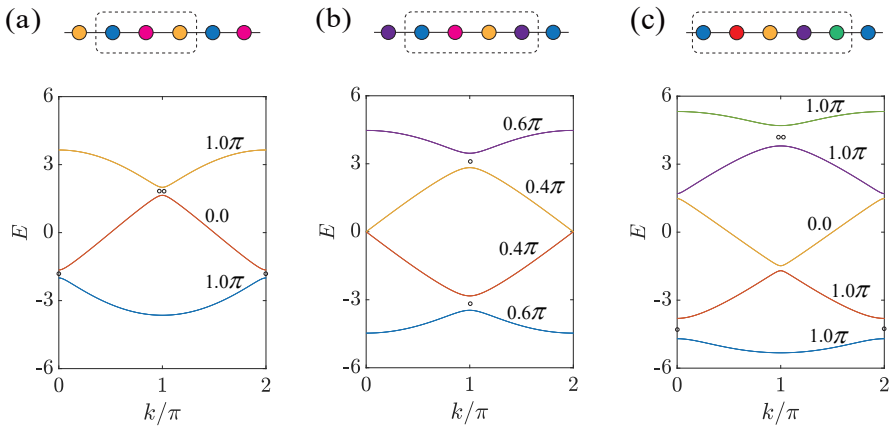
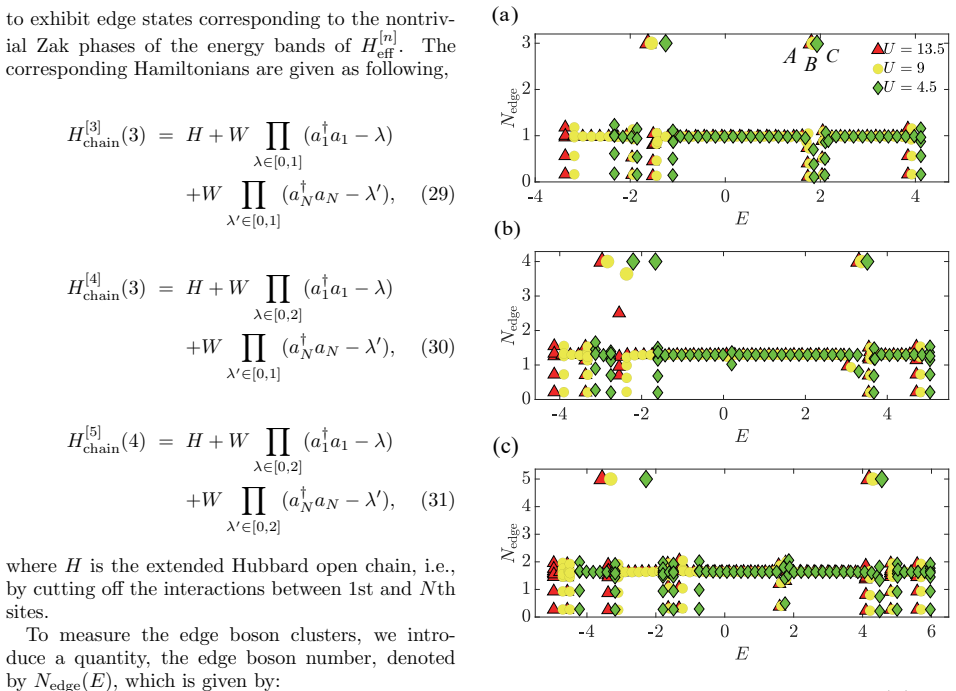
In the resonant extended Bose-Hubbard model a series of quantum slinky oscillations occur for boson numbers n from 2 to infinity. In the strong interaction limit these motions become the dominant channels for boson propagation and are described by sets of effective non-interacting Hamiltonians. The Hamiltonians are generalized Su-Schrieffer-Heeger chains with an n-site unit cell that possess non-trivial Zak phases, and the corresponding edge states are the n-boson bound states at the ends of the chains. Quench dynamics can detect these edge boson clusters.
What carries the argument
effective non-interacting generalized Su-Schrieffer-Heeger Hamiltonians with n-site unit cells derived from resonant slinky motions
If this is right
- Generalized SSH chains for each n exhibit non-trivial Zak phases.
- n-boson bound states localize at the open ends of the chains.
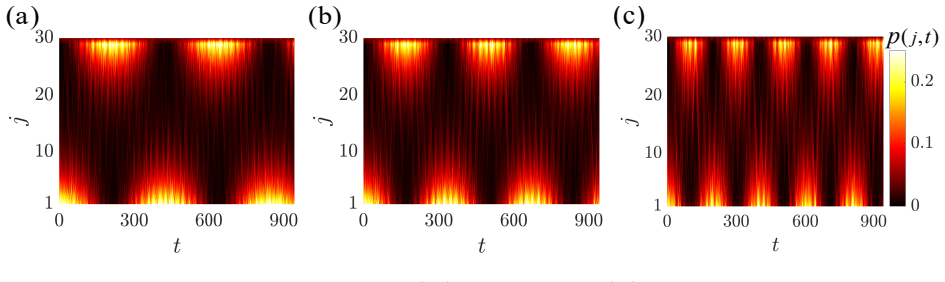
- Quench dynamics from the edge produce stable oscillations that reveal the topological features.
- The trimerization, tetramerization and higher-order cases all follow the same pattern.
Where Pith is reading between the lines
- Similar resonant conditions might produce topological protection in other interacting bosonic lattices.
- Experiments in optical lattices could test whether the predicted n-boson edge clusters survive weak perturbations.
- The mapping to non-interacting models suggests that interaction-induced topology can be engineered without additional gauge fields.
Load-bearing premise
The resonant condition allows the strong-interaction dynamics to separate cleanly into independent slinky channels each exactly equivalent to a non-interacting generalized SSH chain.
What would settle it
A numerical simulation of the full extended Bose-Hubbard model in the strong-interaction resonant regime that fails to show n-boson localization at the chain ends under open boundary conditions would falsify the effective-model claim.
Figures

read the original abstract
We study the one-dimensional Bose-Hubbard model under the resonant condition, where a series of quantum slinky oscillations occur in a two-site system for boson numbers $n\in \lbrack 2,\infty )$. In the strong interaction limit, it can be shown that the quantum slinky motions become the dominant channels for boson propagation, which are described by a set of effective non-interacting Hamiltonians. They are sets of generalized Su-Schrieffer-Heeger chains with an $n$-site unit cell, referred to as trimerization, tetramerization, and pentamerization, etc., possessing non-trivial Zak phases. The corresponding edge states are demonstrated by the $n$-boson bound states at the ends of the chains. We also investigate the dynamic detection of edge boson clusters through an analysis of quench dynamics. Numerical results indicate that stable edge oscillations clearly manifest the interaction-induced topological features within the extended Bose-Hubbard model.
Editorial analysis
A structured set of objections, weighed in public.
Referee Report
Summary. The paper examines the resonant extended one-dimensional Bose-Hubbard model and shows that, in the strong-interaction limit, quantum slinky oscillations become the dominant propagation channels. These are mapped onto a family of effective non-interacting generalized Su-Schrieffer-Heeger (SSH) chains with n-site unit cells (trimerization, tetramerization, etc.) that possess non-trivial Zak phases; the associated topological edge states appear as n-boson bound states localized at the chain ends. Quench dynamics are analyzed numerically to detect these edge boson clusters.
Significance. If the effective-model mapping is controlled, the work supplies a concrete mechanism by which resonant conditions in an interacting bosonic lattice generate interaction-induced topological bands whose edge states are multi-particle bound states. This extends the SSH paradigm to n-boson clusters and offers a route to experimental detection via quench protocols in cold-atom systems. The numerical evidence for stable edge oscillations is a positive feature.
major comments (3)
- [Section deriving the effective Hamiltonians] The central claim that the resonant condition produces exactly non-interacting generalized SSH Hamiltonians (no residual density-density, pair-hopping, or inter-channel terms) is load-bearing for the Zak-phase and edge-state conclusions. The manuscript must supply the explicit effective Hamiltonian (or the Schrieffer-Wolff generator) together with the order in 1/U at which all unwanted terms vanish; otherwise the non-interacting character and the applicability of single-particle topological invariants remain unverified.
- [Zak-phase and band-structure section] For the n-site generalized SSH chains, the Zak phase is stated to be non-trivial, yet the manuscript does not specify the Brillouin-zone integration formula employed, the gauge choice, or the parameter window in which the phase is quantized away from 0 or π. This detail is required to confirm that the topology survives the projection from the microscopic model.
- [Edge-state and bound-state analysis] The identification of n-boson bound states as the topological edge modes relies on the effective chains being decoupled. Any surviving inter-channel coupling at the working perturbative order would mix the channels and potentially delocalize or destabilize the claimed edge states; the manuscript should quantify the size of such residuals (e.g., via matrix elements or energy scales).
minor comments (2)
- [Introduction / abstract] The abstract states n ∈ [2, ∞); the text should clarify whether the n=1 case is excluded by the resonance condition or simply outside the scope.
- [Model definition] Notation for the extended Bose-Hubbard parameters (U, V, J, resonance detuning) should be collected in a single table or equation block for easy reference.
Simulated Author's Rebuttal
We thank the referee for the detailed and constructive report. We address each major comment below and will revise the manuscript to incorporate the requested clarifications and explicit derivations.
read point-by-point responses
-
Referee: [Section deriving the effective Hamiltonians] The central claim that the resonant condition produces exactly non-interacting generalized SSH Hamiltonians (no residual density-density, pair-hopping, or inter-channel terms) is load-bearing for the Zak-phase and edge-state conclusions. The manuscript must supply the explicit effective Hamiltonian (or the Schrieffer-Wolff generator) together with the order in 1/U at which all unwanted terms vanish; otherwise the non-interacting character and the applicability of single-particle topological invariants remain unverified.
Authors: We agree that the explicit form of the effective Hamiltonian and the perturbative order must be stated clearly. In the revised manuscript we will add the Schrieffer-Wolff generator together with the explicit effective Hamiltonian for each n-boson channel, demonstrating that all residual density-density, pair-hopping and inter-channel terms vanish at order 1/U. This establishes the non-interacting character of the generalized SSH chains at the working perturbative order. revision: yes
-
Referee: [Zak-phase and band-structure section] For the n-site generalized SSH chains, the Zak phase is stated to be non-trivial, yet the manuscript does not specify the Brillouin-zone integration formula employed, the gauge choice, or the parameter window in which the phase is quantized away from 0 or π. This detail is required to confirm that the topology survives the projection from the microscopic model.
Authors: We will expand the Zak-phase section to include the explicit Brillouin-zone integration formula, the periodic gauge choice for the Bloch wavefunctions, and the parameter window (hopping-amplitude ratios) in which the Zak phase is quantized to π. This will confirm that the non-trivial topology is inherited by the effective model. revision: yes
-
Referee: [Edge-state and bound-state analysis] The identification of n-boson bound states as the topological edge modes relies on the effective chains being decoupled. Any surviving inter-channel coupling at the working perturbative order would mix the channels and potentially delocalize or destabilize the claimed edge states; the manuscript should quantify the size of such residuals (e.g., via matrix elements or energy scales).
Authors: We will add a quantitative estimate of residual inter-channel matrix elements, showing that they appear only at O(1/U²) and remain negligible compared with the intra-channel hopping scales throughout the strong-interaction regime. This supports the decoupling of the n-boson channels and the stability of the edge states. revision: yes
Circularity Check
No circularity: effective SSH mapping derived from microscopic resonant condition without reduction to fitted inputs or self-citations.
full rationale
The paper states that under the resonant condition in the strong-interaction limit, slinky motions map to effective non-interacting generalized SSH Hamiltonians with n-site cells, from which Zak phases and edge states follow. This mapping is presented as derivable from the Bose-Hubbard Hamiltonian via the resonant condition and perturbation, without any equation reducing the claimed effective model or topological invariants to a parameter fitted from the same data or to a self-citation chain. The derivation chain remains self-contained against the microscopic model and standard SSH properties.
Axiom & Free-Parameter Ledger
axioms (2)
- domain assumption Strong interaction limit allows reduction to effective non-interacting Hamiltonians for slinky channels
- domain assumption Resonant condition produces a series of quantum slinky oscillations for n greater than or equal to 2
Lean theorems connected to this paper
-
IndisputableMonolith/Foundation/AbsoluteFloorClosure.leanreality_from_one_distinction unclear?
unclearRelation between the paper passage and the cited Recognition theorem.
quantum slinky motions become the dominant channels... sets of generalized Su-Schrieffer-Heeger chains with an n-site unit cell... non-trivial Zak phases
-
IndisputableMonolith/Foundation/AlexanderDuality.leanalexander_duality_circle_linking unclear?
unclearRelation between the paper passage and the cited Recognition theorem.
effective non-interacting Hamiltonians... trimerization, tetramerization... Zak phases
What do these tags mean?
- matches
- The paper's claim is directly supported by a theorem in the formal canon.
- supports
- The theorem supports part of the paper's argument, but the paper may add assumptions or extra steps.
- extends
- The paper goes beyond the formal theorem; the theorem is a base layer rather than the whole result.
- uses
- The paper appears to rely on the theorem as machinery.
- contradicts
- The paper's claim conflicts with a theorem or certificate in the canon.
- unclear
- Pith found a possible connection, but the passage is too broad, indirect, or ambiguous to say the theorem truly supports the claim.
Reference graph
Works this paper leans on
-
[1]
Quantized hall conductance in a two-dimensional periodic potential,
D. J. Thouless, M. Kohmoto, M. P. Nightingale, and M. den Nijs, “Quantized hall conductance in a two-dimensional periodic potential,” Physical Re- view Letters 49, 405–408 (1982)
work page 1982
-
[2]
Unpaired majorana fermions in quan- tum wires,
A Yu Kitaev, “Unpaired majorana fermions in quan- tum wires,” Physics-Uspekhi 44, 131–136 (2001)
work page 2001
-
[3]
Topological origin of zero-energy edge states in particle-hole symmetric systems,
Shinsei Ryu and Yasuhiro Hatsugai, “Topological origin of zero-energy edge states in particle-hole symmetric systems,” Physical Review Letters 89, 077002 (2002)
work page 2002
-
[4]
Quan- tum phase transition from a superfluid to a mott insulator in a gas of ultracold atoms,
Markus Greiner, Olaf Mandel, Tilman Esslinger, Theodor W. H¨ ansch, and Immanuel Bloch, “Quan- tum phase transition from a superfluid to a mott insulator in a gas of ultracold atoms,” Nature 415, 39–44 (2002)
work page 2002
-
[5]
Shuichi Murakami, Naoto Nagaosa, and Shou- Cheng Zhang, “Spin-hall insulator,” Physical Re- view Letters 93, 156804 (2004)
work page 2004
-
[6]
Quantum spin hall effect in graphene,
C. L. Kane and E. J. Mele, “Quantum spin hall effect in graphene,” Physical Review Letters 95, 226801 (2005)
work page 2005
-
[7]
Quantum spin hall effect and topo- logical phase transition in hgte quantum wells,
B. Andrei Bernevig, Taylor L. Hughes, and Shou- Cheng Zhang, “Quantum spin hall effect and topo- logical phase transition in hgte quantum wells,” Sci- ence 314, 1757–1761 (2006)
work page 2006
-
[8]
Topological insulators with inversion symmetry,
Liang Fu and C. L. Kane, “Topological insulators with inversion symmetry,” Physical Review B 76, 045302 (2007)
work page 2007
-
[9]
Topologi- cal insulators in three dimensions,
Liang Fu, C. L. Kane, and E. J. Mele, “Topologi- cal insulators in three dimensions,” Physical Review Letters 98, 106803 (2007)
work page 2007
-
[10]
Classification of topo- logical insulators and superconductors in three spa- tial dimensions,
Andreas P. Schnyder, Shinsei Ryu, Akira Furusaki, and Andreas W. W. Ludwig, “Classification of topo- logical insulators and superconductors in three spa- tial dimensions,” Physical Review B 78, 195125 (2008)
work page 2008
-
[11]
Topological insula- tors and superconductors: tenfold way and di- mensional hierarchy,
Shinsei Ryu, Andreas P Schnyder, Akira Furusaki, and Andreas W W Ludwig, “Topological insula- tors and superconductors: tenfold way and di- mensional hierarchy,” New Journal of Physics 12, 065010 (2010)
work page 2010
-
[12]
Colloquium: Topo- logical insulators,
M. Z. Hasan and C. L. Kane, “Colloquium: Topo- logical insulators,” Reviews of Modern Physics 82, 3045–3067 (2010)
work page 2010
-
[13]
Topological insulators and superconductors,
Xiao-Liang Qi and Shou-Cheng Zhang, “Topological insulators and superconductors,” Reviews of Mod- ern Physics 83, 1057–1110 (2011)
work page 2011
-
[14]
Chern semimetal and the quan- tized anomalous hall effect inhgcr2se4,
Gang Xu, Hongming Weng, Zhijun Wang, Xi Dai, and Zhong Fang, “Chern semimetal and the quan- tized anomalous hall effect inhgcr2se4,” Physical Review Letters 107, 186806 (2011)
work page 2011
-
[15]
Weyl semimetal in a topological insulator multilayer,
A. A. Burkov and Leon Balents, “Weyl semimetal in a topological insulator multilayer,” Physical Review Letters 107, 127205 (2011)
work page 2011
-
[16]
Dirac semimetal in three dimensions,
S. M. Young, S. Zaheer, J. C. Y. Teo, C. L. Kane, E. J. Mele, and A. M. Rappe, “Dirac semimetal in three dimensions,” Physical Review Letters 108, 140405 (2012)
work page 2012
-
[17]
Dirac semimetal and topologi- cal phase transitions ina3bi (a=na, k, rb),
Zhijun Wang, Yan Sun, Xing-Qiu Chen, Cesare Franchini, Gang Xu, Hongming Weng, Xi Dai, and Zhong Fang, “Dirac semimetal and topologi- cal phase transitions ina3bi (a=na, k, rb),” Physical Review B 85, 195320 (2012)
work page 2012
-
[18]
Three-dimensional dirac semimetal and quantum transport in cd3as2,
Zhijun Wang, Hongming Weng, Quansheng Wu, Xi Dai, and Zhong Fang, “Three-dimensional dirac semimetal and quantum transport in cd3as2,” Phys- ical Review B 88, 125427 (2013)
work page 2013
-
[19]
Majo- rana modes in driven-dissipative atomic superfluids with a zero chern number,
C.-E. Bardyn, M. A. Baranov, E. Rico, A. ˙Imamo˘ glu, P. Zoller, and S. Diehl, “Majo- rana modes in driven-dissipative atomic superfluids with a zero chern number,” Physical Review Letters 109, 130402 (2012)
work page 2012
-
[20]
Creating, moving and merging dirac points with a fermi gas in a tunable honeycomb lattice,
Leticia Tarruell, Daniel Greif, Thomas Uehlinger, Gregor Jotzu, and Tilman Esslinger, “Creating, moving and merging dirac points with a fermi gas in a tunable honeycomb lattice,” Nature 483, 302–305 (2012)
work page 2012
-
[21]
S. Lin, X. Z. Zhang, and Z. Song, “Sudden death 9 of particle-pair bloch oscillation and unidirectional propagation in a one-dimensional driven optical lat- tice,” Physical Review A 90, 063411 (2014)
work page 2014
-
[22]
Weyl semimetal phase in noncentrosymmetric transition-metal monophos- phides,
Hongming Weng, Chen Fang, Zhong Fang, B. An- drei Bernevig, and Xi Dai, “Weyl semimetal phase in noncentrosymmetric transition-metal monophos- phides,” Physical Review X 5, 011029 (2015)
work page 2015
-
[23]
Experimental observation of weyl points,
Ling Lu, Zhiyu Wang, Dexin Ye, Lixin Ran, Liang Fu, John D. Joannopoulos, and Marin Soljaˇ ci´ c, “Experimental observation of weyl points,” Science 349, 622–624 (2015)
work page 2015
-
[24]
Anomalous topological phases and unpaired dirac cones in photonic floquet topological insulators,
Daniel Leykam, M.C. Rechtsman, and Y.D. Chong, “Anomalous topological phases and unpaired dirac cones in photonic floquet topological insulators,” Physical Review Letters 117, 013902 (2016)
work page 2016
-
[25]
Classification of topo- logical quantum matter with symmetries,
Ching-Kai Chiu, Jeffrey C.Y. Teo, Andreas P. Schnyder, and Shinsei Ryu, “Classification of topo- logical quantum matter with symmetries,” Reviews of Modern Physics 88, 035005 (2016)
work page 2016
-
[26]
Lattice models with exactly solvable topological hinge and corner states,
Flore K. Kunst, Guido van Miert, and Emil J. Bergholtz, “Lattice models with exactly solvable topological hinge and corner states,” Physical Re- view B 97, 241405 (2018)
work page 2018
-
[27]
Weyl and dirac semimetals in three-dimensional solids,
N.P. Armitage, E.J. Mele, and Ashvin Vishwanath, “Weyl and dirac semimetals in three-dimensional solids,” Reviews of Modern Physics 90, 015001 (2018)
work page 2018
-
[28]
W. P. Su, J. R. Schrieffer, and A. J. Heeger, “Soli- tons in polyacetylene,” Physical Review Letters 42, 1698–1701 (1979)
work page 1979
-
[29]
Berry’s phase for energy bands in solids,
J. Zak, “Berry’s phase for energy bands in solids,” Physical Review Letters 62, 2747–2750 (1989)
work page 1989
-
[30]
Interaction-induced topological states of photon pairs,
Andrei A. Stepanenko and Maxim A. Gorlach, “Interaction-induced topological states of photon pairs,” Physical Review A 102, 013510 (2020)
work page 2020
-
[31]
Repulsively bound atom pairs in an optical lattice,
K. Winkler, G. Thalhammer, F. Lang, R. Grimm, J. Hecker Denschlag, A. J. Daley, A. Kantian, H. P. B¨ uchler, and P. Zoller, “Repulsively bound atom pairs in an optical lattice,” Nature 441, 853–856 (2006)
work page 2006
-
[32]
Direct ob- servation of second-order atom tunnelling,
S. F¨ olling, S. Trotzky, P. Cheinet, M. Feld, R. Saers, A. Widera, T. M¨ uller, and I. Bloch, “Direct ob- servation of second-order atom tunnelling,” Nature 448, 1029–1032 (2007)
work page 2007
-
[33]
Control of interaction-induced dephasing of bloch oscillations,
M. Gustavsson, E. Haller, M. J. Mark, J. G. Danzl, G. Rojas-Kopeinig, and H.-C. N¨ agerl, “Control of interaction-induced dephasing of bloch oscillations,” Physical Review Letters 100, 080404 (2008)
work page 2008
-
[34]
Exact two-body bound states with coulomb repulsion in a periodic potential,
S M Mahajan and A Thyagaraja, “Exact two-body bound states with coulomb repulsion in a periodic potential,” Journal of Physics A: Mathematical and General 39, L667–L671 (2006)
work page 2006
-
[35]
Quantum liquid of re- pulsively bound pairs of particles in a lattice,
David Petrosyan, Bernd Schmidt, James R. Anglin, and Michael Fleischhauer, “Quantum liquid of re- pulsively bound pairs of particles in a lattice,” Phys- ical Review A 76, 033606 (2007)
work page 2007
-
[36]
Coherent control of self-trapping of cold bosonic atoms,
C. E. Creffield, “Coherent control of self-trapping of cold bosonic atoms,” Physical Review A 75, 031607 (2007)
work page 2007
-
[37]
Detecting multiatomic composite states in optical lattices,
Anatoly Kuklov and Henning Moritz, “Detecting multiatomic composite states in optical lattices,” Physical Review A 75, 013616 (2007)
work page 2007
-
[38]
Few-boson dynamics in double wells: From single-atom to correlated pair tunneling,
Sascha Z¨ ollner, Hans-Dieter Meyer, and Peter Schmelcher, “Few-boson dynamics in double wells: From single-atom to correlated pair tunneling,” Physical Review Letters 100, 040401 (2008)
work page 2008
-
[39]
Quantum dy- namics of repulsively bound atom pairs in the bose- hubbard model,
L. Wang, Y. Hao, and S. Chen, “Quantum dy- namics of repulsively bound atom pairs in the bose- hubbard model,” The European Physical Journal D 48, 229–234 (2008)
work page 2008
-
[40]
Two-particle states in the hubbard model,
M Valiente and D Petrosyan, “Two-particle states in the hubbard model,” Journal of Physics B: Atomic, Molecular and Optical Physics 41, 161002 (2008)
work page 2008
-
[41]
Coherent shift of localized bound pairs in the bose-hubbard model,
L. Jin, B. Chen, and Z. Song, “Coherent shift of localized bound pairs in the bose-hubbard model,” Physical Review A 79, 032108 (2009)
work page 2009
-
[42]
Scattering resonances and two-particle bound states of the extended hub- bard model,
M Valiente and D Petrosyan, “Scattering resonances and two-particle bound states of the extended hub- bard model,” Journal of Physics B: Atomic, Molec- ular and Optical Physics 42, 121001 (2009)
work page 2009
-
[43]
Three-body bound states in a lattice,
Manuel Valiente, David Petrosyan, and Alejan- dro Saenz, “Three-body bound states in a lattice,” Physical Review A 81, 011601 (2010)
work page 2010
-
[44]
Dimer of two bosons in a one-dimensional optical lattice,
Juha Javanainen, Otim Odong, and Jerome C. Sanders, “Dimer of two bosons in a one-dimensional optical lattice,” Physical Review A 81, 043609 (2010)
work page 2010
-
[45]
Repulsive bound- atom pairs in an optical lattice with two-body in- teraction of nearest neighbors,
Y.-M. Wang and J.-Q. Liang, “Repulsive bound- atom pairs in an optical lattice with two-body in- teraction of nearest neighbors,” Physical Review A 81, 045601 (2010)
work page 2010
-
[46]
Metastable superfluidity of repul- sive fermionic atoms in optical lattices,
Achim Rosch, David Rasch, Benedikt Binz, and Matthias Vojta, “Metastable superfluidity of repul- sive fermionic atoms in optical lattices,” Physical Review Letters 101, 265301 (2008)
work page 2008
-
[47]
Doublons bloch oscillations in the mass-imbalanced extended fermi-hubbard model,
Kun-Liang Zhang, “Doublons bloch oscillations in the mass-imbalanced extended fermi-hubbard model,” (2024), 10.48550/ARXIV.2408.08194, arXiv:2408.08194 [cond-mat.quant-gas]
-
[48]
Fast transfer and efficient co- herent separation of a bound cluster in the extended hubbard model,
L Jin and Z Song, “Fast transfer and efficient co- herent separation of a bound cluster in the extended hubbard model,” New Journal of Physics13, 063009 (2011)
work page 2011
-
[49]
Elementary excitations of a linearly conjugated diatomic polymer,
M. J. Rice and E. J. Mele, “Elementary excitations of a linearly conjugated diatomic polymer,” Physical Review Letters 49, 1455–1459 (1982)
work page 1982
-
[50]
Berry phase effects on electronic properties,
Di Xiao, Ming-Che Chang, and Qian Niu, “Berry phase effects on electronic properties,” Reviews of Modern Physics 82, 1959–2007 (2010)
work page 1959
-
[51]
Dynam- ical bulk-edge correspondence for degeneracy lines in parameter space,
R. Wang, C. Li, X. Z. Zhang, and Z. Song, “Dynam- ical bulk-edge correspondence for degeneracy lines in parameter space,” Physical Review B 98, 014303 (2018)
work page 2018
-
[52]
Dynamical topological invariant for the non-hermitian rice-mele model,
R. Wang, X. Z. Zhang, and Z. Song, “Dynamical topological invariant for the non-hermitian rice-mele model,” Physical Review A 98, 042120 (2018). 10
work page 2018
discussion (0)
Sign in with ORCID, Apple, or X to comment. Anyone can read and Pith papers without signing in.