Detecting State Changes in Functional Neuronal Connectivity using Factorial Switching Linear Dynamical Systems
Pith reviewed 2026-05-23 17:25 UTC · model grok-4.3
The pith
A factorial switching linear dynamical system models multiple subnetworks activating at once to detect changes in neuronal connectivity.
A machine-rendered reading of the paper's core claim, the machinery that carries it, and where it could break.
Core claim
Neuronal activity arises from multiple subnetworks that activate jointly or independently, and a switching dynamical system based on the factorial hidden Markov model can infer these latent states and parameters from microelectrode array data using variational inference.
What carries the argument
Factorial hidden Markov model within a switching linear dynamical system, which factors the state into multiple independent chains to allow partial rather than global changes in connectivity.
If this is right
- A change in connectivity in one subnetwork does not require the entire pattern to change.
- The model separates cases where subnetworks activate together from those where they activate alone.
- Scalable inference allows practical application to real recordings from neuronal cultures.
- Analysis reveals maturation patterns in how neuronal activity develops over time in vitro.
Where Pith is reading between the lines
- This structure might extend to modeling other systems with overlapping latent processes, such as multi-task learning in time series.
- Successful recovery of ground truth suggests the relaxation technique could help inference in similar discrete latent variable models.
- Applying the model to in vivo data could test whether the maturation insights hold outside controlled cultures.
Load-bearing premise
Neuronal activity comes from multiple subnetworks whose activations the factorial structure can separate without one state dominating the inference.
What would settle it
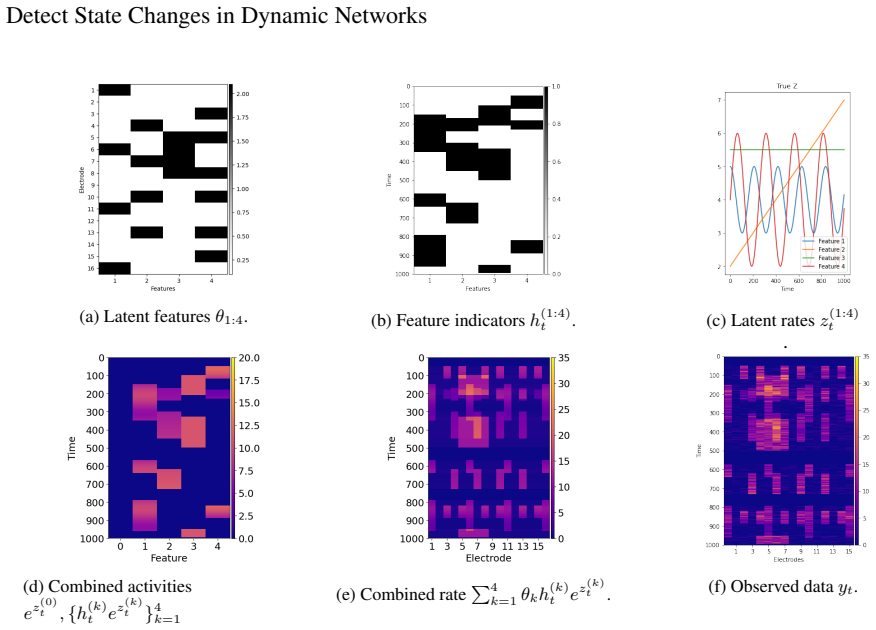
A simulation where multiple subnetworks are known to be active simultaneously but the algorithm infers only one active state at a time, or fails to match the known ground-truth connectivity changes.
Figures


read the original abstract
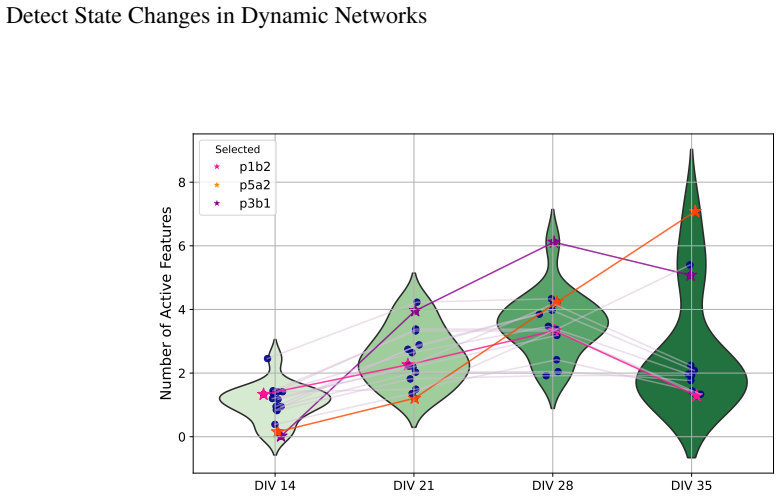
A key question in brain sciences is how to identify time-evolving functional connectivity, such as that obtained from recordings of neuronal activity over time. We wish to explain the observed phenomena in terms of latent states which, in the case of neuronal activity, might correspond to subnetworks of neurons within a brain or organoid. Many existing approaches assume that only one latent state can be active at a time, in contrast to our domain knowledge. We propose a switching dynamical system based on the factorial hidden Markov model. Unlike existing approaches, our model acknowledges that neuronal activity can be caused by multiple subnetworks, which may be activated either jointly or independently. A change in one part of the network does not mean that the entire connectivity pattern will change. We pair our model with scalable variational inference algorithm, using a concrete relaxation of the underlying factorial hidden Markov model, to effectively infer the latent states and model parameters. We show that our algorithm can recover ground-truth structure and yield insights about the maturation of neuronal activity in microelectrode array recordings from in vitro neuronal cultures.
Editorial analysis
A structured set of objections, weighed in public.
Referee Report
Summary. The manuscript proposes a factorial switching linear dynamical system (FSLDS) extending the factorial hidden Markov model to capture time-evolving functional neuronal connectivity. Unlike standard switching models that assume a single active latent state, the FSLDS allows multiple subnetworks to activate jointly or independently. It introduces a scalable variational inference procedure based on a concrete relaxation of the discrete factorial states and applies the model to both simulated data (claiming ground-truth recovery) and microelectrode array recordings from in vitro neuronal cultures (claiming insights on maturation of activity patterns).
Significance. If the central claim holds, the work would offer a methodological advance for modeling multi-state neuronal dynamics beyond single-state switching LDS approaches, with potential utility in analyzing complex connectivity changes. The concrete-relaxation variational scheme is a practical strength for scalability. Credit is given for attempting both simulation-based validation and real-data application.
major comments (2)
- [§3.2] §3.2: The identifiability argument for recovering distinct subnetwork states rests on sufficient separation in emission parameters and state-transition matrices. However, the ELBO derivation does not include a penalty against posterior collapse when one factor dominates the likelihood (as occurs with correlated onsets or similar dynamics), and no diagnostic or regularization is provided to detect or mitigate this on real data lacking ground truth. This directly affects the central claim that the factorial structure disentangles subnetworks.
- [Experiments] Experiments (ground-truth recovery results): The abstract states that the algorithm recovers ground-truth structure, yet no quantitative metrics (e.g., state-inference accuracy, Hamming distance on binary indicators, or parameter error) are reported for regimes with partial activation overlap, nor are comparisons shown against non-factorial switching LDS baselines under controlled correlation levels. This leaves the advantage of the factorial extension unsubstantiated for the load-bearing case of overlapping activations.
minor comments (2)
- [Abstract] Abstract: The phrasing 'in vitro neuronal cultures' and 'organoid' appear in close proximity; a brief clarification of whether the recordings are from organoids or standard cultures would improve precision.
- [Inference] Notation in the variational inference section could be clarified by explicitly defining the temperature parameter schedule for the concrete relaxation and its effect on the posterior approximation.
Simulated Author's Rebuttal
We thank the referee for the constructive and detailed review. We address each major comment point by point below, indicating planned revisions to strengthen the manuscript.
read point-by-point responses
-
Referee: [§3.2] §3.2: The identifiability argument for recovering distinct subnetwork states rests on sufficient separation in emission parameters and state-transition matrices. However, the ELBO derivation does not include a penalty against posterior collapse when one factor dominates the likelihood (as occurs with correlated onsets or similar dynamics), and no diagnostic or regularization is provided to detect or mitigate this on real data lacking ground truth. This directly affects the central claim that the factorial structure disentangles subnetworks.
Authors: We agree that the ELBO as derived lacks an explicit term to penalize posterior collapse under correlated factor activations, and that no diagnostic is currently provided for real data. While §3.2 grounds identifiability on parameter separation, this does not fully address the variational inference behavior on real recordings. In the revised manuscript we will add (i) a diagnostic that monitors the entropy and marginal activation probabilities of each factor across time and (ii) a lightweight diversity regularizer in the ELBO. These changes directly support the claim that the factorial structure disentangles subnetworks. revision: yes
-
Referee: [Experiments] Experiments (ground-truth recovery results): The abstract states that the algorithm recovers ground-truth structure, yet no quantitative metrics (e.g., state-inference accuracy, Hamming distance on binary indicators, or parameter error) are reported for regimes with partial activation overlap, nor are comparisons shown against non-factorial switching LDS baselines under controlled correlation levels. This leaves the advantage of the factorial extension unsubstantiated for the load-bearing case of overlapping activations.
Authors: The referee correctly observes that the current experiments section does not report quantitative metrics (Hamming distance, accuracy, parameter error) specifically for partial-overlap regimes nor include controlled comparisons against non-factorial switching LDS baselines. Although the abstract summarizes recovery, these omissions leave the advantage of the factorial extension insufficiently quantified. We will add a new simulation study with systematically varied overlap and correlation levels, reporting the requested metrics and baseline comparisons. The revised experimental results will be presented in an expanded §4. revision: yes
Circularity Check
No circularity: model and inference are standard constructions applied to data
full rationale
The paper introduces a factorial switching LDS extending the standard factorial HMM with linear dynamics and concrete-relaxed variational inference. All parameters are learned from observed MEA time series via the ELBO; ground-truth recovery is demonstrated on simulated data with known subnetwork activations, and real-data insights are post-hoc interpretations. No equation defines a quantity in terms of itself, no fitted parameter is relabeled as a prediction, and no load-bearing claim reduces to a self-citation. The derivation chain is self-contained against external benchmarks (simulations with injected structure).
Axiom & Free-Parameter Ledger
Lean theorems connected to this paper
-
IndisputableMonolith/Cost/FunctionalEquation.leanwashburn_uniqueness_aczel unclear?
unclearRelation between the paper passage and the cited Recognition theorem.
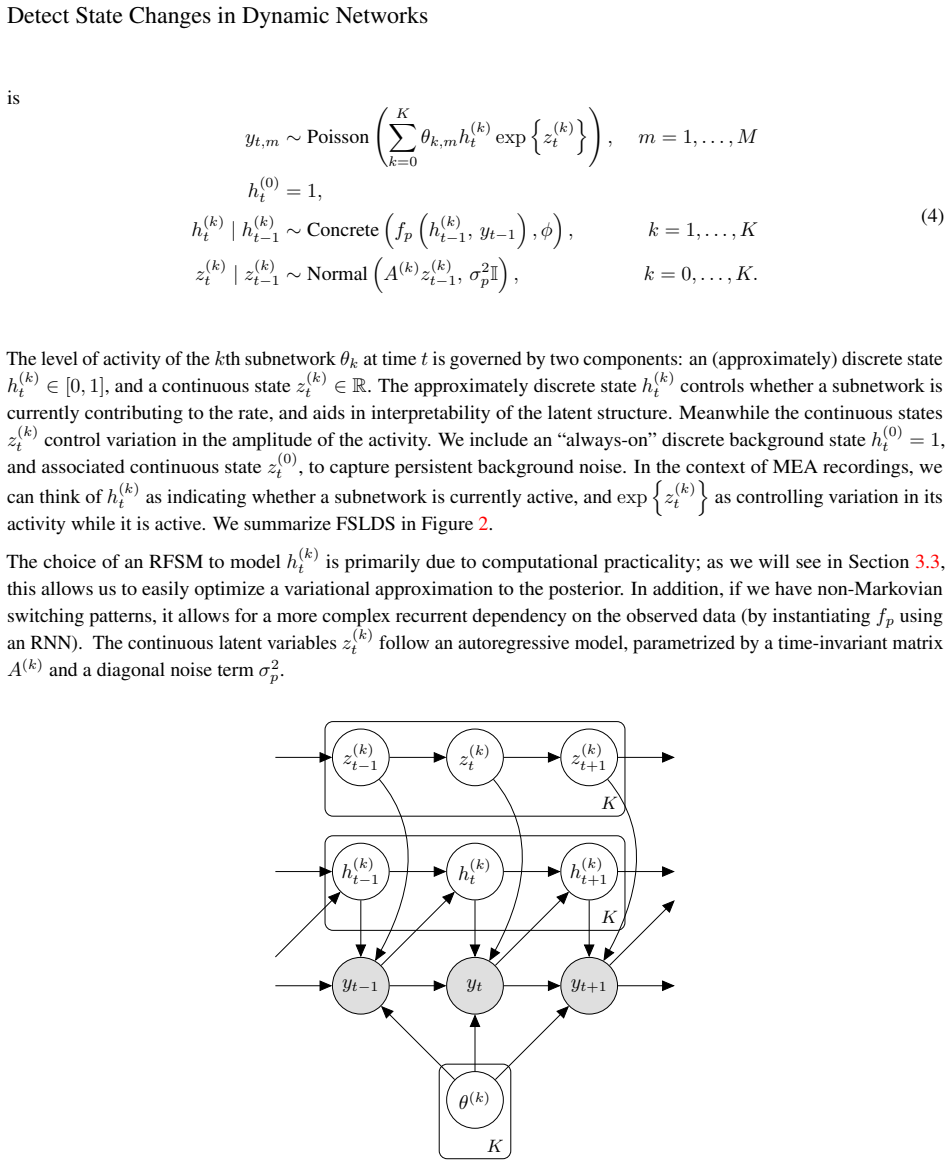
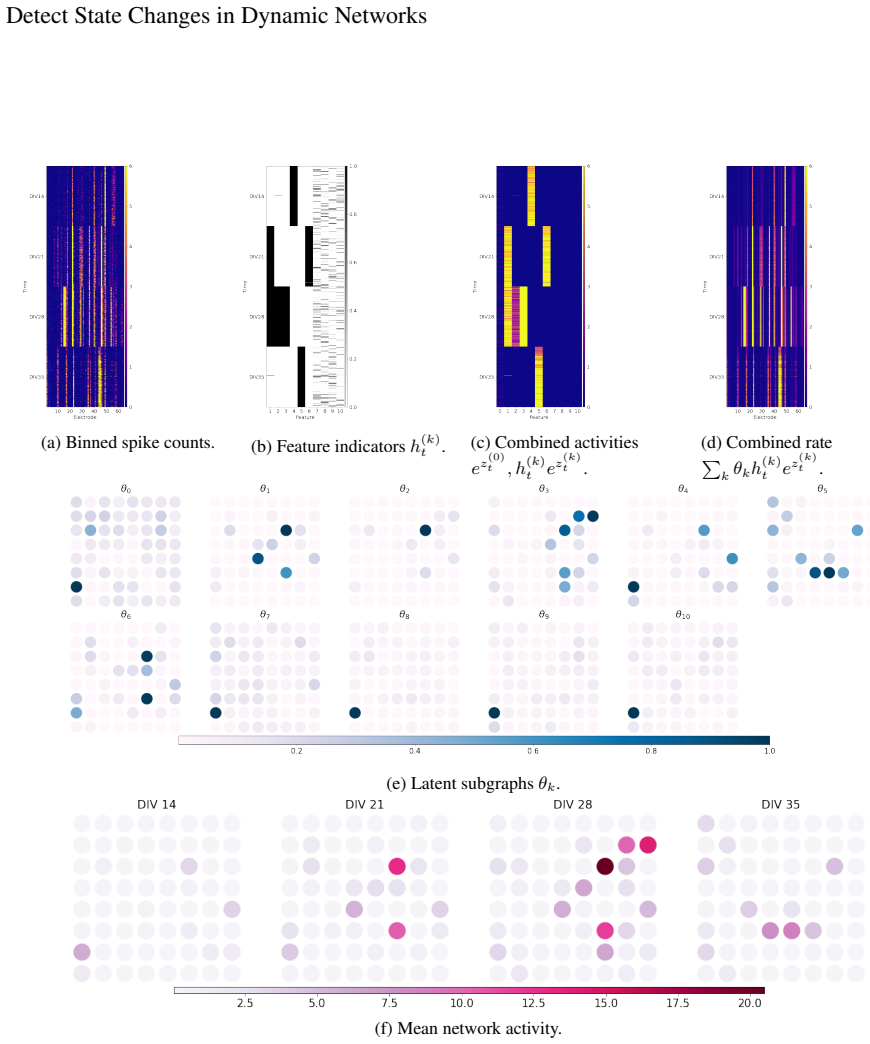
We propose a switching dynamical system based on the factorial hidden Markov model. ... yt|h(1)t,… ,h(K)t∼f(θh(1)t,… ,θh(K)t).
-
IndisputableMonolith/Foundation/ArithmeticFromLogic.leanLogicNat.induction unclear?
unclearRelation between the paper passage and the cited Recognition theorem.
h(k)t|h(k)t−1∼Concrete(fp(h(k)<t, y<t), ϕ) ... yt,m∼Poisson(∑k=0K θk,m h(k)t exp{z(k)t})
What do these tags mean?
- matches
- The paper's claim is directly supported by a theorem in the formal canon.
- supports
- The theorem supports part of the paper's argument, but the paper may add assumptions or extra steps.
- extends
- The paper goes beyond the formal theorem; the theorem is a base layer rather than the whole result.
- uses
- The paper appears to rely on the theorem as machinery.
- contradicts
- The paper's claim conflicts with a theorem or certificate in the canon.
- unclear
- Pith found a possible connection, but the passage is too broad, indirect, or ambiguous to say the theorem truly supports the claim.
Reference graph
Works this paper leans on
-
[1]
On state estimation in switching environments
Guy Ackerson and K Fu. On state estimation in switching environments. IEEE Transactions on Automatic Control , 15(1):10--17, 1970
work page 1970
-
[2]
Switching linear dynamics for variational B ayes filtering
Philip Becker-Ehmck, Jan Peters, and Patrick Van Der Smagt. Switching linear dynamics for variational B ayes filtering. In International Conference on Machine Learning , pages 553--562. PMLR, 2019
work page 2019
-
[3]
A hidden M arkov model approach to neuron firing patterns
Anne-Claude Camproux, Francois Saunier, Guy Chouvet, Jean-Christophe Thalabard, and Guy Thomas. A hidden M arkov model approach to neuron firing patterns. Biophysical Journal , 71(5):2404--2412, 1996
work page 1996
-
[4]
Collapsed amortized variational inference for switching nonlinear dynamical systems
Zhe Dong, Bryan Seybold, Kevin Murphy, and Hung Bui. Collapsed amortized variational inference for switching nonlinear dynamical systems. In International Conference on Machine Learning , pages 2638--2647. PMLR, 2020
work page 2020
-
[5]
Emergence of a small-world functional network in cultured neurons
Julia H Downes, Mark W Hammond, Dimitris Xydas, Matthew C Spencer, Victor M Becerra, Kevin Warwick, Ben J Whalley, and Slawomir J Nasuto. Emergence of a small-world functional network in cultured neurons. PLoS computational biology , 8(5):e1002522, 2012
work page 2012
-
[6]
Parsing neural dynamics with infinite recurrent switching linear dynamical systems
Victor Geadah, International Brain Library, and Jonathan W Pillow. Parsing neural dynamics with infinite recurrent switching linear dynamical systems. In International Conference on Learning Representations , 2024
work page 2024
-
[7]
An introduction to hidden M arkov models and B ayesian networks
Zoubin Ghahramani. An introduction to hidden M arkov models and B ayesian networks. International Journal of Pattern Recognition and Artificial Intelligence , 15(01):9--42, 2001
work page 2001
-
[8]
Factorial hidden M arkov models
Zoubin Ghahramani and Michael Jordan. Factorial hidden M arkov models. Advances in Neural Information Processing Systems , 8, 1995
work page 1995
-
[9]
Monte C arlo smoothing for nonlinear time series
Simon J Godsill, Arnaud Doucet, and Mike West. Monte C arlo smoothing for nonlinear time series. Journal of the American Statistical Association , 99(465):156--168, 2004
work page 2004
-
[10]
Mark D Humphries. Dynamical networks: Finding, measuring, and tracking neural population activity using network science. Network Neuroscience , 1(4):324--338, 2017
work page 2017
-
[11]
Categorical reparameterization with G umbel-softmax
Eric Jang, Shixiang Gu, and Ben Poole. Categorical reparameterization with G umbel-softmax. In International Conference on Learning Representations , 2017
work page 2017
-
[12]
Diederik P. Kingma and Max Welling. Auto-encoding variational B ayes. In International Conference on Learning Representations , 2014
work page 2014
-
[13]
Sixo: Smoothing inference with twisted objectives
Dieterich Lawson, Allan Ravent \'o s, Andrew Warrington, and Scott Linderman. Sixo: Smoothing inference with twisted objectives. In Advances in Neural Information Processing Systems , volume 35, pages 38844--38858, 2022
work page 2022
-
[14]
Auto-encoding sequential M onte C arlo
Tuan Anh Le, Maximilian Igl, Tom Rainforth, Tom Jin, and Frank Wood. Auto-encoding sequential M onte C arlo. In International Conference on Learning Representations , 2018
work page 2018
-
[15]
Jie Li, Xiuli Chen, and Zheng Li. Spike detection and spike sorting with a hidden M arkov model improves offline decoding of motor cortical recordings. Journal of Neural Engineering , 16(1):016014, 2018
work page 2018
-
[16]
S. Linderman, M. Johnson, A. Miller, Adams R., D. Blei, and L. Paninski. Bayesian learning and inference in recurrent switching linear dynamical systems. In Artificial Intelligence and Statistics , pages 914--922, 2017
work page 2017
-
[17]
Filtering variational objectives
Chris J Maddison, John Lawson, George Tucker, Nicolas Heess, Mohammad Norouzi, Andriy Mnih, Arnaud Doucet, and Yee Teh. Filtering variational objectives. Advances in Neural Information Processing Systems , 30, 2017
work page 2017
-
[18]
Maddison, Andriy Mnih, and Yee Whye Teh
Chris J. Maddison, Andriy Mnih, and Yee Whye Teh. The concrete distribution: A continuous relaxation of discrete random variables. In International Conference on Learning Representations , 2017
work page 2017
-
[19]
Variational sequential M onte C arlo
Christian Naesseth, Scott Linderman, Rajesh Ranganath, and David Blei. Variational sequential M onte C arlo. In Artificial Intelligence and Statistics , pages 968--977. PMLR, 2018
work page 2018
-
[20]
Tree-structured recurrent switching linear dynamical systems for multi-scale modeling
Josue Nassar, Scott W Linderman, Monica Bugallo, and Il Memming Park. Tree-structured recurrent switching linear dynamical systems for multi-scale modeling. In International Conference on Learning Representations , 2019
work page 2019
-
[21]
Switching dynamical systems with deep neural networks
C \'e sar Ojeda, Bogdan Georgiev, Kostadin Cvejoski, Jannis Schucker, Christian Bauckhage, and Rams \'e s J S \'a nchez. Switching dynamical systems with deep neural networks. In International Conference on Pattern Recognition , pages 6305--6312. IEEE, 2021
work page 2021
-
[22]
Jimmy Olsson and Tobias Ryden. Rao- B lackwellization of particle M arkov chain M onte C arlo methods using forward filtering backward sampling. IEEE Transactions on Signal Processing , 59(10):4606--4619, 2011
work page 2011
-
[23]
Variational B ayesian inference with stochastic search
John Paisley, David M Blei, and Michael I Jordan. Variational B ayesian inference with stochastic search. In International Coference on International Conference on Machine Learning , pages 1363--1370, 2012
work page 2012
-
[24]
A new look at state-space models for neural data
Liam Paninski, Yashar Ahmadian, Daniel Gil Ferreira, Shinsuke Koyama, Kamiar Rahnama Rad, Michael Vidne, Joshua Vogelstein, and Wei Wu. A new look at state-space models for neural data. Journal of Computational Neuroscience , 29:107--126, 2010
work page 2010
-
[25]
Dynamical segmentation of single trials from population neural data
Biljana Petreska, Byron M Yu, John P Cunningham, Gopal Santhanam, Stephen Ryu, Krishna V Shenoy, and Maneesh Sahani. Dynamical segmentation of single trials from population neural data. Advances in Neural Information Processing Systems , 24, 2011
work page 2011
-
[26]
Manuel S Schroeter, Paul Charlesworth, Manfred G Kitzbichler, Ole Paulsen, and Edward T Bullmore. Emergence of rich-club topology and coordinated dynamics in development of hippocampal functional networks in vitro. Journal of Neuroscience , 35(14):5459--5470, 2015
work page 2015
-
[27]
Micro-connectomics: probing the organization of neuronal networks at the cellular scale
Manuel Schr \"o ter, Ole Paulsen, and Edward T Bullmore. Micro-connectomics: probing the organization of neuronal networks at the cellular scale. Nature Reviews Neuroscience , 18(3):131--146, 2017
work page 2017
-
[28]
Timothy PH Sit, Rachael C Feord, Alexander WE Dunn, Jeremi Chabros, David Oluigbo, Hugo H Smith, Lance Burn, Elise Chang, Alessio Boschi, Yin Yuan, George M Gibbons, Mahsa Khayat-Khoei, Francesco De Angelis, Erik Hemberg, Martin Hemberg, Madeline A Lancaster, Andras Lakatos, Stephen J Eglen, Ole Paulsen, and Susanna B Mierau. MEA-NAP compares microscale f...
work page 2024
-
[29]
Reverse engineering recurrent neural networks with J acobian switching linear dynamical systems
Jimmy Smith, Scott Linderman, and David Sussillo. Reverse engineering recurrent neural networks with J acobian switching linear dynamical systems. Advances in Neural Information Processing Systems , 34:16700--16713, 2021
work page 2021
-
[30]
Reinforced variational inference
Theophane Weber, Nicolas Heess, Ali Eslami, John Schulman, David Wingate, and David Silver. Reinforced variational inference. In Advances in Neural Information Processing Systems Workshops , 2015
work page 2015
-
[31]
Mike West. Bayesian dynamic modelling. Bayesian Inference and Markov Chain Monte Carlo: In Honour of Adrian FM Smith , 145:166, 2013
work page 2013
-
[32]
Dimitris Xydas, Julia H Downes, Matthew C Spencer, Mark W Hammond, Slawomir J Nasuto, Benjamin J Whalley, Victor M Becerra, and Kevin Warwick. Revealing ensemble state transition patterns in multi-electrode neuronal recordings using hidden M arkov models. IEEE Transactions on Neural Systems and Rehabilitation Engineering , 19(4):345--355, 2011
work page 2011
discussion (0)
Sign in with ORCID, Apple, or X to comment. Anyone can read and Pith papers without signing in.